An Actual Exit from Climate Hell

by Bill McKibben

Earlier today I went after libertarians for their troubles with climate change. But it’s conservatives in general that have been the real hypocrites here, given that the least conservative thing you can possibly imagine would be running the temperature of the earth way out of the range where human civilization has previously thrived. And the irony is, some of the most obvious ways out are… kinda conservative. Or at least should appeal to conservatives who are not, in reality, shills for the fossil fuel industry. Yes, given that we’ve delayed  as long as we have we need a big government effort to put in renewable energy, and yes we need wholesale shifts in who holds power (the key new text on climate change will be Naomi Klein’s This Changes Everything, due for release next month). We also need to provide massive aid for the countries we’ve endangered by our unchecked carbon emissions.  But one of the big changes we require is remarkably conservative in nature.

It’s called Cap and Dividend, long proposed in one form or another by the great climate scientist James Hansen and by an excellent advocacy group called the Citizens Climate Lobby. It derives from the work of Peter Barnes, who has a fine new book called With Liberty and Dividends for All. Let today’s Washington Post editorial page explain:

A prominent member of Congress has proposed a comprehensive national climate-change plan. It’s only 28 pages long, it’s market-based, and it would put money into the pockets of most Americans.

His proposal would put a limit on the country’s greenhouse-gas emissions, a cap that would decline each year. Beneath that cap, companies would have to buy permits for the emissions their fuels produce. The buying and selling of permits would set a market price for carbon dioxide. The government would rebate all of the revenue from selling permits back to anyone with a Social Security number,more than offsetting any rise in consumer prices for 80 percent of Americans. Most upper-income people, who use more energy, and government, which would get no rebate, would pay more under the plan.

Every time you ratcheted down the cap on carbon (in order to keep the planet from being wrecked, which would be… expensive) the dividend check would rise; therefore there’d be far less political opposition to doing the right thing. And this plan posits a different understanding of the world: if anyone owns the atmosphere, it’s us, not Exxon. Since the fossil fuel industry currently gets to use the atmosphere as a free dump, there will doubtless be opposition from the likes of the Kochs. But this is a sensible, straightforward plan.
Don’t Speak, Memory

by Sue Halpern

Cross-Section

I’ve been reading various reports (like this one) of the success of a research group at MIT in taking the sting out of bad memories by switching the bad ones with good ones:

“In our day to day lives we encounter a variety of events and episodes that give positive or negative impact to our emotions,” said Susuma Tonegawa, Professor of Biology and Neuroscience at the Riken-MIT Centre for Neural Circuit Genetics.

“If you are mugged late at night in a dark alley you are terrified and have a strong fear memory and never want to go back to that alley.

“On the other hand if you have a great vacation, say on a Caribbean island, you also remember it for your lifetime and repeatedly recall that memory to enjoy the experience.

“So emotions are intimately associated with memory of past events. And yet the emotional value of the memory is malleable. Recalling a memory is not like playing a tape recorder. Rather it is like a creative process.

Granted, the experiments are on mice, but mouse models tend to transfer well-enough to humans that the scientists are hopeful that they are on to something useful. But will it be?

I realize this sounds crazy. Given the chance, who wouldn’t want to erase or in some way circumvent the memory of being mugged? And what about PTSD? The MIT group is hopeful that their technique, when applied to humans, will counter the effects of post traumatic stress.

If the MIT group fails, there still may be hope, courtesy of DARPA, the research arm of the Defense Department, which is developing an implantable chip that intended to lessen the effects of post traumatic stress. According to the Washington Post:

It’s part of the Obama administration’s larger “BRAIN Initiative,” which involves the National Institutes of Health, DARPA, the National Science Foundation and the Food and Drug Administration, among other organizations.

Officials say the BRAIN Initiative — which stands for Brain Research through Advancing Innovative Neurotechnologies — includes a related DARPA effort to build new brain chips that will be able to predict moods to help treat post-traumatic stress. It’s known as the SUBNETS program, short for Systems-Based Neurotechnology for Emerging Therapies. Teams at both the University of California, San Francisco, and Massachusetts General Hospital in Boston are involved.

“Instead of relying only on medication, we envision a closed-loop system that would work in concept like a tiny, intelligent pacemaker,” said Doug Weber, the program’s manager. “It would continually assess conditions and provide stimulus patterns tailored to help maintain healthy organ function, helping patients get healthy and stay healthy using their body’s own systems.”

(If I am a little suspicious of this technique, it may be because a few years ago, while writing about the use of virtual reality to help veterans overcome PTSD, I also learned that the military was interested in using the technique in the field, to get psychologically damaged soldiers quickly back into action, which seemed both dangerous and creepy to me.)

We are made of memories and formed by experience. I keep wondering what kind of people we would be, and what kind of world this would be, if when bad things happened we could erase them, or somehow make them sweet. Consider Anna Whiston-Donaldson, author of the just published memoir Rare Bird, whose 12-year-old son died in a freak accident, drowning during a rainstorm. One imagines what she’d wish for is that her son did not die, not that she didn’t remember it, and not, even, that it wasn’t as painful as it was.  Wouldn’t that impair grieving? Wouldn’t it dishonor–for lack of a better word–her son? I am not presuming to know. I don’t know. But I do know that meaning comes from many places.

So here is my question: if you could forget or erase that bad thing that happened to you, whatever it is, would you? Another way of asking this question is this: how has that bad thing made you who you are? Is there value–not in grief, but in grieving?

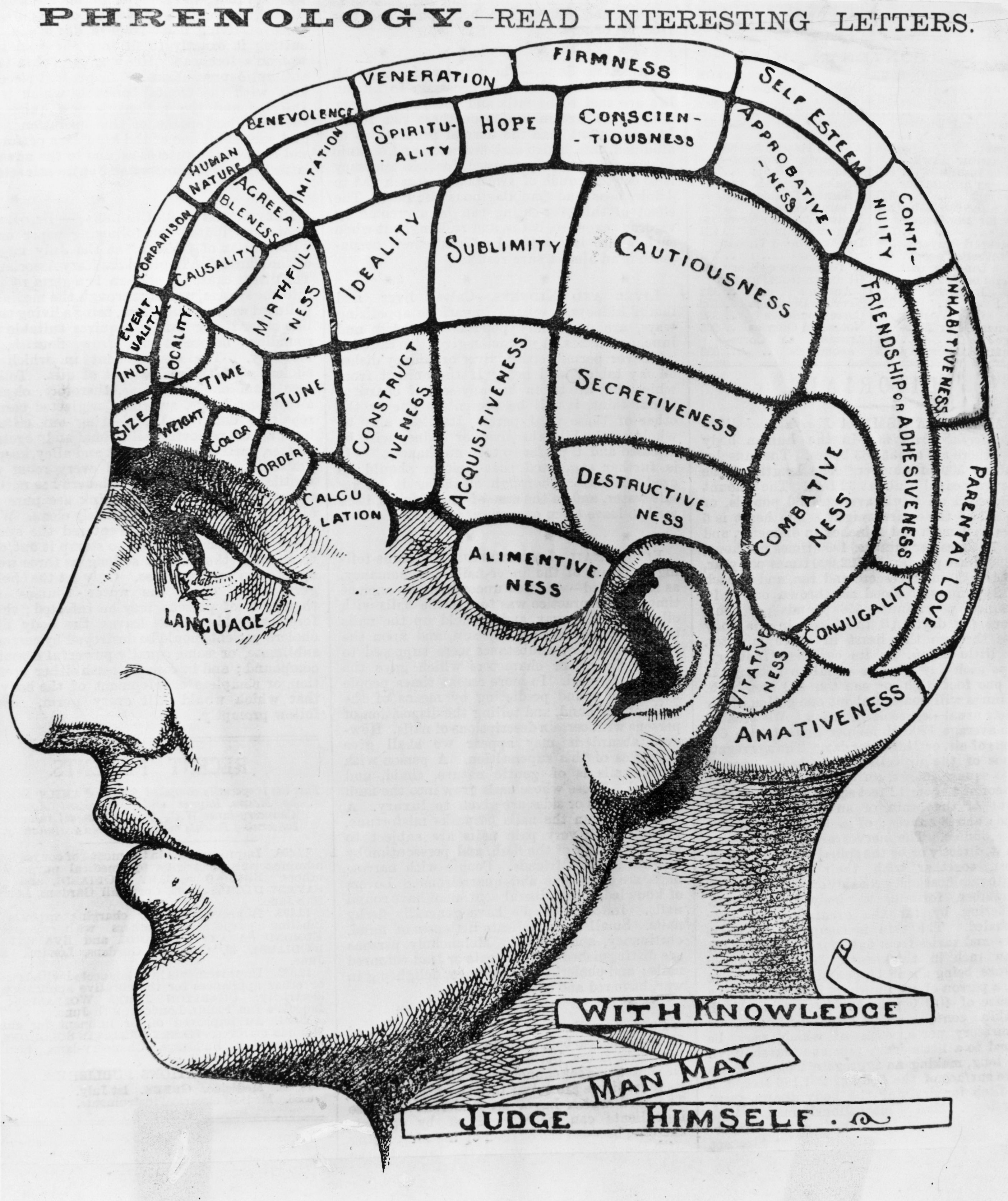
(Photo: circa 1880: A phrenological cross-section of a man’s head, illustrating the idea that the brain processes thoughts in different locations according to their type. By Hulton Archive/Getty Images)


The Safety Divide

by Dish Staff

Neighborhood Safety

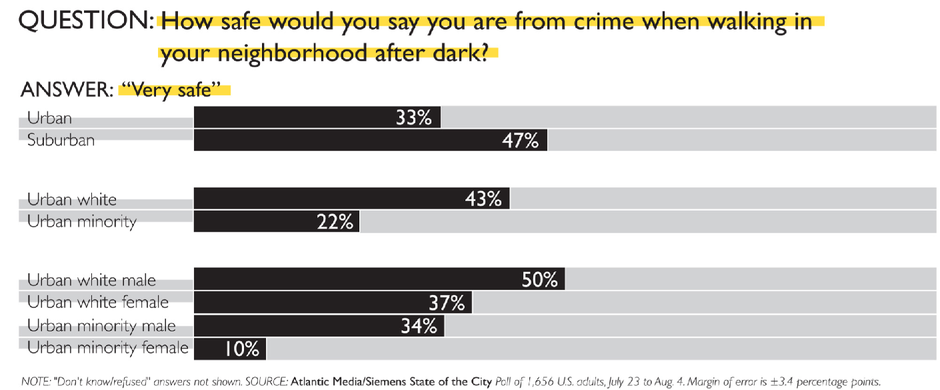
A recent poll measured it:

Only 22 percent of those who identified themselves as nonwhite and live in urban settings said that they feel “very safe” on the streets near their homes at night, compared with nearly twice as many urban whites, some 43 percent. Thirty-four percent of urban minorities said they feel “not too” or “not at all” safe, compared with just 14 percent of urban whites who feel the same way.

The stark disparity in feelings of personal safety was further heightened along gender lines. A mere 10 percent of minority urban women said they felt safe in their neighborhoods after dark, compared with 34 percent of minority urban men, 37 percent of white urban women, and a full 50 percent of white men living in cities.

Will The ISIS War Come To A Vote? Ctd

by Dish Staff

Jay Newton-Small doubts an authorization would pass Congress in the run-up to midterm elections. For that reason, she argues, Obama probably won’t bother asking for one:

“Congress does not have the political will to approve a War Powers Resolution when the American people have very little appetite for war,” said Ron Bonjean, a former senior Republican congressional aide. “Getting the approval of Congress before the November elections to bomb ISIS targets in Iraq would likely require an attack on American soil or a very imminent threat of danger. Members of Congress want to secure their own re-elections and this type of vote could be the defining factor in several tight Senate races across the country.” …

The most likely path here is that Obama will continue to do what he’s been doing, and probably expand attacks into Syria, using the Article II justification. As the White House has argued, he’s protecting Americans in Erbil, the Kurdish capital in northern Iraq. By that measure, wherever America has an embassy, or citizens in peril, Presidents in the future will now have the precedent to engage in hostilities to protect them.

Damon Linker is dismayed, if not exactly surprised, that members of Congress are putting political considerations before Constitutional duty here:

Bombing a nation — even when it’s mainly to attack substate actors operating within it — is unquestionably an act of war. And debates about whether to go to war should be taking place in Congress, with our elected representatives taking a stand one way or another. The refusal to take that stand is a monumental evasion of Congress’s constitutionally delineated responsibility. That this shirking of responsibility is a product of abject cowardice and self-protectiveness makes it especially contemptible.

Serving in Congress has become so cushy that our representatives would rather protect their jobs than take a risk in defense of the public good or the prerogatives of their branch of government. Sure, they’ll support demagogic partisan stunts, like House Speaker John Boehner’s lawsuit against President Obama. But actually take responsibility for war and peace? Nah. Much better to stay silent now and then reserve the right to attack the president if military action goes badly — or benefit from the outpouring of national good will if it goes well.

Conor Friedersdorf lists some more reasons why a Congressional authorization would be a good idea, other than, y’know, how it’s required by law and all:

• The legislature is in a better position than the executive branch to carry out the will of the American people, which ought to dictate United States foreign policy.
• A congressional debate can help to test the arguments for intervention, which may well be wanting given the dearth of public scrutiny they’ve gotten.
• Every two years, Americans decide whether to keep or oust their representatives in the House. Knowing where they stand on hugely consequential matters of national policy is integral to the American system functioning.
• A war to defeat ISIS would be a huge undertaking. Embarking without the support of the citizenry casts doubt on whether the country would see the effort through.
• It is dangerous to give a single man the power to take a nation to war without anyone being able to do a thing to stop him. It is, in fact, anti-Madisonian.

Let Them Build Seawalls

by Bill McKibben

Greeehouse Emissions

As a good Dish reader, I know I’m supposed to take libertarianism seriously, and so I try, even if every time I contemplate Ayn Rand I find myself wishing I’d been born to a different species. It’s possible that my trouble stems from the fact that dealing with climate change is notoriously difficult for libertarians: if you burning the coal in your coal mine raises the sea level around my continent, something’s amiss. So too many theoretically rational and science-minded libertarians have tended towards denying the physics of global warming, just to avoid dealing with the implications for the philosophy. (There are of course honorable exceptions, like Ronald Bailey at Reason).

But this is really rich. Writing from his perch at the Cato Institute, Charles “Chip” Knappenberger explains why the U.S. should avoid taking a leadership role in any climate negotiation: because others have more at stake:

Such information is carefully concealed in Obama Administration reports, such as the one issued recently by the Council of Economic Advisors that predicts escalating costs the longer we delay serious climate change mitigation efforts. Instead of focusing on domestic costs of climate change, the report is built around an estimation of the global cost for carbon dioxide emissions—which, by the Administration’s numbers—is some 4 to 14 times greater on a per ton of emitted CO2 basis than those projected for the U.S.

Translated: climate change is going to be worse for Bangladesh, so let them deal with it. And it is going to be worse–it already is. People are starting to evacuate their island nations as seas rise. It’s true we may lose Miami, but we’re well off enough, perhaps, to take the hit. Asks Knappenberger sweetly:

Why should the President’s rush to restrict U.S. carbon dioxide emissions, which even his own officials say raises concerns about domestic energy costs and grid reliability, be justified upon supposed benefits which will largely accrue to foreign nations?

That would be piggish enough right there–but of course what Knappenberger doesn’t even mention in his column is that we’re the reason that Bangladesh has a problem. They hardly emit any co2–they’re a rounding error in any calculation. Whereas the United States has contributed more by far than any nation to the concentration of greenhouse gases in the atmosphere (China won’t match us even by 2030, and on a per capita basis, we’ll be champs forever).

Knappenberger’s logic will doubtless play well in the GOP as it stymies any nascent Obama administration effort to lead the world in a new direction. But if the libertarian creed is about people taking responsibility for their actions, as opposed to getting away with what they can, this is crass.

(Chart from the PBL Netherlands Environmental Assessment Agency)

A Less Than Visionary Foreign Policy

by Dish Staff

After listening to Obama’s recent interview with Tom Friedman, Greg Djerejian wishes the president’s foreign policy showed “more transformative greatness”:

It is very easy to take cheap pot-shots at Obama. We must recall the alternatives would have been tragically worse. Even within his own party, as Hillary Clinton’s recent comments to Jeffrey Goldberg make clear, breezy certitudes around play-pretend muscularity are meant to showcase greater foreign policy gravitas, but actually too often indicate precisely the opposite. Indeed, we should commend Obama his caution, his rationality, his use of scalpels rather than hammers. By this I mean that a period of American retrenchment was well needed—almost inevitable—after the gross excesses of the post 9/11 Bush years. But Obama’s tragedy is that he has not accompanied a period of American retrenchment, even decline, with strategic panache (for instance, Nixon and Kissinger’s opening to China on the heels of the disastrous Vietnam War). He does not seem seized of the possibilities his office affords.

Due to his lack of an overarching strategy, Paul Saunders objects to those who would label Obama a “realist”:

The principal reason that Obama’s critics and defenders considered him a realist for so long has been his administration’s generally pragmatic policies. But realism is much more than pragmatism; confusing the two is one of the most fundamental and enduring errors in America’s foreign-policy debates. Realism is pragmatism rooted in awareness of international anarchy, infused with a deep understanding of American power and in service of a strategy based on American national interests. Obama is not a realist because his policies typically start and stop with the pragmatic and even the opportunistic. He appears to have excessive faith in international norms, little real appreciation of power’s uses and limits, and minimal interest in foreign policy, much less American international strategy.

In The Mood To Procrastinate

by Dish Staff

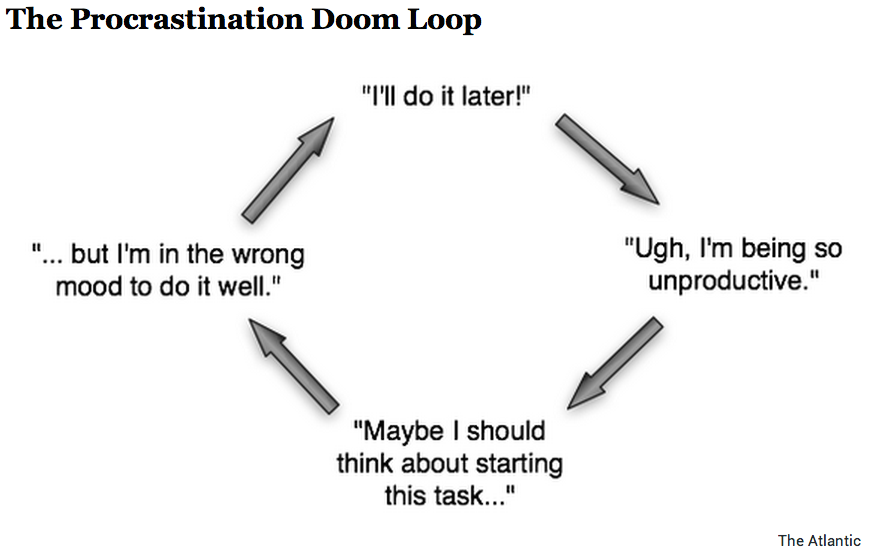
Doom Loop

Derek Thompson examines why we put things off:

In the last few years …  scientists have begun to think that procrastination might have less to do with time than emotion. Procrastination “really has nothing to do with time-management,” Joseph Ferrari, a professor of psychology at DePaul University, toldPsychological Science. “To tell the chronic procrastinator to just do it would be like saying to a clinically depressed person, cheer up.”

Instead, Ferrari and others think procrastination happens for two basic reasons: (1) We delay action because we feel like we’re in the wrong mood to complete a task, and (2) We assume that our mood will change in the near future.

So, how does one become more productive?

To hack your way to productivity, you could schedule one-shot reminders as late as possible—even slightly after you were supposed to start the project. Not only will the last-second reminder and looming deadline break the doom loop and shock you into action, but also it won’t give you time to put off—and, potentially, forget about—the task.

For pathological procrastinators, recognizing that we need deadlines to bind ourselves to our responsibilities is the first step. The second step is recognizing that our own deadlines are less effective than other people’s deadlines.

“Africa Is Where The Future Is”

by Dish Staff

And that’s what Pascal-Emmanuel Gobry believes is missing from most analyses of China’s involvement in the continent:

For sure, China’s drive into Africa is mainly motivated by natural resources. But this is merely the catalyst of a broader phenomenon, which is really driven by the frustration of so many Chinese with the unbearably stifling and corrupt Chinese system.

From a slow-growth West myopically hypnotized by China’s largely meaningless growth figures (and a bizarre envy of authoritarianism), we don’t actually see China for what it is, which is a very unhealthy society. The limitation on births. The ruthless and ineffective education system, which now no longer provides the jobs it promised. The omnipresent corruption and inflation. The stifling (literally) pollution. No wonder everyone who can is running for the exits.

For Chinese who cannot find advancement or fulfillment in a tottering system, Africa is actually enticing. Chinese are more at home than Westerners in cultures where clientelism (understood non-judgementally as a system where networks of interpersonal reciprocal relations are very important) is more important than legalism, and in Africa they can find a world where opportunities are more available for the taking for the driven and hard-working who are shut-out of the best networks in China. And, of course, we cannot discount the fact that most of the Chinese doing business in Africa are men coming from a country with an increasing shortage of women to a continent where there is not. It is this social phenomenon which is driving China’s scramble for Africa, more than “neo-colonialism” or a mere geopolitical grab for oil and soybean fields.

Obscure Diagnosis, STAT!

by Dish Staff

Julie Beck explains how TV medical dramas have warped our perception of health care and illness:

Treatments for patients with seizures are sometimes downright dangerous, with doctors trying to hold patients down, or put things in their mouths (they could choke). Patients tend to survive cardiac arrest more often on television than they do in real life, making CPR seem more effective than it often is. “That can lead to a misunderstanding as to the likelihood of a patient or loved one surviving a cardiac arrest,” says Dr. David Brown, chair of the department of emergency medicine at Massachusetts General Hospital. “But it isn’t really good TV if everybody dies, right?”

What does make for good TV: Rare diseases. Injuries. Natural disasters. Which means the amount of screen time given to different conditions isn’t proportional to how common those diseases are in real life, according to a new study published in Human Communication Research. People flock to these shows, after all, first and foremost to be entertained. So less sensational, more quotidian conditions like diabetes are underrepresented.

The Freedom Of Fiction

by Dish Staff

Etgar Keret speculates about why he turned to writing:

What I feel about fiction is that it’s removed from life, that nothing in it is real, the characters can die or have wings. For me it’s a great release. I’m the kind of person who thinks about the consequences of his actions. Especially as the youngest son of two Holocaust survivors. One of the first things I knew about my mother was that her mother and her brother were murdered in front of her eyes and that a year after that her father was murdered too. She was in the Warsaw ghetto. So from very early on I realized that if my mother were to ask me if I wanted to eat another cucumber, regardless of what I might or might not want, if I said yes, then this woman, whom I loved more than life itself and who had suffered so much, would be happy. And if I said no, then she would not be happy. So the idea was that whatever I felt or did resonated in life, caused people pain or happiness. This gave me a feeling of huge responsibility even as a child – to the extent that sometimes I had to block my own feelings or wishes. When I started writing fiction, suddenly I was allowed to do what I wanted.