Walter Bernstein, Still Kicking

by Bill McKibben and Sue Halpern

Okay, admittedly, we can put a headline like that our post because we know Walter Bernstein, and chances are, so do you. Remember “You Were There?” (Probably not, you’re too young). Remember “Fail Safe?” “The Magnificent Seven?” Bernstein, who just turned 95, wrote the screenplays for all of them. How old is 95 in film years? Movies were just starting to talk when he would ditch school in Brooklyn to watch them.

Bernstein’s best known, though, for not working, at least under his own name: he was one of the many in Hollywood blacklisted during the 1950s for supposed communist ties. According to a remarkable encomium in Variety (the kind of thing that for once was published before someone dies, not after), his crimes included “supporting the Republican side in the Spanish Civil War, and advocating for the Russian War Relief Fund.” He spent those years trying to find work under pseudonyms, and he later wrote a memoir (“Inside Out”) and a great screenplay for “The Front”–which starred a then little known Brooklyn movie buff that other Brooklynite, Woody Allen.

He’s writing still: in addition to a biopic about the crusading lawyer William Kunstler, he’s finishing a project started by his late friend Sidney Lumet, working as an advisor at Sundance and teaching at the Tisch School, and on and on. And remains politically engaged, and unrepentant:

“If you want to attack someone in this country, you’re always safe to call them a socialist. It’s a word that’s been successfully demonized,” he says, noting the prevalence of the term in much anti-Obama rhetoric. And getting a script from page to screen? That remains as tricky as ever. “One of my sons has been a location manager and is now dipping his feet into producing,” he says. “So he’s on the phone talking to agents and people like that. The thing I keep trying to knock into his head, which is so hard, is that nothing is real until it’s real.”

NSA Overshare

by Sue Halpern

Back in March, in his virtual appearance at a TED conference in Vancouver, Edward Snowden said that the most shocking revelations from the documents he’d taken from the NSA were yet to come. On Monday, Ryan Gallagher and the team at First Look Media made good on that claim. Since at least 2010 and most likely before that, the NSA has been sharing 850 billion surveillance records with a dozen other government agencies including the DEA and the FBI through a Google-like search engine called ICREACH.  When an FBI agent enters a scrap of information like a phone number, for example, the ICREACH search engine sends back everything in the NSA archives associated with that number–private chats, phone logs, photos and so on. According to the Intercept report, “Information shared through ICREACH can be used to track people’s movements, map out their networks of associates, help predict future actions, and potentially reveal religious affiliations or political beliefs.” While the database for ICREACH is, in theory, restricted to material obtained from foreign surveillance operations, in practice many of those operations have netted information on American citizens with no ties to terrorism:

In a statement to The Intercept, the Office of the Director of National Intelligence confirmed that the system shares data that is swept up by programs authorized under Executive Order 12333, a controversial Reagan-era presidential directive that underpins several NSA bulk surveillance operations that monitor communications overseas. The 12333 surveillance takes place with no court oversight and has received minimal Congressional scrutiny because it is targeted at foreign, not domestic, communication networks. But the broad scale of 12333 surveillance means that some Americans’ communication get caught in the dragnet as they transit international cables or satellites—and documents contained in the Snowden archive indicate that ICREACH taps into some of that data.

In the words of Elizabeth Goitein of the Brennan Center for Justice at NYU Law School, “with ICREACH, the government ‘drove a truck’ through loopholes that allowed it to circumvent restrictions on retaining data about Americans”:

A key question, according to several experts consulted by The Intercept, is whether the FBI, DEA or other domestic agencies have used their access to ICREACH to secretly trigger investigations of Americans through a controversial process known as “parallel construction.”

Parallel construction involves law enforcement agents using information gleaned from covert surveillance, but later covering up their use of that data by creating a new evidence trail that excludes it. This hides the true origin of the investigation from defense lawyers and, on occasion, prosecutors and judges—which means the legality of the evidence that triggered the investigation cannot be challenged in court.

Here, again, is yet more evidence that collecting phone and Internet metadata is not a benign activity, as President Obama among others would like us to believe. But we knew that, didn’t we? It should give us pause, if nothing else, that the newly “strengthened” USA Freedom Act proposed last month by Senator Patrick Leahy, is not going to slow down traffic to ICREACH. And those 850 billion records? That number was from back in 2010. As Gallagher notes, “while the NSA initially estimated making upwards of 850 billion records available on ICREACH, the documents indicate that target could have been surpassed… .”

Legalize Opium?

by Dish Staff

800px-Special_Tax_Stamp_Opium_New_Orleans_1932

Gene Callahan suggests giving it a try:

My proposal offers the following advantages over the current situation:

  1. It allows us to test the waters of just how socially damaging full cocaine or heroin legalization might be, without simply plunging in head first. If simply legalizing coca leaves and opium produces droves of drugged-out zombies (which I don’t think it would), we could rule out full cocaine and heroin legalization, and even consider repealing this halfway legalization. If the effects are that bad, we can be sure that they would have been worse if we had legalized the harder forms of these drugs.
  2. A strong libertarian argument for full legalization (I say ”strong,” and not “decisive,” because I think there are significant counter-arguments here), is that many people are able to use these drugs in moderation without destroying their lives. … Well, these moderate, responsible users ought to find a milder, safer, and legal form of the drug they use to be a very welcome thing indeed. They could avoid the risk of arrest, of unregulated and adulterated street products that may contain dangerous additives, of job loss, and would enjoy a much greater ability to control their dosage.
  3. The considerations in point number two indicate what I think would be the greatest potential upside of this idea: its impact upon the economics of the trade in hard drugs. The shift in consumption predicted above would greatly lessen the demand for the more dangerous forms of these drugs.

In other opioid news, Olga Khazan examines a study finding that “the 13 states that had legalized medical marijuana prior to 2010 had a 25 percent lower rate of opioid mortality than those that didn’t”:

This equates to roughly 1,729 fewer painkiller deaths, just in 2010. The results suggest, in other words, that people were choosing pot over Percocet.

There are a few limitations to keep in mind. The rate of opioid deaths increased in all the states, it just increased less in the states that allowed medical marijuana. It’s not as though everyone with a backache bought a water bong and lived stoned and pain-free ever after.

Marijuana is also not a perfect replacement for painkillers, though it does have some analgesic effects.

Sullum focuses on another finding from the study:

Notably, Bachhuber et al. found that state policies aimed at preventing nonmedical use of opioids, such as prescription monitoring programs, were not associated with lower overdose rates. “If the relationship between medical cannabis laws and opioid analgesic overdose mortality is substantiated in further work,” they write, “enactment of laws to allow for use of medical cannabis may be advocated as part of a comprehensive package of policies to reduce the population risk of opioid analgesics.”

(Image of 1932 opium tax stamp via Wikimedia Commons)

“Connoisseurship In Canned Goods”

by Dish Staff

Harold McGee contends that it has a long pedigree:

It was well established by 1924, when James H. Collins compiled The Story of Canned Foods. Collins noted that while the American industry – which started in the 1820s and took off during the Civil War – focused on mechanization and making locally and seasonally abundant seafood and vegetables more widely available, the European industry continued to rely on handwork and produced luxury goods for the well-off, who would age their canned sardines for several years like wine. Today, Rödel and Connetable, both more than 150 years old, are among the sardine makers that mark select cans with the fishing year and note that the contents “are already very good, but like grand cru wines, improve with age” for up to 10 years.

He adds, “I do hope that some restless, frontier-seeking food lovers will look past our present happy surfeit of small-batch pickles and fruit preserves and try their hands at canning age-worthy meats and fish.”

Eat More Salt?

by Dish Staff

salt

Studies showing that one’s preferred vice or guilty-pleasure condiment is actually good for you always have an audience. And so, here’s one for the salt-lovers out there. Sort of. Aaron E. Carroll explains (NYT):

Last year, experts convened by the Institute of Medicine assessed the evidence concerning sodium intake around the world. They agreed that efforts to reduce excessive sodium were warranted. But they cautioned that no such evidence existed to recommend a very low salt diet. They hoped that future research would assess the potential benefits of a diet where sodium intake was 1.5 to 2.3 grams per day.

The second New England Journal of Medicine study did just that. In addition to looking at high sodium diets, it also compared the health outcomes of those who had very low sodium diets. What they found was worrisome. When compared with those who consumed 3-6 grams per day, people who consumed less than 3 grams of sodium per day had an even higher risk of death or cardiovascular incidents than those who consumed more than 7 grams per day.

The key to health is (sadly) not pouring tremendous amounts of salt on absolutely everything. Writes Carroll:

It’s a cliché but true: In so many things moderation is our best bet. We have to learn that when one extreme is detrimental, it doesn’t mean the opposite is our safest course. It’s time to acknowledge that we may be going too far with many of our recommendations.

(Photo by Flickr user Lars K)

The Essential Creepiness Of DFW Fandom

by Dish Staff

Mike Miley owns up to it in a fascinating essay about his experiences at the David Foster Wallace Archive at the University of Texas, confessing, “I came to Austin as a stalker, the kind of person who ought to be the recipient of a restraining order, not a research fellowship”:

The fellowship faintly disguises the fact that I am here to invade David Foster Wallace’s privacy, and that I took advantage of the Mellon Foundation to satisfy my personal compulsion to get as close to the inside of Wallace’s literary head as I could possibly get. What I failed to anticipate during all my academic grifting was how much peering into the dark recesses of Wallace’s skull would give me the howling fantods. What I wanted, I learned, was much more than I bargained for.

This realization came fast and hard the moment I opened DFW’s copy of End Zone. I knew the DeLillo books would be juicy because DeLillo was pretty much Wallace’s favorite author, but that was no preparation for the words that greeted me when I carefully opened the book’s brittle paperback cover: “SILENCE = HORROR.”

My breath tripped in my throat. I was hoping for revealing annotations, and Wallace exceeded my expectations with his first gloss. Freaky things like “SILENCE = HORROR” are not the first thing a researcher stumbles across anywhere outside of a TV show. Wallace may have been talking about End Zone, but the context was totally different now; these were words from beyond the grave, written in a dead man’s hand, and even though I’d never met him, here I was holding his treasured book, staring his mind in the face, and his first utterance to me is “SILENCE = HORROR.”

Alan Jacobs marvels, “I don’t think I’ve seen, in my lifetime, a writer who has generated the kind and intensity of veneration that DFW has”:

We might contrast his fans to, say, Tolkien fans, who know a little bit about the author — enough to have an image of a man in a colorful waistcoat smoking a pipe – but who can’t spare much time for him because they are so fully absorbed in his legendarium. But the people I know who love every word of Infinite Jest are also fascinated by Wallace himself: they are constantly aware of him as its author, of its relations to the circumstances of his own life.

Montaigne said of his Essays that “It is a book consubstantial with its author,” and this seems to be true for everything DFW wrote. Absorption in his work seems almost necessarily to involve scrutiny of his life. And given how his life ended, it’s hard not to see this as a worrisome trend. What I wouldn’t give for a detailed and sensitive ethnography of DFW devotees – something like what Tanya Luhrmann did for charismatic evangelicals.

Unliking Facebook

by Sue Halpern

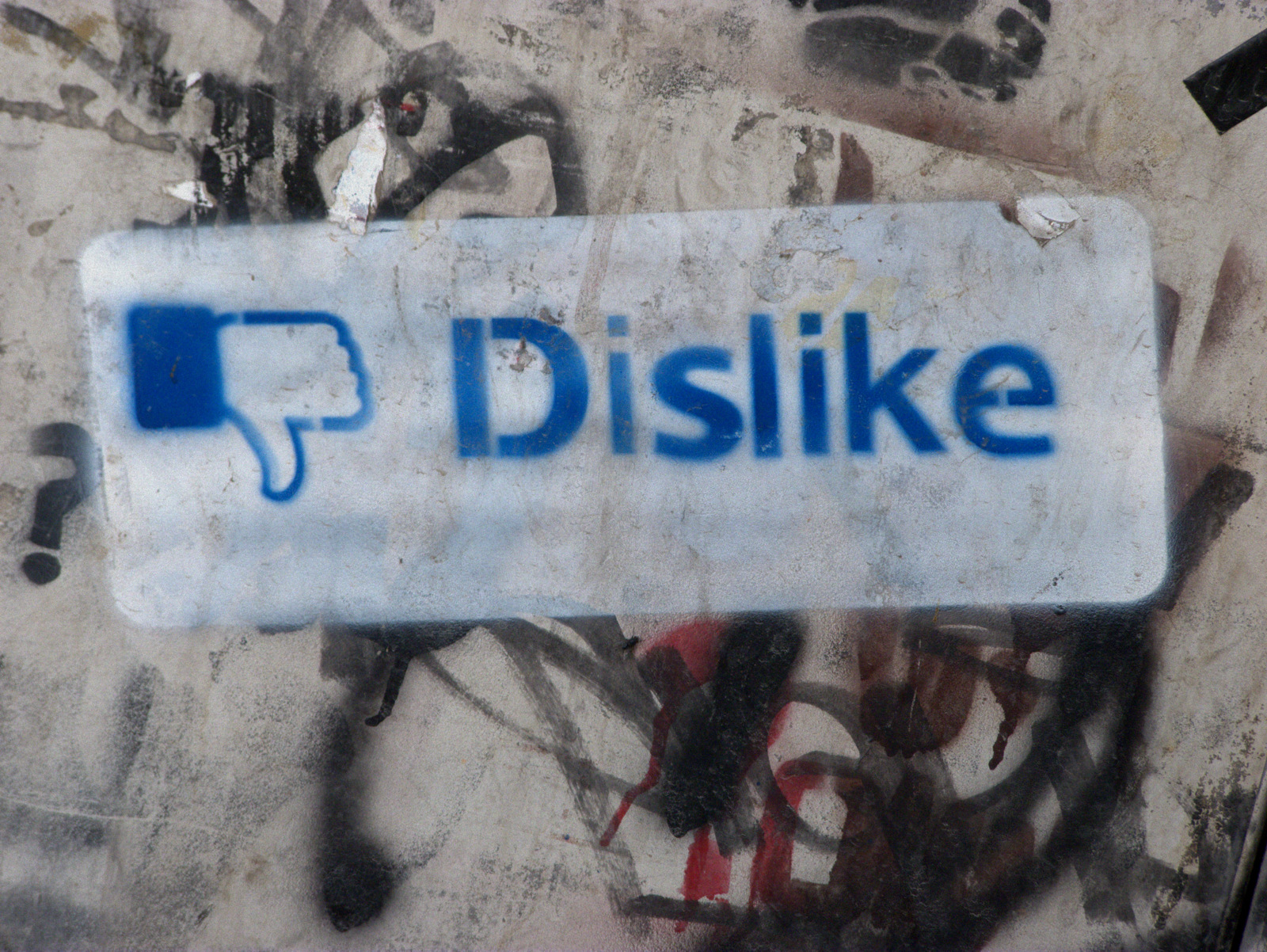
Dislike Facebook

Anyone who has ever read Facebook’s privacy policy–and that probably would not include you–understands that it is not meant to protect your privacy, but provide Facebook and its clients with access to you, your habits, your contacts, your life. This kind of access is the lifeblood of Facebook (read: money), so attempting to indemnify itself against any claims of invasiveness is crucial. This, of course, has not exempted the company from lawsuits, as well as from less formal but no less vociferous user discontent. A quick search on the website of the Electronic Frontier Foundation is a lesson in the thrust and parry around privacy that’s accompanied Facebook’s remarkable insinuation into the culture.

Earlier this summer, a young Austrian law student named Maximilian Schrems filed a class action lawsuit against Facebook which has draw an unprecedented number of claimants.

As Malarie Gokey writes, 60,000 people have now joined young Schrems:

According to the advocate’s site, the Vienna Regional Court in Austria has reviewed the case and commanded Facebook Ireland to respond to the charges within four weeks. Facebook’s international efforts are based in Ireland and serve 80 percent of its users worldwide.

Shortly after Schrems announced the lawsuit and called upon Europeans and anyone outside the U.S. and Canada to join him, the lawsuit reached its maximum number of claimants with 25,000 people joining the suit. An additional 35,000 pledged their support for the privacy lawsuit, should it be expanded to include more claimants, bringing the total number of people suing Facebook for violating privacy laws above 60,000.

Among other things, Schrems is suing Facebook for providing user data (including private messages) to the National Security Agency for its massive, data-mining PRISM program. He is also hoping to hold Facebook’s collective feet to the EU Data-Protection Directive fire, which is meant to protect European Union citizens from the very kinds of intrusive activities practiced by both the NSA and Facebook. (The US has nothing comparable.) “Our aim is to make Facebook finally operate lawfully in the area of data protection,” he said.

Another suit against Facebook, this one closer to home:

A Texas woman is suing Facebook for $123 million dollars. Allegedly, the social media company failed to take down a fake profile that was created with the intent to publicly humiliate her. The woman, Meryem Ali, claims that the profile displayed her name alongside photos of her face photoshopped onto pornographic images.

(Photo by zeevveez.)

Libya Just Keeps Getting Worse, Ctd

by Dish Staff

Juan Cole finds the US response to yesterday’s revelation that Egypt and the UAE had carried out airstrikes in Libya pretty ironic:

According to the BBC, “the US, France, Germany, Italy and the UK issued a joint statement denouncing “outside interference” in Libya.” Seriously, guys? Except for Germany, these are the NATO countries that intervened in Libya in the first place, in large part at the insistence of an Arab League led by Egypt and the UAE! It is true that the UAE and Egypt don’t have a UN Security Council Resolution, which authorized NATO involvement (I supported the then no fly zone on those grounds). But the newly elected Libyan House of Representatives has openly called for international intervention against Libya’s out-of-control militias and it is entirely possible that the Libyan government asked, behind the scenes for these air strikes. In any case, “outside interference” isn’t the issue!

Claims that the airstrikes caught us unawares are also beyond belief:

“With as many Aegis-class ships as the U.S. Navy has in the Persian Gulf and Mediterranean, there is no possible way the UAE could pull this off without the U.S. knowing it,” said Christopher Harmer, a former Navy officer and an analyst with the Institute for the Study of War.

Harmer said that he had no information about U.S. involvement, “but the U.S. government knows who bombed what,” he said. Egypt and the UAE are highly motivated to strike out at Islamist fighters, whose gains in Libya are only the latest reminder that a new wave of religiously aligned political groups and militias threaten secular regimes and monarchies across the region. … Despite denials from the Egyptians and American claims that the United States knew nothing of the airstrikes, there’s no doubt that the UAE’s Air Force, which is newer and more advanced than Egypt’s, could attack Tripoli.

But Keating wonders if this isn’t a sign that the US is no longer running the regional security show in the Middle East:

Despite all the various ways that regional powers have sought to influence each other’s internal politics, the U.S. and Europe (and on a few occasions Israel) have largely had a monopoly on airstrikes and direct military intervention. With crises elsewhere taking up diplomatic attention, U.S. involvement in the worsening situation in Libya has been limited. It shouldn’t be too surprising that others have stepped in to fill the void. The New York Times, which originally reported on the strikes, puts them in the context of a larger proxy battle in the Middle East between Egypt, the UAE, and Saudi Arabia—which have sought to roll back the gains made by Islamist groups—and Turkey and Qatar, which have largely supported them. This battle will mostly be fought within the region’s most unstable countries, including Syria, Iraq, and Libya

Michael Brendan Dougherty, meanwhile, blames the chaos in Libya on the failures of the “Responsibility to Protect” doctrine advanced by Hillary Clinton:

In the most obvious form of moral hazard, this pernicious “R2P” norm lowers the price of civil war in the developing world, encouraging rebels to make provocative attacks, then lobby for Western air support when the local bad guy punishes them for it. Uncle Sam or NATO deploys resources in a civil war these rebel groups could never win with their own blood and treasure. They often fail to win even when they do get help. The expectation of Western air power has exacerbated and intensified conflicts in Serbia, the Sudan, Libya, and Syria. As an international norm, R2P adds nothing but a noble-sounding gloss on getting more people killed than usual.

Parental Whoa-vershare, Ctd

by Phoebe Maltz Bovy

A reader writes:

Bless your heart, Phoebe, for attempting to curb the tide of parental overshare. I am a parent of young children, and I post pictures of them and the occasional adorable quip they make on Facebook. Honestly, I post more than I should of them, but I try very hard to limit it to only the nicest photos of my kids, and not too frequently, for the exact reasons you discussed. I do not want my kids to be searching for jobs and have a potential employer know about their childhood doctors appointments. I appreciate having someone out there pointing out the long term effects if parental oversharing, so thanks for… sharing.

The two genres of parental sharing you mentioned really only account for the high-end posts (I.e., the Times and the Atlantic are the publishers). There is a plethora of other parental overshares on the so-called mommy blogs. So many kids with digestive problems and mothers trying to help their kids understand God and stay-at-home dads trying to be clever and funny. And the larger blogs have sponsored content (albeit often clearly labeled). I once read a post by a woman whose blog received a sponsorship from a razor company, and she talked about the first time her tween daughter shaved. Ugh. And that doesn’t even begin to get to the quick shares on Facebook of potty training successes and failures. Please keep up the good work of reminding people not to start embarrassing their children until they are a little older, like our parents did.

Even with my limited knowledge of colloquial American English from places outside the Northeast, I know that “bless your heart” implies that my cause here is a futile one. Which, alas, it probably is. But this response is reminding me of an important clarification regarding just what that cause, as I see it, involves.

When it comes to parental overshare, two issues get confused. First, there’s the excessive-to-some presence of babies in one’s Facebook feed (a common complaint of many who don’t have kids, whether or not by choice). Second, there’s the question of large-scale privacy violation. “Mommy blog” complaints fall somewhere between the two. Sometimes people are offended by the mere presence online of content that isn’t news, opinion, or mansplanation about the serious issues of the day, and it’s basically part of the standing grievance that exists against all ‘lifestyle’ content. Other times, it’s that some of these blogs are sharing identifiable information about kids, including that which is embarrassing, medical, or both, and are – as this reader notes – doing so for profit.

Anyway, social-media sharing and “mommy blogs” are easier targets than serious publications taking on serious parenting-related issues. But the parental overshare that’s a real concern is precisely the sort that isn’t so readily declared irrelevant. The point here isn’t to dismiss certain types of (largely female-oriented-and-produced) content as boring or frivolous. It’s normal, in an age of online photo-sharing, that family photo albums would be digital, and would include kids. It’s normal to be some mix of bored or annoyed by what long-lost acquaintances put on Facebook, but – as Maureen O’Connor eloquently explained – it’s not unethical to post things others find uninteresting. The issue, as I see it, is not that children are owed a complete digital invisibility of the sort that’s near-unachievable in this day and age. Rather, it’s that parents shouldn’t be profiting from their children’s secrets. There shouldn’t be something to gain, professionally, by breaching that trust.

Another response gets it exactly right:

Tufekci is correct that change needs to come from editors. As it stands, someone with a toilet-training essay to sell will find an outlet; someone with an essay not about toilet-training will be nudged by the market to include an anecdote along those lines. The business model needs to change. Since the demand for really courageous articles of this nature appears insatiable, this will take an act of courage-in-the-non-sarcastic-sense from the gatekeepers themselves.