Summer’s End

by Bill McKibben

Yikes, I’ve been looking forward to doing this ever since Andrew asked in mid-summer, but now I feel like Sue and I have been given the keys to a shiny car that we’re a little unsure how to drive. I note with some relief that the week before Labor Day is the temporal equivalent of the empty mall parking lot, and that the regular Dish staff, in addition to doing most of the posting, also oversees what we write, a bit like the driving instructor with the extra set of brakes on his side of the floorboard. But I’m thrilled to be here, because like Sue I’ve been following Andrew around the web for years, and find myself strangely moved be part of the inquiring and eloquent community of readers that has developed here.

I’m best known as an environmental writer and activist. My preoccupation is global warming, about which I wrote what is commonly regarded as onePCMiheartNYC02 of the first books for non-scientists. The End of Nature came out a quarter-century ago next month—and I will cap that 25 years of involvement by helping organize what will (we hope) be the largest climate demonstration in human history on Sept. 21st in New York. (You sign up here and yes I will mention it again). Thinking about climate has molded my outlook enormously. I’ve come to think that the culture, including the blogosphere, pays far too little attention to the ongoing collapse of our physical systems: yes, the planet is burning in Diyala province, in the streets of Aleppo, in the country around Donetsk, in the fearful alleys of Gaza City, and in a dozen other places. But the planet is also burning—last month the demographers told us that a majority of the planet’s population has never known a month where the globe was cooler than the 20th century average. Climate change is no longer a future threat—it’s the single most distinctive fact about our time on earth, so it tends to preoccupy me.

That said, I’m conscious we’re at summer’s end—I feel the need to wring the last easy joys out of the season before the world really begins again a week from tomorrow. So with any luck I’ll manage a post or two of the slightly less-dire variety. It’s useful to me to remember that when it gets hot out one should build a giant protest movement (in my case I’ve volunteered at 350.org since I helped found it six years ago) but one might also consider going for a swim.
Framing A Hidden Paris

by Dish Staff

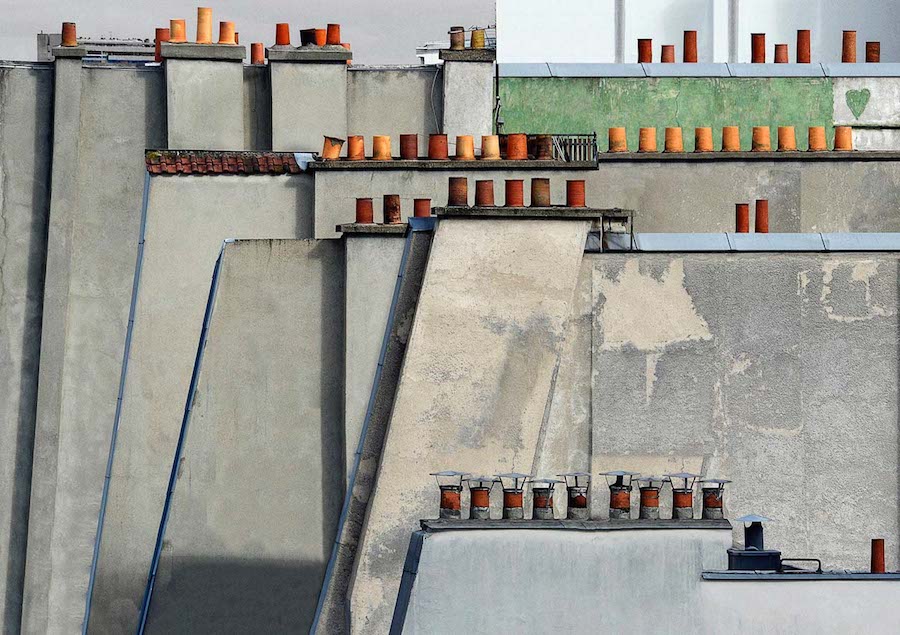
Jonathan Curiel explores photographer Michael Wolf‘s new series capturing the city’s rooftops:

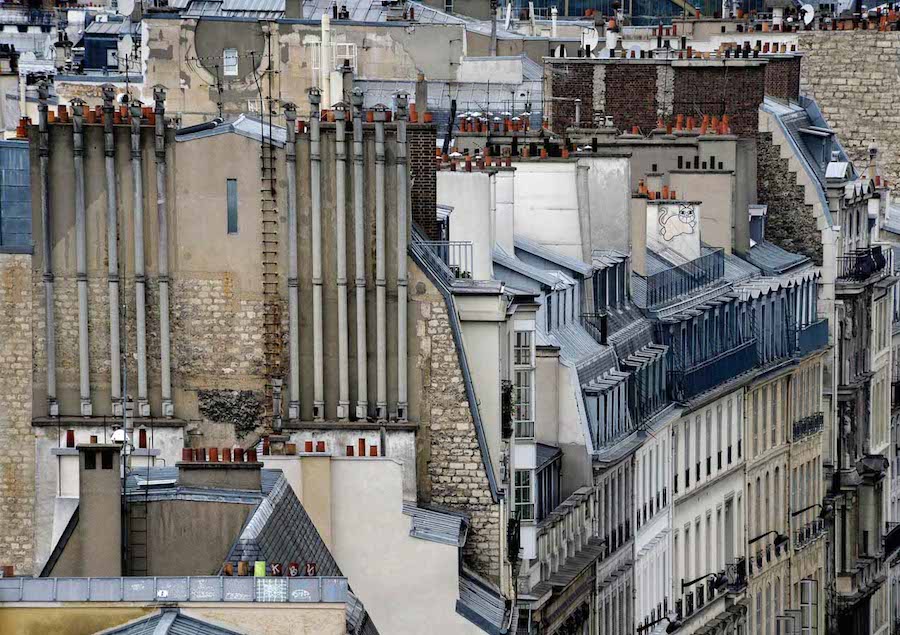
Wolf, whose previous photo series have been mostly centered in China and Japan, wandered along Paris’ rooftops to find an architectural side of Paris that is cracking and atrophying out of public view. Wolf — as he did with his acclaimed “Architecture of Density” series from Hong Kong — squeezes the skyline out of each scene, condensing what could be sprawling vistas into tight layers of metal and cement. Dotting Wolf’s roofs are scores of orange, red, and blueish vents that look like patterns of pottery or even engorged Lego pieces. The title of Wolf’s exhibit, “Paris Abstract,” advertises his photos’ location but also his aim: to disconnect Paris from its idealized reputation — to, in a sense, “de-Paris” Paris.

“When I went up on rooftops, I realized that it’s a perspective that most people don’t see,” says Wolf during a visit to Robert Koch Gallery in downtown San Francisco, where his exhibit is on display through [Sept 6]. “If you see Paris from the foot perspective, it’s all polished and perfect, and there’s nothing improvised or broken or damaged. The rooftops are totally different. The people who work up there say, ‘Oh, no one’s going to see this anyway,’ and they dump something, or the chimney is broken. In that sense, it was a Paris that I found very sympathetic.”

A few more images from the series after the jump:


The Dish previously featured Wolf’s urban-Asia photographs here. His other Paris series, utilizing Google Street View, is here. You can also follow him on Facebook.

And So We Begin

by Sue Halpern

Greetings, People of the Dish. My name is Sue Halpern and I have been one of you for at least a decade, having followed this blog from independence to Time to the Atlantic to the Daily Beast and back to independence. When The New York Review of Books, my spiritual and intellectual home, was in the beginning stages of designing its own blog, I suggested to my friends there that that they take a page or two out of Andrew’s playbook because The Dish, it seemed to me then, as it does to me now, manages to combine the serious and the playful, skips the mean part (no comments, thank you very much), all the while trading on serendipity and engagement. That’s what drew me in as a reader, even though my own unrepentant liberal politics stood at a sharp angle from Andrew’s studied conservatism. But over time there has been an unlikely convergence and the angle has largely collapsed. Not completely, but more often than not.

Pransky At Work
Pransky At Work

Over those same years, though, I’ve found that my “belief” in politics, has diminished. If, before, I thought that electoral politics mattered—and I did; I was the one going door-to-door in swing states—now I have a hard time holding on to that belief. If I thought that government, our government, because it is of and by and for the people—that is, because it is us—existed to make our lives together more tenable, well, let’s just say that with my tax dollars going to support Gitmo, the militarization of the police, subsidies to oil companies, and on and on, I’ve become much more cynical. Wouldn’t it be nice if, when we paid our taxes we could tell the government where we wanted our money to go—to the National Parks, say, and not to those oil companies—but of course that’s not the nature of democracy. If faith is the belief in things unseen, then I guess I will continue to have faith in “we the people,” but it is, and will be, a faith sorely tried by doubt.

Did I say that I have a doctorate in political theory from Oxford? Or that I’m married to a man who has been manically trying to bring together people from all over the world into a concerted movement to redirect the trajectory of climate change? Or that I live in Vermont, where neighborliness is a good part of our politics? Scale, it turns out, matters. Scale things up and no one knows anyone, and decisions are made using algorithms and rubrics. Am I suspicious of big government? I guess by now I am. Are most Americans with me? Not as much as you might imagine. A few weeks ago I wrote a piece for the New York Review of Books about Edward Snowden, Glenn Greenwald, and the NSA, in which I noted that when George W. Bush was in office, the majority of Democrats were opposed to indiscriminate government surveillance and the majority of Republicans were fine with it, while that under Obama, those responses flipped, and Democrats were cool with government spying. To my mind, we maintain a naïve understanding of the power of bureaucracy to direct government when we think it’s okay for one party to do something that we revile if the other party were to do the same.

I’ve been writing about privacy issues, and technology, for a long time, and not always in tandem. I appreciate technology—I am a sucker for the latest Indiegogo gadgetry and know more about the iPhone 6 than I care to admit—but I also appreciate the vigilance it should, but rarely does, inspire in us. Meanwhile privacy, which I have taken as a social good, and as a right, and as a part of my DNA and yours, no longer seems a given. Instinctively I think that’s bad, but I’m willing to consider the opposite.

So let’s talk about dogs. My most recent book, “A Dog Walks Into A Nursing Home,” is about the work my canine partner, Pransky, and I do, as a therapy team at our local public nursing home. (I did an “Ask Anything” about it when the book came out last year.) I am thrilled to be writing for a publication that has a baying beagle as its mascot, so be prepared, over the next seven days, to help me ponder the essential bond we have with our dogs.

I am thrilled, too, to be sharing this virtual space with the man with whom I share real, physical, tangible space. After decades of what the child psychologists call “parallel play,” career-wise, we have spent the past year collaborating on a series of pieces for Smithsonian that combine our passion for ethnic food with our interest in the immigration, and have found that we really like working together. So thank you Andrew and crew for this opportunity to double-team the Dish. And here we go.

Unfair Trade

by Dish Staff

fair trade coffee

Oscar Abello suggests fair-trade coffee might actually be bad for workers:

Fair-Trade certified coffee has become known as an easy way for coffee drinkers to make the world a better place for coffee growers, many of whom are among the world’s poorest people. But a study released in April 2014 seriously questions how much fair-trade certification really does for them. Limited to 12 research sites in Ethiopia and Uganda, the study found that non-fair-trade certified farms paid better wages and provided better working conditions than fair-trade certified farms. The study authors surveyed 1,700 farm workers, going beyond the usual farm owner or farming co-op member that has historically been the beneficiary at the heart of fair trade’s story. …

So why are farm workers finding a better deal on non-fair-trade certified farms? Scale could be one reason. Until recently, only small farms, loosely defined as 10 acres or less, have been eligible for fair-trade certification. The report says larger farms appeared to be in better financial position to offer higher pay, more annual days of work, and better working conditions. Regulatory requirements like paid maternity leave for agricultural workers may also apply only to larger farms, the study found.

(Photo by Eric Magnuson)

The Cost Of Pop-Ups

by Dish Staff

Ethan Zuckerman, who helped invent the pop-up ad, expresses regret about where ads have taken the Internet:

I have come to believe that advertising is the original sin of the web. The fallen state of our Internet is a direct, if unintentional, consequence of choosing advertising as the default model to support online content and services. Through successive rounds of innovation and investor storytime, we’ve trained Internet users to expect that everything they say and do online will be aggregated into profiles (which they cannot review, challenge, or change) that shape both what ads and what content they see. Outrage over experimental manipulation of these profiles by social networks and dating companies has led to heated debates amongst the technologically savvy, but hasn’t shrunk the user bases of these services, as users now accept that this sort of manipulation is an integral part of the online experience.

Users have been so well trained to expect surveillance that even when widespread, clandestine government surveillance was revealed by a whistleblower, there has been little organized, public demand for reform and change.

Zuckerman encourages sites to “charge for services and protect users’ privacy.” Meanwhile, DJ Pangburn is skeptical users would cough up the cash for an internet without ads:

Paying for an ad-free internet would be cheaper than cable, but nearly zero people do so.

By dividing digital advertising spending in the UK in 2013 (£6.4 billion) by the total number of UK internet users (45 million), Ebuzzing found that an ad-free internet would cost around £140 ($232.24) a year. The survey also found that 98 percent of UK consumers would be unwilling to pay that amount of money for an ad-free internet.

A Poem For Sunday

by Alice Quinn

9164900485_a3c36b503d_k

Another from Samuel Daniel’s sonnets, To Delia:

Why should I sing in verse, why should I frame
These sad neglected notes for her dear sake?
Why should I offer up unto her name
The sweetest sacrifice my youth can make?
Why should I strive to make her live forever,
That never deigns to give me joy to live?
Why should m’afflicted muse so much endeavor
Such honor unto cruelty to give?
If her defects have purchased her this fame,
What should her virtues do, her smiles, her love?
If this her worst, how should her best inflame?
What passions would her milder favors move?
Favors, I think, would sense quite overcome,
And that makes happy lovers ever dumb.

(Photo by Pavlina Jane)

A Novel Idea For A Book

by Dish Staff

Dan Piepenbring calls Cory Arcangel’s Working on My Novel “a brilliant litmus test—there are those who will read it as a paean to the fortitude of the creative spirit, and those who will read it as a confirmation of the novel’s increasing impotence”:

Arcangel suggests there’s something inherently ennobling in trying to write, but his book is an aggregate of delusion, narcissism, procrastination, boredom, self-congratulation, confusion—every stumbling block, in other words, between here and art. Working captures the worrisome extent to which creative writing has been synonymized with therapy; nearly everyone quoted in it pursues novel writing as a kind of exercise regimen. (“I love my mind,” writes one aspirant novelist, as if he’s just done fifty reps with it and is admiring it all engorged with blood.)

It’s also a comment on the peculiar primacy the novel continues to enjoy—not as an artistic mode but as a kind of elevated diary, a form of what we insidiously refer to as “self-expression,” as if anyone’s self is static enough to survive transmission to the page. Not for nothing do we have Working on My Novel instead of Working on My Screenplay or Working on My Scrimshaw, because the novel, with its rich intellectual-emotional tradition and its (very occasional) commercial viability, is still perceived as the ideal vehicle for saying something ambitious. Even as fewer people read novels, we’re made to feel that writing one is a worthy, rigorous enterprise for serious thinking people, a means of proving that we have reservoirs of mindfulness and discipline deeper than our peers’. And so we try to write fiction, though certainly we don’t need to, and, as this book attests, we often don’t especially want to, even if we greet the task steeled by a perfect cup of coffee, a glass of red wine and a hot bath, or an Eminem song.

Thanks and See You Later

by Freddie deBoer

me


I would like to thank Andrew, Patrick, Chris, and the entire Dish crew for the opportunity. (And the money.) It’s been a lot of fun. I want to thank the team here for making things so streamlined for me, particularly given that I sent like a dozen emails asking questions, and I want to thank Andrew for the chance to put my feet up on his desk. It’s been fun.

I also want to thank all of you, for the opportunity to invade your space for awhile, and for all the emails. Even the many, many cranky ones. I am not an easy person to know. I have pretty much been a take-it-or-leave-it, love-me-or-hate-me deal for my whole life, even as a little kid. So I appreciate your patience and your candor, and I’m glad to have had the chance to occupy your space for a little while. Writing, for me, is pathological in the simple sense. I don’t stop for long mostly because I don’t know how. This is about the only way I’ve ever found to distract my mind for long enough that it stops beating itself up, and so I have to thank Andrew and his team and all of you for the opportunity to seek that solace here. It’s my privilege. It’s my privilege.

As for the future, you can check me over at my website, although I reckon I’ll be pretty busy this fall. In the long term, I hope I still get the opportunity to speak to fine people such as yourselves, and that when I do, I tell the truth. Cheers.

The Bad Boy Of Belles-Lettres

by Dish Staff

Sam Leith ponders the British press’ vexed relationship with Martin Amis:

Has there in living memory been a writer whom we (by which I mean the papers, mostly) so assiduously seek out for comment – we task him to review tennis, terrorism, pornography, the state of the nation – and whom we are then so keen to denounce as worthless? In recent years his public interventions on everything from Islamist terror to population demographics have caused mini shitstorms; and critics seem to take a particular, giant-killing glee in slamming his fiction. Setting out to write a retrospective essay on his work and reputation, the implied title you find yourself reaching for is “in defence of … ” It’s as if, and in answer to some inchoate public need, we demand of Amis that he say things in public so we can all agree on what an ass he is.

Pivoting off of Leith’s essay, Emily Temple wonders why America has so few literary bomb-throwers:

As I read the article, I couldn’t help but be slightly jealous. It’s true that Amis is a singular fellow, but it seems like all of the real contemporary enfants terribles in the literary world come to us from overseas. Michel Houellebecq, Salman Rushdie, V.S. Naipaul, Will Self (just read this delightfully snooty Q&A), etc. Where oh where is the American Martin Amis? (The fact that Amis somewhat recently moved to Brooklyn is not relevant; he is not ours.) Is there a writer we love to hate? Or one who picks fights with equal glee?

No. You know who we’ve got? Franzen. Whiny, whiny Jonathan Franzen. Our hatred of him is there, but it’s utterly joyless. We don’t love to hate him. He just kind of pisses everyone off. And unlike their reactions to Amis, which are frequently ambivalent and all over the map, the critics pretty much universally enjoy Franzen’s writing – which leaves us arguing about whether or not he’s right about Twitter.

Revisiting Leukerbad

by Dish Staff

Teju Cole experiences a sense of communion while rereading James Baldwin’s 1955 essay “Stranger in the Village” in the tiny Swiss hamlet in which it was written:

I took a room at the Hotel Mercure Bristol the night I arrived. I opened the windows to a dark view, but I knew that in the darkness loomed the Daubenhorn mountain. I ran a hot bath and lay neck-deep in the water with my old paperback copy of “Notes of a Native Son.” The tinny sound from my laptop was Bessie Smith singing “I’m Wild About That Thing,” a filthy blues number and a masterpiece of plausible deniability: “Don’t hold it baby when I cry / Give me every bit of it, else I’d die / I’m wild about that thing.” She could be singing about a trombone.

And it was there in the bath, with his words and her voice, that I had my body-double moment: here I was in Leukerbad, with Bessie Smith singing across the years from 1929; and I am black like him; and I am slender; and have a gap in my front teeth; and am not especially tall (no, write it: short); and am cool on the page and animated in person, except when it is the other way around; and I was once a fervid teen-age preacher (Baldwin: “Nothing that has happened to me since equals the power and the glory that I sometimes felt when, in the middle of a sermon, I knew that I was somehow, by some miracle, really carrying, as they said, ‘the Word’ – when the church and I were one”); and I, too, left the church; and I call New York home even when not living there; and feel myself in all places, from New York City to rural Switzerland, the custodian of a black body, and have to find the language for all of what that means to me and to the people who look at me. The ancestor had briefly taken possession of the descendant. It was a moment of identification, and in the days that followed that moment was a guide.