Losing The Narrative

by Dish Staff

Rachel Shteir, who calls (NYT) writing “daily frustration, not to mention humiliation,” mulls writers’ failures:

I remember the first time I felt like a bona fide failure as a writer. This feeling of nausea washed over me, but it was confusing because it appeared at the exact moment when I was supposed to be feeling success. It was when I finished my first book and realized there were some things in it that I hated, things that were made all the more hideous to me whenever people said, “You must have such a sense of accomplishment.” I asked a more experienced writer if she ever got over this nauseated feeling. She didn’t reassure me. “Oh, that never goes away.”

Every writer has subjects that are our “Moby-Dicks,” the ones we imagine will transform us, more than the others, catapulting us to some other more pleasant climate.

Instead, they sink us. Help, help, we cry, as we drift out to sea on a leaky lifeboat. Doomed.

What’s Wrong With Anglophone Philosophy?

by Dish Staff

Roger Scruton offers a diagnosis:

Academic philosophers in the English speaking world still regard philosophy as Locke defined it in the 17th century, as “the handmaiden of the sciences”: it doesn’t explore the world beyond science but the limits of science, with the result that philosophy doesn’t really intrude into the public world. In the early 20th century were were caught up by the movement to form analytical philosophy, based in the study of logic, the foundations of mathematics, the syntax of ordinary language, the validity of arguments, something very formal. So when people have a big question, especially now since the decline of the orthodox religions, they don’t turn to philosophy for the answer but try to formulate it in whatever technical words have been bequeathed to them, and when a scientist comes along and says “I have the answer,” or even “there is no question,” they think “this guy knows what he’s talking about, I’d better lean on him.”

Face Of The Day

by Dish Staff

lucy

Photographer Sophie Gamand, who brought us last year’s Wet Dogs, is out with a new series called “Flower Power”:

I realized pit bulls were always portrayed in very urban, gritty photographs. The imagery associated with these dogs is often harsh, very contrasted, conveying the idea of them being tough. In my opinion, this feeds the myth that these dogs are dormant psychopaths. So I decided to take the other route and portray them like hippies, soft fairy-tale-inspired characters, feminine and dreamy. The idea of Flower Power blossomed.

I made flower headpieces and approached three rescue groups in New York City: Sean Casey Animal Rescue, Second Chance Rescue and Animal Haven. All three welcomed my project with enthusiasm. I set up a studio in both boarding facilities and photographed some of the pit bulls who were up for adoption (July and August 2014).

Two of the dogs have already been adopted. As the Dish is a proud member of Club Tripod, we’ve featured Lucy above, who is currently a sling-walking bipod while she recovers from a spinal cord injury. Head here for adoption information. Sophie will also be selling prints and calendars from the series with proceeds going to the three shelters she worked with. You can follow the project’s progress on Twitter.

Reading Your Way Through Life: Still More Responses

by Matthew Sitman

Readers continue to tell us about the writing that’s meant the most to them along life’s way. One nodded along with my description of Marilynne Robinson’s prose:

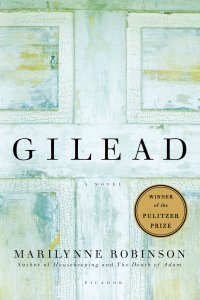
I had to smile at your explanation of why you reread Gilead, “just to immerse myselfGilead in the rhythms of its prose.” That is exactly why I regularly reach for Chaucer’s Canterbury Tales. I often feel embarrassed that sometimes I don’t take much meaning from the words themselves; but there’s a certain zen to be found just in their tempo and cadence, and that’s what brings me back each time. I’ve always likened it to riding a wave. As I start in on a particular Tale, for a page or two it’s like swimming out to the crest of that wave. And then if I’m lucky, if I’m able to really let myself be pulled in, I can get up on that wave and ride it for awhile. Its exhilarating on a spiritual level to allow my mind to go on that journey, free of distraction. Also, it’s marvelous that the words a man wrote so many centuries ago can take me there.

Another reader finds a beautiful passage amidst the rather dry confines of academic philosophy:

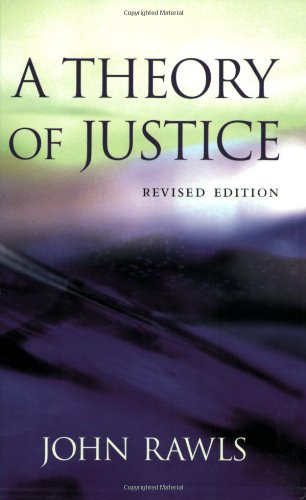
This isn’t a passage from a novel, or a poem, but almost reads like one. The last lines of John Rawls’ A Theory of Justice. I read the book many years ago, but the passage has acquired new meaning for meA Theory Of Justice after I became very involved in climate activism. I don’t know why I find it so touching and calming, or why I know it by heart and occasionally find myself reciting it.

“The perspective of eternity is not a perspective from a certain place beyond the world, nor the point of view of a transcendent being; rather it is a certain form of thought and feeling that rational persons can adopt within the world. And having done so, they can, whatever their generation, bring together into one scheme all individual perspectives and arrive together at regulative principles that can be affirmed by everyone as he lives by them, each from his own standpoint. Purity of heart, if one could attain it, would be to see clearly and to act with grace and self-command from this point of view.”

This reader points to a memorable poem from Milton:

One poem that stayed with me 11 years after finishing high school is John Milton’s Sonnet 23: Methought I Saw, written after his wife’s death during childbirth, and all the more poignant as he had been blind when they married. The passage:

Mine, as whom wash’d from spot of child-bed taint
Purification in the old Law did save,
And such as yet once more I trust to have
Full sight of her in Heaven without restraint,
Came vested all in white, pure as her mind;
Her face was veil’d, yet to my fancied sight
Love, sweetness, goodness, in her person shin’d
So clear as in no face with more delight.
But Oh! as to embrace me she inclin’d,
I wak’d, she fled, and day brought back my night.

Another reader finds these religious poems remain a consolation:

I would like to offer Naked Song by Lalla (translated by Coleman Barks). Lalla was a 14th century kashmiri mystic poet. These poems are beautifully written, and express an element of the divine that can be found in Christianity, Hinduism, Judaism or Islam, or any other religion. They were an incredible solace to me when I was young and struggling with my identity and faith.

1)

I traveled a long way seeking God,
but when I finally gave up and turned back,
there He was, within me!

O Lalli!
Now why do you wander
like a beggar?
Make some effort,
and He will grant you
a vision of Himself
in the form of bliss
in your heart.

2)

Dying and giving birth go on
inside the one consciousness,
but most people misunderstand

the pure play of creative energy,
how inside that, those
are one event.

3)

To learn the scriptures is easy,
to live them, hard.
The search for the Real
is no simple matter.

Deep in my looking,
the last words vanished.
Joyous and silent,
the waking that met me there.

Another reader writes:

Little, Big by John Crowley.  A multi-generational epic of magic realism, rendered in prose that feels both totally immediate and totally timeless.  It’s not super well known, but it is still in print, and a great work of American fiction.

Another reader can’t get enough of this ode to wearing shorts:

I feel like I could give you so many selections, but I’ll limit it to just one poem. It is easily my favorite poem, and sometimes I feel like it was written just for me. It’s called “The Dream of Wearing Shorts Forever,” by Les Murray. He takes such a relaxed, casual garment, and turns it into the sublime.

To go home and wear shorts forever
in the enormous paddocks, in that warm climate,
adding a sweater when winter soaks the grass,

to camp out along the river bends
for good, wearing shorts, with a pocketknife,
a fishing line and matches,

or there where the hills are all down, below the plain,
to sit around in shorts at evening
on the plank verandah –

I can’t select just one part…

shorts and their plain like
are an angelic nudity,
spirituality with pockets!
A double updraft as you drop from branch to pool!

Ideal for getting served last
in shops of the temperate zone
they are also ideal for going home, into space,
into time, to farm the mind’s Sabine acres
for product and subsistence.

Now that everyone who yearned to wear long pants
has essentially achieved them,
long pants, which have themselves been underwear
repeatedly, and underground more than once,
it is time perhaps to cherish the culture of shorts

I re-read it regularly, and it gets better every time I read it. You can read the full poem at the Australian Poetry Library here.

Another poetry-loving reader writes:

This love poem by e.e. cummings (1894-1962) never fails to haunt – one knows this is what he lived:Somewhere I Have Never Travelled

somewhere i have never travelled, gladly beyond
any experience, your eyes have their silence:
in your most frail gesture are things which enclose me,
or which i cannot touch because they are too near

your slightest look easily will unclose me
though i have closed myself as fingers,
you open always petal by petal myself as Spring opens
(touching skilfully, mysteriously) her first rose

or if your wish be to close me, i and
my life will shut very beautifully, suddenly,
as when the heart of this flower imagines
the snow carefully everywhere descending;

nothing which we are to perceive in this world equals
the power of your intense fragility whose texture
compels me with the colour of its countries,
rendering death and forever with each breathing

(i do not know what it is about you that closes
and opens; only something in me understands
the voice of your eyes is deeper than all roses)
nobody, not even the rain, has such small hands

And one more poem:

When I was 17, this poem by Carl Sandburg helped me through a difficult time (leaving behind my best friends and my first love); it also inaugurated my love for poetry. Its effect for me has something to do with the way it begins so gently and ends on a note of defiance:

Troths
Yellow dust on a bumble
bee’s wing,
Grey lights in a woman’s
asking eyes,
Red ruins in the changing
sunset embers:
I take you and pile high
the memories.
Death will break her claws
on some I keep.

You can read the entire thread, including previous reader selections, here.

The Lioness Of Iran

by Dish Staff

Davar Ardalan pays tribute to the great Iranian poet Simin Behbahani, who died this week at the age of 87:

For millions of Iranians all over the world, Behbahani represented the invincible power of the Iranian psyche. Her words were piercing and fierce, lamenting on the lack of freedom of expression through the ages. For six decades, many Iranians found refuge in her poetry as a way to nurture their hunger for dialogue, peace, human rights and equality.

Farzaneh Milani, who teaches Persian literature and women’s studies at the University of Virginia, has been translating Behbahani’s work for decades. She has said that much of Iran’s history can be studied through Behbahani’s poems, as her words stir the mind and quench the thirst of those who can only whisper their laments away from the public eye.

Those words also made her a perpetual target of Iran’s regimes. Soraya Nadia McDonald details the one such harassment:

In 2010, Iranian officials stopped [Behbahani] at the airport in Tehran. The 82-year-old poet, nearly blind due to macular degeneration, was on her way to Paris to speak at an International Women’s Day event. Somehow, she was a threat. Authorities confiscated her passport, interrogated her all night and told Behbahani if she wanted her passport back, she would have to retrieve it from Iran’s Revolutionary Court. Behbahani, by then a recipient of the Simone de Beauvoir Prize for Women’s Freedom and a two-time nominee for the Nobel Prize in literature, had developed quite the reputation for speaking out against tyranny. Behbahani wrote about social issues with a populist bent. She wasn’t afraid to draw attention to the problems faced by prostitutes in Tehran or bring context to the Islamic revolution of 1979 by including Iranian history in her accounts.

Soraya Lennie puts Behbahani’s life and work in context:

She came from a different generation – often referred to by Iranians as the “best generation” – which rediscovered the freedom of critical thinking in a society controlled by absolute monarchy, and refused to be silenced after the Islamic revolution that replaced it. Much like [her contemporaries, the late Forough Foroukhzad and Ahmad Shamlou], she had been a critic and a poet long before the revolution in 1979. She learned censorship and self-censorship. But never silence. It was her words that revolutionaries used to inspire their opposition to the monarchy, and the very same words their children now use against the Islamic Republic.

Regarding Behbahani’s feminism, she rejected the notion that a woman’s poetry should ever be held in a different light than a man’s. Douglas Martin explains how that ethos drove her writing as well:

Ms. Behbahani wrote more than 600 poems, collected in 20 books, on subjects including earthquakes, revolution, war, poverty, prostitution, freedom of speech and her own plastic surgery. … One of her first literary innovations was to experiment with the ghazal, a sonnetlike Persian poetic form. Traditionally, the ghazal had been written from the perspective of a male lover admiring a woman, but Ms. Behbahani made the woman the sexual protagonist. Her skill at writing about love and sex led her to compose lyrics for many popular songs. She later used the ghazal format to write about all manner of subjects, including the Iran-Iraq war.

More on the ghazal form and her contributions to it here. In a 2011 interview with Shiva Rahbaran, Behbahani remarked on what it was like to write knowing that censors awaited the result:

Despite my age, I can almost say that I have never put pen to paper without worrying about censorship. The nightmare of censorship has always cast a shadow over my thoughts. Both under the previous state and under the Islamic state, I have said again and again that, when there is an apparatus for censorship that filters all writing, an apparatus comes into being in every writer’s mind that says: “Don’t write this, they won’t allow it to be published.” But the true writer must ignore these murmurings. The true writer must write. In the end, it will be published one day, on the condition that the writer writes the truth and does not dissemble. Of course, whenever censorship is stringent, most writers resort to metaphor and figurative and symbolic language. And this can help stimulate the imagination. But taking comfort from this fact doesn’t lessen the writer’s dream of attaining freedom.

She also discussed the power and responsibility of being a poet:

Our literature has always been a reflection of contemporary events. The Shāhnāmeh is the greatest epic in history. It is a treasure trove of ideas, wisdom, advice, help, guidance, and rites. With this immense work, Ferdowsi revived the spirit of serenity, magnanimity, and pride in the Iranian nation, which had lost itself under the weight of the Arab conquest of Iran. It empowered divided Iranian peoples to unite. Most of our poets, even those who worked as tyrannical kings’ eulogists, have used their poems to remind rulers of the right way to run the state, practice justice, and uphold the welfare of the people. At the time of the Mongol invasion of Iran and the horrific massacres, writers and poets belonging to the mystical school of thought set out to soothe the people’s pain and sorrow, to teach them to be patient and ascetic, because there was no other alternative at the time. In any age, writers have produced works which were in keeping with their society’s needs and which helped and guided the nation.

When Neda Agha-Soltan was murdered by the regime during the 2009 Green Movement protests, Behbahani was one of the Iranians who spoke out. And with respect to her influence, even President Obama chose Behbahani to quote at the end of his 2011 Norouz address. Stepping back, Azadeh Moaveni mourns, but is also grateful:

She stayed in Iran when many of her literary compatriots, novelists and poets alike, transplanted themselves to Europe or North America, prizing a fierce national loyalty over personal freedom. For many Iranians, she was nothing less than the country’s literary conscience, a figure whose poetry refracted all the anger, disappointment and displaced beauty of the modern Iranian experience. …

The lioness of Tehran’s literary scene, the hiking partner of [Nobel Peace Prize winner] Shirin Ebadi, the poet who refused to leave and refused to be forced into silence, I can hardly begin to describe the force Behbahani has exerted on Iran, carving out a literary realm and inviting everyone to take refuge alongside her verse.

An English-language collection of Behbahani’s poetry can be found here.

Where Have You Gone, Reinhold Niebuhr?

by Matthew Sitman

Oh how I remember those heady days when everyone was writing about and discussing Reinhold Niebuhr, the American theologian famous for books like The Nature and Destiny of Man and The Irony of American History, the preacher who taught us how to think about the Cold War. As a graduate student immersed in Niebuhr’s work around this time – the “Niebuhr moment” probably peaked in 2007 or 2008, but his specter loomed over many of the arguments about the invasion and occupation of Iraq – I had the rare pleasure of feeling like my labors in the stacks really connected to contemporary debates. For once, a preoccupation with theology was cool. In his 2007 Atlantic essay, “A Man for All Reasons,” Paul Eli aptly summarized the Niebuhr-love that seemed to be everywhere:

[T]he Niebuhr revival has been perplexing, even bizarre, as people with profoundly divergent views of the war have all claimed Niebuhr as their precursor: bellicose neoconservatives, chastened “liberal hawks,” and the stalwarts of the antiwar left. Inevitably, politicians have taken note, and by now a well-turned Niebuhr reference is the speechwriter’s equivalent of a photo op with Bono. In recent months alone, John McCain (in a book) celebrated Niebuhr as a paragon of clarity about the costs of a good war; New York Governor Eliot Spitzer (at the Chautauqua Institution) invoked Niebuhr as a model of the humility lacking in the White House; and Barack Obama (leaving the Senate floor) called Niebuhr “one of [his] favorite philosophers” for his account of “the compelling idea that there’s serious evil in the world.”

Seven years after Elie could compare him to Bono, we seem to be hearing much less about Reinhold Niebuhr, a fact that I was reminded of while reading Dale Coulter’s short essay this week marking sixty years since the publication of Niebuhr’s The Children of Light and the Children of Darkness. Coulter lays out the book’s basics, but there’s no real attempt to connect Niebuhr to present days concerns. That’s not a criticism, but it was telling, given all the previous attempts, noted above, to make Niebuhr a sage for our times. And even more, this was the first time in quite awhile I had read anything at all about Niebuhr aimed at a general audience.

I have a theory about why the Niebuhr moment has passed – and why it matters.

Part of Niebuhr’s post-9/11 popularity, I would argue, was the compelling way he connected Christian theology to modern political problems. He could use original sin to diagnose American democracy, or discuss the coming of a world community as embodying Christ’s love. He wrote about war and peace while drawing on figures ranging from St. Augustine to Abraham Lincoln. Niebuhr was no mere pundit; his writing had a depth and seriousness notable in his own day and even more rare in ours. And when we found ourselves struggling to understand how to make our way in a newly terrifying world, we turned to Niebuhr as both a model and a resource.

But as Elie points out, there were elements of Niebuhr’s thought that seemed to support, or could be wrenched into supporting, nearly every imaginable position regarding the war on terror and, especially, regime change in Iraq. Which is another way of saying we found in Niebuhr what we wanted to find, all while enjoying the heft he gave our own ideas. The way we read him confirmed our preexisting inclinations more than it provoked us to think deeply and creatively – his work should have been, but wasn’t, a mirror in which we were forced to take a long hard look at ourselves and confront our fallibility and pride, to question our assumptions and cherished certainties.

The more I’ve considered Niebuhr’s work the more I’m convinced that’s what he calls us to, and what we resist. Once we had rummaged through his work for polemical purposes, we left him behind, refusing to grapple with the most enduring elements of his thought. Niebuhr saw the self-interest lurking behind every argument, understood self-deception to be perennial, grasped that nothing in this world was pure. He should have been used not to endorse this or that particular position, but turned to as a prophetic figure who calls all of us acknowledge what, in a different time, we’d have called our sinfulness. As he wrote in The Children of Light and the Children of Darkness:

Democracy therefore requires something more than a religious devotion to moral ideals. It requires religious humility. Every absolute devotion to relative political ends (and all political ends are relative) is a threat to communal peace. But religious humility is no simple moral or political achievement. It springs only from the depth of a religion which confronts the individual with a more ultimate majesty and purity than all human majesties and values, and persuades him to confess: “Why callest thou me good? There is none good but one, that is, God.”

Niebuhr asked us to see ourselves as the flawed beings we are not to encourage pessimism, but to brace us for the hard work of engaging political life aware that there are never simple or easy answers. We are called to pursue justice, but there always will be a tragic element to that pursuit. Our “moral ideals” are never unmixed with the narrowness of our own perspective. This is less of a political program than a political sensibility, one perhaps best summarized in these oft-quoted words from The Irony of American History:

There are no simple congruities in life or history. The cult of happiness erroneously assumes them. It is possible to soften the incongruities of life endlessly by the scientific conquest of nature’s caprices, and the social and political triumph over historic injustice. But all such strategies cannot finally overcome the fragmentary character of human existence. The final wisdom of life requires, not the annulment of incongruity but the achievement of serenity within and above it…

Nothing worth doing is completed in our lifetime; therefore, we are saved by hope. Nothing true or beautiful or good makes complete sense in any immediate context of history; therefore, we are saved by faith. Nothing we do, however virtuous, can be accomplished alone; therefore, we are saved by love. No virtuous act is quite as virtuous from the standpoint of our friend or foe as from our own; therefore, we are saved by the final form of love, which is forgiveness.

Niebuhr doesn’t leave us with mere doom and gloom – he is not merely a realist or cynic. He holds out the hope that realizing the ways we all, inevitably, are caught up in a sinful world might prove the precondition for learning to love each other. Humility and repentance can lead to forgiveness. This approach to the problems we face has very few takers in American life. Which is another way of saying that, like all great prophets, he has no honor in his own country.

(Thumbnail image: Reinhold Niebuhr by Ernest Hamlin Baker. Photo by Nostri Imago)

The Pope Isn’t A Pacifist

by Dish Staff

In light of Pope Francis’ comments about ISIS this week, Christopher J. Hale explains why:

[F]or those who know the intricacies of Catholic moral teaching, Francis’s openness to military intervention in Iraq makes perfect sense. For 1500 years, the Church has promoted the teaching of St. Augustine: that there can be no true peace without justice. This ancient teaching has crystallized into the Church’s modern day just war principle, which holds that nations only ought to enter into military campaigns against unjust aggressors as a last resort and only in limited scope and circumstances.

Under that paradigm, does the current situation in Iraq merit such a military response? Pope Francis isn’t ruling it out. Now contrary to the absurd claim by Vox’s Max Fisher, Pope Francis isn’t calling for the tenth crusade against the Middle Eastern people. Instead, he’s proposing a clear-eyed response to a critical crisis.

Ed Morrissey also has a column detailing Catholic just war doctrine and how it applies to the situation in Iraq. In a follow-up, he summarizes why he’s almost, but not quite, a pacifist either:

I’m not arguing that Jesus would applaud a military intervention anyway. Pacifism is, and should be, the first impulse of the Christian, and the second and third impulse as well.We are called to prayer and to make peace — when peace is possible.

What Pope Francis and the Catholic Church in its Catechism argue is that war should be a last resort, and that it should be fought with “as much humility and restraint as possible.” My column points out what Francis meant, and why a fight to stop ISIS fits within the paradigm presented in Catholic teaching.

That’s why the Just War doctrine exists at all — to distinguish between wars of necessity and wars of choice. War is a result of a fallen world, which Christ offered salvation to those who accept it of their own free will. But the fallen world remains, and with it difficult moral choices as to the proper use of power for the good of humanity. Most wars are fought over petty concerns over territory, power, or even ideology, but some of those in the latter category involve such intrinsic evil with which it is impossible to negotiate or allow to continue unabated. Leaving victims to die at the hands of evil sadists and standing on the sidelines while entire populations get erased or sent into slavery is a choice, yes, but it’s not one compatible with Christian teaching either.

Brandon Ambrosino adds:

After Francis affirmed the Church’s doctrine of just war, he quickly noted how that doctrine has been abused many times in the past and can be abused again. “How many times under this excuse of stopping an unjust aggressor the powers [that intervened] have taken control of peoples, and have made a true war of conquest?”

Francis recognizes the necessity of stopping an unjust aggressor, but he also recognizes that this same sort of logic has at times been abused as a justification for domination. (For instance, yes, the Crusades.) To prevent the principles of Catholic just war doctrine from being abused, Francis thinks the decision for when and how to engage in war must not be left up to one isolated power: “One nation alone cannot judge how to stop an unjust aggressor.”

Read Diana Wynne Jones

by Freddie deBoer
Diana Wynne Jones

I did not have a lonely childhood, although sometimes I remember myself as having one, in that way that you make your own childhood more like a story than it was. I had three siblings and lots of friends. But I also had books, and books were a kind of chosen loneliness– an exciting loneliness, sometimes almost an illicit loneliness. Because when I was reading, I was probably reading about magic. Magic was, for me, all the things I wanted and did not believe. It was the vehicle through which I would gain the control that all young people long for, the adventure I yearned for and knew I would never achieve, and in time, religion, the traditional family, and America. I poured all of these superstitions into my belief in magic, and I would clutch books about magic to my chest on the bus to school, counting syllables and thinking about the places I would go if I only had the power. And I believed it all willfully until I found that expenditure of will too much to give, and then one day I didn’t believe anymore.

But before that were my books, and the ones I loved more than any others were by Diana Wynne Jones. Jones should be more well known than she is. She was a favorite and personal friend of fantasy superstar Neil Gaiman; one of her best known books was made into a movie by Hayao Miyazaki; and her stories, filled with wizards and spells and schools, would seem a perfect fit in the post-Harry Potter world. And yet I find she’s still somewhat unknown, even among fans of fantasy and Young Adult.  Google lovingly celebrated her 80th birthday just a couple weeks ago, and yet I think many people responded with confusion. That’s a shame. All these years later, she’s my favorite.

Certainly, the things that are great about Jones’s work are things you might look for in any fantasy author. Her imagination is expansive and individual. With fantasy, it’s not just about the degree of someone’s imagination, but the style, and Jones imagined unlike anyone else. It’s a well-worn notion that the trick in fantasy lies in how to describe the mundane, and at that task, Jones had few peers. Her worlds are lived-in and worn, never terrifying but never quite comfortable, filled with details as familiar as your grandmother’s house but as disconcerting and alien as a dream. Her settings are frequently cold and foreboding, but her characters are warm and familiar, her books filled with knowing, kind, distracted, difficult, smart, flawed, headstrong, clumsy, misunderstanding people. People in Jones’s books are forever hurting each other through their distraction, or through their misunderstanding, or very often, through their genuine desire to help. There is warmth and friendliness in her world, but there is also the real-life condition of the endless harms we pile up on the people we love and do not understand.

I truly believe Jones is one of the greatest chroniclers of childhood we’ve ever had, and it’s because of nothing so much as her utter rejection of romanticizing being a child. The world she describes, for kids, is strange, rule-bound, fickle, and unknowable. Children are hurt, mostly by other children, and they all grow up too fast. I don’t mean to make her work sound impossibly depressing or grim; in fact her books are frequently joyous affairs. But there is an absolute and unwavering commitment to reckoning with the disappointment and confusion of being young, in her work, an honesty that is wonderfully supportive simply in its willingness to confront the way things are when you are young and your life is not yet yours. It’s a rare and valuable message to get as a kid, the recognition of loss by an adult who understands. Throughout all of it, there’s possibility, teeming and inventive, a world of magic and adventure that most children want beyond wanting. Some children, in her books, get that magic and that adventure. But never without a price.

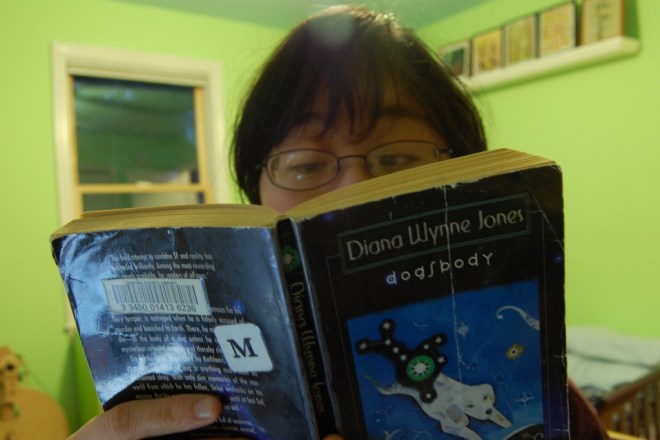
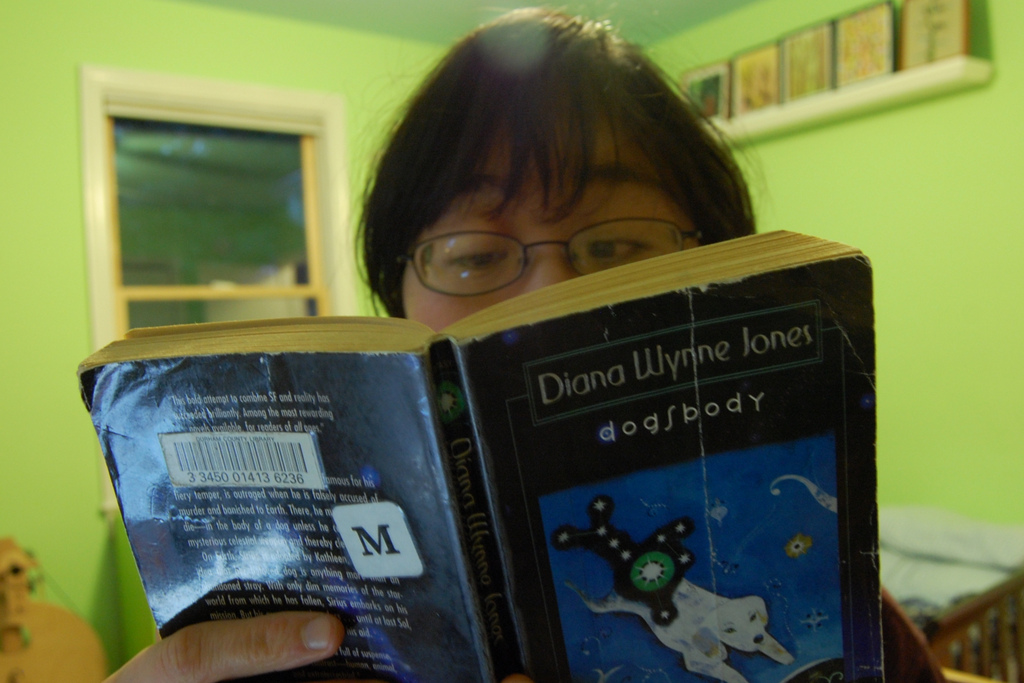
So here’s a few books by her that you could read, or read to your children, although I wish I could tell you about a half dozen others– the bravura sci-fi of A Tale of Time City; the grown-up pleasures of Dogsbody, about a star that takes animal form; the Gothic creepiness of teenagers in Eight Days of Luke; the subtle unease and brilliant consideration of gender in Aunt Maria…. But for now, these will do.

Howl’s Moving CastleThis is often the first book of Jones’s that people read, and it isn’t hard to imagine why. It’s not just that they get pulled in by the Miyazaki movie. (It’s worth saying that Miyazaki has an unusual adaptation style: the first half of the movie is slavishly faithful to the book, the second half, not faithful at all.) The story of how a young woman named Sophie earned the enmity of the Witch of the Wastes and the attention of the wizard Howl, the book is among Jones’s most accessible. It’s filled with familiar fantasy tropes: witches and wizards, curses, magical sidekicks, transformations. But like most of Jones’s work, the story is told slant, every trope and idea delivered just a little differently than you would expect. It’s filled with fun, fully-realized characters, none more satisfying than Sophie. Jones is a master at portraying female characters that are sharp and brave without ever falling into the “strong female character” trap; Sophie is smart but unobservant, kind but judgmental, and forever getting in her own way. There is never a moment when Jones’s characters seem to exist to satisfy or defy a stereotype, which means that there is space for them to exist in wonderful, human imperfection. The book suffers a bit from anti-climax, but it’s a funny, satisfying love story. And while you can read the cracking, joyful, impossibly clever sequel Castle in the Air without having read this one, if you do read Howl’s first, you’ll find that book lands even better.

Archer’s Goon. It seems that this book might be out of print, which has got to be some kind of cosmic crime. If I had to pin one book down as Jones’s masterpiece, this would be the one. It’s funny; like with most of Jones’s books, I got this one from the public library, but I resisted for years, even though it was stacked up next to a bunch of my favorites. That cover was awful. Yes, I judged a book by its cover, and paid for it. Because Archer’s Goon is astonishing, a brilliant, meticulous work of young adult literature that I would feel comfortable recommending to any adult. It’s fantasy, I guess, but it’s hard to name a single traditional trope or convention in it. Howard Sykes’s classic (but not idyllic– Jones’s children endure the real world of childhood indignity and fear) suburban life in England is interrupted by a goon, sent by the wizard Archer, to collect several thousand words of nonsense that Howard’s father owes. This inconvenience leads Howard to learn that Archer is in fact one of seven siblings, who have divided up municipal life– and taxes– in Howard’s town. They are bound, in a strange way, by the words that Howard’s father produces. Jones’s magical worlds are full of strange and arbitrary rules, the sense of which constantly escapes the understanding of her protagonists, perfectly dramatizing the confusion and misunderstanding of childhood. Gradually, Howard learns more about the magical world around him, coming to discover the way in which Archer and his siblings are and are not what they seem. The book is perceptive, funny, moving, and more than anything, genuinely surprising in a way that’s rare in fiction. A gem.

Charmed LifeThis book is part of a larger cycle, and yet as is common with Jones, you can read it separately and lose little. It’s here, with one of her earliest books, that Jones’s unflinching portrayal of childhood loss is presented most completely, and most achingly. It’s a story, ultimately, about unrequited love, about the profound fissure that occurs in every young life when we realize that we can love something completely and receive nothing in return. Cat Chant and his sister, Gwendolen, are orphans, like most young people in fantasy stories. Cat clings to Gwendolen after the death of their parents, adoring her, even while his life is changed again and again by her growing magical powers. There is an exquisite sadness in this novel, a sense of loss that is profound, even when the resolution brings Cat some peace. Jones is not a moralist; her antagonists rarely receive satisfying comeuppance and if you’re looking for that, look elsewhere. But things do have a way of coming together, in the end. Still, as happy as things may end up, there’s no mistaking it: this book is a line in the sand, a message from an author who insisted on telling beautiful fantasy tales about children who learn how sad the world can really be.

Witch WeekI’m not a Harry Potter grump. Hey, Harry Potter’s great, it’s fine. But when I read Witch Week, a little of my disappointment with that series becomes plainer,  because there’s nothing in Rowling’s seven novels about school that are as real, recognizable, and utterly funny as Witch Week. Everyone who has ever known the specific, excruciating indignities of going to school will find much to recognize in this book. What Jones understood, intuitively, was the way in which the major catastrophes and minor losses of dignity mix together in the day-to-day flow of life, how hard it is to separate the true emergencies from the simple problems that nag at you every day. Witch Week, like a lot her work, is about the thin walls between worlds, and the way in which they can get ripped and crossed. Charles, a lonely and angry boy– a genuinely unpleasant protagonist, a risk that Jones was often willing to take– occupies a world where magic is common but forbidden, enforced against with the zeal and terror of an inquisition. Jones works that constant fear of oppression against the shock and glee at discovering real magic among a cast of misfits, trying to survive in the unique social horror of British boarding school. The twists and turns are surprising and darkly comic, and the stakes very real and frequently frightening. Her images are gorgeous, and for the rest of my life I will remember the image of the image on the old hardcover at my library, a young girl soaring above the English countryside on a broom, wrapped in a pink blanket. There’s metaphors to be had here, metaphors for sex and adulthood and freedom, but Jones’s touch is light, and at the center there’s a perceptive, well-crafted, and remarkably funny magic story. Witch Week is, in some ways, a very dark book, and yet I can’t think of many that are more likely to make me smile.

I read all of her work that my library had, as a kid. When I was older, I read them all again, though I had never really stopped picking through them. They were as good as I’d remembered, or better. Many things had changed. I saw them then through the eyes of someone who had learned what we all eventually learn, that fairy godmothers aren’t real, but wicked stepmothers are. But I also connected again with her flawed, human, compassionate characters, and I thought of those I had loved who I would never see again, and about our capacity to make each other a little more comfortable, even if it were just with the power of quiet understanding. And though I felt I had become cynical in a cynical world, I remembered too that once, I believed in magic.

(Photo by Eunice.)