Saint George

by Dish Staff

Noting that people “don’t realize the patience it takes to be a good icon,” Jennifer M. Kroot suggests that George Takei is a sort of holy man for a secular age:

We filmed George at the Emerald City Comicon where George signed autographs for four hours and did photo-ops with fans for another two hours. George engaged with thousands of fans that one day (no exaggeration!) … George offers a firm handshake and stays present with each fan for the moment or two that they have his attention. George always sounds sincerely appreciative, even though he must have heard every compliment a million times. Some fans even bring homemade gifts. One woman offered George a charming diorama of a little living room scene with a blackbird wearing Mr. Sulu’s yellow Star Trek uniform. George accepted it graciously. If a fan has a Spanish or Japanese accent, George will switch languages to accommodate them.

These encounters are fairly short, but fans clearly find meaning in them, almost like they’ve received a blessing. Shortly after I began following George, I started to think of him as a sort of Dalai Lama of popular culture because of the comfort he seems to give his fans.  It’s true that George does get paid for each signature or photo-op at sci-fi conventions (as seen in the documentary), but he works hard to give each fan a sincere, authentic George Takei experience.


Quote For The Day

by Chas Danner

“Is it not possible that rocks, hills and mountains, and the great physical body of the Earth itself may enjoy a sentience, a form of consciousness which we humans cannot perceive only because of the vastly different time scales involved? For example the mind of a mountain may be as powerful and profound as that of a Buddha, Plato, Spinoza, Whitehead and Einstein. Say that a mountain takes 5,000,000 of our human or solar years to complete a single thought. But what a grand thought that single thought must be. If only we could tune in on it. The classic philosophers of both east and west have tried for 5,000 years more or less to convince us that Mind is the basic reality, maybe the only reality and that our bodies, the Earth and the entire universe is no more than a thought in the mind of God. But consider an alternative hypothesis. That Buddha, Plato, Einstein and we are all thoughts in the minds of mountains, or that humanity is a long, long thought in the mind of the Earth. That we are the means by which the Earth, and perhaps the universe becomes conscious of itself. I tell you that God, if there is a god, may be the end, not the origin of this process. If so, then our relationship to Earth is something like that of our minds to our bodies. They are interdependent. We cannot exploit or abuse our bodies without peril to our mental health and our survival. We have definitely seen some mindless bodies dancing around us, but we have yet to observe a disembodied mind. At least I haven’t seen any. And as mind is to body, so is humanity to Earth. We cannot dishonor one without dishonoring and destroying ourselves.” – Edward Abbey, from his 1975 lecture “In Defense of Wilderness” given at St. John’s College in Santa Fe, New Mexico and later transcribed and published by Jack Loeffler in his book, Adventures with Ed: A Portrait of Abbey.

(Photo: Caineville Reef, Utah by Andrew Smith. This image has been slightly cropped.)

A War Poet In Palestine

by Dish Staff

Nina Martyris considers the enduring relevance of Siegfried Sassoon, who was stationed in Gaza briefly in 1918:

To read Sassoon on war is to read about Israel and Gaza today. After he left Palestine, he wrote a tightly crafted sonnet calledSiegfried_Sassoon_by_George_Charles_Beresford_(1915) “Ancient History” on the fratricidal nature of war, told through the allegory of Cain and Abel. Ironically, that same story of brotherly murder provided the name of Israel’s Operation Brother’s Keeper, launched to search the West Bank for the three Israeli teenagers whose abduction and murder sparked the ongoing clash. In Sassoon’s scorching parable, Adam stands in for the cynical old politicians who watch their young kill one another. Described as “a brown old vulture in the rain,” Adam ponders over the character of his two sons. He admires Cain, who is “Hungry and fierce with deeds of huge desire,” and despises Abel, “soft and fair – / A lover with disaster in his face.” Adam even justifies Cain’s murdering his own brother because even murder is more tolerable than weakness: “Afraid to fight; was murder more disgrace?” In the end, murder only begets murder, and the vulture finds both his “lovely sons were dead.”
What makes this poem a moral grenade is its self-awareness. Sassoon knew that there were bits of Cain and Abel tussling inside him. At the start of the war, he had been a soldier filled with bloodlust, and made quite a reputation for himself for his revenge killings of Germans. But he had also sickened of the slaughter and campaigned for it to stop. In Sassoon’s case, Abel finally won, but the current war, with its far more ancient and complex metabolism, is inevitably stamped with the mark of Cain.

(Photo of Sassoon by George Charles Beresford via Wikimedia Commons)

Gay Love Comes Of Age

by Dish Staff

Kevin Fallon praises the new film Love Is Strange for its depiction of gay romance later in life:

So often when a film is made about a gay romance, the characters are young and promiscuous, or young and questioning, or young and in love, or young and trying to find themselves and their place in the world. Mostly, though, they are young.

But when George climbs into bed with Ben midway through the film and the two characters just hold each other, with all the comfort and feeling of men who have been in love for 40 years, it was a portrayal of a gay relationship that I don’t think I had ever seen before on screen. I can’t think of another example of older, settled gay film characters long into their lives that young gay people could look at and think, “One day I hope that my partner and I will be like that, like them.”

For all of the progress in depicting modern gay relationships in film now, there has never been one for people to aspire to in the future. We’ve seen men meet the men they want to grow old with, but we’ve never seen what it’s like when they actually get old. More importantly, that they can be happy.

Kinkysexuals?

by Dish Staff

Jillian Keenan argues that kink counts as a sexual orientation:

We don’t choose kink. Yes, there are vanilla people who, inspired by popular books or movies, choose to experiment with BDSM. (There are also straight people who choose to experiment with same-sex attraction, as anyone who went to college on a coast can attest.) And some people find BDSM later in life, don’t feel that it’s an orientation they were born with, and yet are full and equal members of the BDSM community (to the extent that such a thing even exists) in every way. But that doesn’t minimize the fact that, for a huge portion of kinky people, BDSM is not a choice, a hobby, or a phase. Kink is often so fundamental to our sexual identities that it has to be, at least in some cases, an orientation.

From the outside, “this thing we do” seems like nothing more than weird sex stuff. I understand that. But, from the inside, kink is so much more than merely physical. Our orientation is so deeply rooted that many of us feel we were born with it. For us, kink mixes language, ritual, trust, power, pleasure, pain, and identity in a way that can’t be captured by a stereotype. You know what else mixes language, ritual, trust, power, pleasure, pain, and identity? Love. Every kind of love.

A Dickish Move

by Dish Staff

Over at Jezebel, Tracie Egan Morrissey and Tara Jacoby have put together an illustrated guide to the Disney princes’ nether regions. Emily Shire is not amused:

[I]t is perturbing to see the site proudly revel in the double standard of giving their favorite Disney characters “idealized” genitals and the villains smaller, less “attractive” ones. To briefly indulge in a close-reading of the Disney prince dick descriptions (because what else am I going to do with my college degree in history and literature), Morissey perpetuates the same pressure on men to exhibit a certain physique that she critiqued Disney of doing to women. Of Cinderella‘s Prince Charming, she writes:

The perfect guy has the perfect dick: like eight or nine inches, thick—but not too thick otherwise it’s painful—rock hard with a nice throbbing vein. He’s groomed perfectly in a way that’s considerate of lovers without being too gay porn-y about it.

In contrast, Beauty and the Beast‘s Gaston—the asshole/villain—has “a small dick—very tiny—pube-less and uncut.” So smaller, uncircumcised penises are conflated with being a jerk and a loser. Jezebel also dabbles in some racial stereotypes by ensuring that Prince Naveen—the sole African American male in the collection—has the longest gentalia. It’s unavoidable (and unfortunately) noticeable because it’s the only penis that doesn’t actually fit in the image frame. … If a male-focused site, let’s say BroBible, drew The Little Mermaid‘s Ursula with, oh, a large labia and full-bush pubes to conflate these female genital characteristics with her negative personality, I doubt any writer at Jezebel, or any feminists, would find it humorous, or remotely acceptable.

Running The Numbers On Relationships

by Dish Staff

Daniel A. Medina presents new findings on how race relates to success at online dating:

The breakthrough came when the researchers found that three multiracial groups were favored more than anyone else, something they referred to as the “bonus effect.” These three groups were Asian-white women, who were viewed more favorably than all other groups by white and Asian men, and Asian-white and Hispanic-white men, who were given “bonus” status by Asian and Hispanic women. … This “bonus effect,” which the researchers said was “truly unheard of in the existing sociological literature,” goes against the long established “one drop rule” amongst American sociologists. Usually applied to people with partial African descent, the rule essentially states that multiracial people even who are even a small part non-white are viewed simply as part of the lower-status (non-white) group.

Of course, even those who’ve parlayed their most desirable qualities (including, apparently, multiracial-ness) into coupledom aren’t guaranteed relationship success. Luckily, Emily Esfahani Smith and Galena Rhoades discuss research (pdf) on how healthy relationships progress:

The freedom to choose any relationship sequence has benefits, but it may also come at a cost long-term. Couples today seem less likely to move through major relationship milestones in a deliberate, thoughtful way. Rather, the new data show that they tend to slide through those milestones. Think of the college couple whose relationship began as a random hookup, the couple who moved in together so that they could pay less rent, or the couple who chose to elope on a whim rather than have a formal wedding. These are couples who, often without realizing it, slid through relationship transitions that could have been planned out, discussed, and debated.

The data show that couples who slid through their relationship transitions ultimately had poorer marital quality than those who made intentional decisions about major milestones. How couples make choices matters.

And how those relationships start also matters. Tom Jacobs flags a study that casts doubt on the longevity of relationships that begin when one partner swoops in and “poaches” the other from an existing relationship:

In three studies, “individuals who were poached by their current romantic partners were less committed, less satisfied, and less invested in their relationships,” reports a research team led by psychologistJoshua Foster of the University of South Alabama.

“They also paid more attention to romantic alternatives, perceived their alternatives to be of higher quality, and engaged in higher rates of infidelity.”

Being poached by your current partner, the researchers conclude, is both fairly common (10 to 30 percent of study participants reported their relationship began that way), and “a reliable predictor of poor relationship functioning.”

Hot And Heavy In The 17th Century

by Dish Staff

Hal Gladfelder traces the history of outrage over porn:

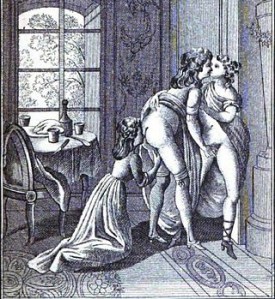
The brave new world of “sexting” and content-sharing apps may have fueled anxieties about the apparent sexualization of popularJustine_ou_les_Malheurs_de_la_vertu_(ménage_à_trois_2)culture, and especially of young people, but these anxieties are anything but new; they may, in fact, be as old as culture itself. At the very least, they go back to a period when new print technologies and rising literacy rates first put sexual representations within reach of a wide popular audience in England and elsewhere in Western Europe: the late 17th and early 18th centuries.

Most readers did not leave diaries, but [English diarist Samuel] Pepys was probably typical in the mixture of shame and excitement he felt when erotic works like L’École des filles began to appear in London bookshops from the 1680s on. Yet as long as such works could only be found in the original French or Italian, British censors took little interest in them, for their readership was limited to a linguistic elite. It was only when translation made such texts available to less privileged readers – women, tradesmen, apprentices, servants – that the agents of the law came to view them as a threat to what the Attorney General, Sir Philip Yorke, in an important 1728 obscenity trial, called the “public order which is morality.”

(Illustration from the Marquis de Sade’s Justine [1791] via Wikimedia Commons)

Drinking Straight From The Box

by Dish Staff

Megan Kaminski believes it’s well past time for us to take boxed wine seriously:

 In America, boxed wine selection has been generally limited to red alcoholic fruit punch and white alcoholic fruit punch. European and Australian winemakers have been putting quality wines in boxes for decades. In some ways, boxed wine is a natural extension of the French tradition of bottles and casks that can be refilled at wineries; they provide efficient and ecologically sound ways of selling and storing wine. They also add to the longstanding tradition of having a house wine—a reliable standby, free from the pomp-filled expectations associated with “discovering” a new bottle. …

Every glass tastes as if it is from a fresh bottle. Gone are concerns about a half bottle of oxidized wine left over from the night before. Boxed wine is also easy to transport on foot. I know from experience that lugging four bottles of wine home from the store is less pleasant than toting a slender box.

She thinks wine culture could use a little more egalitarianism as well:

The fetishized wine bottle might be relegated, rightfully, to the realm of fine wines. And we could be done with pretense—no need to fake proper French pronunciation of some made-up “chateau” from a California mass-producer, no tired discussion of vintage and whether it was a good year for a wine that is clearly not meant to age, no listening to remarks about the charming animals that adorn the label. It’s hard to talk about terroir or feel snooty when you are drinking a wine that in an ounce per ounce comparison costs about as much as a latte.


A Poem For Saturday

by Alice Quinn

I have been luxuriating this August in a college textbook, Tudor Poetry and Prose, edited by five superior scholars (J. William Hebel is first on the list). I’ve been hugely rewarded by the selections as well as the notes and biographies of the poets.Samuel_Daniel

So we’ll add to our summer store of poems on love and courtship (and thwarted and vaunted wooing, as you shall see). We’ll begin with sonnets by Samuel Daniel (1562-1619), who was educated at Magdalen Hall, Oxford and made his early living mostly as tutor to the children of exceptionally well-placed people—among them, the sister of Sir Philip Sidney, Mary Herbert, Countess of Pembroke, whose literary circle Daniel considered his “best school.”

In 1591, twenty eight of his sonnets appeared in the “surreptitious” edition of Sidney’s Astrophil and Stella. (Please investigate this fascinating episode of English literary history.) The next year saw his authorized publication of a volume of sonnets, and in 1604, he was commissioned to write the first masque for the court of the new king, James I, patron of Shakespeare and force behind the third and ever-glorious translation of the Hebrew Bible into English.

In the 19th century, Coleridge described the style which Daniel’s contemporaries praised in similar terms (Sir Thomas Browne referred to him as “well-languaged Daniel”) as “just such as any very pure and manly writer of the present day—Wordsworth, for example—would use,” adding “Thousands of educated men could become more sensible, fitter to be members of Parliament or Ministers, by reading Daniel.”

From the sonnet sequence, To Delia by Samuel Daniel:

Fair is my love, and cruel as she’s fair:
Her brow shades frowns, although her eyes are sunny,
Her smiles are lightning, though her pride despair,
And her disdains are gall, her favors honey.
A modest maid, decked with a blush of honor,
Whose feet do tread green paths of youth and love;
The wonder of all eyes that look upon her,
Sacred on earth, designed a saint above,
Chastity and beauty, which were deadly foes,
Live reconciled friends within her brow;
And had she pity to conjoin with those,
Then who had heard the plaints I utter now?
For had she not been fair and thus unkind,
My muse had slept, and none had known my mind.

(Frontispiece engraving of Daniel for his poem The Civile Ware, 1609, via Wikimedia Commons)