by Dish Staff

Yellowstone National Park, Wyoming, 7.16 pm
Chuck Hagel thinks so:
The group “is as sophisticated and well-funded as any group that we have seen. They’re beyond just a terrorist group,” Hagel said in response to a question about whether the Islamic State posed a similar threat to the United States as al Qaeda did before Sept. 11, 2001. “They marry ideology, a sophistication of strategic and tactical military prowess. They’re tremendously well-funded. This is beyond anything that we’ve seen,” Hagel said, adding that “the sophistication of terrorism and ideology married with resources now poses a whole new dynamic and a new paradigm of threats to this country.”
Hagel’s comments added to the mismatch between the Obama administration’s increasingly aggressive rhetoric and its current game plan for how to take on the group in Iraq and Syria, which so far involves limited airstrikes and some military assistance to the Kurdish and Iraqi forces fighting the militants. It has also requested from Congress $500 million to arm moderate rebel factions in Syria. But for now, the United States is not interested in an Iraqi offer to let U.S. fighter jets operate out of Iraqi air bases.
Retired Gen. John Allen seconds Hagel’s assessment, arguing that the US has the means to destroy ISIS and a moral and security-based obligation to do so:
IS must be destroyed and we must move quickly to pressure its entire “nervous system,” break it up, and destroy its pieces. As I said, the president was absolutely right to strike IS, to send advisors to Iraq, to arm the Kurds, to relieve the suffering of the poor benighted people of the region, to seek to rebuild functional and non-sectarian Iraqi Security Forces and to call for profound change in the political equation and relationships in Baghdad.
The whole questionable debate on American war weariness aside, the U.S. military is not war weary and is fully capable of attacking and reducing IS throughout the depth of its holdings, and we should do it now, but supported substantially by our traditional allies and partners, especially by those in the region who have the most to give – and the most to lose – if the Islamic State’s march continues. It’s their fight as much as ours, for the effects of IS terror will certainly spread in the region with IS seeking soft spots for exploitation.
Observing how the official rhetoric on ISIS has escalated, Eli Lake picks up on a choice of phrasing by Obama that he interprets as revealing:
In the aftermath of the 2012 attack on the U.S. diplomatic compound in Benghazi, Obama vowed to bring the attackers to justice. This week Obama struck a different tone, saying: “When people harm Americans, anywhere, we do what’s necessary to see that justice is done.” The difference between bringing suspects to justice and seeing that justice is done is roughly the same as the difference between treating terrorism as a crime and as an act of war.
Even though special operations teams were dispatched to Libya after Benghazi to target the jihadists suspected of carrying it out, Obama chose to treat the attack, which cost the lives of four Americans, as a crime. It took until June of this year for the FBI in conjunction with U.S. special operations teams to capture one of the ringleaders of the attack and bring him to the United States to face trial. A different fate likely awaits the leaders of ISIS.
Larison is steaming, of course:
The good news so far is that the administration doesn’t appear to be taking its own rhetoric all that seriously, but the obvious danger is that it will trap itself into taking far more aggressive measures by grossly exaggerating the nature of the threat from ISIS in this way. The truth is that ISIS doesn’t pose an imminent threat to the U.S. and its allies, unless one empties the word imminent of all meaning. Hagel made the preposterous statement today that the group poses an “imminent threat to every interest we have.” That is simply a lie, and a remarkably stupid one at that, and it is the worst kind of fear-mongering. Administration officials are engaged in the most blatant threat inflation with these recent remarks, which is all the more strange since they claim not to favor the aggressive kind of policy that their irresponsible rhetoric supports.
If the group can be contained, as Gen. Dempsey states, then it can be contained indefinitely. If that is the case, then the threat that it poses is a much more manageable one than the other ridiculous claims from administration officials would suggest.
Allahpundit figures it’s only a matter of time before ISIS attempts an attack on American soil:
ISIS has every incentive to do it, too. Nothing would lift their prestige in the jihadiverse more than an attack on American soil. They have nothing to lose at this point by holding off either; quite rightly, we’re going to bomb them whether they do it or not. They have the motive and they most certainly have the means, flush with cash to pay traffickers handsomely for smuggling them across and well supplied with men who can melt into the U.S. population more easily than the average ISIS neckbeard. If you want to knock Perry for something, knock him for understating the threat: Why would ISIS send a jihadi to cross the border, where he might be caught, when they could put one with a British passport on a plane and have him waltz into the United States instead?
By engaging the jihadists in battle, Keating points out, the US creates that incentive:
ISIS and its predecessor organization, al-Qaida in Iraq, have long held hostile views toward the United States and its presence in the Middle East. It has issued threats against the U.S. before, including a promise to “raise the flag of Allah in the White House.” U.S. and European governments have also warned for some time that the large numbers of international fighters who have traveled to Syria to fight with ISIS could return with the means and know-how to carry out attacks in their home countries. So far there hasn’t been much evidence of this actually taking place. … This has arguably been to ISIS’s strategic benefit. It’s hard to believe the U.S. would have taken quite this long to send in the drones had there been evidence that ISIS was actively plotting attacks against the U.S. homeland or even U.S. facilities in the Middle East. Now, that’s obviously changed. With the U.S. bombing its forces in Iraq, there’s no benefit for ISIS in refraining from attacks against Americans.
All this week Brian Merchant has been reporting from Berlin’s Climate Engineering Conference. On Monday, he brought word that “Professor Steve Rayner, the co-director of the Oxford Geoengineering Programme, has unveiled a proposal to create the first serious framework for future geoengineering experiments”:
It’s a sign that what are still considered drastic and risky measures to combat climate change, like artificially injecting tiny particles into the Earth’s atmosphere to reflect sunlight back into space, are drifting further into the purview of mainstream science. The august scientific body has issued a call to create “an open and transparent review process that ensures such experiments have the necessary social license to operate.”
In a second post he discusses how, in “the international and academic communities, geoengineering is still something of a scientific non grata” because, for many, “even by floating the idea that climate change can be solved with a techno-fix, it’s presenting humanity with a get-out-of-jail-free card that could erode the impetus for tougher action”:
For better or for worse, we’re talking about hacking the planet.
Let’s be clear: This is fairly terrifying stuff, from every angle. Nearly all of those involved admit that should geonengineering ever be attempted, there will be unintended consequences. Weather patterns could shift, temps might grow too cold; there could be drought. Meanwhile, the fact that humanity has backed itself so far into a carbonic corner as to need to consider these drastic options at all is hellish enough.
In a newer dispatch, Merchant considers the likelihood of geoengineering:
Whether they want it to happen or not, many scientists I interviewed considered geoengineering inevitable, given mankind’s unwillingness to address climate change otherwise. The climate and policy analyst Penehuro Lefale and hydrologist Masahiko Haraguchi each predicted climate engineering was all but guaranteed. Caldeira told me he gave it a 10-30 percent chance of happening. Rayner told me that part of the reason he drafted the Declaration is that some scientist, somewhere, was going to take a stab at geoengineering, with or without a framework.
The consensus seemed to be that climate engineering experiments were on the horizon. So are we going hack the planet?
“I’m pretty sure we will,” Lefale said. “It’s only a matter of time.”
NATO claims that Russian artillery have been moved into Ukraine over the past few days and are now firing on Ukrainian forces:
NATO Secretary General Anders Fogh Rasmussen, in a statement from Brussels, said the group has “also seen transfers of large quantities of advanced weapons, including tanks, armoured personnel carriers, and artillery to separatist groups in Eastern Ukraine. Moreover, NATO is observing an alarming build-up of Russian ground and air forces in the vicinity of Ukraine.” Rasmussen condemned Moscow for allowing an ostensibly humanitarian economic convoy to enter Ukraine with no involvement from the International Committee of the Red Cross, which typically coordinates such missions. He went on to blame Russia for escalating tensions with a military buildup along the Ukrainian border.
Brett LoGiurato portrays Russia’s decision to send its suspicious aid convoy across the border without the Ukrainian government’s consent as calling the bluff of Kiev and its backers in the West:
The European Union commission urged Russia to “reverse its decision.” The Pentagon told Russia to “remove its vehicles immediately.” But the “or else” threats from the West have been piling up for months in the Ukrainian crisis. And Putin suspects that Ukraine will not fire on the convoy, which would give Russia a pretext for more direct intervention. Putin also knows the European Union and U.S. are unlikely to directly intervene, as they are looking to calm tensions in the region and for a possible cease-fire. Putin and Ukrainian President Petro Poroshenko are scheduled to meet next week in Minsk, Belarus, the first time the two will have met face-to-face since June. It’s the best chance in a while that European leaders have seen to defuse the crisis.
“Meanwhile, Russia has been losing on the military front in southeast Ukraine. So the advantage to Russia is to get the humanitarian convoy in and sit there, making it much more difficult for the Ukrainian government to defeat the separatists. The separatists, in turn, can take the time to rearm and reorganize,” Bremmer told Business Insider in an email. “Putin just called Ukraine’s bluff … and Ukraine (wisely, in my view) has chosen not to attack the convoy,” Bremmer added. “But that means what we’ve known all along. Putin was never going to allow Ukraine to ‘win’ this conflict. We’re back to the long game.”
Naturally, the Kremlin and its supporters are spinning the situation a bit differently:
But the indispensable Interpreter, which has been documenting Russian military incursions into Ukraine for some time now, clears up a few things about who the aggressor is:
Despite the Russian Foreign Ministry’s statements that Moscow is working to bring peace to eastern Ukraine while Kiev and the West are working to continue the conflict, two things should be noted. The first is that Kiev, with the cooperation of the International Red Cross, have already delivered an aid convoy to Lugansk within the last week. The delivery of that convoy was incident free. Russia, on the other hand, has been pouring weapons and soldiers across the border and has continued to build an invasion force just kilometers from Ukraine (here’s just yesterday’s evidence of that buildup). In the last week Ukrainian positions have been laced with artillery and mortars which are firing from inside Russian territory. Ukrainian soldiers say that they have orders not to fire back, and are taking heavy losses as a result.
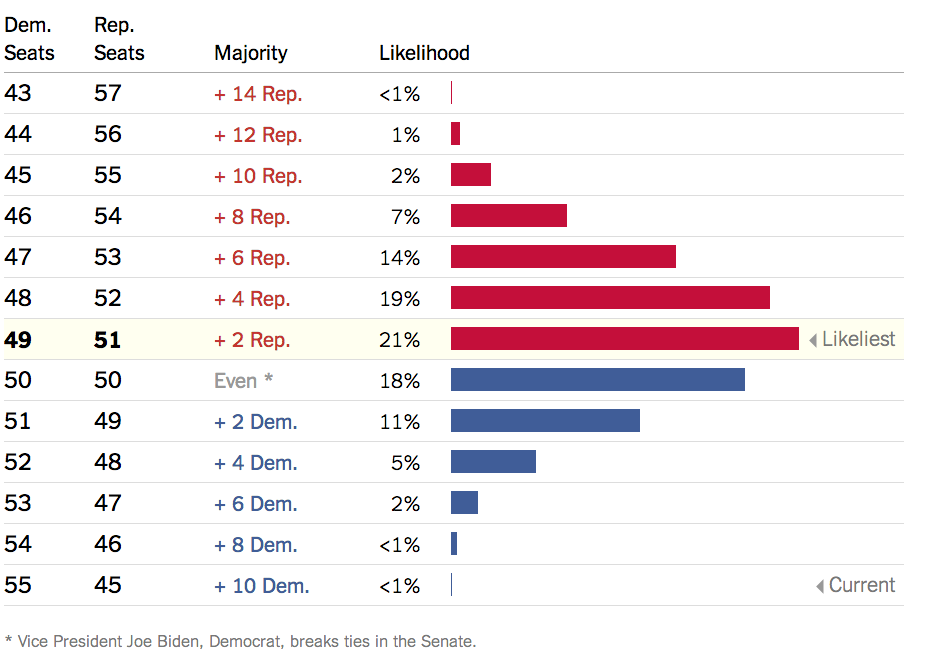
How will the midterms change the balance of power in the Senate? The NYT calculates the odds of various scenarios:
This week McConnell previewed how a Republican Senate would function:
Mitch McConnell has a game plan to confront President Barack Obama with a stark choice next year: Accept bills reining in the administration’s policies or veto them and risk a government shutdown.
In an extensive interview here, the typically reserved McConnell laid out his clearest thinking yet of how he would lead the Senate if Republicans gain control of the chamber. The emerging strategy: Attach riders to spending bills that would limit Obama policies on everything from the environment to health care, consider using an arcane budget tactic to circumvent Democratic filibusters and force the president to “move to the center” if he wants to get any new legislation through Congress.
In short, it’s a recipe for a confrontational end to the Obama presidency.
Beutler doubts his strategy will work:
[W]hat McConnell’s promising makes very little sense. Even if you assume he and the House Speaker can unite their fractious conferences tightly enough to round up majorities for legislation, McConnell would still have a filibuster to contend with. And even if you ignore that obstacle, the political play is a known loser. Republicans controlled both the House and Senate when they shut down the government in 1995, and they lost the fight. Bill Clinton was a bit more popular at the time than Obama is now, but that’s not really what drove the dynamic. It’s just a losing ask to condition basic government services on weakening pollution restrictions or cutting health care spending or whatever. McConnell might be able to extract modest concessions in an appropriations tussle, but nothing big, and nothing along the lines of what conservative members will expect.
Ezra agrees that such tactics would be self-defeating:
McConnell intends to unleash a tactic that will almost inevitably end with shutdowns — whether he wants them or not. This might make sense if Barack Obama were running for reelection in 2016: the shutdown hurt his popularity, too, and perhaps it would make sense for congressional Republicans to mount a kamikaze mission against his third term.
But Obama isn’t up for reelection in 2016. These shutdowns will be a disaster for the Republican Party that will help elect Hillary Clinton — and help Harry Reid retake the Senate. Republicans will end up backing controversial positions with wildly unpopular tactics and the Democrats will take full advantage when they face the friendlier presidential electorate.
While I’m on the subject of making professional online writing sustainable– yesterday, Amanda Hess at Slate took a look back at the first year of Bustle, the controversial women’s site that launched to much derision. That criticism largely stemmed from Bustle’s founder, Bryan Goldberg, and a disastrous announcement he made that made his site sound simultaneously self-important and condescending to its own audience. Internet infamy followed. And yet Hess has found that Goldberg has wooed many of his old critics, and that Bustle has been a massive success in terms of building an audience and securing ad revenue additional capital. To which I say: good, I guess?
Goldberg is a dink. His initial rollout of the site was plainly dopey, although from a troll bait, “any publicity is good publicity” standpoint, kind of genius. I can understand why people would be upset that this guy has become a powerful force in women’s media, and that he’s raking in more money. But I think there was a simple reason to cheer Goldberg’s site even back before he did his apology tour: Bustle pays, and it pays women, and that in and of itself is a kind of victory online.
Hess quotes The Toast’s Mallory Ortberg, who said “On the other hand, women write and work for Bustle, and they get paid, and I’m always in support of that.” As Hess points out in her piece, whatever you think about Goldberg, he’s making it easier for bright young women to break into an industry that can be brutal for workers. Perhaps we’d prefer the head of the site to be more enlightened, or just less doofy, but he’s spending on talent and that matters.
Diversity in media, like diversity in other fields, is one of the problems that can be easiest solved with brute force: when there aren’t enough women writers, you hire more. When their aren’t enough black actors, you hire more. You can throw money at this problem. Chris Hayes found that cable news systematically under-represents people of color, so he went out of the way to correct that by explicitly and unapologetically looking for non-white voices for his own show. I am always confused by those who argue that this somehow diminishes the accomplishment of the people involved; those voices wouldn’t be heard if that effort wasn’t made, we know that there are systemic inequalities that ordinarily exclude those voices, so we fix it with brute force. That’s just a good thing. Same here: Bustle means there’s more work for women writers online, which makes the internet a more diverse, honest place, and that’s worth celebrating in and of itself.
James #Foley's death underlines Western agony of ransom payment in hostage situations u.afp.com/hin http://t.co/X8OgR2COeZ—
Agence France-Presse (@AFP) August 21, 2014
Before deciding to murder captive American journalist James Foley, ISIS had attempted to extort an enormous ransom from the US government in exchange for his release:
Long before the dark bluster behind ISIL’s rationale for killing an American civilian, there had reportedly been a call for a ransom. Philip Balboni, Foley’s boss at GlobalPost, told The Wall Street Journal that the captors demanded 100 million euros in exchange for Foley’s release. The New York Times reported the figure as $100 million USD, and says the captors also added other demands, including an exchange of prisoners being held by the United States. … Balboni also told WCVB, that the family received an email last week — after the U.S. began its bombing campaign against ISIL — indicating that they were going to kill Foley. That email made no demands and was “full of rage,” making no suggestion that he could be spared with a payment.
This revelation has left some people wondering why the administration was willing to trade with the Taliban for Army Sgt. Bowe Bergdahl, but not with ISIS for Foley. Joshua Keating makes the case for why those were the right calls:
As counterterrorism scholar Peter Neumann argued in a 2007 Foreign Affairs article, governments must at times negotiate and even grant concessions to groups it considers to be terrorists. The decision about whether to do so should be made less on the basis of the group’s relative odiousness than on whether such a deal could help stop violence. …
As I argued after the Bergdahl swap, the deal should be seen less in terms of what the U.S. was willing to give up for one soldier than as the Obama administration settling unfinished business before it pulls troops out of Afghanistan and gets out of the business of fighting the Taliban entirely. But a truce, or even a de-escalation of hostility, between the U.S. government and ISIS or any of its former affiliates in al-Qaida is hard to imagine. While the payment of a ransom could secure the release of a prisoner, it can do little beyond that except provide the group with much-needed funding. It would also encourage more kidnappings, both by ISIS and other groups that would be inspired by its example.
Will Saletan agrees that we were right to reject the ransom demand for Foley:
If you pay the ransom, you’re not just fueling the kidnap market. As Slate’s Josh Keating notes, you’re also funding ISIS’s war and its atrocities against civilians. Callimachi found that al-Qaida and its affiliates reaped a minimum of $125 million in ransoms in the last five years, and $66 million just last year. It’s now al-Qaida’s main revenue stream. And the demands won’t end with money. In addition to Sotloff, ISIS reportedly has at least three more American hostages it’s threatening to kill. It also has some Brits. The New York Times says ISIS “has sent a laundry list of demands for the release of the foreigners, starting with money but also prisoner swaps.” Altogether, according to the Committee to Protect Journalists, ISIS and other extremists in Syria have about 20 foreign journalists. I fear for those reporters. I’m horrified by Foley’s death, and I know Sotloff is probably next. But we have to think about the next 20 hostages, and the 20 after that. Every time we ransom a reporter, we put a price tag on the next one.
Adam Taylor explores the practices of European countries that do pay ransoms for civilian hostages, and why those decisions are controversial:
In countries that may pay ransoms, there appear to be mixed feelings about the practice: Last year French President François Hollande told families of hostages being held in Africa’s Sahel region that no more ransoms would be paid, though a few months later there were reports in French media of more money paid out. Germany also has questioned its own payments to terrorists. “We need to ask ourselves whether or not we can live with the fact that the money we are paying in ransom for hostages,” a German government security expert said in a 2007 newspaper interview, “could be used to buy weapons that could kill our soldiers in Afghanistan.” Countries where hostages are taken have sometimes complained about ransoms, too. “Yemen constantly rejects handling the release of kidnapped hostages through the payment of ransoms to kidnappers,” Yemen’s foreign minister, Abu Bakr al-Qirbi, said in an interview with Saudi Arabia’s Asharq al-Aswat newspaper last year. “We do not want this conduct to expose many foreigners in Yemen to abduction as other kidnappers would seek to receive a ransom,” Qirbi explained.
Gary Sick offers his take in an interview with the Wire:
[A] live hostage is actually worth something. A dead hostage is really not worth anything. If they kill the second hostage, which they have suggested that’s what they’re going to do, they just lost the last of their bargaining effort. They have to ask themselves what they’re going to do. … I would say, in a cold-blooded way, that the second hostage’s value has gone up in their eyes unless they think something really significant could come from it. If they kill him and the bombing goes on, they’ve lost it.
Although this is all done with great bravado, I remember my good friend Danny Pearl, he was at the Wall Street Journal and al-Qaeda beheaded and killed him. One man was already hung for that. Another has admitted he carried out the beheading. If he ever comes to trial, he will be sentenced to death. Eventually, and it might be surprising, justice does catch up with these guys, and it is clearly a war crime. Killing an innocent civilian you are holding as a hostage is a war crime, period. If they ever get captured, they will be interrogated and they’re likely to be hanged for it. Now, in battle, they don’t think on it.
Douthat contends that a “cultural consensus” is to thank for the decline in teen pregnancy, because “the idea that we should (and, just as importantly, can) reduce the teen birth rate unites just about every faction in American politics and culture”:
This possibility makes a case for being relatively optimistic that today’s trend will, in fact, persist, and that tomorrow’s teen birth rate could be lower still than today’s. At the same time, it leaves room for pessimism about whether our culture’s success in this area can be easily translated to the broader problem of adult out-of-wedlock births, adult family instability, and the cultural and socioeconomic problems associated with those trends. …
Delaying irresponsibility till adulthood makes it, well, less irresponsible, and not having a kid at 17 by itself suffices, for obvious reasons, to raise your chances of a stable family life, as does every delay thereafter. But to date, in the big picture, the strides we’ve made in reducing teenage pregnancy and births haven’t translated into a reversal of working and middle class family life’s slow disintegration; quite the opposite, in fact. Perhaps that will change; the out-of-wedlock birth rate finally stopped rising in the last couple of years, and it’s possible that the teenage birth rate’s recent decline will start to have major positive follow-on effects as today’s teenagers move through their life cycles. But for now, what’s happened with teen pregnancy is both a real and welcome success and one whose ripple effects have been more limited than we might have hoped.
Readers continue to respond to our thread on the books, poems, and stories that have meant the most to them. One reader sent in the above video of Mary Oliver reading her poem “Wild Geese.” Another wryly appreciates this poem:
This makes me chuckle even when I’m in that emotional black hole called depression. It was also one of my late mother’s favorites. From the irrepressible Dorothy Parker:
Razors pain you;
Rivers are damp;
Acids stain you;
And drugs cause cramp.
Guns aren’t lawful;
Nooses give;
Gas smells awful;
You might as well live.
Another holds close a poem from Jack Gilbert:
The following poem is one that I come back to often for solace during dark times. I studied International Aid in grad school and I think it has given me a good perspective on suffering across the world: on the one hand, there’s more extreme poverty, disease, oppression, general hardship out there than most Westerners ever dream of, and on the other hand, most people across the world find ways to get by and squeeze some joy and meaning out of life anyway, even in the direst of circumstances. This poem reminds me of that.
“A Brief For The Defense” by Jack Gilbert:
Sorrow everywhere. Slaughter everywhere. If babies
are not starving someplace, they are starving
somewhere else. With flies in their nostrils.
But we enjoy our lives because that’s what God wants.
Otherwise the mornings before summer dawn would not
be made so fine. The Bengal tiger would not
be fashioned so miraculously well. The poor women
at the fountain are laughing together between
the suffering they have known and the awfulness
in their future, smiling and laughing while somebody
in the village is very sick. There is laughter
every day in the terrible streets of Calcutta,
and the women laugh in the cages of Bombay.
If we deny our happiness, resist our satisfaction,
we lessen the importance of their deprivation.
We must risk delight. We can do without pleasure,
but not delight. Not enjoyment. We must have
the stubbornness to accept our gladness in the ruthless
furnace of this world. To make injustice the only
measure of our attention is to praise the Devil.
If the locomotive of the Lord runs us down,
we should give thanks that the end had magnitude.
We must admit there will be music despite everything.
We stand at the prow again of a small ship
anchored late at night in the tiny port
looking over to the sleeping island: the waterfront
is three shuttered cafés and one naked light burning.
To hear the faint sound of oars in the silence as a rowboat
comes slowly out and then goes back is truly worth
all the years of sorrow that are to come.
Another reader’s go-to poem:
The poem I find myself returning to over and over is Mark Strand’s “Keeping Things Whole”:
In a field
I am the absence
of field.
This is
always the case.
Wherever I am
I am what is missing.When I walk
I part the air
and always
the air moves in
to fill the spaces
where my body’s been.We all have reasons
for moving.
I move
to keep things whole.It’s no escape in hard times or corrective of melancholy. It’s a companion. A reminder that, while I may be as alone as the poem suggests, I am not the only one.
Another turns to a famous memoir:
I have frequently delved into Ulysses S. Grants Memoirs, as they are triumph over adversity. Written nearing the end of his life, whilst being poor and suffering from incurable throat cancer, the book is a testament to a human’s ability to endure. He went from being ill-educated shop keeper to a masterful commander, and then to President.
Facing financial ruin, compelled by Mark Twain, he wrote a magisterial memoir to secure his family financial future. Sitting on his porch, writing away, being unable speak and to produce a piece that is both lucid and concise, that a young man (myself), nearly one hundred and thirty years later could read it and draw inspiration, at times of personal hardship, is nothing short than remarkable.
Another reader writes:
John Steinbeck once wrote, “It’s almost impossible to read a fine thing without wanting to do a fine thing.” I’d add that a book’s value is no less if you fail to act on the impulse. Like you, I continue to seek solace in literature. It eases loneliness and alienation and allows me to carve out what amounts to an alternative dimension free of market dictates and a soul-killing public discourse.
Twenty years after I first read the books, I still find great comfort in [Hemingway’s] Nick Adams’ stories and McCarthy’s Border Trilogy and their wholly estranged characters. I find that literature is my one true escape from a life of quiet desperation. Most of us cannot express our innermost feelings in the office or even to our loved ones—either people don’t want to hear it or you don’t want to depress them. Thus we struggle on, constantly fighting the sense that we’re alone in this fight. Literature lets us know that we’re sane after all.
Now in my mid 40s, living in Asia, with no western friends or colleagues, literature has taken on an even more profound role, standing in for an entire culture that I’ve consciously separated myself from. Billy Parham, Silas Marner, Thomas Fowler—they may not be real men, but I find them essential to my understanding of the world and my capacity to withstand it.
Another:
My absolute favorite since age 12 (I’m now 57) has been The Lord of the Rings. I can’t narrow it down to any favorite passages because they’re all favorites. Part of it certainly has something to do with the many years over which I’ve read and reread the book (it’s just one book, not a trilogy, regardless of how it was published). I can still recall the delight with which I read the first words “When Mr. Bilbo Baggins . . .” in the summer of 1969. I certainly don’t remember anything else I read that long ago with the same fervor, unless it was The Hobbit which I read a few months before LOTR.
But Tolkien’s masterpiece has more to offer than just long term familiarity. Beauty of language, certainly, but even more important are the emotions. I still tear up when I read the cheers in various tongues for Frodo and Sam after they awaken from their long ordeal at the Field of Cormallen, and again when Frodo boards that ship at the Grey Havens. When Treebeard first speaks to Merry and Pippin I’m always just as amazed as they are. I laugh every time Gandalf catches Sam eavesdropping, and when Tom Bombadil first comes singing through the Old Forest, and when Bilbo disappears with a flash at the Farewell Party. It’s just a magnificent experience every time I read it.
Another reader shares a personal story:
Your post concerning readers’ favorite passages triggered an obvious choice for me. I am bipolar, and in times of acute depression I have reached for this one snatch of translated prose more times than I can recount. Something about it feels primal; by turns I hear a howl or a whisper, but somehow always a prayer. To this day, it delivers a visceral punch. In any case, since I first encountered it eons ago in the marginalia of a high school history textbook, it has been like a worry stone in my pocket, there for me when my unquiet mind is groping for some purchase.
“Elpis (Hope) is the only good god remaining among mankind; the others have left and gone to Olympus. Pistis (Trust), a mighty god has gone, Sophrosyne (Restraint) has gone from men, and the Kharites, my friend, have abandoned the earth. Men’s judicial oaths are no longer to be trusted, nor does anyone revere the immortal gods; the race of pious men has perished and men no longer recognize the rules of conduct or acts of piety. But as long as man lives and sees the light of the sun, let him show piety to the gods and count on Elpis. Let him pray to the gods and burn splendid thigh bones, sacrificing to Elpis first and last.”
This reader celebrates a favorite poet:
I wrote my PhD dissertation on Adrienne Rich and still find her poetry coming back to me when contemplating memory, loss, and grappling with inequality and injustice in the world. Been a good summer for that. She is at the same time a brilliant nature poet and evokes beauty in language and landscapes.
Here is an except from the final section of “An Atlas of the Difficult World,” the title poem of her 1990 volume. The poem surveys a variety of American people and places, coming back to Rich’s sense of obligation to work with “the materials” of life, however difficult or wretched. Lots of echoes of Whitman here and throughout:
I know you are reading this poem
late, before leaving your office
of the one intense yellow lamp-spot and the darkening window
in the lassitude of a building faded to quiet
long after rush-hour. I know you are reading this poem
standing up in a bookstore far from the ocean
on a grey day of early spring, faint flakes driven
across the plains’ enormous spaces around you.
…I know you are reading this poem which is not in your language
guessing at some words while others keep you reading
and I want to know which words they are.
I know you are reading this poem listening for something, torn between bitterness and hope
turning back once again to the task you cannot refuse.
I know you are reading this poem because there is nothing left to read
there where you have landed, stripped as you are.More on Rich from my tribute to her after her death in 2012, plus a photo of me in a Dr. J jersey holding up a stethoscope to one of her books.
Another reader offers two favorites:
I’d have to start with Dragondoom by Dennis McKiernan – how could someone not be stirred by the lines of a song: “Would you fight to the death, for that which you love? In a cause surely hopeless, for that which you love?” This is high fantasy in the Tolkien style, but unique and wondrous in its own right.
Carl Sagan’s Pale Blue Dot has done it for a lot of people I’m sure, but I’m hopeful some leader has thought twice when they read this,”Think of the rivers of blood spilled by all those generals and emperors so that in glory and in triumph they could become the ‘Momentary’ masters of a ‘Fraction’ of a ‘Dot’.” Or at least some 18-year old reading this like I did so long ago when his dad died took some solace in the infinite wonders of the universe and the beauty that everything has as Sagan described ice volcanoes and hurricanes many times the size of Earth on other planets.
Can’t wait to build my library with a bunch of the suggestions from other readers.
This reader notes a poem that’s made him a better man:
I have read and re-read this poem so many times, and yet, even as I read it now, I feel like I might start crying. I am a man and try hard, really hard, to be the kind of feminist that would make my girlfriend proud. I fail all the time. But, I know it is this this poem that convinced me that I must keep trying. The last line gives me goosebumps.
“What’s That Smell in the Kitchen?” by Marge Piercy:
All over America women are burning dinners.
It’s lambchops in Peoria: it’s haddock
in Providence; it’s steak in Chicago:
tofu delight in Big Sur; red rice and beans in Dallas.
All over America women are burning food they’re supposed to bring with calico smile on
platters glittering like wax.
Anger sputters in her brainpan, confined but spewing out missiles of hot fat.
Carbonized despair presses like a clinker
from a barbecue against the back of her eyes.
If she wants to grill anything, it’s
her husband spitted over a slow fire.
If she wants to serve him anything it’s a dead rat with a bomb in its belly ticking like the
heart of an insomniac.
Her life is cooked and digested,
nothing but leftovers in Tupperware.
Look, she says, once I was roast duck
on your platter with parsley but now I am Spam.
Burning dinner is not incompetence but war.
Another reader turns to a classic from T.S. Eliot:
I am probably older than most of the Dish’s readers (71), but the poem that struck me in 1962 when I was a nineteen-year old freshman in college was Eliot’s “The Love Song of J. Alfred Prufrock.” Like a patient etherized upon a table? Never had I read a line so real and shocking in the poems I had devoured in my high school textbooks. I shivered with the discovery of something totally new … the sentiments, the images, the mesmerizing rhythms. It felt to me so wonderfully sophisticated to empathize with a world-weariness I was beginning to experience not so much as fact as aspiration and to aspire at the same time to a social class I did not belong to. I still read it with pleasure, with a frisson of ironic recognition that “I grow old … I grow old … I shall wear the bottom of my trousers rolled.” Which on occasion I do. I read the poem with excited admiration in my youth; now I read it with a smile and love it all the more in the bittersweet glow of nostalgia.
Another reader:
Gilead has been sitting unread in my to-read pile for years. I adored Robinson’s novel Housekeeping, and there is a page-long paragraph that shifts back and forth in time that still takes my breath away.
“Where he was, was still. Somewhere else, wind whined.”
But the book that has been my companion since I first read it in high school is Samuel Delany’s Dhalgren. Starting to recognize my homosexuality in an upper-middle-class, very white suburb where the illusion of unfailing heterosexual monogamy was carefully cultivated and maintained as the only possible reality for ordering your life, the comfortable bisexuality of Delany’s unnamed narrator, the models he presented of unwed casual but caring relationships, and the racial and cultural diversity he deployed across the landscape of Bellona realigned my mental world: Somewhere there was a place for me, even if not in this suburb scrubbed to monochrome brightness.
But as It tried to weave among systems of thought and ideologies all trying to claim me, all trying to convince me of their foundational reality, and all incongruous with one another, and none of them feeling real or authentic to me, I was drawn repeatedly to the denouement of a story the character Lanya, and it would help me keep skipping lightly and never settling:
“But I realized something. About art. And psychiatry. They’re both self-perpetuating systems. Like religion. All three of them promise you a sense of inner worth and meaning, and spend a lot of time telling you about the suffering you have to go through to achieve it. As soon as you get a problem in any one of them, the solution it gives is always to go deeper into the same system. They’re all in rather uneasy truce with one another in what’s actually a mortal battle. Like all self-reinforcing systems. At best, each is trying to encompass the other two and define them as sub-groups. You know: religion and art are both forms of madness and madness is the realm of psychiatry. Or, art is the study and praise of man and man’s ideals, so therefore a religious experience just becomes a brutalized aesthetic response and psychiatry is just another tool for the artist to observe man and render his portraits more accurately. And the religious attitude I guess is that the other two are only useful as long as they promote the good life. At worst, they all try to destroy one another. Which is what my psychiatrist, whether he knew it or not, was trying, quite effectively, to do to my painting. I gave up psychiatry too, pretty soon. I just didn’t want to get all wound up in any systems at all.”
And, finally, Virginia Woolf makes her first appearance in our thread:
I recently discovered Virginia Woolf’s To the Lighthouse. Because of this novel, more specifically because of the quoted passage below, I purchased a fancy leather-bound notebook that I try to carry with me while I’m reading so I can write down great quotes. The act of physically picking up a pen and writing down these words has been a wonderful experience for me as a reader. It has forced me to slow down and ponder what it is about what I’ve chosen to transcribe that grabbed my attention. Over time, I’ve come to realize that this notebook says a lot about not just what I read but what I find interesting, funny, insightful, beautiful, maddening. It says a lot about who I am. I don’t know if I’ll ever have it in me to write a story of my own, but I feel that this little notebook (and hopefully future notebooks if I live long enough to fill this one up) will in some strange way tell my story.
In this passage, our protagonist, Mrs. Ramsay, begins to come to terms with her sense that a friend of the family, an opium-using poet whom she generously allows to stay at her house every summer, doesn’t seem trust her:
“It injured her that he should shrink. It hurt her. And yet not cleanly, not rightly. That was what she minded… the sense she had now when Mr Carmichael shuffled past, just nodding to her question, with a book beneath his arm, in his yellow slippers, that she was suspected; and that all this desire of hers to give, to help, was vanity. For her own self-satisfaction was it that she wished so instinctively to help, to give, that people might say of her, ‘O Mrs Ramsay! dear Mrs Ramsay … Mrs Ramsay, of course!’ and need her and send for her and admire her? Was it not secretly this that she wanted, and therefore when Mr Carmichael shrank away from her, as he did at this moment, making off to some corner where he did acrostics endlessly, she did not feel merely snubbed back in her instinct, but made aware of the pettiness of some part of her, and of human relations, how flawed they are, how despicable, how self-seeking, at their best.”
 The Dish