Grand Jury, Limited Justice?

by Dish Staff

Darren Wilson, the police officer who shot and killed Michael Brown, may be facing a grand jury. Jonathan Cohn explains:

Here’s how the process will work, according to criminal law experts based or practicing in Missouri. The grand jury, which consists of twelve people plucked from the local population, will sit around a table in a deliberation room somewhere in the county courthouse building. It’s the prosecutor’s show: He will present the case, starting with an overview and then bringing forward evidence. But it’s not like a trial. There will be no attorney for the other side, no judge, not even a bailiff. For most of the time, they will be alone except for the prosecutor and, on occasion, a witness who will be providing testimony.

The idea behind a grand jury is that it serves as the people’s voicein effect, a democratic check on the enormous power of prosecutors to bring charges and force people into trials. A grand jury can be a truly deliberative body if it wants. Members can ask for witnesses to appear and testifyand ask those witnesses questions directly. Grand juries can also control their proceedings, deciding how much evidence to hear and when, finally, to vote on charges. In Missouri, it takes at least nine jurors to deliver an indictment, which is known as a “true bill.” Any less and the jury reaches a verdict of “no true bill,” which means no indictments.

Amanda Taub interviews former federal prosecutor Alex Little on what a grand jury will mean for this case:

The only question the grand jury must answer is whether there is probable cause to believe a crime has occurred. That’s a very low standard, and it’s almost always met when the District Attorney seeks charges.

“So when a District Attorney says, in effect, ‘we’ll present the evidence and let the grand jury decide,”‘that’s malarkey. If he takes that approach, then he’s already decided to abdicate his role in the process as an advocate for justice. At that point, there’s no longer a prosecutor in the room guiding the grand jurors, and — more importantly — no state official acting on behalf of the victim, Michael Brown.

“Then, when you add to the mix that minorities are notoriously underrepresented on grand juries, you have the potential for nullification — of a grand jury declining to bring charges even when there is sufficient probable cause. That’s the real danger to this approach.”

Joe Coscarelli points out that the same procedure is taking place in the case of Eric Garner’s killing:

In Staten Island, District Attorney Daniel Donovan said in a statement, “I have determined that it is appropriate to present evidence regarding the circumstances of [Eric Garner’s] death to a Richmond County Grand Jury. Yesterday, the Court granted my application for the impaneling of an additional Grand Jury and I intend to utilize that Grand Jury sometime next month to begin presenting evidence on this matter.” In what the medical examiner ruled a homicide, Garner died after being put in what appeared to be an illegal NYPD chokehold during an arrest for selling loose cigarettes.

The move to a grand jury comes after a “careful” review of the evidence, Donovan said.

Angela J.Davis argues we should look beyond just the cops in Ferguson:

Bob McCulloch is the prosecutor for St. Louis County and has held the position for 23 years. McCulloch has stated that he will present the evidence of Michael Brown’s killing to a grand jury, but members of the African-American community have expressed concern about his ability to be fair. There is always such a concern in cases involving the investigation of police officers. Police officers don’t technically work for prosecutors, but they are definitely part of the prosecution team. They investigate the cases, gather the evidence, and testify as witnesses for the state. Without police officers, prosecutors can’t bring cases or secure convictions. So prosecutors have an inherent conflict of interest when they are considering charges against police officers.

The conflict seems particularly deep-seated in this case. Bob McCulloch’s father was a police officer who was killed in the line of duty when McCulloch was a child. And McCulloch was very critical of Missouri Governor Jay Nixon’s decision to place the Missouri State Troopers in charge of security after complaints about the St. Louis police department’s violent attacks on peaceful protestors and journalists. McCulloch called the governor’s decision “shameful” and accused him of “denigrat[ing] the men and women of the county police department.”

Chris Geidner expects lawsuits all around:

“There will be lawsuits up the kazoo,” said Barbara Arnwine, the longtime president and executive director of the Lawyers’ Committee for Civil Rights Under Law, in an interview Sunday evening. “I think you’re going to see ripple after ripple of legal matters here in response to this outrageous situation.”

The first matter will be the potential criminal and civil actions related to Brown’s death. But legal experts also predict possible litigation stemming from the actions taken by police in Ferguson, lawsuits brought by store owners against the police related to looting, and even the imposition of a curfew.

Fark Self-Censorship

by Dish Staff

Amanda Hess has limited expectations for a new misogyny ban at Fark:

Policing misogyny is fabulous in theory. In practice, it’s a bitch. [Drew] Curtis notes that Fark’s commenters often appear to be engaging in an extreme “parody” of sexism, using a pastiche of satirical cultural references. (Fark contributors favor the SNL line “Jane, you ignorant slut” and callbacks to Blazing Saddles’ rape jokes.) Where is the line between pointed social commentary and vile misogyny? “On SNL and in a comedy movie … the context is clear,” Curtis continues. “On the Internet, it’s impossible to know the difference between a person with hateful views and a person lampooning hateful views to make a point. The [moderators] try to be reasonable, and context often matters. We will try and determine what you meant, but that’s not always a pass.” He added: “I recommend that when encountering grey areas, instead of trying to figure out where the actual line is, the best strategy would be to stay out of the grey area entirely.”

Telling members of an anonymous Internet message board to stop hating women is, unfortunately, a monumental ask. But instructing posters to refrain from pushing the boundaries of acceptable human discourse—to avoid a “grey area” just in case—is an irresistible provocation. The gray area between vile offensiveness and dark humor is where Fark’s commenter community thrives.

Jason Koebler is more optimistic:

“oderating speech online is tricky, and there’s the whole “slippery slope” argument to be made about censorship. Let’s be clear here: privately owned websites are obviously not required to respect the First Amendment, but there’s a mandate on the internet that anything and everything goes that there’s this de facto assumption that you should be able to say whatever you want, anywhere on the internet.

But Fark’s move is more likely to actually facilitate truly free speech, rather than restrict it. And it’s a sign that women’s rights are thankfully and finally being taken a bit more seriously of late (take a look at what Gawker finally did over at Jezebel last week for another example).

Jessica Roy, meanwhile, responds to some of the backlash the ban has received:

It’s hard to imagine Fark’s community will suffer from the banning of easy rape jokes — if anything, it will make the community a safer space for women and might even elevate the quality of humor. And don’t worry, if you’re desperate to discuss how women who dress slutty deserve to be raped, there’s always r/mensrights.

The Slums Of The Future

by Dish Staff

Prachi Vidwans explains why we should worry about them:

If it seems like conflict over slums is mounting, that’s because it is: The urbanization of the world is accelerating. In 1950, just 29 percent of the world’s population lived in cities; back then, that was roughly 742 million people. Today, more than half of the world’s people — more than 3.5 billion — are citydwellers. That may sound like a dramatic shift, but you ain’t seen nothing yet. Roughly 70 million people move into cities every year, and the vast majority of them usually end up in illegal or informal urban settlements. According to U.N. estimates, by 2050, a third of the world’s population will live not just in cities, but in slums.

The growth of slums is a bit like climate change: We know it’s happening. We know it’s important. But no one, so far, seems to have much of a response. Policymakers tend to view slums as a necessary evil, a problem best contained through coercion or ad hoc responses. Experts point out, however, that there is a rational way to deal with the coming surge of urbanization: Plan for it. If cities are prepared to anticipate and acknowledge the inevitable influx of urban migrants, slums might not be slums.

What’s The Matter With St. Louis?

by Dish Staff

St Louis

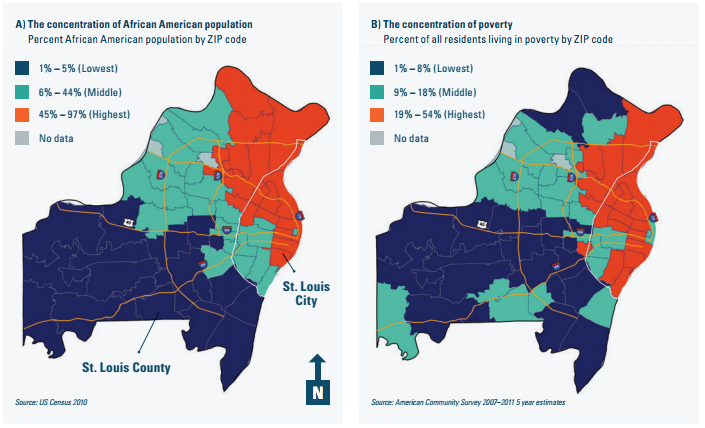
Yglesias digs up an illuminating set of maps:

In May of 2014, researchers from Washington University in St Louis and St Louis University put together a long report on racial health disparities in the St Louis area. It’s largely a deep dive into the socioeconomic roots of these disparities, and includes this map highlighting the pattern of segregation by race and income levels in both the City and County of St Louis. On the left is the distribution of the African American population in the city and county, and on the right is the distribution of poverty

Philip Bump examines the racial disparities in St. Louis:

The unemployment and poverty rates for blacks in St. Louis County are consistently higher than those rates for white residents. Only one time between 2007 and 2012 has the poverty rate for blacks been less than three times that of whites, according to Census data (which is only available through the latter year). The unemployment rate is two-to-three times higher, and, as of 2012, had grown worse while it grew better for whites.

What’s more, those figures disproportionately affect younger residents. [St. Louis Post-Dispatch columnist David] Nicklaus pulls out a subset of Census data: “47 percent of the metro area’s African-American men between ages 16 and 24 are unemployed. The comparable figure for young white men is 16 percent.”

Jamelle Bouie expects tensions in the St. Louis area to continue for some time:

A 2012 report from University of Missouri–St. Louis criminologist David Klinger found that, from 2008 to 2011, St. Louis police officers fired their weapons 98 times. “Any comparison across cities right now is still missing the lion’s share of circumstances in which people are shot by the police,” Klinger said to the St. Louis Post-Dispatch. “There are only a smattering of cities that report their officer-involved shootings, and when compared against them, St. Louis is on the high end.” The data on police violence is incomplete, as there is no federal effort to pull together information on unjustified homicides. But the anecdotes of brutality and excessive force out of St. Louis  and St. Louis County are rampant and often startling. In 2009, for example, a man was wrongly arrested, beaten by police, and subsequently charged for bleeding on their uniforms.

This abuse is so ubiquitous that the shooting of Michael Brown might seem like static against a backdrop of awfulness. But even for the area, Brown’s death was brutal. Which is why—in an otherwise quiet town in an otherwise quiet area—we’re dealing with an explosive fire that shows no signs of ending.

Perfectionist Parenting

by Dish Staff

Jesse Singal flags new sociological findings about the pressure on mothers and fathers to be “super-parent[s]”:

It’s almost as though when you tell parents that they need to be able to perfectly juggle work and child-rearing, but don’t give them the assistance basically every other rich developed country does, this leads to mental-health issues. Almost.

Jessica Grose concurs:

Of course, this is a very small study, and we can’t draw any sweeping conclusions from it. It doesn’t mean that these women would not be depressed if they breast-fed easily or if they had ample maternity leaves or if they had better family support. But certainly these things are not helping them feel like their best selves. I am a broken record these days in my exhortations to lay off judging new moms and to give them some goddamn maternity leave. So I’m glad that [Carrie] Wendel-Hummell did this study, and that we hear more and more voices of new moms who are struggling. The louder we are, the likelier we are to see some actual cultural and political change.

Public Assistance Isn’t “Free Money”

by Jonah Shepp

Darlena Cunha, a mother of twins who spent 18 months on the WIC program (while working full time and paying taxes), brings some personal perspective to bear on why drug testing welfare recipients amounts to utter overkill in a welfare system that already assumes all applicants are lying:

It’s also not just a phone call and done. Women applying must be pregnant or up to six months post-partum. Children can receive services Drug Screenup to their fifth birthday, according to the United States Department of Agriculture’s Food and Nutrition Services. Once you’ve called, you have to provide proof of income for everyone in the household, proof of identity, proof of residence, proof of participation in any other program—including Medicaid, Supplemental Nutrition Assistance Program, Temporary Assistance for Needy Families, or General Assistance—immunization records for your children, pregnancy confirmation (official note from your doctor), recent height and weight measurements and a blood test for hemoglobin levels, and a WIC Referral Form from your doctor. You also have to provide documentation of any child support payments, unemployment benefits, or short-term disability money received. These requirements vary slightly from state to state, but for the most part they are consistent. …

Applying and being accepted for aid is a mentally grueling process that can stretch on for months. Add to that the humiliation of having to pee in a cup just because you can’t afford to eat.

I’ve touched on this before (and garnered some angry e-mails from readers for suggesting that Paul Ryan was on to something about how demoralizing it can be to live on welfare), but I’m always glad to see someone speak on this from a personal perspective, given how few such stories make their way into the public consciousness. I grew up on welfare in New York City in the 80s and 90s with an alcoholic single mother, so my experience in the system is very different from Cunha’s, yet I agree abundantly with the main thrust of her argument, which cannot be stressed enough: welfare is not exactly designed to make recipients feel good about themselves.

Conservative critics of the welfare state tend to denigrate it as easy money for doing nothing, and often imply or claim outright that poor people feel no shame in taking it because they (I should say, “we”) have no conception of the moral value of labor or feel that we are “entitled” to our food stamps and Obama Phones. That may be true of some poor Americans (Indeed, I have at least one or two family members who fit that description), but it’s not at all representative of those who receive public assistance. The welfare system is badly in need of fixing, not primarily because it’s too expensive but rather because it doesn’t do enough to help ameliorate entrenched poverty. Reform conservatives have some decent ideas about how to do that, but as long as this caricature of the poor is the starting point for their critique of the welfare state, they shouldn’t be surprised if they have a hard time finding an audience.

People tend to take it personally when you call them freeloaders and layabouts. Who knew?

(Photo by Francis Storr)

Excessive Financial Force

by Dish Staff

Sarah Stillman spotlights the economics of police militarization:

[T]he economic arm of police militarization is often far less visible, and offender-funded justice is part of this sub-arsenal. The fears that [Jelani] Cobb and [Malik] Ahmed describe—court debts that lead to warrants and people who are afraid to leave their homes as a result—compound the force that can be wielded during raids or protests like those on the streets of Missouri. Debtors’ fears change their daily lives—can they go to the grocery story or drive a child to school without being detained? “It deters people who have legitimate problems from calling the police, and removes the police’s ability to do what they’re supposed to be doing—helping people in the community respond to emergencies,” [Equal Justice Under Law cofounder Alec] Karakatsanis said. It erodes the community’s trust in and coöperation with law enforcement.

Court fees are Ferguson’s second biggest source of municipal revenue. Thomas Harvey, whose “group represents low-income residents of St. Louis County in municipal court proceedings,” illustrates what this means for individuals:

We had one woman who was pulled over and charged with driving with a suspended license, failure to register and no proof of insurance. She was ticketed and assessed fines of $1,700. She couldn’t pay that; she’s a mother of three living in Section 8 housing. She didn’t go to court, a warrant was issued for her failure to appear and a few months later she got into a car accident that wasn’t her fault.

They saw that she had a warrant, and held her for two weeks and then took her in front of a judge. She told them I can’t pay this money, so they reduced it to $700. For her, that might as well have been $700,000. What ended up happening was her mom borrowed against her life insurance policy and her sister gave her half her bi-weekly paycheck. That was two weeks in jail for unpaid traffic tickets. And what the court learned from that, is that, if they send people to jail, they’ll probably make money.

The Adaptable ISIS

by Dish Staff

While US airstrikes and advances by Kurdish forces have begun to reverse the gains ISIS has made in recent weeks, Joshua Keating doubts the group will be easily defeated:

Over the past few months, the group has shown remarkable flexibility in both its tactics and its targets, one of its key advantages over the national governments trying to stamp it out. If its progress against Baghdad stalls, it can turn against Erbil. If it suffers a setback in Iraq, it can simply focus its efforts on Syria (or Lebanon), where the dynamics of the ground as well as the international alliances work completely differently. If U.S. airstrikes turn the tide against it on the battlefield, it can turn back to urban warfare or suicide bombings.

In other words, a group like ISIS is perfectly positioned to exploit the hazy national boundaries, sectarian divisions, and mistrust among governments in the region where it operates. Given that those factors don’t seem to be going away anytime soon, my guess is that the Islamic State will find a way to regroup. British Prime Minister David Cameron is probably right to be warning the public of a long fight to come.

Yochi Dreazen warns that ISIS is also getting better at governing the territory it controls:

U.S. intelligence officials say the leaders of the Islamic State are adopting methods first pioneered by Hezbollah, the Lebanon-based Shiite militia, and are devoting considerable human and financial resources toward keeping essential services like electricity, water, and sewage functioning in their territory. In some areas, they even operate post offices. …

Taken together, the moves highlight the fact that the Islamic State, already the best-armed and best-funded terror group in the world, is quickly adapting to the challenges of ruling and governing. That, in turn, dramatically reduces the chances that the extremists will face homegrown opposition in what amounts to the world’s newest territory.

Accordingly, Faysal Itani argues that the key to defeating ISIS is to treat it like the state it claims to be:

Above all, ISIS wants to control territory and borders. Otherwise it is just one militia among many others in Syria and Iraq. This requires fighting on multiple fronts against multiple enemies, within both Syria and Iraq. That means openly moving fighters, arms and equipment across vast desert areas. Therefore, like any conventional army, ISIS is prone to overstretch. These increasingly lengthy lines of communication are prime targets for ground and air attacks that would destroy ISIS’ territorial integrity and fighting capability. …

But ISIS is adaptive, creative and ambitious. By contrast, the international community’s response has been rigid, predictable and unimaginative. If it continues to see and treat ISIS as simply a terrorist group, the international community will forever be playing defense, which ISIS can happily live with, until it no longer has to and can go on the offensive abroad. Unless its rivals understand and treat ISIS as a state, and exploit the vulnerabilities statehood presents, ISIS will continue to outclass them in ambition and sophistication, and it will have its state.