Why Are American Police Trigger-Happy?

by Dish Staff

The Economist blames Americans’ easy access to guns:

Last year, in total, British police officers actually fired their weapons three times. The number of people fatally shot was zero. In 2012 the figure was just one. Even after adjusting for the smaller size of Britain’s population, British citizens are around 100 times less likely to be shot by a police officer than Americans. Between 2010 and 2014 the police force of one small American city, Albuquerque in New Mexico, shot and killed 23 civilians; seven times more than the number of Brits killed by all of England and Wales’s 43 forces during the same period.

The explanation for this gap is simple. In Britain, guns are rare. Only specialist firearms officers carry them; and criminals rarely have access to them. The last time a British police officer was killed by a firearm on duty was in 2012, in a brutal case in Manchester. … In America, by contrast, it is hardly surprising that cops resort to their weapons more frequently. In 2013, 30 cops were shot and killed—just a fraction of the 9,000 or so murders using guns that happen each year. Add to that a hyper-militarised police culture and a deep history of racial strife and you have the reason why so many civilians are shot by police officers.

What A (Hemingway) Man Wants

by Dish Staff

TNR recently pulled this review by Max Eastman of Hemingway’s Death in the Afternoon by from their archives, which purportedly causes Hemingway to track Eastman down in his New York City office and show him just what was under shirt. You can see why:

Why then does our iron advocate of straight talk about what things are, our full-sized man, our ferocious realist, go blind and wrap himself up in clouds of juvenile romanticism the moment he crosses the border on his way to a Spanish bullfight? It is of course a commonplace that Hemingway lacks the serene confidence that he is a full-sized man. Most of us too delicately organized babies who grow up to be artists suffer at times from that small inward doubt. But some circumstance seems to have laid upon Hemingway a continual sense of the obligation to put forth evidences of red-blooded masculinity. It must be made obvious not only in the swing of the big shoulders and the clothes he puts on, but in the stride of his prose style and the emotions he permits to come to the surface there. This trait of his character has been strong enough to form the nucleus of a new flavor in English literature, and it has moreover begotten a veritable school of fiction-writersa literary style, you might say, of wearing false hair on the chestbut, nevertheless, I think it is inadequate to explain the ecstatic adulation with which Hemingway approaches everything connected with the killing of bulls in the bull ring.

Reviewing The Letters of Ernest Hemingway, Volume 2: 1923-25, Edward Mendelson offers related insights into Papa’s psyche:

What makes the book revelatory is not its biographical detail but the spacious view it gives of Hemingway’s mind at work in his long, eager, and unguarded letters to boyhood friends. For the past fifty years, ever since his embittered older sister Marcelline reported that their mother had dressed the young Hemingway as a girl and had tried to raise the two of them as twins, and ever since his posthumous novel The Garden of Eden (1986) revealed his androgynous fantasies, the conventional reading of Hemingway explained him away as the product of sexual confusion and category-crossing. This turns out to be as simplifying and crude as the he-man image it supplanted. These letters make clear that both the he-man and the androgynous fantasist were surface expressions of a deeper wish that shaped Hemingway’s life and work, a driving impulse that ultimately had nothing to do with sex.

The wish, Mendelson argues, has to do with the breakdown of heroic male code the young Hemingway upheld, which included belonging to a band of brothers – but which failed as he became an adult, at which point he fantasized that “he could merge instead with a lover”:

Everyone quotes the most obvious examples. A Farewell to Arms: “There isn’t any me. I’m you.” “We’re the same one.” “I want us to be all mixed up.” For Whom the Bell Tolls: “I am thee also now…. You are me now.” “I am thee and thou art me and all of one is the other…. I would have us exactly the same.” The Garden of Eden: “Now you can’t tell who is who can you?” (this after the woman enters the man with her hand). Everyone interprets these as gender-crossing, but they express the same wish for dissolution that recurs throughout Hemingway’s letters to his band of brothers, where, in one enthusiastic paragraph after another, he refers to each of them with the single phrase “a male.”

What Hemingway wanted—both as he-man and as androgyne—was a lasting intimate connection that did not require him to be a separate individual person—something no one can have. Virginia Woolf, in a review that infuriated him, perceived the price he paid for his wish. Hemingway’s characters, she said, are like people overheard in a restaurant talking in rapid slang, “because slang is the speech of the herd.” Those who speak it are “seemingly much at their ease, and yet if we look at them a little from the shadow not at their ease at all, and, indeed, terribly afraid of being themselves.”

Israel Has Been Singled Out by Israel’s Defenders, Ctd

by Freddie deBoer

A reader shares some very typical sentiments in a criticism of my piece yesterday on the “why do you single Israel out?” narrative:

I’m  a Jewish American who is not at all afraid to criticize Israel, particularly with respect to its settlements in the West Bank.  As I mention to friends whenever Israel is being discussed, there are plenty of Israelis who completely disagree with the Netanyahu administration and many current policies of the Israeli government, so no reason we in the U.S. can’t do the same.

That said, deBoer’s argument is wanting on several fronts, two of which I will address here because they are the most egregious, and interrelated in many ways.  First, deBoer makes no mention whatsoever of anything that Hamas may have done to provoke the recent violence, as if the entire situation is 100% the fault of Israel.  I sometimes disagree with Andrew about Israel, but I respect his opinion and am open to be persuaded by his arguments because he always makes clear that he condemns what Hamas (or others) have done, and explains that he understands the larger historical context that Israel (and Jews) operate under, even if he disagrees with their conclusions.  I see no similar effort by deBoer, and if the effort is to persuade someone with his writing, it causes me to completely tune him out, because he gives the impression that he only sees this conflict from one perspective, i.e., Israel=bad/evil, Hamas=oppressed/innocent.

This is a very common rhetorical ploy: why do you not mention Hamas’s problems when you mention Israel’s? Well, first, that’s the very argument of my post: that we bear responsibility for Israel’s actions because we enable them to a degree that is completely unprecedented in American history, and so we are responsible for them. That simply is not true of Hamas. Not remotely. Second, the idea that we should always take pains to achieve balance in our criticism of Israel– a kind of “one for you, and one for me,” reciprocal approach”– is fundamentally misguided, because it misrepresents the reality of official support for Israel and for Hamas. Support for Israel is as close to unanimous in national American politics as you can get, despite the fact that public polling shows a great deal of criticism from America’s people. Essentially all of our legislature and our executive will support Israel’s actions literally without exception. In this recent conflict, the vast majority of those killed have been civilians, by absolutely anyone’s reckoning, including within the Israel media. Hundreds of children have been killed. That has not changed the elite political consensus one iota. Meanwhile, the number of American politicians who support Hamas is exactly zero. Such a person does not exist in our Congress. So who exactly am I supposed to be scolding for supporting Hamas? Why would I bother to criticize the side that has no establishment political support whatsoever, when the other side has slaughtered hundreds of children and lost no face with America’s political class? This emailer is operating under a broken understanding of political responsibility:

Second, I understand deBoer’s point about people here in the U.S. being able to single out Israel for criticism because of how much moral and financial support the U.S. provides to Israel, but his complete dismissal of any possibility of anti-Semitism is simply naive and, again, makes me question his entire perspective.  Does he not see the news about supposed anti-Israel rallies in Europe turning into pogroms against synagogues and Jews there?  Modern Orthodox friends of mine traveling to Europe this summer, even the UK, wear hats in public so they don’t invoke the ire of residents there.  Is there no anti-Semitism in this lashing out at Jews who have no direct connection to Israel?  deBoer completely dismisses the notion that there could possibly be anti-Semitism behind at least some of the criticism lobbed at Israel.  Again, this is in contrast with Andrew, because he always acknowledges the reality of anti-Semitism, particularly in Europe where it should be particularly concerning for anyone with a modicum of knowledge of history, both recent and ancient, to see graffiti and violence condemning Jews.

The reasoning is again the same: the political establishment of my country, which is my responsibility, is entirely opposed to anti-Semitism. I don’t doubt that there is hatred of Jews lurking around out there, but there is no one– literally no public figure of any importance whatsoever, whether politician or celebrity– who would ever publicly express anti-Semitic remarks, unless they’re interested in committing reputation suicide. If they did, they would be rightfully cast out and reviled. Meanwhile, hatred of Muslims and Arabs generally, and Palestinians specifically, is an absolutely mainstream phenomenon. Republicans in Congress spew hatred and venom for Muslims and Palestinians daily. Can you imagine if a celebrity said “Jews deserve to die,” the way Joan Rivers said Palestinians deserve to die? Can you imagine a celebrity saying that Israelis are like a crazy woman who needs to be slapped, as Bill Maher said about Hamas? No. No, you can’t imagine it, because it would never happen. Because it’s OK in public life to hate Palestinians. It’s not OK in public life to hate Jews. I don’t “balance” condemnation of Palestinian oppression with condemnation of anti-Semitism because the whole world defends the former and only a lunatic fringe defends the latter.

Nobody of importance defends Hamas’s rockets. Almost everyone of national prominence defends Israel’s right to murder children. That is the condition under which I argue, and for that reason, I will not take part in the facile exercise of mentioning Hamas’s bad deeds every time I mention Israel’s. They are not comparable phenomena:

deBoer actually makes me much more sympathetic to Israel, because unmitigated condemnations like these, without any scintilla of sympathy or perspective on what it must be like to be an Israeli, whose homeland (and fellow Jews around the world) has been the consistent target of mass genocide by your neighbors, give Israelis the distinct feeling that they are on their own and must do whatever is necessary to protect their citizens and preserve their state.

If your take on collective punishment and illegal occupation can change because I didn’t do enough to assure you that I don’t condone anti-Semitism, I would suggest you think it over a bit more.

Art-Sigh

by Dish Staff

dish_demoisellesdavignon

Bryan Appleyard isn’t convinced by Arthur I. Miller’s Colliding Worlds: How Cutting-Edge Science Is Redefining Contemporary Art, a book based on dozens of interviews with “science-influenced artists and musicians” that heralds “the onset of a new ‘third culture’ in which art and science will, somehow, embrace.” Why he’s skeptical of what Miller calls “art-sci”:

Perhaps the problem is that the very idea of some kind of art-science union is incoherent. Art and science are not separated by misunderstandings or ignorance, they are separated by definition. Art engages with the complexity of human experience, more precisely with that it feels like to be human; science explores the material world in a manner that necessarily ignores all such considerations. In the book the problem with this discontinuity is repeatedly made apparent by scientists who know perfectly well that art cannot impinge in any way on what they do, however enthusiastic certain artists may be. A deal between the two – Miller’s Third Culture – is, therefore, likely to be more of an annexation than a partnership.

The one exception to this might be said to be neuroscience.

This now claims to have access to the physical substrate of our minds, feelings, impulses and so on. And, indeed, Miller does mention Semir Zeki, the genial and entertaining UCL professor who observes the reaction of our brains to works of art. Thanks to Zeki and others, neuroaesthetics is a distinct discipline. But what does any of that mean – that Titian would have been a better painter if he had been stuck in an MRI machine?  Or, in biology, there are those fatuous evolutionary explanations of art as some kind of adaptive mechanism. Maybe but so what? You’re not going to get very far with Les Demoiselles d’Avignon if you persist in seeing it as nothing more than an attempt to propagate Picasso’s genes. The point about art is that it is precisely about those things that science cannot address, those things that make us more than the sum of our (no doubt) adaptive parts.

(Photo of Picasso’s Les Demoiselles d’Avignon, 1907, via Flickr user gωen)

ISIS vs The Obama Doctrine

by Dish Staff

In Peter Feaver’s view, Obama’s intervention in Iraq disproves what had been a main feature of his foreign policy doctrine: the value of leading from behind. “In authorizing new combat action in Iraq when he did,” he argues, “Obama conceded that his approach of doing less as a way to make others do more was not working — at least not with respect to Iraq”:

President Obama rightly recognized that there was no long-term solution in Iraq until the Iraqi polity picked a less sectarian successor to Maliki. More controversially, Obama rejected multiple appeals for help from the Iraqis (and from our Kurdish partners) earlier in the crisis in the hopes that withholding aid would drive the Iraqis to dump Maliki in a desperate effort to secure American assistance. … Finally, when Obama was staring at a potential catastrophe in Erbil in the Kurdish region that might eclipse the disaster in Benghazi, he decided he could wait no longer and ordered U.S. forces into combat — despite the failure of Iraqis to meet the hitherto stated conditions for U.S. assistance.

Shortly after Obama acted, the Iraqis finally acted themselves, nominating a (hopefully more inclusive) replacement to Maliki. In other words, the Iraqis themselves may have been waiting to see if they could trust Obama’s offers of help. Perhaps it was Obama’s initiative that catalyzed the Iraqi’s action, rather than vice-versa, as Obama had intended. That, at least, is how the Bush administration would have interpreted the strategic dynamic.

James Jeffrey worries that Obama’s aversion to direct military action makes him reluctant to use one of his most potent tools:

Given Obama’s ambivalent views on the efficacy of military force, and America’s tortured history in Iraq, he downplays his strategy’s second element: direct U.S. military actions. Despite the president’s oft-stated belief that there is never any military solution to, well, almost anything, IS’s advances into Kurdish and Shiite Arab areas of Iraq are not a political or social phenomenon but a military achievement. And one cannot confront a classic military strategy with diplomatic niceties. …

Do military actions of this sort open the door to a “slippery slope” that could lead to new Iraqs and Vietnams? In theory, yes. But Barack Obama is the least likely president to make a mistake of this sort. Moreover, the reality doesn’t equal the fear: Over scores of deployments and combat operations since 1945, the United States has rarely headed down the slippery slope. And let’s be clear: The Iraq adventure under President George W. Bush was not a slippery slope but an intentional regime-change strategy gone wrong. What the president thus must do is to convince first himself and then the American people that our key interests — oil supply, protecting the homeland and allies from terrorism — are at stake so long as the Islamic State is rampant. Americans need to understand that if the United States does not stop them, no one will.

And Nabeel Khoury believes that we have no choice but to take the lead in defeating ISIS or concede hegemony in the Arab heartland to Iran:

There are no good options for the U.S. administration at this point, only bad and worse ones. Any counter-offensive to dislodge ISIS would have to include large forces on the ground, something the president has ruled out. This leaves two options for Washington: Take a deep breath, hunker down, and focus on a long term project to arm and train Kurdish forces, hopefully in collaboration with what’s left of the Iraqi army. The long delayed adoption of the FSA would be a natural part of this strategy. Washington’s failure to lead in these efforts will leave only one other option, which is to step aside and let Iran and Hezbollah take the responsibility for ousting ISIS, and therefore take credit and full control of Iraq after the fight is done.

Why Is Ferguson’s Government So White?

by Dish Staff

dish_fergusonturnout

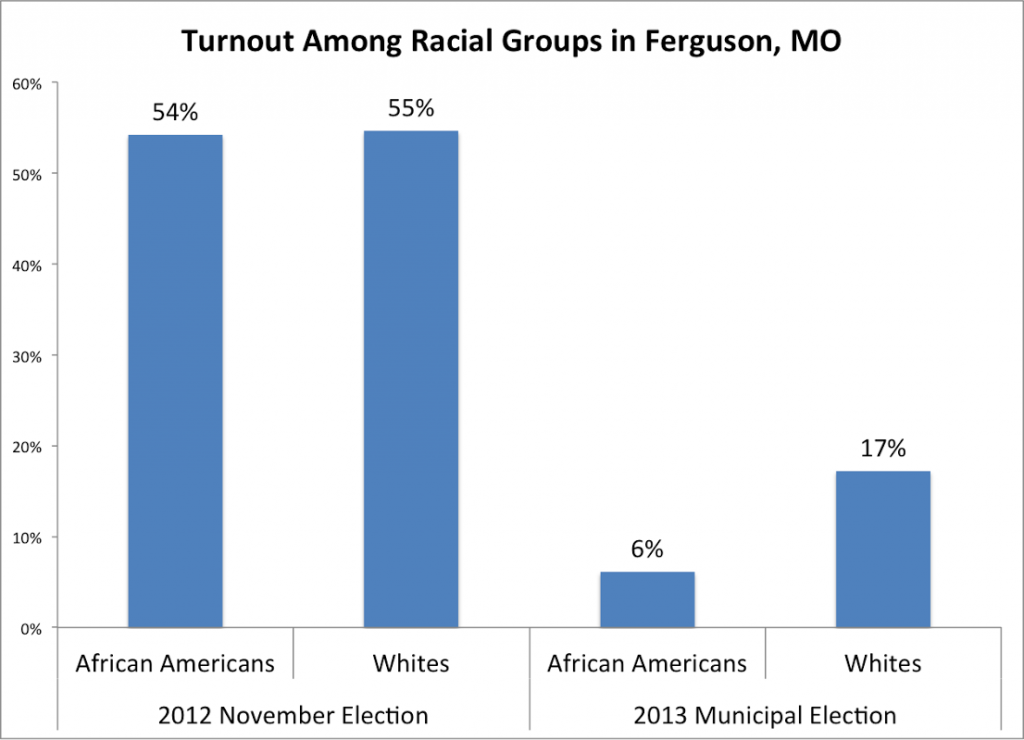
Brian Schaffner, Wouter Van Erve and Ray LaRaja illustrate “why Ferguson’s elected officials look so little like its population”:

The first chart shows turnout rates among African Americans and whites in Ferguson for both the 2012 general election in November and the 2013 municipal election in April. In 2012, African Americans and whites turned out in nearly identical numbers (54 percent and 55 percent, respectively). In the April 2013 municipal election, turnout was dramatically lower among both groups, but whites were three times more likely to vote than African Americans. …

In 2012, when turnout was high and African Americans voted at a similar rate to whites, 71 percent of Ferguson voters were black. However, in 2013, whites became a majority of the Ferguson electorate, by a margin of 52 percent-47 percent. This is a dramatic difference, and it would almost certainly help to account for the extent to which Ferguson’s elected officials are of a much different racial makeup than its population.

But Masket calculates that “Ferguson is a serious outlier” in this regard:

As of 2001, it was a majority African American city with zero African Americans on the city council. The only city with a greater representational disparity was Riverdale, Georgia, but African American representation in that city has increased dramatically since then. Ferguson, meanwhile, has gained one African American city council member since then (17 percent of the council), but its African American population has increased to 67 percent, meaning it’s still a rather extreme outlier in terms of representation. …

This isn’t to dismiss Ferguson as a meaningless outlier. As Clarissa Hayward notes: “Ferguson is anything but anomalous. It’s an all-too-familiar manifestation of how racial injustice lives on, even after significant shifts in white racial attitudes.” There are problems with representation in a number of places across the country, and Ferguson is, sadly, hardly the only city to see an unarmed young black man gunned down by a white police officer.

Toward Lifespan Equality

by Dish Staff

M.S.L.J. notes a new study on life expectancy for black and white Americans, writing that although a gap persists “despite policies aimed at closing it … the good news is that blacks are slowly catching up”:

Between 1990 and 2009 the difference in average life expectancy for black and white men narrowed from 8.1 to 5.4 years, and for women from 5.5 to 3.8 years. But some places made more headway than others. Washington, DC had the largest gap between blacks and whites of both sexes in 1990 (14.4 years for men and 10.4 for women) and saw the least improvement overall (reducing the spread by just 0.4 years for men and 0.2 for women). The city also underwent a significant demographic shift: the proportion of blacks as a percentage of the District’s population decreased from 70% to 50% in the decades studied. …

In New York campaigns to stamp out crime and provide care for those suffering from HIV/AIDS are seen to have contributed to a 5.6-year reduction in the male black-white gap—the largest reduction in the country. Tougher and smarter policing tactics and a jump in arrest rates helped lower the number of murders in New York City by 73% during the 1990s. This extended the lives of young black men in particular. More than half of America’s murder victims are black, though blacks make up just 13% of the population. Blacks are also more likely to die from AIDS than any other racial group, so new treatments and a decline in needle-sharing amongst drug users has benefited them disproportionately.

Reading Your Way Through Life

by Matthew Sitman

12404871373_7994dddeb8_h

I’ve already mentioned how my instinct, when the world seems a bit depressing, is to retreat into books. Reading literature and poetry, for me, always has been therapeutic. An element of escapism surely is a part of this, but I’d like to think there’s more to it than that. The best books don’t move me to avoid reality, but rather see the world with fresh eyes – they remind me not of the world’s limitations, but its possibilities. Sometimes that’s because looking at life from the perspective of a novel’s narrator or the writer of a poem lets me realize just how narrow my own field of vision can be, and getting a purchase on life apart from the whirring of my own brain is just what I need. It’s a way of getting out of the rut of how I usually think about matters. But most of all, reading is a way of feeling less lonely. Certain passages of literature allow me to say, yes, she understands just what it’s like. A kind of communion occurs between the writer and the reader, and the problems of the moment seem more bearable if only because you realize you’re not the first to get there. Books offer the remarkable consolation of getting to a particular point in your life, or reaching a certain impasse, only to look around and see a flag planted in the dust: someone else has been here too.

I’m interested in what books or poems have offered this experience to Dish readers, what texts have been your companion along life’s way. I’ll go first. Often I’ve reached for Marilynne Robinson’s novel Gilead, which takes the form of a long letter written by a dying father to his young son, just to immerse myself in the rhythms of its prose. And I usually turn, at some point, to this passage near its conclusion:

There are two occasions when the sacred beauty of Creation becomes dazzlingly apparent, and they occur together. One is when we feel our mortal insufficiency to the world, and the other is when we feel the world’s mortal insufficiency to us. Augustine says the Lord loves each of us as an only child, and that has to be true. ‘He will wipe the tears from all faces.’ It takes nothing from the loveliness of the verse to say that is exactly what will be required.

Theologians talk about a prevenient grace that precedes grace itself and allows us to accept it. I think there must also be a prevenient courage that allows us to be brave – that is, to acknowledge that there is more beauty than our eyes can bear, that precious things have been put into our hands and to do nothing to honor them is to do great harm. And therefore, this courage allows us, as the old men said, to make ourselves useful. It allows us to be generous, which is another way of saying exactly the same thing. But that is the pulpit speaking. What have I to leave you but the ruins of old courage, and the lore of old gallantry and hope? Well, as I have said, it is all an ember now, and the good Lord will surely someday breathe it into flame again.

I’d love to hear what texts have been by your side as go through life – a favorite passage from a novel, a cherished poem, the short story you return to again and again. Email me at dish@andrewsullivan.com.

(Photo by José Manuel Ríos Valiente)

Policing The Police With Cameras, Ctd

by Dish Staff

Last week, in the wake of Michael Brown’s shooting, making police wear body cameras was suggested as a way to rein in the police. Mark Steyn focuses instead on the lack of dash cam footage:

“Law” “enforcement” in Ferguson apparently has at its disposal tear gas, riot gear, armored vehicles and machine guns …but not a dashcam. That’s ridiculous. I remember a few years ago when my one-man police department in New Hampshire purchased a camera for its cruiser. It’s about as cheap and basic a police expense as there is. … In 2014, when a police cruiser doesn’t have a camera, it’s a conscious choice. And it should be regarded as such. And, if we have to have federal subsidy programs for municipal police departments, we should scrap the one that gives them the second-hand military hardware from Tikrit and Kandahar and replace it with one that ensures every patrol car has a camera.

No argument there. But Jonathan Coppage has concerns about cops wearing cameras:

Yet even setting aside the natural privacy concerns raised by strapping recording devices to every patrol officer circumambulating their city’s streets, it is worth raising a smaller, subtler, but nevertheless potentially significant concern: the increasingly intermediated cop. One only has to glance in the window of a local patrol car to see the sprawling array of screens, keyboards, and communication devices designed to link the officer to all the information they could need. The problem being, of course, that the most important information the common cop needs still can’t be pulled up within his car: the knowledge gained from building relationships with those in the community he patrols.

That relationship-building is a core component of a police officer’s mission, and may be almost entirely divorced from the work he can get done on his car’s mounted notebook computer. It also requires a certain amount of discretion, getting to know a neighborhood’s warts as well as its virtues. The conversations that give an officer an accurate picture of the seedy but not destructive side of his citizens’ lives could very well be more difficult or awkward should the policeman’s sunglasses be rolling film.

However, Conor Friedersdorf bets that cops will want such cameras:

As the police continue to lose the trust of the public, due largely to documented instances of bad behavior by fellow officers, as well as law enforcement’s longstanding inability to police themselves, I suspect that more and more good cops will be clamoring for cameras on their dashboards and lapels. Until then, citizens ought to record police during every incident as it unfolds.