ResearchGate is “essentially a scholarly version of Facebook or LinkedIn” that allows members “a place to create profile pages, share papers, track views and downloads, and discuss research.” It’s certainly gaining traction with researchers:
More than 4.5 million researchers have signed up for ResearchGate, and another 10,000 arrive every day, says Madisch. That is a pittance compared with Facebook’s 1.3 billion active users, but astonishing for a network that only researchers can join. And [co-founder Ijad] Madisch has grand goals for the site: he hopes that it will become a key venue for scientists wanting to engage in collaborative discussion, peer review papers, share negative results that might never otherwise be published, and even upload raw data sets. “With ResearchGate we’re changing science in a way that’s not entirely foreseeable,” he says, telling investors and the media that his aim for the site is to win a Nobel prize.
Though the project has attracted support – and counts Bill Gates among its investors – some have voiced criticism:
[M]any wonder why researchers would deposit their data sets and reviews on these new social networks, rather than elsewhere online — on their own websites, for example, in university repositories, or on dedicated data-storage sites such as Dryad or figshare…. To Madisch, the answer lies with the social sites’ burgeoning communities of users — the famed ‘network’ effect. “If you post on ResearchGate, you are reaching the people who matter,” he says. But Titus Brown, a computational scientist at Michigan State University in East Lansing, is concerned about the sites’ business plans as they seek to survive. “What worries me is that at some point ResearchGate will use their information to make a profit in ways that we are uncomfortable with — or they will be bought by someone who will do that,” he says.
One academic who signed up had more pointed criticism of the “RG score” assigned to users, described as “a metric that measures scientific reputation based on how all of your research is received by your peers”:
The current score is, not to put a too fine point on it, totally useless. There is a more or less universally agreed on ranking of scholars which is based on CVs and the offers they get. There is also a correct ranking based on the originality and quality of research. These two rankings are typically very different. The RG score is similar to neither.
If the score is the most useless feature of RG, the most annoying feature is the aggressive way in which they try to force you to update your site. First, their minions search the web for every old version of your papers, and once they find it they will suggest that you add it you your profile. I say `suggest’ but it’s not like you can refuse. You can choose between `yes’ and `maybe later’. And by `later’ they mean next time you log in. In the end you either surrender or accidentally click yes.
Gabrielle Walker, 5, protests the killing of teenager Michael Brown in Ferguson, Missouri on August 17, 2014. Despite the Brown family’s continued call for peaceful demonstrations, violent protests have erupted nearly every night in Ferguson since his death. By Scott Olson/Getty Images.
Early reports were that the two sides were close to agreement on an Egyptian compromise proposal for a long-term cease-fire. On Friday and Saturday, however, declarations on both sides indicated that positions were hardening as fierce internal divisions emerged, pulling the leaderships on both sides away from the center. The Palestinian side appears to be stymied by the refusal of the organization’s Qatar-based political secretary, Khaled Meshaal, and the head of its military wing, Mohammed Deif, to go along with the compromise proposals laid out by the Egyptians and mostly accepted by both delegations.
On the Israeli side, meanwhile, chaos appears to be reigning. Prime Minister Netanyahu, who rode a wave of popularity during the military operation, has been facing a tsunami of criticism over the past week from the left, the right, the residents of Gaza-adjacent communities and his top coalition ministers. Two of his senior coalition partners, foreign minister Avigdor Liberman of the Yisrael Beiteinu party and economics minister Naftali Bennett of the Jewish Home party, have repeatedly attacked the prime minister’s management of the Gaza conflict from the right, demanding a continuing assault until Gaza has been taken over and Hamas disarmed or dismantled. Broad circles on the right accuse him of giving away the store (i.e. lifting the blockade) in return for “nothing” (i.e. Hamas-Jihad agreement not to shoot, bombard or tunnel).
David Kenner examines one of the key sticking points, namely whether, how, and by whom Gaza will be rebuilt:
In his remarks on Wednesday, Aug. 13, announcing a five-day extension to the cease-fire, Palestinian delegation chief Azzam al-Ahmed said that there had been significant progress in efforts to lift the Israeli economic blockade on Gaza — but that there were still disagreements over reconstruction issues. These debates will not only determine whether residents can rebuild after the war, they also promise to be an important tool in Israeli efforts to weaken Hamas’s hold on the territory. As Finance Minister Yair Lapid put it, Israel would demand that “there is no rehabilitation without some sort of demilitarization [of Gaza].” …
The importing of building materials to rebuild Gaza’s tens of thousands of destroyed homes is one of the most potentially fraught issues. Hamas used large quantities of cement, allegedly smuggled in across the border with Egypt during the presidencies of Hosni Mubarak and Mohamed Morsi, to build its extensive tunnel network, which posed one of the most deadly threats to Israel during the current war. For that reason, Jerusalem has only allowed U.N. agencies to import cement — and is going to be loath to ease restrictions on construction material that could be used by the Palestinian Islamist group to rebuild its tunnel network.
On another major point of contention—lifting the Gaza blockade—the EU is willing to step in and help monitor border crossings in order to make that happen:
The EU has offered to resume its operations at Gaza’s Rafah crossing with Egypt, and to train Palestinian Authority officials who are supposed to take over the bulk of operational work at the crossings. At the U.N. Security Council’s request, it would also expand its operations to other checkpoints. (The EU previously monitored the Rafah crossing between 2005 and Israel’s withdrawal in 2007.)
According to the AP, EU officials said that lifting the blockade is needed for “a fundamental improvement in the living conditions for the Palestinian people in Gaza.” This is one of many outside expressions of disapproval at Israel’s conduct during the latest Gaza operation. The United States recently decided that Israel’s new weapons requests would need individual approval from the presidential administration, rather than going through military channels.
Since Andrew and the Dish team gave me carte blanche to write about what I want, I’m going to go ahead and abuse the privilege by writing a defense of a largely-forgotten, eight-year-old movie, Richard Kelly’s Southland Tales. Because when it isn’t being ignored, it’s usually being reviled, which is a crime. Southland Tales is a masterpiece.
Explaining the plot of the movie could take up thousands of words—and in fact, already has. I’ll leave it to others to explore the complex web of plot lines, references, digressions, and symbols. Suffice is to say for now that Southland Tales is the story of America in the age of terror, an America where a nuclear terrorist attack on Texas leads to a massive surveillance infrastructure, a nascent resistance movement, and the desperate search for an alternative energy source in a world where the Middle East is on fire. While American wars rage in Syria and North Korea, the sprawling USIDENT surveillance system keeps tabs on us through both sophisticated electronic means and more old fashioned, soldiers-with-telescopes techniques. Meanwhile, a genius scientist has discovered Fluid Karma, seemingly a source of unlimited free energy, drawn from the endless churn of the oceans. When we enter the scene, Dwayne Johnson’s character Boxer Santeros, a Schwarzenegger-style movie star and fiancee of a powerful Senator’s daughter, has gone missing, having lost his memory in a mysterious event in the desert. During his disappearance, he’s shacked up with Krista Now, a porn star who wants to start a new life, and sees Santeros as her ticket out. The story really gets rolling when Santeros goes on an ill-fated ride along, ostensibly to research a movie role, with a cop named Roland Taverner—or is it Ronald? Then there’s the question of Santeros and Now’s screenplay, The Power, which keeps mimicking real life….
But, well, there I go, getting into the plot without really meaning to. The movie’s like that.
You won’t understand everything happening in the movie the first time you watch it, and you aren’t really meant to. Among its many references and influences are the great film noirs of the past, and like those films Southland Tales is usually experienced in a state of mild confusion, comprehension always lagging just behind the progression of the Byzantine plot. But you don’t need to understand all of what’s going on for the themes to resonate, or to enjoy the many fantastic set pieces, which are sometimes hilarious and sometimes gorgeous. The characters are pulled into these moments in surprising ways. All of them are portrayed as at least partially comic, and yet all are allowed to entertain grandiose schemes and levels of self-importance. Wallace Shawn’s mad scientist wears the haircut of a synth player from some 80s Euro band; Cheri Oteri’s witless revolutionary/con woman makes up for her bad plans with a talent for violence; Zelda Rubinstein, the diminutive actress from the Poltergeist movies, quotes T.S. Eliot. Kelly arranges them in carefully choreographed moments that play out almost as skits within the larger narrative, and it’s here that they are allowed to achieve some sort of dignity, or at least self-determination. A staged domestic disturbance between Amy Poehler and Wood Harris from the Wire turned real shooting bleeds out into a paranoid escape across the foggy, overgrown lawns of suburban LA, set to The Pixies. The Rock, Mandy Moore, and Buffy the Vampire Slayer dance to Moby in a scene right out of your senior prom. A hallucinating Justin Timberlake, shirt covered in blood, lip syncs to the Killers in a psychedelic arcade. Gorgeous, every frame.
Like Who Framed Roger Rabbit?, Southland Tales is one of the handful of greatest LA movies without being recognized as such. It’s cliched to say that a city is a character in a film, so perhaps I’ll just say that Los Angeles is a ubiquitous presence in Southland Tales. The city is at once a central concern of the film and a subtle one. There’s little about the plot, as plot, that necessitates it being shot in LA, and yet there’s no way it could have been made anywhere else. The city is alluded to in the (excellent) soundtrack and in the voiceover narration, but it reveals itself especially in the movie’s geographic expansiveness, the way it lazily stretches out across its setting. Donnie Darko, the film that made Kelly’s reputation, is a claustrophobic movie, its suburban cul-de-sacs a metaphor for a time line looped back on itself. Southland Tales, in sharp contrast, spreads out across its setting like it’s in no particular rush to get anywhere, mimicking the expansive interconnectedness it dramatizes, as vast and inescapable as the surveillance network that is at the center of both its plot and its themes. In its centerless sprawl and wide boulevards, LA works for this movie in a way that a more cramped city like New York never would.
Though it’s a 9/11 movie and a War on Terror movie and a political movie, show business is at the heart of its themes. The movie is about Hollywood the culture and Hollywood the industry, if not so much Hollywood the place (In its aesthetics, Southland Tales is much more Venice Beach than Hollywood and Vine.) In The Power, Santeros’s name is “Jericho Kane,” a reference to the Arnold Schwarzenegger schlockfest End of Days. That movie, while one of the worst Arnold ever made, is peak meta-Schwarzenegger, the dopiest and most self-important of his blockbuster career, a symbol of overstuffed action movies with overmuscled action stars. And it was the beginning of the end for Schwarzenegger as unironic action star, a relative box office dud from an actor who was once the most reliable draw in Hollywood. Kelly is interested in Hollywood people on the down swing; he’s interested in value in Hollywood, how it’s perceived and what it means. The cast is filled with actors who were seen as Grade C-types even at the time—Oteri, Jon Lovitz, John Laroquette, the guy from Highlander. I’ve heard people suggest that this means that Kelly couldn’t get bigger names in his movie, but that’s wrong; coming off of Darko, his career would have been at peak buzz. Instead, I think Kelly intentionally sought out actors who were perceived as washed up or in some sense ridiculous, like pre-Renaissance Johnson. In his movie, Kelly is working through the idea of who is allowed to be taken seriously. Sarah Michelle Gellar’s porn star character, for example, is underestimated and dismissed, despite taking part in a complex conspiracy that drags in some of the most powerful people in the world. Two feminist neo-Marxist radicals fight for revolution and respect from government officials who underestimate them. A character who fulfills one of the most reviled stereotypes we have—the rich white kid who dresses and talks like a character from a rap video, complete with ridiculous doo-rag—is given respect and compassion, playing a key role in the bravura climax, one of the most indelible visuals I’ve ever seen on screen.
All of this, I’m sure, makes the film sound deeply pretentious. If so, that’s appropriate; it’s a pretentious movie, in the best sense. The rampant fear of pretension has been one of the great mistakes of our current aesthetic era. It’s led to lots of perfectly crafted, perfectly unambitious, perfectly safe movies, the type Manohla Dargis aptly summarized, in her positive review of Southland Tales, as “elegantly art-direct murder.” We’re in an artistic age where the omnipresence of critical judgment has led so many creators to create from a defensive crouch. It’s an age of recappers and social media chatterers and Rotten Tomatoes, and so the response has been the rise of artwork designed to appease them rather than to take the kinds of risks that, sometimes, lead to transcendence. It’s the Era of the Critic Proof, the age of celebrating the perfectly fine. True Detective, Drive, Haim—I enjoy each of these, sometimes a great deal, and I’m happy they exist. But none moves me like the big shaggy mess that is Southland Tales, and in their workshopped perfection, they sand away the natural impurities that are the source of character. It’s kind of a dismal feeling, to perceive so much competence and so little risk, but in a world of towering fan entitlement and an entire industry of nitpickers, it’s probably inevitable. Here’s to the messes, and to Southland Tales.
Jeffrey A. Stacey and John Herbst argue that the international community needs to do more to combat Putin’s aggressive behavior:
The time has come for the West to make a decisive move to counter Putin’s irregular war against Ukraine. The Russian president has introduced a perilous new norm into the international system, namely that it is legitimate to violate the borders of other countries in order to “protect” not just ethnic Russians, but “Russian speakers” — with military means if necessary. Putin has notoriously threatened to annex Transnistria, the Russian-speaking territory of Moldova, inter alia. The Putin Doctrine represents a serious transgression of the status quo that has guaranteed the continent’s security since the end of World War II; moreover, it violates the most essential tenet of the post-1945 international order.
They recommend a comprehensive approach to increase the cost of Putin’s meddling in Ukraine, including “even tougher economic sanctions; military armaments to Ukraine; and an updated NATO strategy.” But Eugene Rumer thinks the situation may be hopeless:
With force off the table, the West’s response to Putin’s actions in Ukraine has been sanctions and more sanctions. They have failed to dissuade and deter Russian support for the separatists. Yet, the West is threatening more sanctions if Russia attacks. Albert Einstein supposedly described insanity as doing the same thing over and over again and expecting different results.
The West can double down on sanctions and threaten more of the same, but the result is also going to be the same. The United States and its allies have made it clear that Ukraine is not as important to them as it is to Russia. Russia is prepared to go to war for it. They are not. It is tempting to say that all parties need to talk and reach a reasonable, mutually acceptable compromise. But it looks less and less likely or feasible at this stage of the conflict. Kyiv senses victory and appears poised to go for it. Putin fears defeat and is not prepared to accept it.
Masha Gessen is chagrined at how far Putin’s lies have gotten him so far:
Bald-faced lying is the one tactic Putin has used consistently through the six months of his Ukrainian incursion. It works every time, precisely because he and his Western counterparts are playing by different sets of rules: Every time, the West has to accept Putin’s version of events until it can be disproved beyond a reasonable doubt, and even then he gets to claim any area that remains gray.
He got to annex Crimea before his assertion that the Russian military was not there was exposed as the lie it was. Because his claim that the Russian military is not in eastern Ukraine has not been definitively disproved, Western media and politicians continue to call the fighters “separatist rebels” or “pro-Russian” or “Russian-backed separatists.” We all know that these are armies formed and armed by Russian military and intelligence officers, but we know this the same way we know the “humanitarian convoy” is a lie: without being able to prove it. So the strongest term Western media or politicians have applied to these fighters is terrorists, which is not strong enough—calling these people terrorists defines them as nonstate actors. Nor is the suggestion that Russia should be labeled a state sponsor of terrorism strong enough. Russia is not sponsoring other people’s terrorism; it is waging an illegal war against a neighboring country.
Tomasky examines the potential jury pool in the Michael Brown case:
Now let’s get to the matter at hand in Ferguson: criminal justice. The specific issue is this that juries in the United States are drawn from county-wide population pools. This means, as the criminologist William Stuntz has observed, that people from large counties with exurbs and farms are often sitting in judgment of urban kids…. Will a St. Louis County jury be likely to look sympathetically upon Michael Brown? Quite unlike the two-thirds black Ferguson, the county is 70 percent white.
Alex Tabarrok reads through a study on the racial composition of juries:
The authors have data on the race, gender, and age of each member of the jury pool as well as each member of the ultimate jury. The authors also know the race and gender of the defendant and the charges. What the authors discover is that all white juries are 16% more likely to convict black defendants than white defendants but the presence of just a single black person in the jury pool equalizes conviction rates by race. The effect is large and remarkably it occurs even when the black person is not picked for the jury. The latter may not seem possible but the authors develop an elegant model of voir dire that shows how using up a veto on a black member of the pool shifts the characteristics of remaining pool members from which the lawyers must pick; that is, a diverse jury pool can make for a more “ideologically” balanced jury even when the jury is not racially balanced.
Ken White worries that the release of the robbery video will bias a jury against Michael Brown:
Whether or not they released the surveillance video in response to a public records request, as they claim, the Ferguson Police Department undoubtedly knew that the news would reach the pool of prospective jurors in any criminal or civil case against Officer Wilson, telling them facts that they might not hear in court. They knew that the media would run with the story, and that the media would run with it multiple times: first to report it, then to ask why the police released it, and possibly a third time in a mock-self-critical analysis of whether they were played. The effect in the public’s mind is to emphasize the point Mike Brown was a robber, with the subtext so he probably had it coming. …
I don’t care that Mike Brown apparently robbed the convenience store. I don’t give a shit if Mike Brown was a career thug or a saint destined for a Rhodes scholarship. The question is the same: did Officer Wilson him have cause to believe that Mike Brown posed a serious physical threat at the moment Wilson pulled the trigger?
Australian artist Andy Thomas creates what he describes as “audio life forms,” specifically 3D animations that respond to audio input. For these latest pieces he used archival bird recordings from the Netherlands Institute for Sound and Vision (in addition to one of his own recordings) to create these new digital sound sculptures that animate in different ways in reaction to the songs of each bird. Thomas uses more software tools than we could reasonably share here, but you can learn a bit more over on his website.
Peer review, the vetting of academic writing by subject-matter experts, is an essential element of academic progress. But the peer review process is also dysfunctional, sometimes out-and-out broken– and that brokenness stems from the well-meaning ideals peer review is meant to protect.
Gabriel Rossman wrote a fantastic piece illustrating the difficulties with peer review, and I highly urge you to read it if you are at all interested. I think Rossman is perfectly right in arguing that it’s the self-same people who complain about peer review as authors who often turn around and exemplify its worst tendencies when reviewing. As a peer reviewer myself, I try to always place myself in the position of the author, and in particular, I try never to review an article by thinking about what I would have done differently, but rather to ask if there are glaring theoretical holes, methodological errors, or problems with presentation. Far, far too much peer review becomes a matter of reviewers telling you what you should have done rather than making the work you did write better. As Rossman writes,
Rather, fixing peer review has to begin with you, the reviewer, telling yourself “maybe I would have done it another way myself, but it’s not my paper.” You need to adopt a mentality of “is it good how the author did it” rather than “how could this paper be made better” (read: how would I have done it). That is the whole of being a good reviewer, the rest is commentary.
But the particular problems with how peer review happens are less important than the basic structural problem. The fundamental issue is this. Peer review, at the vast majority of credible journals, is built on a double blind system. In order to ensure that a big name academic’s big name doesn’t get inferior work published, and so that reviewers can respond honestly without fear of retribution from people with disciplinary and institutional power, neither author nor reviewer knows the other’s name. That’s a sound idea, but it has a perverse effect, particularly given how important publishing is to an academic career. Reviewers and editors have enormous power to make or break careers; one major journal article could mean the difference between launching a professional career and having that career die on the vine. And with no knowledge of who exactly is responsible, we’re left with unaccountable power, which is never a good idea even when people are trying their best and mean well.
Though I’m talking about peer review, it’s also worth saying that this can apply to the whole academic publishing process. You might know the names of the editors you’re working with, but going public with complaints, in the event those complaints are fair and warranted, could be disastrous if you aren’t established or tenured.
For the better part of a year, I’ve been wrestling with an onerous, deeply unpleasant review process at an established journal. All editing, of course, is to some degree an unhappy business. But I’ve gotten peer reviews, even for rejections, that have been smart, fair, sympathetic, and constructive. This is not one of those times. The initial reviews were actually quite positive, though they came months after submission. I made those changes without complaint. Since then, there have been additional requests for changes again and again, each time separated by a period of months. I’ve made those changes to the best of my ability, but the requests have sometimes been unclear, rude, or worse. These changes have been, at times, plainly contradictory of previous requests, in the most direct and unambiguous sense. It’s frequently unclear what requests for changes are coming from the peer reviewers and which are coming from the editors, or if the peer reviewers are even still involved in the process at all. At some point it became clear that I was being edited by several different editors and that these editors were not communicating with each other. I would receive questions, answer them, and get the same questions again, months later. And so on.
Is it possible that I’m just wrong, about everything, and they’re just right? Sure. But the fact is that if I was right even hypothetically, there would be no way for me to fix the problem. I don’t know who the reviewers are, so there’s no way to expect individual accountability. And as someone who lacks the benefit of employment, tenure, or prestige, speaking out publicly about the journal by name would be professional suicide. Even this missive, in and of itself, is likely to be seen as violating proper academic decorum, even though there’s no way to tell what journal I’m talking about. Under those conditions, how could we expect fairness or accountability? I think a lot of peer reviewers do a great job, and for no money. So do most journal editors, who if they are paid, are paid a pittance in most fields. It’s a lot of work. But I don’t know how to deal with problems with peer review and editing when the professional stakes are so high, the personal accountability so low, and when notions of collegiality and respect prevent people from making complaints like this one.
What makes all of this worse is that the double blind system was designed as a bulwark against the corrosive effects of power imbalances. The whole idea is that an unknown graduate student should have the same chance to publish in the biggest journals as the most respected academic celebrity. But that tenured prof can write books, publish research on his or her own web site, and be sure to receive respect and fair process from editors. Younger academics need to have their work vetted if they want to build a career, and they have to do so without complaining. The right to register grievance when grievance is warranted should be available to everyone, but the current structure of academic publishing makes that right unavailable to the most vulnerable.
I’m still plugging away on the article, but the communication has become so acrimonious that I’ve never represented the article on any of my professional documents and have essentially written off ever seeing the piece get published. Which is a shame, because I think it’s a good piece, as the reviewers did, to say nothing of the dozens of hours I’ve spent over the past year writing, researching, and revising the piece. That time represents a major opportunity cost at a critical juncture in my work and my life. And with the review process at many journals being so slow, it’s not reasonable to expect that I could withdraw the piece, get it published elsewhere, and get appropriate credit for it in time for it to help me on the job market.
Are you an academic who’s been caught in review hell? Are you a peer reviewer or editor who thinks your role is misunderstood? Or am I just full of it? Write in to dish@andrewsullivan.com and let the Dish know.
David F. Schmitz hopes the US government has finally learned a thing or two from its experience at trying and failing to manage clients like Nouri al-Maliki and won’t make the same mistakes with his successor, Haider al-Abadi. There’s a broader lesson to be learned here, he argues, about the limits of our superpowers as a superpower:
Now that Iraq has a new leader who is said to be an amiable technocrat without Maliki’s overriding partisan agenda, can the United States escape its past as a poor puppeteer? Can Washington find a way to help Abadi rather than hinder him, empowering his government to take on the Islamic State without seeming to dictate its choices ? The Obama administration says it supports Abadi because it wants to see the democratic process upheld, and there is nothing wrong with this position. There’s no reason to think the Obama administration, no matter how many hundreds of advisers it sends or airstrikes it launches, will have any more success than the Bush administration did in stabilizing Iraq, because the underlying problem remains: It’s almost possible to get a foreign leader to do what is best for you, rather than what he believes is best for him, no matter how much money you throw his way or how hard you twist his arm.
The United States can still play a positive role, but instead of the business of building puppets, we should be more in the business of cultivation—helping good leaders to grow. Success in Iraq or Afghanistan can only come if an indigenous force and leader emerges with local support, and then only if the United States doesn’t demand that they reflect the will of Washington and the goals of the United States in all of their actions and policies.
Christopher Preble is on the same page. Abadi’s problems are many and daunting, he writes, but making them our problems won’t help solve them:
Abadi will need to find a way to form an inclusive coalition government, one that protects the rights of Sunnis and appeases the Kurds’ desire for autonomy, while maintaining support from Iraqi Shiites. This is a tall order. … Americans should wish Iraq’s new leader well, but policymakers should resist the urge to try to micromanage political events in Iraq. Even the appearance of U.S. influence over Abadi will undermine his legitimacy and thus could be counterproductive. Besides, it isn’t obvious that U.S. action—and only U.S. action—is essential to turning things around in Iraq.
Taking a closer look at those problems, Martin Chulov argues that bridging Iraq’s sectarian divide will be Abadi’s most daunting challenge:
Abadi has told followers his first job as prime minister will be to convince those Sunnis who have endorsed Isis in its attempt to establish a caliphate across Syria and Iraq that an Iraqi nation within its current borders remains a better option. Regional and Iraqi officials have encouraged Abadi to start by revitalising the demoralised national military and overhauling state institutions that have been co-opted by warlords and political blocs over the past decade. Many barely function. Abadi also aims to revive relations with Sunni Arab neighbours, including Saudi Arabia and the Gulf States, which boycotted Maliki’s government for close to seven years. Maliki, in turn, had accused Riyadh of bankrolling extremism in Iraq.
“He was such a divisive, polarising figure,” said one senior Saudi official of the ousted leader. “A new start was essential to even beginning to sort out this mess.”
But Ghaith Abdul Ahad resists the temptation to blame Maliki, and only Maliki, for running Iraq into the ground. At least to some extent, the problem is structural:
Maliki was not alone in his corruption, nepotism and oppression. In Iraq’s national unity government, ministries run by Maliki’s opponents are as corrupt as ministries run by his allies. Yes, he dominated the army, but every other party and sect had its own share of positions that were sold to the highest bidder. Detainees were freed by bribing officials who belonged to different parties. Ministers who publicly opposed Maliki never left his government because it generated so much wealth and power. Iraq’s division into fiefdoms, where each party greedily consumed its spoils, has created a country in which an oligarchy of a few thousand ministers, government officials, generals, militia commanders and all those people blessed with much-sought-after green zone badges – Sunnis, Shias and Kurds – have a monopoly on resources, leaving the rest of the nation with nothing much but the blame game.
Meanwhile, Ali Hashem spotlights Iran’s role in Abadi’s designation as prime minister, which suggests the level of interest with which Tehran is engaging the Iraq crisis:
During the weeks of talks, Iran’s secretary of national security, Adm. Ali Shamkhani, led the Iranian efforts on the ground. He visited Iraq on July 18 and met main leaders in Baghdad, Najaf and Erbil. Shamkhani was given a green light from Khamenei to try to end the crisis at any price. He was aware that the situation isn’t the same as before: Iran is no longer defending its regional security borders, but rather its direct borders; the Islamic State (IS) is now in Diyala, which borders Iran; and the last city that fell under IS control is Jalawla, less than 40 kilometers (25 miles) from the Iranian border.
In Tehran, the murmurs that Shamkhani will oversee the Iraq file have gotten louder. This is an indication that Iran is about to adopt a new policy, given Shamkhani’s historic relations with the Gulf countries and Iraq, his wide experience in dealing politically with regional conflicts and his closeness to Khamenei, all without ignoring the fact that he’s an Iranian of Arab origins.
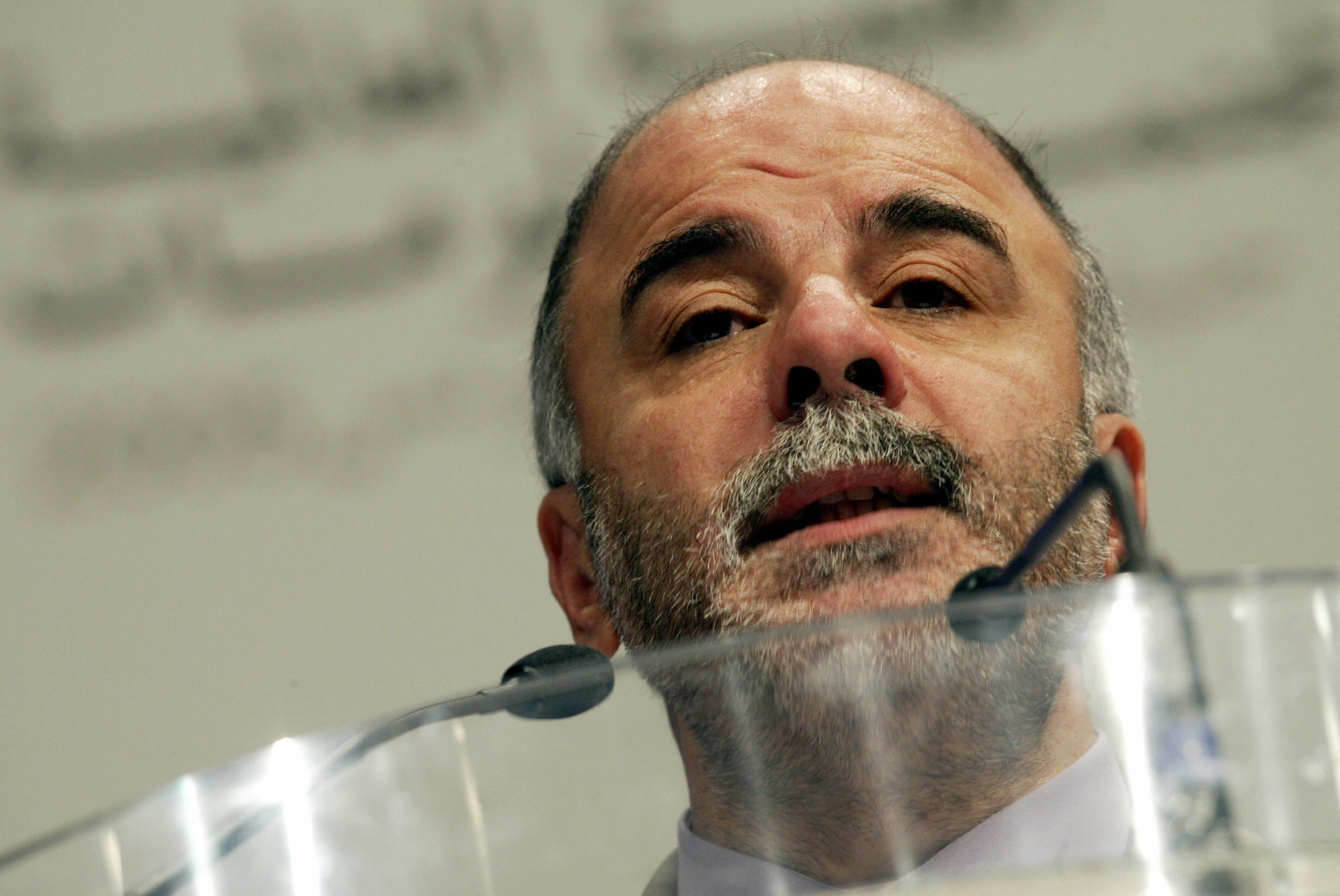
(Photo: Haider al-Abadi by Jean-Philippe Kziazek/AFP/Getty Images)
Anna Feigenbaum provides a brief history of tear gas. Her bottom line:
In the 100 years since it was first developed, tear gas, advertised as a harmless substance, has often proven fatal, asphyxiating children and adults, causing miscarriages, and injuring many. The human-rights organization Amnesty International has listed tear gas as part of the international trade in tools of torture, and Turkey’s medical association has condemned it.
Yet while tear gas remains banned from warfare under the Chemical Weapons Convention, its use in civilian policing grows. Tear gas remains as effective today at demoralizing and dispersing crowds as it was a century ago, turning the street from a place of protest into toxic chaos. It clogs the air, the one communication channel that even the most powerless can use to voice their grievances.
In this way, tear gas offers the police a cheap solution for social unrest. But rather than resolve tensions, it deepens them. This week in Ferguson, police fired tear gas into people’s backyards, set it off near children, and launched it directly at journalists.


 The Dish