Improving the FDA, Ctd

by Elizabeth Nolan Brown

Should the U.S. Food and Drug Administration inch closer to Europe’s drug approval model, in which certified, independent bodies can (and compete to) review new products? A Dish reader says, hey, it worked for the Federal Communications Commission:

The European system you describe has been in place for more than 15 years for much of the equipment that’s approved by the FCC.  Those of us who worked in the field at the time wondered if it really would be as reliable as the system the FCC used before, which required applications that were reviewed by the FCC and had to be approved before the equipment would be sold.  In practice, though, this system works much better than the old way – products come to market faster, the process is quicker and cheaper and, most important, there’s no evidence that there’s any more cheating than their used to be.  The FCC also has, as suggested, agreed that testing that meets European requirements also is good in the U.S., saving companies the trouble of re-testing equipment they know is compliant.  It’s a model the FDA definitely should consider.

Another Dish reader is more skeptical—but offers his own FDA improvement plan:

I’m the Director of Engineering at a small medical device company… While the European method of getting device/drug approval does seem attractive, I just wanted to clarify that the FDA does have an “independent reviewer” option that allows third party organizations that are certified by the FDA to perform the review for market clearance for many types of devices. The Catch-22 here is that the third party reviewers, while generally being more efficient than direct FDA review, are very expensive, certainly more expensive than a standard FDA 510(k) fee ($5,100 per device). So do we move to more third party review to expedite device approvals, and make medical device development more expensive, or do we bolster the FDA staff so review can be faster there?

One way the FDA could become more efficient is if they took a more libertarian approach to approval. Right now, a device/drug has to be proven “safe and effective” to get pre-market clearance. Why not have the FDA only concern itself with the “safe” part and let the market take care of the “effective” part? If a device or drug is ineffective, no one will buy it. That radically simplifies clinical trials as well, lowering the requirements for FDA approval while maintaining the safety of patients.

But another reader takes issue with the idea that Europe’s drug approval process is something to emulate:

I actually work in drug discovery and am currently working on a filing. But I don’t know where this animus is really coming from in terms of approval times. Consider this paper from the New England Journal of Medicine. In it they analyze the drug approval times for the FDA, the (European Medicines Agency) and Health Canada. There are a lot of statistics and different ways to look at the data, but these are the main conclusions:

For novel therapeutic agents approved between 2001 and 2010, the FDA reviewed applications involving novel therapeutics more quickly, on average, than did the EMA or Health Canada, and the vast majority of these new therapeutic agents were first approved for use in the United States.

In that study, a total of 289 unique novel therapeutic agents were approved, including 190 that earned approval in both the U.S. and Europe. Of this group, about 64 percent were first approved in the United States. Some 154 agents were approved in both Canada and the U.S., with us first 86 percent of the time.

The same reader points to another study, this one comparing the EMA, FDA and Japan’s Pharmaceutical and Medical Devices Agency (PMDA):

If you look at the first figure you’ll see the median values for the FDA are the best over the entire period. There is some variability, but I think that’s because of a couple outliers. Drugs are also generally submitted to the FDA first. So even thought submissions are completed by the FDA faster, the other agencies have more information from the drugs approved/being processed in the US.

I must say, all of the data I’ve seen says the FDA is doing a decent job in terms of approval times.

The researchers behind the New England Journal of Medicine paper, published in 2012, may provide some insight into mixed perceptions of the FDA’s approval process. Writing in Forbes, Joseph Ross and Nicholas Downing tease out some nuances in their findings:

… there was much more variation in time to approval among applications to the FDA. More than half of approvals were complete within one year, but there were many examples of the FDA requiring 800, 1000, even 1200 total days before approval. For instance, the well-known anti-cancer drugs Sanofi‘s Eloxatin and Novartis‘ Gleevec were both approved in less than 80 days, however it took more than 10 years from initial submission to approval for Sabril, and (sic) anti-seizure medication, and Asclera, a sclerosing agent to treat varicose veins.

A lot of the variation in FDA time to approval can be attributed to whether one or more cycles of review were required. Among the 62% of applications the FDA approved after a single review, the median time to approval was 278 days. In contrast, the median time to approval was 765 days among the 38% of applications that required multiple cycles of review.

Interestingly, applications within the hematology, oncology, and immune-modulating and anti-infective therapeutic classes were most likely to receive FDA approval after a single review. Applications within the musculoskeletal and pain and psychiatry and central nervous system therapeutic classes were most likely to require multiple cycles of review.

Okay, but can we all agree the FDA needs to hurry it up on the sunscreen already?

Your Saturday Morning Cartoon

by Dish Staff

Jonathan Crow heaps praise on Astro Boy, the early ’60s cartoon developed by Japan’s “god of manga,” Osamu Tezuka, who counted Stanley Kubrick among his fans. Crow describes the first episode, “Birth of Astro Boy,” seen above:

After his son dies in a freak car accident, scientist Dr. Astor Boynton is driven mad by grief. He develops an insane laugh and, with it, an equally insane plan to build a robot who looks just like his dead son. After a Frankenstein-esque montage, Astro Boy is born. All seems well for the adorable, sweet-natured robot, until Boynton freaks out over Astro Boy’s lack of growth. “I’ve been a good father to you, haven’t I?” he whines. “Well then, why can’t you be a good son to me and grow up to be a normal human adult?” How’s that for a parental guilt trip?

So Dr. Boynton casts Astro Boy out, selling him into slavery to The Great Cacciatore, an evil circus ringleader who forces him to be the world’s cutest robot gladiator. Fortunately, Dr. Elefun, a colleague of Dr. Boynton, takes pity on Astro Boy and works to free him from his bondage.

The whole story plays out as if Mary Shelley and Fritz Lang collaborated to make Dumbo. Tezuka throws in a lot of wacky slapstick comedy, which just barely takes the edge off the story’s Dickensian melodrama, which relentlessly mines all those primal fears you thought you got over. In short, it’s brilliant.

Enjoy The Silence?

by Phoebe Maltz Bovy

Separate from all of the other debates raging online is the question of whether you are, in fact, a terrible person if you’re steering clear. Or, conversely, if you’re joining in. Which is it? First, the counterpoint:

Nick Bilton is also skeptical (NYT):

Trying to discuss an even remotely contentious topic with someone on social media is a fool’s errand. Yet still we do it. My Twitter and Facebook feeds over the last month have been filled with vulgar discourse about Israel and Gaza. For example, someone posts a link saying Hamas hailed rockets upon Israel, someone else responds by accusing Israel of killing hundreds of civilians, and next thing you know it’s chaos on social media. A link quickly devolves into vicious and personal attacks.

Been there, done that. While I do scan Twitter and Facebook to see what others have linked to or are discussing (and, ahem, linking to the things I’ve written), when it comes to actually posting things myself, I’m ever more drawn to Pinterest, Instagram, and the upbeat, apolitical world of adorable pets, space-age fashion, and from-scratch yuba preparation. (No, that was not a gratuitous link to a Saveur article that, yes, happens to include a photo of a fit, shirtless man. That was just the best explanation of yuba I could find!)

But there’s also a strong case that social-media silence is itself unethical. Writes Janee Woods:

For the first couple of days, almost all of the status updates expressing anger and grief about yet another extrajudicial killing of an unarmed black boy, the news articles about the militarized police altercations with community members and the horrifying pictures of his dead body on the city concrete were posted by people of color. … And almost nothing, silence practically, by the majority of my nonactivist, nonacademic white friends – those same people who gleefully jumped on the bandwagon to dump buckets of ice over their heads to raise money for ALS and those same people who immediately wrote heartfelt messages about reaching out to loved ones suffering from depression following the suicide of the extraordinary Robin Williams, may he rest in peace. But an unarmed black teenager minding his own business walking down the street in broad daylight gets harassed and murdered by a white police officer and those same people seem to have nothing urgent to say about pervasive, systemic, deadly racism in America?

They have nothing to say?

Why? The simplest explanation is because Facebook is, well, Facebook. It’s not the New York Times or a town hall meeting or the current events class at your high school. It’s the internet playground for sharing cat videos, cheeky status updates about the joys and tribulations of living with toddlers, and humble bragging about your fabulous European vacation. Some people don’t think Facebook is the forum for serious conversations. Okay, that’s fine if you fall into that category and your wall is nothing but rainbows and happy talk about how much you love your life.

Woods goes on to discuss factors beyond social media pertaining to what she sees as white silence regarding Ferguson (worth reading), but let’s pause on her analysis of what it means to remain silent on social media. Woods is ostensibly referring to two different phenomena: First, to the people who are very much part of the conversation, but who’ve skipped a particular topic, and next, to those who have active social-media accounts but tune out. These are, however, two sides of the same coin. If someone’s weighing in, but only in uncontroversial cases (does anyone support depression or ALS?), they may be making the world a better place, but they’re not risking anything.

But! Before weighing in, there’s something to be said for knowing a little bit about what you’re talking about. Like Woods, I found that a disproportionate amount of my social-media reading material (links and commentary) on Michael Brown has come from non-white (specifically: black) Facebook friends and Twitter users, but… I’m actually fine with that. Listening-to rather than speaking-for, you know? Everyone should be upset about what’s happening, and it relates to all Americans, but when it comes to figuring out what’s going on and what to do about it, I would, all things equal, rather hear what black people have to say. I’m not sure what’s added if white people, responding principally to an “in case you missed it” social-media environment, start holding forth before… well, before doing what Woods advises later in her post: “Diversify your media.”

Is abstaining from these squabbles a noble way of focusing on more serious debate (or of leaving important problems to the experts)? Or is engaging what it means to be an informed citizen? It’s hard to avoid the sense that some of the weighing-in is see-I-care posturing. An appropriately-timed status update that hits just the right notes garners “likes”; is the warm feeling that ensues about what those “likes” say about how one’s friends stand on this key issue, or is it maybe just the teensiest bit personal? But it’s also hard to hear justifications of prolonged silence on certain issues as anything other than defensiveness.

Do you battle it out on social media? Email dish@andrewsullivan.com to let us know.

A Legal Nightmare

by Dish Staff

In a long and compelling article, Paul Campos presents the for-profit Florida Coastal School of Law as a microcosm of the problems afflicting higher education in America:

Florida Coastal is one of three law schools owned by the InfiLaw System, a corporate entity created in 2004 by Sterling Partners, a Chicago-based private-equity firm. InfiLaw purchased Florida Coastal in 2004, and then established Arizona Summit Law School (originally known as Phoenix School of Law) in 2005 and Charlotte School of Law in 2006.

These investments were made around the same time that a set of changes in federal loan programs for financing graduate and professional education made for-profit law schools tempting opportunities. Perhaps the most important such change was an extension, in 2006, of the Federal Direct PLUS Loan program, which allowed any graduate student admitted to an accredited program to borrow the full cost of attendance – tuition plus living expenses, less any other aid – directly from the federal government. The most striking feature of the Direct PLUS Loan program is that it limits neither the amount that a school can charge for attendance nor the amount that can be borrowed in federal loans. … This is, for a private-equity firm, a remarkably attractive arrangement: the investors get their money up front, in the form of the tuition paid for by student loans. Meanwhile, any subsequent default on those loans is somebody else’s problem – in this case, the federal government’s.

He adds, “From the perspective of graduates who can’t pay back their loans, however, this dream is very much a nightmare”:

How much debt do graduates of the three InfiLaw schools incur? The numbers are startling. According to data from the schools themselves, more than 90 percent of the 1,191 students who graduated from InfiLaw schools in 2013 carried educational debt, with a median amount, by my calculation, of approximately $204,000, when accounting for interest accrued within six months of graduation – meaning that a single year’s graduating class from these three schools was likely carrying about a quarter of a billion dollars of high-interest, non-dischargeable, taxpayer-backed debt.

And what sort of employment outcomes are these staggering debt totals producing? According to mandatory reports that the schools filed with the ABA, of those 1,191 InfiLaw graduates, 270 – nearly one-quarter – were unemployed in February of this year, nine months after graduation. And even this figure is, as a practical matter, an understatement: approximately one in eight of their putatively employed graduates were in temporary jobs created by the schools and usually funded by tuition from current students.

Every Sex Worker Is Somebody’s Daughter

by Elizabeth Nolan Brown

knox

Last night, a close friend told me he had been reading my posts about decriminalizing sex work. “I’m sympathetic,” he said, “and I want to agree with you. But I just keep thinking, ‘what if it were my daughter?’ That’s, like, every father’s worst nightmare.”

My friend doesn’t have a daughter, to be clear. He’s also one of the most sexually liberal people I know. But while his attitude does discourage me, it doesn’t surprise me. This is the sexist culture we live in—one where a man who I know has had sex with at least three different women in the past week can literally imagine nothing worse for his hypothetical daughter than getting paid to have sex.

Damon Linker trots out similar sentiment at The Week today. Using his apparent mind-reading powers, he asserts that no one could honestly be okay with having a child in porn:

People may say they see nothing wrong with or even admire (Miriam Weeks’) decision to become a porn actress, but it isn’t unambiguously true. And our ease of self-deception on the matter tells us something important about the superficiality of the moral libertarianism sweeping the nation.

How do I know that nearly everyone who claims moral indifference or admiration for Weeks is engaging in self-deception? Because I conducted a little thought experiment. I urge you to try it. Ask yourself how you would feel if Weeks — porn star Belle Knox — was your daughter.

I submit that virtually every honest person — those with children of their own, as well as those who merely possess a functional moral imagination — will admit to being appalled at the thought.

Linker knows that nearly everyone must feel appalled because… he thought about it and was appalled? That’s some pretty shaky logic. (By the reverse, I conducted a thought experiment and am not appalled ergo everyone wants porn star daughters!) It also preemptively dismisses disagreement—anyone who says they are not appalled is just not being honest.

Under that rubric, I’m not even sure what sense it makes to argue, but nonetheless: I would not be appalled to have Weeks as my daughter. I would be proud to have raised a young woman of intelligence, confidence, academic commitment, libertarian leanings, a strong feminist streak, and a way with words. I would worry about a daughter doing porn—but not because of the porn itself. I would worry about the way she might be treated by people outside the industry. I would worry that she might experience sexual violence not on set, but at the hands of people who think porn stars and prostitutes don’t deserve the same bodily integrity as “good” women. And my heart would break to think of her other accomplishments being dismissed by people intent on defining a women’s worth by how many people with which she’s had sex.

I would sure as shit rather have a porn star daughter (or son) than one who thinks, as Linker does, that being in porn makes someone “low, base, and degraded.”

I think I get this viewpoint from my very Catholic, sex-negative, virgin-until-marriage mother. She taught me that we’re all created equal, that only God can judge, and everyone, everyone, is deserving of charity and respect. (The God part didn’t resonate so much with me, but you win some, you lose some.) I’m also reminded of one of my favorite quotes, from a book called Das Energi:

Don’t ever think you know what’s right for the other person. He might start thinking he knows what’s right for you

There’s nothing wrong with having certain expectations for your children—most parents want to see their kids live up to their fullest potential and achieve certain markers of normative success. All else being equal, I’d rather my own hypothetical daughter choose, say, engineering over becoming a Burger King cashier or a brothel worker, because the former seems to offer more security and room for advancement. But here’s the crux of the matter: Our best laid plans mean jack.

“It’s fine that you wouldn’t want your daughter having sex for money,” I told my friend yesterday, “but say she does anyway, and there’s nothing you can do about it. Would you want her to have to stand out on the street, get in cars with totally unvetted strangers, be arrested, get a criminal record? Or would you want her to be able to work in a safe environment? And go to the police if something bad happened? And not get thrown in jail?”

Decriminalizing prostitution is a means of harm reduction.

It’s the same argument people make about marijuana: You don’t have to get high, or even approve of people getting high, to think we shouldn’t be locking people for up it. Proponents of decriminalization aren’t asking you to become pro prostitution, to encourage your kids to go into sex work, or even to abandon thinking it’s morally wrong, if that’s what you think. Plenty of people think premarital sex in general is wrong, but they probably don’t think it should be illegal. All we’re asking is for you to consider that criminalizing prostitution does more harm than good. If — gasp! horror! disgust! — your daughter did happen to become a sex worker, wouldn’t you want to make it as safe and non-ruinous for her as possible?

Thoughts? Email dish@andrewsullivan.com.

(Photo: @belle_knox/Twitter)

Policing The Police With Cameras

by Dish Staff

Nick Gillespie wants to make cops wear recording devices:

While there is no simple fix to race relations in any part of American life, there is an obvious way to reduce violent law enforcement confrontations while also building trust in cops: Police should be required to use wearable cameras and record their interactions with citizens. These cameras—various models are already on the market—are small and unobtrusive and include safeguards against subsequent manipulation of any recordings.

“Everyone behaves better when they’re on video,” Steve Ward, the president of Vievu, a company that makes wearable gear, told ReasonTV earlier this year. Given that many departments already employ dashboard cameras in police cruisers, this would be a shift in degree, not kind.

Derek Thompson is on the same page:

When researchers studied the effect of cameras on police behavior, the conclusions were striking.

Within a year, the number of complaints filed against police officers in Rialto fell by 88 percent and “use of force” fell by 59 percent. “When you put a camera on a police officer, they tend to behave a little better, follow the rules a little better,” Chief William A. Farrar, the Rialto police chief, told the New York Times. “And if a citizen knows the officer is wearing a camera, chances are the citizen will behave a little better.”

Matt Stroud talked with attorney Scott Greenwood about putting cameras on cops:

“On-body recording systems [OBRS] would have been incredibly useful in Ferguson,” he says. “This is yet another controversial incident involving one officer and one subject, a minority youth who was unarmed,” a reference to Michael Brown, who was killed by police on August 9th. “OBRS would have definitively captured whatever interaction these two had that preceded the use of deadly force.” Armed with footage from an on-body camera system, it’s possible that police would’ve had no option but to take swift action against the officers involved — or if Brown’s behavior wasn’t as eyewitnesses describe, perhaps protests wouldn’t have swelled in the first place. Instead, the citizens of Ferguson are left with more questions than answers.

Moving forward, Greenwood doesn’t see how on-body cameras can be avoided. “I see no way moving forward in which Ferguson police do not use OBRS,” he says. “The proper use of OBRS is going to be a very important part of how these agencies restore legitimacy and public confidence.”

A Poem For Friday

by Alice Quinn

8582455227_01191d14f4_k

My friend Stephen Kramer – who loved poetry and birds, people and life so much – died last Friday, August 8th, after a four-and-a-half year battle with Multiple Myeloma. Steve had been a hugely respected lawyer for the City of New York but retired after his diagnosis in January 2010 at the age of 62.

Recently, he’d been writing a column for The Myeloma Beacon, a blog and online forum for the Myeloma community. I recommend these essays for their gallantry and their portrait of life lived simultaneously on the edge and to the brim.

Steve and I corresponded about poems, and two in particular called out to me in the last days when I was in touch with his family, who also surrounded him with song. The first is Emily Dickinson’s poem #1747 (of 1789), one of hundreds she sent to her sister-in-law, Susan Dickinson.

That Love is all there is
Is all we know of Love,
It is enough, the freight should be
Proportioned to the groove.

The second is Walt Whitman’s “When lilac’s last in the dooryard bloom’d.” Whitman served as a nurse during the Civil War, and watching the young die was a continual torment to him. He begins with an announcement of the mourning he has performed and ever shall for a man he proclaims later in the poem to be “the sweetest, wisest soul of all my days and lands.” The poem invokes the figure of a hermit thrush, caroling to the bard, “Loud, human song, with voice of utterest woe/…. And he sang the carol of death, and a verse for him I love.”

From “When lilacs last in the dooryard bloom’d” by Walt Whitman (1819-1892):

Then with the knowledge of death as walking one side
of me,
And the thought of death close-walking the other side
of me,
And I in the middle as with companions, and as holding
the hands of companions,
I fled forth to the hiding receiving night that talks not,
Down to the shores of the water, the path by the swamp
in the dimness,
To the solemn shadowy cedars and ghostly pines so still.

And the singer so shy to the rest receiv’d me,
The gray-brown bird I know receiv’d us comrades three,
And he sang the carol of death, and a verse for him I
love.

*
Come lovely and soothing death,
Undulate round the world, serenely arriving, arriving,
In the day, in the night, to all, to each,
Sooner or later delicate death.

(Photo by Justin Young)

You Might Be a Millennial If …

by Elizabeth Nolan Brown

I am a member of the millennial generation, which means so are my same-age friends, obviously. Yet they routinely refuse to acknowledge this. Some genuinely don’t realize that they, born in the early 1980s, could possibly be considered part of the same generational cohort as those born in, say, 1997. Some seem to know they are millennials technically but refute the label on grounds of principle. So strong is this Millennial Denial Syndrome that appeals to logic – most generations span 15 to 20 years! not identifying with generational tropes doesn’t change your birth year! – only work about half the time.

Millennial journalist Lauren Alix Brown was recently forced to confront the terrible truth about herself:

No one likes the term “millennial,” with its connotations of narcissism, laziness, and self-delusion. And yet it wasn’t until I was editing a piece on millennials, and my office debated the merits of the term for a global audience, that I realized I was one.

But don’t worry, her pain was short-lived. Brown quickly decides that if she is considered a millennial, the term must be meaningless:

Millennial has become a catchall for everything right and wrong with the younger generation. In being used too broadly and frequently, it’s become meaningless for some of the nuances that differentiate us. It also covers a swath as wide, in some definitions, as those born from 1977 to the year 2000.+

The official millennial birth boundaries are blurry, but most place the start between 1979-1982 and the end between 1994-and the late 90s. Generational scholars William Strauss and Neil Howe, who coined the term “millennial”, defined the generation as those born between 1982 and 2000. Regardless of how you slice it, you’ll hear the same complaint from older millennials: they simply have nothing in common with those born 10, 12, 15 years behind.

“Everyone thinks they are distinct from the generation below them,” Brown acknowledges, but she thinks “among millennials, there truly is a divide”:

Most importantly, the Great Recession: A group of us entered the workforce in a distinctly different economy from today’s graduates. A recent survey conducted by Zogby Analytics looked at millennials in two cohorts—those born between 1979-1989 and those born 1990-1996. The older cohort was more apt to have a college degree, consider their current job a career, and less likely to have lost a job in the past 12 months. Older millennials were born to Baby Boomer parents and graduated college and entered the job market in a boom time.The younger set, which entered adulthood during the financial crisis, are products of Gen X-ers.

Yet millennials who entered the job market pre-recession were quickly greeted by it. Many of my friends had no sooner gotten their first professional, post-college jobs than they were losing them in 2008-2009 layoffs. I’m not convinced that entering the workforce pre- or post-recession is as great a marker of difference as some say it is. Perhaps older millennials are more likely to have college degrees and consider their current jobs a career because they are older? In the Zogby survey, we’re talking about the difference between people 25-35 versus those ages 18 to 24!

Putting economic influences aside, Brown quips that she doesn’t feel at all millennial as she encounters “new grads who drink coffee through a straw during an interview or respond with ‘k’ over Gchat.” Yet I remember hearing similar complaints from folks when my friends and I were just out of college and searching for jobs. Boomers and Gen X-ers assure me that their elders had similar complaints about them as interns and entry-level staffers.

I understand why it may seem weird, looking at a 16-year-old from the ripe old age of 30, and being told that you’re supposed to have something in common with them. But generations are, in theory, taxonomied more for historical shorthand purposes than major in-the-moment meaning. So you remember dial-up Internet and they don’t? So they got a Facebook profile at 12 and you were 20? Compared to the cultural gulf between any millennial and any member of our grandparents’ generation, or any member of the post- post- millennial generation, these differences are minuscule and virtually meaningless. And in 50 or 100 years, they will be undetectable to those looking back.

So anyway, here’s my plea to my fellow millenials: Accept the label, because you’re never going to shake it. But this doesn’t mean you have to accept what they say about us. Part of the reason millennials are so mocked and maligned is because nobody wants to admit to being one. The sooner you admit to your dreaded millennial-ness, the sooner you can start changing the conversation about us.

This Is Why Men Need Feminism

by Elizabeth Nolan Brown

Love, love, love the response from actor Joseph Gordon-Levitt when asked about calling himself a feminist:

I read that you consider yourself a “male o-BITE-YOU-570feminist,” and you credit your parents who are educators and really taught you about the history of feminism. But nowadays, you have a lot of young stars coming out against being labeled a feminist.

Coming out against the label? Wow. I guess I’m not aware of that. What that means to me is that you don’t let your gender define who you are—you can be who you want to be, whether you’re a man, a woman, a boy, a girl, whatever. However you want to define yourself, you can do that and should be able to do that, and no category ever really describes a person because every person is unique. That, to me, is what “feminism” means.

So yes, I’d absolutely call myself a feminist. And if you look at history, women are an oppressed category of people. There’s a long, long history of women suffering abuse, injustice, and not having the same opportunities as men, and I think that’s been very detrimental to the human race as a whole. I’m a believer that if everyone has a fair chance to be what they want to be and do what they want to do, it’s better for everyone. It benefits society as a whole.

What’s great about Gordon-Levitt’s definition is that it shows why feminism is directly relevant to men’s lives as well as women’s. We’re all in this mess of gender expectations together. Feminism isn’t just about raising women up but helping us all – men, women, cis, trans, whatever – get to a place where we’re a bit more free.

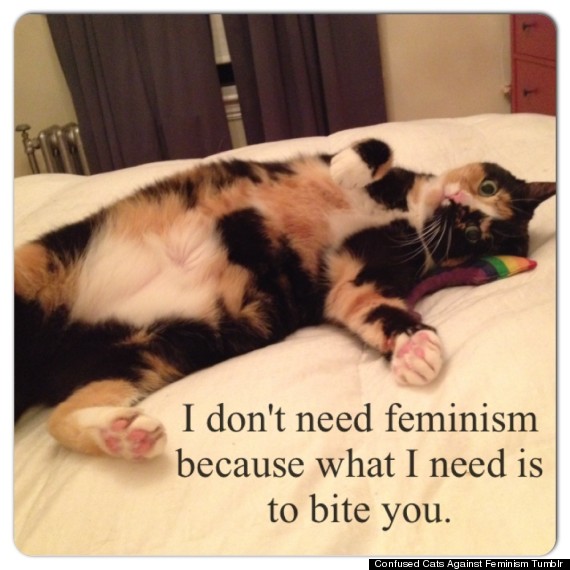
(Image from Confused Cats Against Feminism)