Has Erdogan Lost The Plot?

Not necessarily, Steven Cook argues, though his “Hitler fetish” and cult-of-personality stunts like the bizarre soccer match in the video above might suggest otherwise. Rather, Cook writes that what looks like erratic, blustery illiberalism to us is pitch-perfect politics in Turkey, where Erdogan is vying to become the first popularly elected president:

When it comes to anti-Semitism, Erdogan is guilty as charged, but sadly so are large numbers of Turks. It is true that Jews found refuge in Turkey during the Inquisition and have lived and prospered there ever since, but that does not mean that anti-Semitism is alien to Turkish culture. Recent events in which blood curdling hatred of Jews appeared in the pro-Erdogan press (is there any other kind these days?) and among Turkish users of social media in response to Israel’s attack on the Gaza Strip demonstrate that it is decidedly not, particularly among Erdogan’s core constituency. Yet even beyond the particular strand of Turkish Islamism from which Erdogan’s worldview comes, anti-Semitism is widespread in Turkey. For Turks, Erdogan is not even necessarily an anti-Semite; more important, by calling out the Israelis for killing Palestinian innocents on a large scale, he is acting as the conscience of the Muslim world.

It would be unfair to a political talent like Erdogan, however, to suggest that he has been successful because of Turks’ dislike of the United States, Israel and Jews, let alone his ability to move around a soccer field relatively well. Erdogan’s repeated electoral victories are attributable to his many achievements.

Since he became prime minister in March 2003, Turkey has made important strides in health care, redeveloped significant portions of its transportation infrastructure, put money in the pockets of the middle class, and become a regional power. … For many Turks, only Erdogan—the strong, unapologetic, tough guy—could have transformed Turkey in the way the prime minister has, even if from the perspective of outside observers these achievements have come at the cost of what was once promising political reform. Erdogan’s rule has become fundamentally illiberal, which seems just fine with his constituents.

But maybe not with Turkey’s ethnic and religious minorities, who find some of Erdogan’s campaign rhetoric discomfiting:

Erdogan has been criticized for repeatedly talking about ethnic and religious differences in what appears to be a bid to shore up his support among his Sunni Islam base. Earlier this week, he had called on his rivals to be clear about their backgrounds. “I am a Sunni, Kemal [Kılıcdaroglu of the Republican People’s Party, or CHP] is an Alevi [a branch of Shiite Islam], Selahattin [Demirtas, presidential candidate of the Peoples’ Democratic Party] is Zaza [a type of Kurdish people],” he said, according to Hurriyet Daily News, later adding. “I respect Alevis. Just as I make my sect public, so should he.” 70,000 or so Armenians still call Turkey home, and many in that community felt marginalized or even threatened before the comments. Erdogan often uses “extremely aggressive and bellicose language when referring to the Armenians or Armenian issue,” Richard Giragosian, an American-born Armenian analyst, told Today’s Zaman in July.

And as for anti-Semitism, he maintains that Israel is to blame for it:

Turkey’s prime minister, Recep Tayyip Erdogan, has some advice for his strongest supporters in the U.S. Congress: If you don’t like the rise of anti-Semitism that has accompanied Israel’s latest war, then you should pressure Israel to stop killing Palestinians. An August 5 letter written by one of Erdogan’s top advisers on behalf of the prime minister and obtained by The Daily Beast disputes accusations that his recent statements about Israel were anti-Semitic. Those statements include an assertion on July 19 that Israel’s actions in Gaza “surpassed what Hitler did to them.” A few days earlier, a top newspaper in Turkey affiliated with Erdogan called on Turkish Jews to apologize for the actions of Israel’s military in Gaza.

“Each Israeli attack undermines the peace and tranquility of Jews living all around the world and turns them into targets of hate speech,” wrote Volkan Bozkir, a former Turkish ambassador to the European Union and now an Erdogan adviser and legislator who serves as the chairman of the Turkey-USA Inter-Parliamentary Friendship Caucus and the Turkish parliament’s Foreign Affairs Committee.
Will Machines Destroy The Jobs Market?

Experts can’t agree:

On Wednesday, Pew Research and Elon University released a report titled “AI, Robotics, and the Future of Jobs.” The report compiles and summarizes the results of a sort of expert opinion survey in which the researchers asked 1,900 economists, management scientists, industry analysts, and policy thinkers one big question: “Will networked, automated, artificial intelligence applications and robotic devices have displaced more jobs than they have created by 2025?”

The results of the survey were fascinating. Almost exactly half of the respondents (48 percent) predicted that intelligent software will disrupt more jobs than it can replace. The other half predicted the opposite. The lack of expert consensus on such a crucial and seemingly straightforward question is startling.

Claire Cain Miller examines the split more closely:

On one side were the techno-optimists. They believe that even though machines will displace many jobs in a decade, technology and human ingenuity will produce many more, as happened after the agricultural and industrial revolutions. The meaning of “job” might change, too, if people find themselves with hours of free time because the mundane tasks that fill our days are automated. The other half agree that some jobs will disappear, but they are not convinced that new ones will take their place, even for some highly skilled workers. They fear a future of widespread unemployment, deep inequality and violent uprisings — particularly if policy makers and educational institutions don’t step in.

Adi Robertson reads through the report:

Few people in the survey seem outright opposed to the idea of automating work, but many are worried that the economic impact on most people will be negative. GigaOM Research head Stowe Boyd lays out an extreme scenario: “An increasing proportion of the world’s population will be outside of the world of work-either living on the dole, or benefiting from the dramatically decreased costs of goods to eke out a subsistence lifestyle. The central question of 2025 will be: what are people for in a world that does not need their labor, and where only a minority are needed to guide the ‘bot-based economy?'”

And, even if technology increases jobs overall, Adrienne LaFrance warns that the adjustment could be rough:

[J]ust because an industry survives a major transition doesn’t mean the workers who are trained in the old way of doing things emerge unscathed—especially for those who don’t have the skills or experience to adapt to new systems. In other words, humans may have figured out a way forward after the Industrial Revolution, but many of them suffered before society as a whole benefitted from the widespread innovation spurred by all that change.  “There is great pain down the road for everyone as new realities are addressed,” said Mike Roberts, president emeritus of ICANN. “The only question is how soon.”

Heather Roff throws politics into the mix:

The future of AI and robotics is not merely a Luddite worry over job loss. This worry is real, to be sure, but there is a broader question about the very values that we want to create and perpetuate in society. I thus side with Seth Finkelstein’s view: “A technological advance by itself can either be positive or negative for jobs, depending on the social structure as a whole. This is not a technological consequence; rather, it’s a political choice.”

Obamacare’s Auto-Renewal Mess

Sam Baker warns that individuals “who decide to stick with the coverage they’ve already gotten through Obamacare, rather than switching plans, are at risk for some of the biggest premium spikes anywhere in the system”:

Insurance plans generally raise their premiums every year, but those costs are just the tip of the iceberg for millions of Obamacare enrollees. A series of other, largely invisible factors will also push up many consumers’ premiums.

In some cases, even if an insurance company doesn’t raise its rates at all, its customers could still end up owing thousands of dollars more for their premiums. It’s all a byproduct of complicated technical changes triggered, ironically enough, by the law’s success at bolstering competition among insurers.

Many consumers will need to switch plans in order to keep their costs steady, but health care experts question how many people will do that.

Cohn hopes the administration is prepared for this issue:

The key to solving this problem is education and outreach. The Administration has to make sure consumers understand their situations when they first choose next year’s plans. Many will have to go back to healthcare.gov, so that they can find out exactly what policies are available next year and how much financial assistance, if any, they are entitled to get. These people may be glad they checked, because of the savings they can realize. But they’ll have to make the effort to shop and they’re not going to do that if nobody tells them.

Can the Administration get that message across? Can it make the relevant information easy to find? Its performance leading up to last year’s open enrollment period doesn’t exactly inspire confidence.

Drum chimes in:

In broad terms, this is yet another bit of fallout from the sausage-making process that created Obamacare. In order to get a bill passed, it had to satisfy lots and lots of interest groups. In order to satisfy those interest groups, the structure of the program was made complex. And then, barnacles were added to barnacles to further satisfy everyone. The result is stuff like this. In narrower terms, this might have a technical fix: add a few steps to the auto-renewal process that make the cost of renewing more transparent.

Sprung calms fears by noting that “there’s tremendous churn in the individual market”:

Many will have found jobs that offer insurance; some will become eligible for Medicaid; some will marry or move and need to select a new plan in any case. In November 2013, healthcare scholars Rick Curtis and John Graves estimated (with some caveats) that just 42 percent of Americans eligible for subsidized exchange coverage at end of 2014 (i.e., the upcoming open enrollment season) were eligible in the prior year. That doesn’t quite tell us what percentage of those currently enrolled in subsidized exchange plans will not be seeking coverage for 2015, but it gives an idea of the degree of turnover.

Others who won’t be affected by this potential disproportionate price hike include those whose current plan doesn’t lose benchmark status, those who bought plans that were not benchmark plans, and those who have established relationships with ACA navigators or with brokers (most of whom report they’re still hearing from customers who need help using their current plans) and reach out to them before re-upping.

Can Rand Paul Thread The Needle?

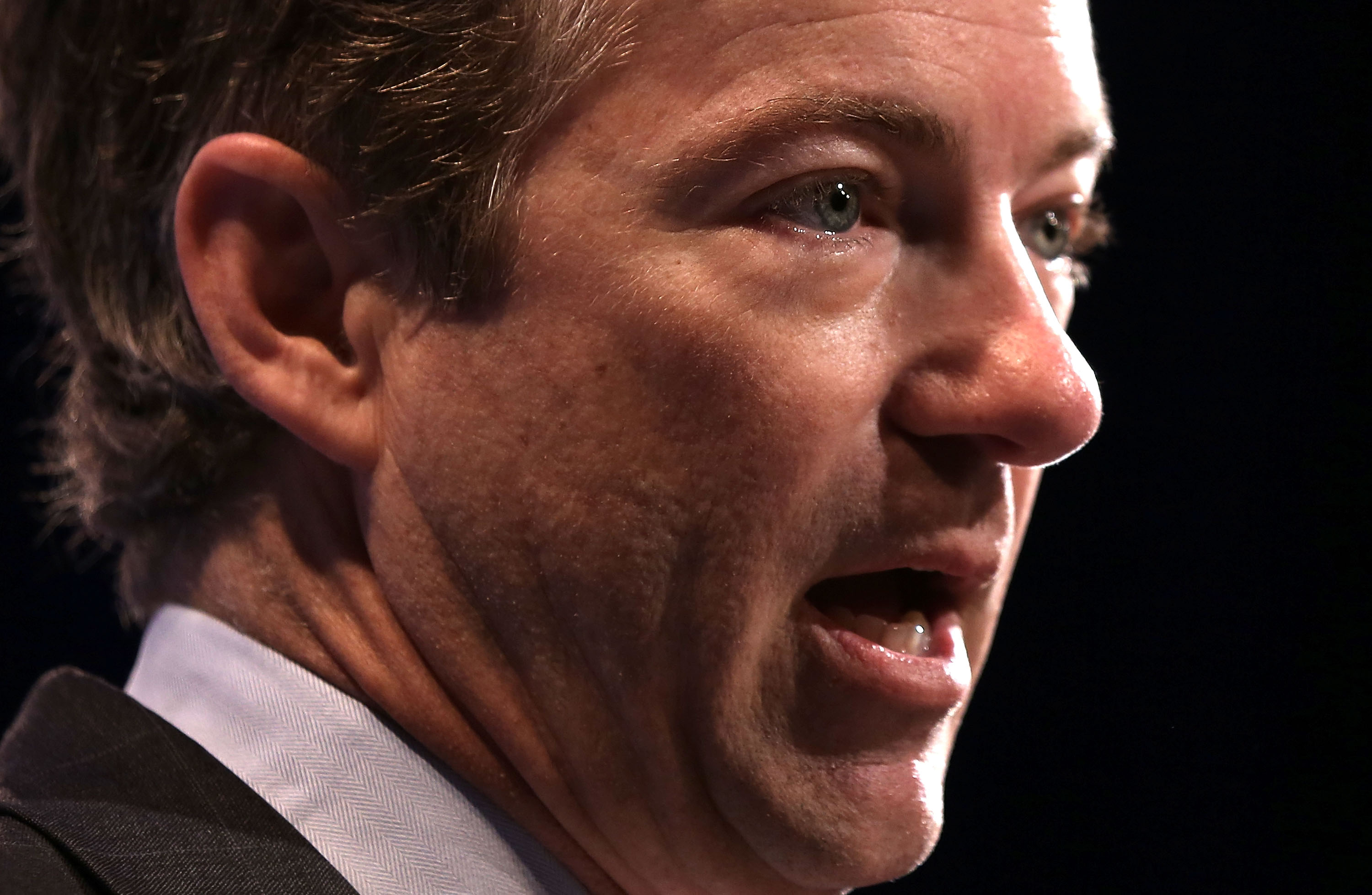
Sen. Rand Paul Delivers Immigration Address Hispanic Chamber Of Commerce Conference

Robert Draper profiles the junior Senator from Kentucky:

“The party can’t become the opposite of what it is,” he told me. “If you tell people from Alabama, Mississippi or Georgia, ‘You know what, guys, we’ve been wrong, and we’re gonna be the pro-gay-marriage party,’ they’re either gonna stay home or — I mean, many of these people joined the Republican Party because of these social issues. So I don’t think we can completely flip. But can we become, to use the overused term, a bigger tent? I think we can and can agree to disagree on a lot of these issues. I think the party will evolve. It’ll either continue to lose, or it’ll become a bigger place where there’s a mixture of opinions.”

In effect, Paul was saying that the way for Republicans to win was to become more libertarian — though only up to a point. … Paul added: “Some people are purists, and I get grief all the time — all these libertarian websites hating on me because I’m not as pure as my dad. And I’m putting restrictions on foreign aid instead of eliminating foreign aid altogether. And I’m like: ‘Look, guys, I’m having trouble putting these restrictions on, much less eliminating them! So give me a break!’ ”

Brownstein instead focuses on whether Rand can make inroads with black voters:

Paul has walked his talk by cosponsoring legislation with Democrats, including Senate Judiciary Committee Chairman Patrick Leahy and Senator Cory Booker of New Jersey to reduce mandatory minimum sentences for nonviolent drug offenders; restore voting rights and access to welfare and food-stamp benefits for more former prisoners; and reform the juvenile-justice system. That agenda might not precipitate an immediate GOP electoral breakthrough with African Americans, but it’s serious enough to provide the party its best opportunity since Kemp to engage that community.

By scrambling the usual party alignment, Paul also has the potential to reshape the sentencing debate, much as Bill Clinton did with welfare reform. The question is whether Paul, as Clinton did, can convince his party to join him.

Meanwhile, Kilgore takes Paul to task for completing his 180 on aid to Israel:

I think Paul would be better advised to say he’s changed his mind on aid to Israel than to claim he’s been there all along. He wouldn’t be the first or last pol to have a sudden metamorphosis on an issue or two before launching a presidential bid. But he’s now getting a reputation for being slippery and defensive about his own past associations and statements; he regularly gets angry if anyone suggests he questioned the constitutionality of key elements of the Civil Rights Act of 1964, which of course he did.

(Photo by Alex Wong/Getty Images)

“A Dad And A CEO”

Executive Max Schireson explains how his desire for work-life balance led him to take a step back in his career:

Earlier this summer, Matt Lauer asked Mary Barra, the CEO of GM, whether she could balance the demands of being a mom and being a CEO. The Atlantic asked similar questions of PepsiCo’s female CEO Indra Nooyi. As a male CEO, I have been asked what kind of car I drive and what type of music I like, but never how I balance the demands of being both a dad and a CEO.

While the press haven’t asked me, it is a question that I often ask myself. Here is my situation:

* I have 3 wonderful kids at home, aged 14, 12 and 9, and I love spending time with them: skiing, cooking, playing backgammon, swimming, watching movies or Warriors or Giants games, talking, whatever. …

* I have an amazing wife who also has an important career; she is a doctor and professor at Stanford where, in addition to her clinical duties, she runs their training program for high risk obstetricians and conducts research on on prematurity, surgical techniques, and other topics.

Ester Bloom ties Schireson’s story to the culture of overwork:

The amount of “all in” we require seems kind of insane. Do we want the only people qualified to lead our companies to be people without families, or with families but without interest in spending time with them? Schireson seems like a mensch who has managed to be successful in business. That’s a golden combination. Shouldn’t we as a society figure out how to retain people like that, rather than drive them out?

Kate Dries, meanwhile, focuses on the gender angle:

The responses to his blog post are overwhelmingly positive; even his daughter wrote in to say, “I’m glad you will be able to spend more time with us at home. yayyyyy.”

It’s somewhat fascinating, however, to consider what the response would be if a woman did the same thing as Schireson; she’d probably be at the receiving end of concern from other women that she was giving up her career. (Though as Schireson touches on, women who focus too much on their careers are judged just as much. Women: they can’t win.).

Voter ID Laws Are Worse Than Useless

Voter Impersonation

Justin Levitt brings some facts to lights:

I’ve been tracking allegations of fraud for years now, including the fraud ID laws are designed to stop. In 2008, when the Supreme Court weighed in on voter ID, I looked at every single allegation put before the Court. And since then, I’ve been following reports wherever they crop up.

To be clear, I’m not just talking about prosecutions. I track any specific, credible allegation that someone may have pretended to be someone else at the polls, in any way that an ID law could fix. So far, I’ve found about 31 different incidents (some of which involve multiple ballots) since 2000, anywhere in the country. If you want to check my work, you can read a comprehensive list of the incidents below.

To put this in perspective, the 31 incidents below come in the context of general, primary, special, and municipal elections from 2000 through 2014. In general and primary elections alone, more than 1 billion ballots were cast in that period.

Drum calculates a fraud rate of 0.00002 percent:

Also worth noting: every single one of these cases involves just one or a few people. There’s not a single credible case in the past 15 years of any kind of organized voter impersonation scam of the kind that might actually affect the outcome of an election. There’s just no there there.

Bernstein adds that there “is voter fraud in the U.S., but not of the kind that voter ID is supposed to prevent”:

Most current ID laws — Wisconsin is a rare exception — won’t stop fraud with absentee ballots because measures requiring ID at the polls push more people into the absentee system, where there are plenty of real dangers. Nor will it prevent vote-buying, coercion, fake registration forms, voting from the wrong address or ballot-box stuffing by officials.

These types of voter or election fraud have been documented. But to believe that polling-place voter impersonation is a real problem, you also have to believe that those responsible are super geniuses(because unlike all other election crooks they never get caught), and that these masterminds have chosen the most difficult, inefficient and clunky ways to steal elections.

Alice Ollstein provides the above GIF:

With Republican-controlled states currently fighting the Obama Administration in court over their voting laws, and claiming they need measures to combat voter fraud, the Harvard study is only the latest to find that such fraud is nearly non-existent. … Still, the myth persists, and as minority turnout increases nationwide, the states with the highest rates of participation in communities of color are also the states most likely to pass voter ID laws and other measures proven to suppress minority votes.

Why Bisexuals Need To Come Out


Amanda Marcotte, chiding Larry King for his inability to comprehend how a bisexual can be monogamously married, sees a larger problem of bi visibility:

Part of King’s line of inquiry is just old-fashioned sexism, which has long pushed the belief that women are “naturally” monogamous and only interested in their partners, and that only men have to stifle their interest in others in order to maintain a monogamous commitment.  But part of it really does point to a long-standing challenge when it comes to bisexual visibility: Your sexuality may exist inside your head, but most people are going to judge your orientation by who you’re partnered with. And so monogamous married people tend to “read” as gay or straight, but some may actually be bisexual. … This is a problem because, as the gay rights movement has shown, visibility helps – a lot. There are many myths that proliferate about bisexuals, including the myth that they are oversexed and can’t be monogamous, a myth that King was pushing with this line of questioning whether he intended to or not. These myths exist in no small part because there aren’t a lot of visible bisexuals to act as a counterpoint.

For much more discussion on bisexuality, check out the popular Dish thread, “What’s A Bisexual Anyway?”

Obama’s Imperial Presidency? Ctd

Douthat fears an imminent Obama power grab on immigration. In response, Greg Sargent talks to experts about the limits of executive power. Here’s an important point by attorney David Leopold, “former president of the American Immigration Lawyers Association and immigration reform advocate who has consulted with the White House on immigration law”:

Though many argue that [deferred action for childhood arrivals (DACA)] grants its beneficiaries work status, in fact, the regulation that grants work status to undocumented immigrants who have been granted deferred action predates DACA and applies to many other categories of people granted deferred action. The federal regulations governing employment under immigration law existed well before DACA. Under those regulations, any undocumented immigrant granted deferred action — under programs that preceded DACA or coincide with it — had already been able to apply for employment authorization. It requires them to demonstrate economic necessity. That applied to anyone granted deferred action either individually or categorically.

Therefore, DACA did not create this authorization to work — and nor would its expansion. It simply created a new category extending an already existing work authorization for beneficiaries of deferred action. The president’s authority to grant work status long precedes DACA, and while it does apply to DACA and would apply to its expansion, it is not a direct outgrowth or creation of either.

Beutler goes another round with Ross:

If DACA combines a lawful exercise of prosecutorial discretion with a lawful provision of work permitsand Greg Sargent’s expert sources make a very strong case that it doesthen the question for Douthat is, where along the continuum between a million-or-so potential DACA beneficiaries and the (perhaps) five million beneficiaries of an expanded program would it transform into the “lawless” abomination he decried in his column?

The obvious answer to that question is: We can’t say until we see the details. All we know is that Obama is contemplating a program that’s different in degree, not necessarily in kind, from DACA. Which is why my original response to Douthat’s column posited that he had assumed too much. I still contend that he did.

I remain queasy, but somewhat more sympathetic to the legal case for executive action than before I understood the precise technicalities. I assume that the administration has done due diligence on all of this before it takes a leap in the dark.

Vladimir Putin, Locavore

In retaliation for US and EU sanctions, Putin issued an executive order yesterday banning or restricting food imports from countries that imposed sanctions on Russia. Bershidsky predicts that the counter-sanctions will hurt the Russian economy more than the countries they target:

In all, Europe’s biggest economies plus Poland, Norway, the U.S., Canada and Australia stand to lose some $6 billion in the next year from the Russian food sanctions. That is far from deadly for them. The Russian Micex stock index has lost a third of that amount in capitalization since the food sanctions were announced, because they are expected to hurt retailers such as the discounter Magnit, which has called itself the biggest food importer to Russia. More upscale retailers will need to reconsider their entire sales matrices, shifting to Asian and Latin American imports. That cannot but have an effect on their bottom lines.

Putin appears to care little about the effect of the sanctions. His focus is, as ever, domestic. He is showing his voters in the most tangible way possible that Russia doesn’t need the West to survive. The Kremlin’s propaganda is already playing up this message. “I can survive perfectly well in a world without polish apples, Dutch tomatoes, Latvian sprats, American cola, Australian beef and English tea,” Yegor Kholmogorov wrote on Izvestia.ru before it became clear that tea or cola would not be sanctioned. “Especially if this results in a substituting expansion of Russian agribusiness and food industry.”

Julia Ioffe speculates that the move might backfire:

This is the thing. If the ban really does go through and is as wide-sweeping as the Russian blogosphere fears, it will hurt not America and not the E.U., but the class of people who are well-educated, well-paid, and well-traveled, who know the difference between a Nero d’Avola and a Nebbiolo, and between prosciutto and jamón serrano. That’s a relatively small set of people, and it’s also the people who went out into the streets in the winter of 2011-2012 to protest against Vladimir Putin: the urban middle class, or, as the Kremlin derisively dubbed them, the creacles (from the words for creative class). Still, it will have a wider effect, too. Most restaurants in the country these days serve something from the E.U., things like Czech or German beer (a favorite of Russians of all stripes) and cheap Italian and French wines. Not to mention that much of the beef in Russian restaurants comes from Australia, which has already threatened to ban entry to Vladimir Putin. The ban won’t go unnoticed outside the creative class.

Tyler Cowen still finds it worrying, though:

Commentators are criticizing the economics of such a move, but I think of this more in terms of Bayesian inference.  Long-term elasticities are greater than short.  Under the more pessimistic reading of the action, Putin is signaling to the Russian economy that it needs to get used to some fairly serious conditions of siege, and food is of course the most important of all commodities.  Why initiate such a move now if you are expecting decades of peace and harmony?  Or is Putin instead trying to signal to the outside world that he is signaling “siege” to his own economy?  Then it may all just be part of a larger bluff.  In any case, Eastern Europeans do not take food supply for granted.