Will They Cease The Fire?

Keating thinks the 72-hour truce that went into effect in Gaza yesterday morning may actually hold:

While it never pays to be too optimistic in this part of the world, there’s reason to believe this time could be different. Last week I wrote that any internationally negotiated cease-fire agreement would be irrelevant until Israel decided its military goals had been achieved. As Reuters reports, that seems to have happened: Israeli armour and infantry withdrew from the Gaza Strip ahead of the truce, with a military spokesman saying their main goal of destroying cross-border infiltration tunnels had been completed. “Mission accomplished,” the military tweeted.

Signs point to Hamas also concluding that there’s nothing more to gain from fighting. Rocket fire into Israel had substantially diminished in the days leading up to the truce and, as the New York Times points out, the group has now agreed to an Egyptian-backed truce that is similar to “one that they had rejected earlier in the conflict.”

So both sides get their very own Pyrrhic victory. It’s win-win – over the corpses of 300 children. Beauchamp also gets the sense that both parties are ready to stop fighting:

Israel was very up-front about the primary goal of its ground offensive: destroy Hamas tunnels into Israel. It’s very close to having accomplished that:

Israel says that it has destroyed the tunnel network, presumably meaning all of the tunnels. Indeed, Israel is so confident that it’s telling evacuated Israelis who live in the south near Gaza to return to their homes because the tunnel threat has been “neutralized.” From Israel’s perspective, that’s a big win. … Moreover, Hamas may be in a position to win some partial concessions from Egypt during the Cairo ceasefire negotiations. According to Hussein Ibish, a senior fellow at the American Task Force on Palestine, Hamas is “hoping to get Rafah [the border crossing between Gaza and Egypt] open, and they’re hoping to get the Egyptians to allow the transfer of Qatari and other money, which the Egyptians have been blocking.” Getting a lifeline out of Gaza that Israel doesn’t control would be a big deal for Hamas, as it would allow them to at least somewhat circumvent the Israeli blockade, no matter how much Israel tightens it. But why is Hamas ready to negotiate for these concessions now? It seems, quite simply, that Hamas has likely determined it has nothing more to gain from the conflict.

Mitchell Plitnick assesses what both sides have gained and lost … mostly lost:

The tunnels are very frightening to Israelis and Israel appears to have eliminated them. But there are two big problems with this narrative. Firstly, destroying the tunnels was the main focus of the ground operation, but Egypt managed to destroy hundreds of them without a military attack; they simply flooded them from the Egyptian side. The second problem is that, while Israeli fears about the tunnels are understandble, it’s worth noting that Israel has known about them for quite a while and Hamas hadn’t used them until this round of fighting began.

So what, really, did Israel achieve? It caused Hamas to use about two-thirds of its rockets, but those can be replenished, and at the point of the ceasefire, Hamas and other factions were still firing at will. Israel destroyed Hamas’ tunnels, but they had been there for years and were posing only a potential threat. Israel meanwhile failed to destroy the unity agreement, at least for now. These gains were bought by Israel at the price of Palestinian blood, and a higher domestic death toll than Israel is accustomed to (67, including three civilians). As much as it appears like Tel Aviv doesn’t care about that price, it is clear that Israel’s image took a major hit in this engagement.

Why Is Our Vision Getting Worse?

Too much reading is a possible culprit:

Observational studies have found that, in general, a person’s level of education — and thus the amount of reading they’ve done over their lifetime — is positively correlated with their risk of myopia. But the direction of causation could go either way: they could have read more growing up, becoming both more educated and myopic, or for various reasons people prone to myopia could be more likely to read more. Some studies have suggested that both are caused by socioeconomic factors.

For what it’s worth, several of the eye doctors I spoke with felt that increased computer use — both in school and in the workplace — has indisputably changed the development patterns of myopia, making it more common for people to become nearsighted in their twenties or thirties, rather than the conventional pattern of becoming myopic during childhood and stabilizing by adulthood.

Back Hair Is Beautiful

photo1

All my previous criticisms of Slate BLT columnist Mark Joseph Stern have now been rendered moot and I withdraw every single one of them (well maybe not on Brendan Eich). For it is a far far better thing that he does now than he has ever done, declaring of his own hairy back, that “from this day forward, I refuse to be ashamed of it”:

All other once-taboo forms of body hair now have their partisans, from pubes and armpits to feet and faces. The gay community, especially, has embraced hairy chests, hairy privates, and hairy faces as part of its self-acceptance ethos. But there has been no such renaissance for back hair. Beauty blogs and fitness forums, even open-minded ones, universally malign it. (GQ flatly issued this Kantian edict: “Back hair is never sexy.”) Gay men, except perhaps for a certain subset of deeply dedicated bears, quiver at the sight of it. And back hair has the dubious distinction of being the one type of body hair that straight men—who generally get carte blanche in the personal grooming department—might actually consider to be embarrassing.

This is a strange and unacceptable state of affairs. There’s nothing inherently gross or dirty about back hair, no reason why it should be singled out for near-universal abhorrence—especially when its close cousin, chest hair, remains so widely beloved and even fetishized. It wasn’t always this way, either: As recently as the 1970s, erstwhile James Bond Roger Moore could flaunt his hairy back on the big screen—In a sex scene! In a close-up!—without losing his sex symbol status.

But those of us who grew up after 1979 have been brainwashed to despise any hair that sneaks below the neck. Most male movie stars today have the hairlessness of a pre-pubescent boy, somewhat freakily accompanied by the abs of a body builder. Even the furriest of modern idols, our Jake Gyllenhaals and Jon Hamms, boast perfectly smooth backs and shoulders. Hollywood and glamour magazines have colluded, insidiously and insistently, to convince us that the hairy chest/hair-free back combination is a naturally occurring phenomenon.

One of the greatest bodily regrets of my life – apart from having my foreskin chopped off as an infant because it was allegedly too ample – is that I have no back hair. My brother? An ape. God knows why this aspect of manhood has loomed so large in my erotic imagination … but there we are. The earliest porn I ever saw I had to create myself. I drew sketches of the men I longed for in a scrapbook and they were all covered in fur. Maybe it’s because body hair is such a powerful visual indicator of testosterone and maleness; maybe I’m just a perv. Or maybe because when a man allows his body to be what it is, and doesn’t try to micromanage every inch of it, he’s inherently sexier than the manscaped, plucked and trussed twink version.

Congrats, Mark. And keep keeping it real.

(Photo: the hubby by Ric Ide Photography for Tim-scapes in Provincetown.)

An Insider Attack In Afghanistan

In Kabul yesterday, two-star Major General Harold Greene was shot to death, becoming the highest ranking American military officer killed in a war zone since 1970:

The inside attack, which took place at Afghanistan’s National Defense University in Kabul, also injured more than a dozen members of the International Security Assistance Force (ISAF), defense officials said. A one-star German was wounded, the Bundeswehr German armed forces said. The shooter, allegedly a member of the Afghan military, was killed in the course of the attack, Pentagon spokesman Rear Adm. John Kirby confirmed Tuesday.

So-called “green-on-blue,” or insider attacks, when insurgents either disguised as or within the Afghan security forces turn their weapons on NATO-led international forces in Afghanistan, are common. But a number of factors, including measures implemented by ISAF, have diminished their prevalence in the last two years. The last confirmed green-on-blue incident occurred in February in Afghanistan’s Kapisa province, although, a June 23 attack involving an Afghan police officer and two injured ISAF soldiers is being investigated.

Eli Lake fingers the Taliban:

The Taliban have spent the last seven years trying to embed moles inside Afghanistan’s army and security services. At a press briefing Tuesday, Pentagon spokesman Adm. John Kirby was careful not to assign blame for the attack, describing the assailant only as an Afghan soldier. But the U.S. military has spoken publicly for years about its efforts to root out the Taliban infiltrators inside the military President Obama hopes will keep Afghanistan from becoming an al Qaeda haven. One congressional staff member told The Daily Beast, “Our view is: This is Taliban until proven otherwise.”

Even if the Taliban had nothing to do with Tuesday’s attack—and they might not have—the threat from the group and other Islamic extremists in Afghanistan is rising, current and former U.S. intelligence and military officials tell The Daily Beast. The new danger in Afghanistan reflects an optimism from the Taliban, al Qaeda, and the Pakistan-based Haqqani Network that Obama will remove U.S. forces from the country by the end of his presidency, leaving them an opportunity to re-establish havens within Afghanistan.

But Paul Rogers suggests that a spike in Taliban violence could cause the administration to reconsider the drawdown:

The Taliban may have increased their levels of action against Afghan forces, but they are unlikely to push this too far during the summer months – what is euphemistically called the “fighting season”. If they do, then the United States might decide to keep larger forces in the country in order to support the Afghan government beyond the end of this year.

The current intention is to keep those 10,000 or so troops in Afghanistan, partly to handle training missions but also to support the use of drones and maintain Special Forces for searching out groups that might link to al-Qaida elements in Afghanistan and north-west Pakistan. If the Taliban get so strong that they are threatening the very survival of the Kabul government, then the Pentagon will argue for keeping far more troops in the country.

Ugh.

The Government’s Bloated Watchlist

Watch List

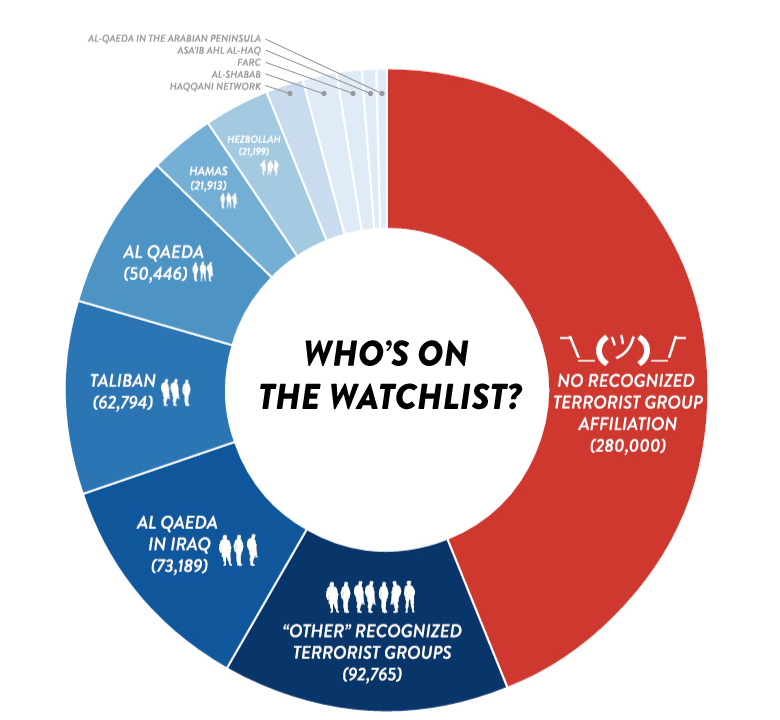
Yesterday, Jeremy Scahill and Ryan Devereaux reported that almost “half of the people on the U.S. government’s widely shared database of terrorist suspects are not connected to any known terrorist group, according to classified government documents obtained by The Intercept”:

Of the 680,000 people caught up in the government’s Terrorist Screening Database—a watchlist of “known or suspected terrorists” that is shared with local law enforcement agencies, private contractors, and foreign governments—more than 40 percent are described by the government as having “no recognized terrorist group affiliation.” That category—280,000 people—dwarfs the number of watchlisted people suspected of ties to al Qaeda, Hamas, and Hezbollah combined.

The documents, obtained from a source in the intelligence community, also reveal that the Obama Administration has presided over an unprecedented expansion of the terrorist screening system. Since taking office, Obama has boosted the number of people on the no fly list more than ten-fold, to an all-time high of 47,000—surpassing the number of people barred from flying under George W. Bush.

Timothy B Lee asks, “Is this a good way to fight terrorism?”

A lot of people don’t think so.

Critics point out that having too many people in a terrorism database can be just as bad as too few. If law enforcement and intelligence agencies are “watching” hundreds of thousands of people, that could mean they’re not actually watching anyone very carefully at all.

Civil libertarians also argue that the secret nature of these lists can run afoul of basic concepts of due process. If you’re put on a watchlist by accident, as the late Sen. Ted Kennedy once was, it can be extremely difficult to get off. And government critics such as Laura Poitras and Jacob Appelbaum have reported being detained and harassed by US officials when they’ve traveled to and from the United States.

The government counters that it can’t tell people who is on its lists and why without compromising intelligence sources and methods. But the result has been to turn airports into a kind of Constitution-free zone, where ordinary principles of due process don’t apply.

Ambinder’s take:

Watchlisting is fine; the uncertainty about the identities of terrorists implies that the list of suspected al Qaeda members will be much larger than the actual list. But providing to the National Counterterrorism Center bulk biometric data from all Americans in a certain number of states? The disproportionate targeting of Muslims in Dearborn, Michigan? The ease with which the government can open a file on you? Not only does the noise drown out the signal, but the actual harm done to people — inconvenience at airports, harassment at border crossings — is tangible.

Scott Shackford sighs:

[T]he first thing this report for 2013 (pdf) describes as an “accomplishment” is adding its one millionth person to its database:

On 28 June 2013, the Terrorist Identities Datamart Environment (TIDE) passed a milestone of one million persons in TIDE. While NCTC’s Directorate of Terrorist Identities (DTI) seeks to create only as many person records as are necessary for our nation’s counterterrorism mission, this number is a testament to DTI’s hard work and dedication over the past 2.5 years.

It’s a monument to the twisted incentives that drive bureaucracies. Having a watch list of a million people is considered an accomplishment even though it contains hundreds of thousands of people with no known ties to terrorist groups.

Iran’s Crackdown On The Press

The WaPo’s reporter in Tehran, Jason Rezaian, and his wife Yeganeh Salehi, also a journalist, were arrested a couple weeks ago:

As one of few foreign correspondents in based in Iran, Rezaian’s reporting hardly breached the sensitivities that the Iranian ruling apparatus is known to crackdown upon. His last two articles for The Washington Post covered baseball in Iran (“In Iran, a spark of enthusiasm for America’s national pastime”) and coverage of the nuclear negotiations from Vienna (“World powers agree to extend talks with Iran”). He was arrested in his home, alongside his wife, upon his return from Vienna. …

It is unclear on what charges the Iranian-Americans are detained, as official state media have verified the arrests but not the reasons behind them. An unconfirmed report by Tasnim news website, associated with Revolutionary Guards, claimed the arrests were on suspicions of spying.

The Economist notes that “Iran has long been hostile to the media”:

Twenty-seven journalists are currently in jail in Iran, according to the International Federation of Journalists, a Brussels-based lobby. But in the wake of the election last year of Hassan Rohani as president pressure on the media eased. Several journalists were freed in the days after he took office.

That now appears to have changed. Mr Rezaian and his wife (pictured above) are part of a worrying new spate of arrests. On May 28th Saba Azarpeik, an Iranian writer, was detained after Etemad (“Trust” in Farsi), a reformist newspaper, published a testy exchange between her and Muhammad Sadegh Kooshky, a professor at Tehran University and a member of an anti-Rohani pressure group. Two months later Marzieh Rasouli, a writer on arts and culture, was sentenced to 50 lashes and two years in prison. Reporters Without Borders, a Paris-based organisation, says she and two other Iranian journalists, Parastoo Dokouhaki and Sahamoldin Borghani, were accused of collaborating with the BBC, which is seen as part of Britain’s spy network by some hardliners.

No one knows why Iran feels the need to crack down now.

Last week, Saeed Kamali Dehghan heard that six Iranian judges are leading the new crackdown on journalists and political activists:

In their testimonies, many prisoners have accused the six judges of acting on the instructions of top security officials and prison interrogators, and collaborating with the country’s intelligence ministry or the elite Revolutionary Guards. Several prisoners said the sort of sentences they were threatened with in interrogation sessions were later handed down in their trials, which they say points to close collaboration between judges and the intelligence apparatus.

Earlier this week, Haleh Esfandiari argued that Iran’s hard-liners are using the arrests “to undercut other countries’ confidence in [Rouhani’s] ability to deliver on promises Iran might make in a negotiated deal”:

The security agencies manage to discover spies and foreign plots whenever an Iranian government seeks a rapprochement with the West. In 1999, when the reformist Mohammad Khatami was president, 13 Iranian Jews from Shiraz and Isfahan, including a 16-year-old boy, were arrested on fabricated charges of spying for “the Zionist entity” and “world arrogance.” Ten were eventually sentenced to prison terms — a carefully calculated decision that defied the concerns of members of the European Union, and chilled Iran’s relations with them.

Mr. Khatami’s failure to take a stand against a trial that was widely regarded as farcical left him looking weak, as did his earlier failure to speak up when a political ally, Gholamhossein Karbaschi, the mayor of Tehran, was tried and sentenced on fabricated corruption charges. Those two events only encouraged his opponents to thwart the president in other ways, further weakening faith abroad that he had the clout within Iran’s political system — and most important, with its supreme leader, Ayatollah Ali Khamenei — to withstand pressure from the hard-liners.

Growing Up Gazan, Ctd

In a brief post on Gaza’s demographics (43 percent of the population is under 15 years old), Yglesias makes a salient observation:

The election in which Gazans voted for Hamas … happened back in 2006 when most currently-alive residents of the Strip were too young to vote.

Andy Coghlan looks at why the Strip’s population is so young:

Demographers say it’s a combination of unusual factors.

One is that an unusually low proportion of Palestinian women hold jobs. “It’s the place in the world where the least women work outside the home,” says Jon Pedersen of the Fafo Institute, a centre for demographic and social research in Oslo, Norway. Latest figures from the Palestinian Central Bureau of Statistics show that 14.7 per cent of women are in the labour market.

“In most other countries, it’s much higher than that, between 70 and 80 per cent in Scandinavia, for example,” says Pedersen, who co-authored a comprehensive study a decade ago on the demography of Gaza. Even in other Middle Eastern countries with similar cultures to Gaza, the proportions working outside the home are significantly higher. In Jordan, for example, 16 per cent of women have jobs.

The data from Index Mundi show that the fertility rate in Gaza, 4.4 children per woman, is among the highest in the world. That has steadily fallen from a peak of 8.3 children per woman in 1991. This compares with a rate of 3 in Israel, although the overall rate there is elevated by higher rates of around 6 among the strictly orthodox Haredi Jews. In most European countries, it’s about 2.

Previous Dish on Gaza’s children here.

Teachers Should Spend Less Time Teaching

Elizabeth Green, author of Building A Better Teachermakes a counterintuitive point:

We don’t give teachers the space to do anything but work, work, work. They have no space to learn. Whereas in Japan or Finland there are 600 hours per year of time spent teaching, in the US, it’s 1,000 hours or more. So teachers have no time to think, no time to learn, no time to study the kids, no time to study the curriculum. They have no way of seeing anything that’s happening outside their own classroom.

They have no time to see each other teach. Other countries show that time is some of the most valuable time. When you get to have a common classroom experience to look at, then you get things like figuring out that “13 minus 9” is the very best problem to teach subtraction with borrowing. That kind of learning doesn’t happen in the US.

White Picket Fence Poverty, Ctd

d0de76281

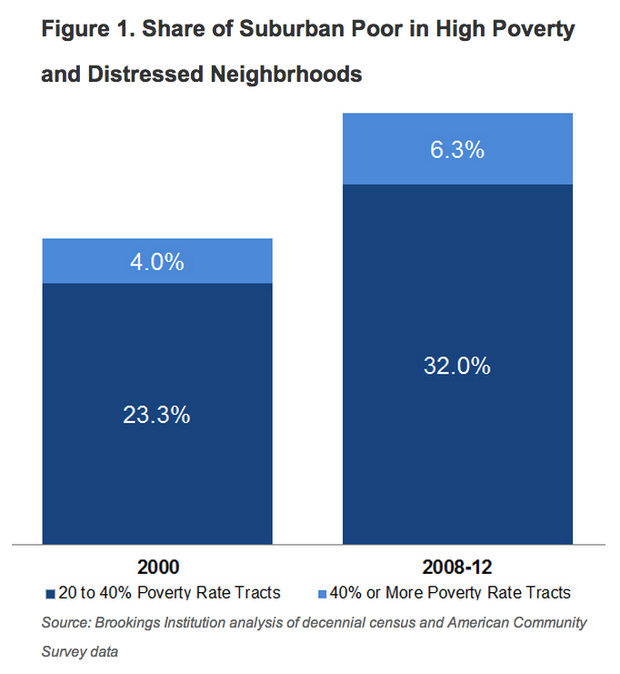
Kriston Capps flags an update to Brookings’ 2011 report on concentrated poverty, which reveals that suburban poverty in particular is growing in the wake of the Great Recession:

A rise in concentrated poverty is something we might expect to see after a prolonged recession. Still, a complete picture of the 2000s shows that the impact registered the hardest in largely rural areas surrounding geographically large metro areas. While concentrated poverty is still highest in cities—where 23 percent of poor residents live in distressed neighborhoods—the slide among poor residents into concentrated poverty was fastest in the suburbs. “Between 2000 and 2008–2012, the number of suburban poor living in distressed neighborhoods grew by 139 percent—almost three times the pace of growth in cities,” according to the report.

That poses a significant challenge to policymakers everywhere. If the best tools geared toward alleviating poverty are designed for urban centers, then they may be rendered increasingly ineffective by the new geography—with poverty spreading to areas with lower density, less transit, and fewer services. By 2008–2012, in fact, the suburbs were home to almost as many high-poverty neighborhoods as cities.

Previous Dish on suburban poverty here, here, and here.

Pregnant With Depression

Lia Grainger unravels the debate surrounding antidepressant use during pregnancy:

My family doctor assured me the drugs were safe and non-habit-forming, and that for a lot of people, they helped. I left with a prescription for Effexor, and have been taking the drug ever since. Now I’m 33, and life looks a lot different than when I gulped down the first of the roughly 2,800 peach colored pills I’ve since ingested. Something new is swirling inside my mind: the idea of a child. So it was with a special kind of horror that, during an afternoon of aimless internet meandering, I happened upon the world of “Effexor Babies.” Typing in this search term reveals link after link to news reportsblogs, and forum discussions detailing a range of negative outcomes in the pregnancies of women on Effexor. Many studies reveal an increase in the risk of a range of birth defects, some of them potentially deadly. I was terrified—and shocked that no one had warned me of these outcomes when I started the drug.

Going off the meds, however, poses another set of problems:

Why? Because there is plenty of evidence suggesting that untreated depression during pregnancy can also be harmful to the child. Most of this evidence suggests a secondary connection—it’s not the depression itself that will hurt the infant, but rather the fact that a depressed mom is less likely to stay healthy and take good care of herself during pregnancy and more likely to engage in negative behaviors like drinking and smoking.