Hard Choices also cannot be called a work of political philosophy or political science. There is no overall argument in the book, no marshaling of evidence to make a particular case or to set forward a particular strategy or thesis. This is not an argument for “realism” or “idealism.” It is not an analysis of America’s priorities … [I]t is an argument about process, not about policy; about the means, not the ends. Most of the time Clinton prudently stays away from thorny debates about just what those core national interests should be.
Clinton’s developing a new formula for politics: stand for nothing but winning power. And the Democrats seem perfectly happy with it.
Not many Americans, according to an Economist/YouGov survey:
Just one in four Americans – and one in three women – call themselves feminists today. But that’s before they read a dictionary definition of feminism. Even then, 40 percent of Americans in the latest Economist/YouGov Poll – including half of all men – say they do not think of themselves as a feminist, defined as “someone who believes in the social, political and economic equality of women.”
Women are more than twice as likely as men to say they are feminists at first, although only a third of women describe themselves that way. The gap remains about the same when people read the dictionary definition. Once that happens, identification increases dramatically: half of men and two-thirds of women say they are feminists.
Roxane Gay confronts her ambivalence about the term in an excerpt from her new book, Bad Feminist:
There are many ways in which I am doing feminism wrong, at least according to the way my perceptions of feminism have been warped by being a woman. I want to be independent, but I want to be taken care of and have someone to come home to. I have a job I’m pretty good at. I am in charge of things. I am on committees. People respect me and take my counsel. I want to be strong and professional, but I resent how hard I have to work to be taken seriously, to receive a fraction of the consideration I might otherwise receive. Sometimes I feel an overwhelming need to cry at work, so I close my office door and lose it. I want to be in charge, respected, in control, but I want to surrender, completely, in certain aspects of my life. Who wants to grow up? …
The more I write, the more I put myself out into the world as a bad feminist but, I hope, a good woman – I am being open about who I am and who I was and where I have faltered and who I would like to become. No matter what issues I have with feminism, I am a feminist. I cannot and will not deny the importance and absolute necessity of feminism. Like most people, I’m full of contradictions, but I also don’t want to be treated like shit for being a woman. I am a bad feminist. I would rather be a bad feminist than no feminist at all.
Cheryl Wischhover alerts consumers to the rampant greenwashing of the cosmetics industry:
[Former cosmetic formulator Perry] Romanowski recounts a story of some classic “greenwashing.” “It’s done all the time,” he says. “We launched a line called V05 Naturals. We just took our regular formula and squirted in some different extracts, changed the color and fragrance and called it ‘natural.’”
Which brings me to one of my biggest pet peeves in all of this:
The word “natural” is meaningless. There’s no regulation of that word, unlike the designation “organic” for food products. Any cosmetics company can use it at any time in any context – they can throw some aloe into something that has three different parabens and formaldehyde in it and call it “natural.” But at the same time, we need to remember that natural doesn’t always mean safe. The impending EU perfume ingredient ban, which has the fragrance industry in a tizzy, includes several natural ingredients, because they have a high potential for causing serious allergic reactions.
Jacob Brogan sees more misleading eco-marketing in the denim industry:
Recent months have found Levi’s CEO Chip Bergh trying to show that durable pants can make the planet last a little longer… According to Levi’s, the total carbon footprint of a pair of blue jeans is a little smaller than one created by a year’s worth of daily cellphone calls. They claim that fully 58 percent of the climate change impact of a given pair of jeans comes after the consumer purchases them.
But Brogan thinks not washing jeans has more to do with fashion than environmentalism:
It might be green to wash your jeans less often, but really caring about the environment means caring about tomorrow. Any environmentalism based on a trend is bound to focus solely on today.
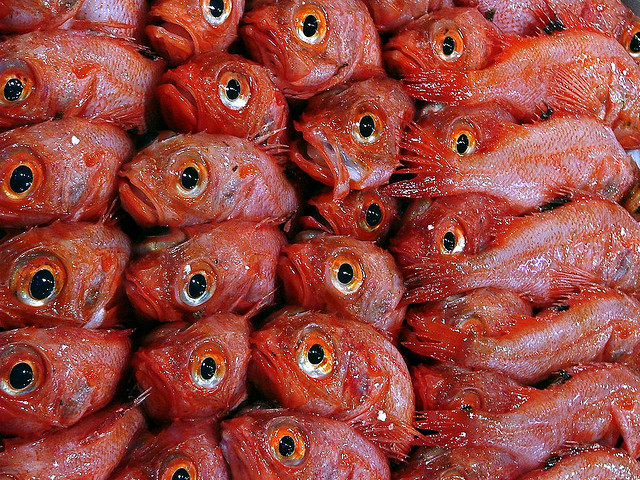
Every major commercial agricultural system has some ethical laws, except for fish. Nobody’s ever asked the questions: “What does a fish want? What does a fish need?” Part of the problem comes back to the question of whether fish feel pain. But for the last 30 years, the neurophysiologists have known that they do, and haven’t even argued about it. …
I think, ultimately, the revolution will come. But it’ll be slow, because the implications are huge. For example, I can’t think of a way to possibly catch fish from the open ocean in a massive commercial way to meet demand that would be anyway near our standards for ethics if we think of them like other animals. Currently, you go out, you catch a bunch of fish, you crush most of them to death in a net, you trawl them up from the bottom of the sea – which causes barotrauma for most of them – you dump them on a deck, half suffocate to death, the ones you don’t want get thrown overboard and die anyway, and the ones you keep go on ice, just to preserve the flesh for market reasons.
How do you do that in a way that has the fish’s interests involved to any degree? You can’t. So it’s not surprising that there is some fierce opposition to this idea. It would mean a massive change in the way we do things.
(Photo of Tokyo’s Tsukiji Fish Market by Flickr user Cranrob)
A military officer serving in Afghanistan reports on how soldiers like him are experiencing the winding down of the war:
For the thousands of service members still working here, the realities of serving in a shrinking military resonate. Gone are the days of job stability as the effects of military drawdowns echo across the services. Like surplus gear, a couple services are getting rid of people too. In the past few weeks, the military has laid off some troops and sent them home early to begin an immediate transition back into civilian life. Others face career uncertainty and stagnation as promotion rates continue to drop for both enlisted and officers. In many ways we’re serving in a post-war military in the middle of war.
Other hints at the changing war are less ominous, but obnoxious nonetheless. Many Americans imagining life in Afghanistan picture remote outposts where battle weary soldiers live with Spartan conditions and constant firefights. That’s a reality for a minority of combat troops, but far from what life is like for most of us. The truth is that the long wars of occupation in Iraq and Afghanistan have produced sprawling bases with various amenities including shopping areas that resemble run-down suburban strip malls. It’s true that you could die from a rocket attack while enjoying your sandwich at a Subway in Afghanistan, but the reality of the war is that you get used to both the rockets and the skewed comforts of home.
When the fast-food restaurants shut down it’s a sure sign that the end of war isn’t far behind.
The popular thread continues. A fan of participatory awards writes:
I love this reader: “I don’t know, maybe because the world IS unfair and we’re realists and not delusional purveyors of utopian fantasy?” Calm down, buddy. These are children. With children, we (collectively) are absolutely purveyors of utopian fantasy. See: Santa Claus, the Tooth Fairy, all dogs going to heaven, et al.
Another reader:
I don’t understand why so many people assume “all the kids get a trophy” means “the kids who excel get the same recognition as the kids who don’t.” All three of my nieces, who are excellent swimmers, have a stack of ribbons, medals, and awards in their bedroom for their specific accomplishments in the pool. One of them has won awards as swimmer of the year and has recognition for breaking multiple club records.
But I’m glad that the other kids, the ones who are struggling to learn strokes, the ones who are there for the exercise, also get a trophy. Because honestly, they deserve some recognition too, and a bit of a chance to brag to adoring aunts. They finished a season, and in a world of 7:00 a.m. pool practice, that’s not the easiest thing for a 10-year-old. Life is not a zero-sum game, folks.
Another:
The parallel I can think of in adult sports is running a marathon.
In most marathons, everybody who finishes gets a medal. My Boston Marathon medal is one of my proudest possessions. It is a memento of my training and accomplishment – yes, the accomplishment of losing a race to 10,000 people or so.
But another doesn’t see the need for such tokens for anyway:
Why not get rid of trophies altogether? Winners know they won. Talented singers know they crushed it. Nobody needs a trophy or a medal. I’d argue that not handing out trophies at every turn would teach a better lesson – life isn’t about the destination (a trophy), but the journey (working hard, staying committed, having fun). What’s so wrong with playing sports for the sake of playing sports? Or singing for the sake of filling the world with beautiful music? Or studying for the sake of expanding one’s mind?
Another looks at an underlying divide in this debate:
It seems that this debate is a ridiculous argument between two extreme world views: one being that we should only reward excellence and never mediocrity, and the other that we should never reward excellence lest someone’s feelings get hurt. I don’t know of anyone who actually makes the latter argument, but the former seems to be an article of faith for some who get offended whenever they see Everyone Winning a Prize.
I consider both viewpoints to be ridiculous. Growing up, I was the chubby, slow kid who got picked last in sports but who blew out the curve in academics, so I’ve seen this from both sides. There’s nothing inherently wrong in acknowledging participation. Most of the kids who participate in an activity – say, youth soccer – spend quite a bit of time doing it. If the coach buys ’em a $2 trophy for showing up to practices and games, what’s horrible about this? If everyone on the team got an award proclaiming each of them to be the MVP, now that would be silly as hell, but participation awards are for participating: no more, no less. The kids who play organized soccer get them, those who stay home and play with their XBox, don’t.
Now, if recognizing excellence were banned – especially in a competitive context, where excellence is actually demanded – that would be a problem. But the quasi-Randian assertion that participation should not be recognized, and that the spoils should only go to the victor, is to me a bit obnoxious – the sort of vainglorious self-aggrandizement that often comes from those who excel at something (or have children who do) and expect the world and dog to come and kiss their ass. Two of my kids are very good at soccer, but I find the attitude that the weaker kids on the team should be treated like garbage because they don’t score as many goals to be morally offensive. And I make sure my boys know that being assholes to their less-skilled teammates will not be tolerated.
A.O. Scott laments the passing of the Book-Of-The-Month-Club era:
[I]t is hard to look back at the middlebrow era without being dazzled by its scale, complexity and size, and without also, perhaps, feeling a stab of nostalgia. More does not always mean better, but the years after World War II were a grand era of more. … High culture became more accessible, popular culture became more ambitious, until the distinction between them collapsed altogether. Some of the mixing looks silly or vulgar in retrospect: stiff Hollywood adaptations or comic-book versions of great novels; earnest television broadcasts about social problems; magazines that sandwiched serious fiction in between photographs of naked women. But much of it was glorious.
Still, he suggests we live in the shadow of the middlebrow, “even as the signs of its obsolescence multiply”:
The middlebrow is robustly represented in “difficult” cable television shows, some of which, curiously enough, fetishize such classic postwar middlebrow pursuits as sex research and advertising. It also thrives in a self-conscious foodie culture in which a taste for folkloric authenticity commingles with a commitment to virtue and refinement. But in literature and film we hear a perpetual lament for the midlist and the midsize movie, as the businesses slip into a topsy-turvy high-low economy of blockbusters and niches. The art world spins in an orbit of pure money. Museums chase dollars with crude commercialism aimed at the masses and the slavish cultivation of wealthy patrons. Symphonies and operas chase donors and squeeze workers (that is, artists) as the public drifts away.
My view is a lot of people never wanted middlebrow culture in the first place, at least not in every sphere of their cultural consumption. The Internet gave them more choice, they took it, and much of middlebrow culture lost its support base. Consider one area where the Internet still doesn’t play that much of a role and that is theatrical productions. You can watch plenty of theatre on YouTube, but it’s not such a close substitute to seeing the show live. And if you look at Broadway theatre, it seems more relentlessly and aggressively middlebrow than ever before. Ugh, that is why I stopped going.
I am an emergency room pediatrician, and your post about reluctance to tell a patient he or she is fat struck home. Overweight and obese children, aside from the well-publicized risks of diabetes, hypertension, and heart disease later in life, are at increased risk for things like injury (because when they fall their weight makes them more likely to be seriously hurt) and delayed diagnosis of appendicitis (because it is much harder to rely on an exam of an obese child, and radiology exams like ultrasound are much less reliable in overweight children.) The same mind-set that says “every kid deserves a trophy” is at work here. Doctors, and perhaps more so parents, are so afraid of harming a child’s self confidence that we refrain from telling the truth.
In addition, remember, most of us work in practices where we are judged on “patient satisfaction,” meaning we have to avoid saying or doing things that might upset parents. I have been cursed at by parents for even suggesting that weight loss might improve there child’s health.
Along the same lines, I’ve had parents walk out of the emergency room when I told them that the biggest risk to their asthmatic child’s health was the parent’s smoking. In some states, mentioning gun safety and risk (gunshot wound being the most likely cause of death after a car accident for most of the pediatric population) can land you in jail. Under Obamacare, hospitals and physicians can be docked pay if their patients aren’t satisfied enough.
Society has come to a place where hard truths are the last thing many want to hear. Most physicians, most of the time, would rather not buck that trend.
Another reader:
Your post struck such a chord for me. I’m the father of two young-adult daughters who are morbidly obese. They were above-average on the height/weight charts pretty much from birth, and compulsive overeating runs through both sides of our family. Our pediatrician was a wonderful person, yet it was clear that she had no training in or comfort level with addictive eating disorders as they relate to children. This is somewhat understandable since research on the psycho/bio-chemical triggers for overeating is still pretty new. But even when we quizzed our pediatrician about the issue and urged her to look into it more, she found that there just isn’t much info out there that will give doctors the comfort level they want before broaching such a volatile subject.
I feel like my wife and I failed our daughters. We couldn’t figure out how to balance being too restrictive with being supportive. We talked with both our daughters about it a lot and made them aware of the issues. But both daughters are morbidly overweight.
Yes; personal choices by the parents and the child matter in childhood obesity, but there are built-in societal causes (high-fructose corn syrup anyone?) and hereditary factors (addiction) that drive these negative outcomes for those with the predisposition. I only hope that pediatric practice will continue to improve its knowledge of this subject so that effective and compassionate interventions can someday become the norm.
My husband has forbidden me from writing any more posts titled New York Shitty. He’s as tired of all that whining as many of you are. But the NYT has come to my rescue. The Times recently asked readers for a reverse bucket list of all the things they’ve experienced in the Big Apple that they never want to experience again. It turns out I’m not alone:
“Disinfecting a phone that’s fallen into a sewer grate puddle,” Francesca Fiore wrote on Twitter. A reader named Ronnie K suggested in a comment on our City Room blog, “Finding a few black specks on your pillow case and a couple of bites on your arms.” Jennifer Fragale offered on Twitter: “Having to move furniture down from a 4th Fl walk up, around the block, and up a 5th Fl walk up.”
Navigating the streets of the city, by whatever mode of transportation, was a particularly rich source of discomfort.
Do you drive? Try “Being stuck in August rush hour traffic behind a garbage truck leaking hot garbage juice, a.k.a. ‘Satan’s Sangria,’ ” Jerome Goubeaux suggested in the comments. You could take a cab instead, or try to. Howard Freeman’s lament almost demands the mournful strum of an acoustic guitar: “Hailing a cab in the rain at 4:30pm, with a broken $5 umbrella.”
The most popular post of the day was “Why Sam Harris Won’t Criticize Israel“. On a program note, Sam and I are going to have a conversation about this subject this week. We’ll post an audio and a transcript soon thereafter. So stay tuned. The second most popular post was “We Tortured. It Was Wrong. Never Mind.”
Many of today’s posts were updated with your emails – read them all here. You can always leave your unfiltered comments at our Facebook page and @sullydish. 23 more readers became subscribers today. You can join them here – and get access to all the readons and Deep Dish – for a little as $1.99 month. One quickly jumped aboard:
I just thought you should know that it was precisely because of John Oliver’s scathing indictment of the native advertising model, and in particular the insane comments by NYT’s Meredith Levien, that by 8:35 pm last night, I cancelled my Times subscription and went looking for an NA-free source of content. Sadly, most search engine results are links to articles about how media outlets are starting NA groups or campaigns. But it took me all of 30 seconds to find your site, which I subscribed to immediately. Thank you for your principled services and your voice in the public discourse, both on TV and in the ether.
If you long-time subscribers want to help spread the word, gift subscriptions are available here. From a Dishhead last week:
I am sitting at the airport in Orlando with my daughter, who is entering 11th grade, on the way to visit my mother in Alexandria, Va. I am reading the Dish on my phone and she is reading your coverage of Gaza over my shoulder. I love her, but enough is enough. I just bought her her own subscription.
See you in the morning.
(Photo of Dish subscriber’s Gmail pic used with permission)



 The Dish