A Constitution Neither Living Nor Dead

Reviewing Richard Epstein’s The Classical Liberal Constitution : The Uncertain Quest for Limited Government, Stephen Rohde describes how the libertarian-leaning law professor offers an an approach to constitutional interpretation “which ‘starts from the twin pillars of private property and limited government’ and emphasizes federalism, separation of powers, and economic liberties.” Despite such concerns, Epstein is no originalist:

Epstein takes “originalists,” such as Justice Antonin Scalia, to task for their insistence that all constitutional issues must be based on the text of the Constitution as publicly dish_US constitution understood in 1791. Sounding very much like the “living Constitution” proponents he’s about to criticize, Epstein points out that conservative originalists cannot remain faithful to the text because “the Constitution is written in broad bold strokes, which at some points confer vast powers on government and at others impose major limitations on their exercise.”

He rejects the originalists’ “cramped mode of interpretation which, ironically, is not faithful to the dominant interpretive norms of the Founding period,” because “in no legal system at any time could the question of construction be reduced to a search for original public meaning of terms that are found in the constitutional text.” Epstein also observes that the originalist view “offers no basis for the implication of additional constitutional terms that are dependent on either government structure or the nature of individual rights.” Consequently, “a bare text raises more questions than it answers,” which make it imperative “to isolate the general theory that animates the text — usually the protection of personal autonomy, liberty, and property.”
In an earlier review, however, Cass Sunstein reminded us that progressives are the real enemies of Epstein’s vision:

To give content to what he calls (controversially) “the classical liberal vision,” Epstein offers a foil, the villain of the piece, which he calls the “modern progressive” or “social democratic” approach. He identifies that approach with the 1930s, when, he urges, policymakers jettisoned “the traditional safeguards against excessive state power.” As a matter of law, their ill-advised, and constitutionally illegitimate, reforms became possible for two reasons. First, the progressives saw ambiguity in the constitutional text, thus licensing those reforms. Second, the progressives insisted that unelected judges should recede in favor of We the People, acting through elected representatives. Epstein does not deny that the Constitution is sometimes ambiguous. Importantly, he acknowledges that “our basic conception of the proper scope of government action will, and should, influence the resolution of key interpretive disputes.” But he emphasizes that a “detailed textual analysis” has priority over our preferred views about political theory.

Much of his book consists of comprehensive and exceptionally detailed accounts of how constitutional provisions ought to be understood. In many places his discussion is highly technical, but in some important respectsof course not in allyou can take it as a careful and sophisticated guide to Tea Party constitutionalism.

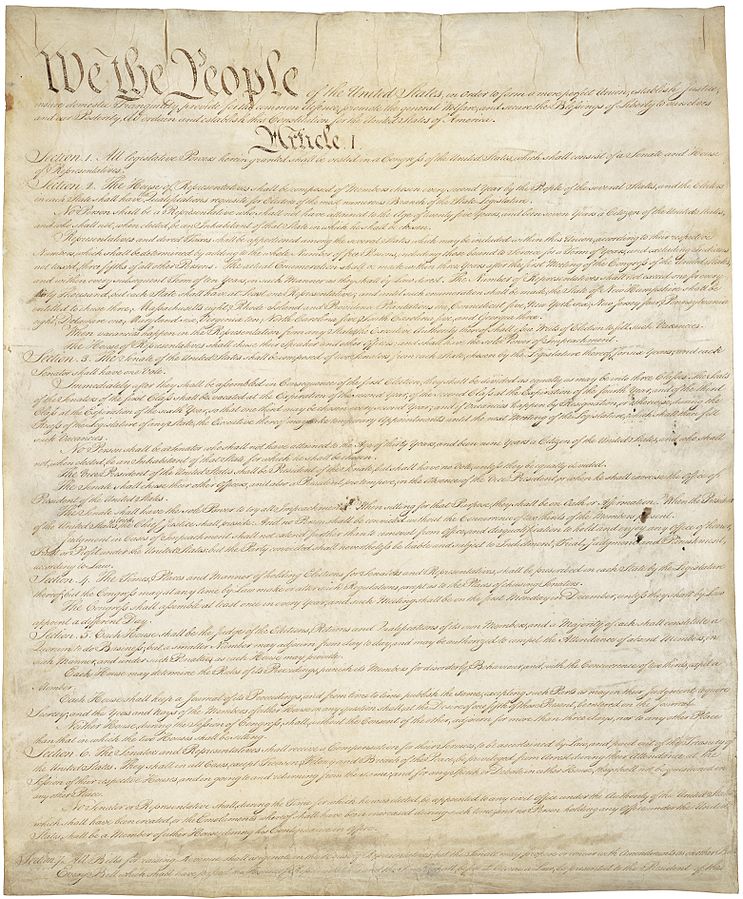
(Image of first page of the US Constitution via Wikimedia Commons)

Learning From Lolita

Grace Boey explores the morality of a number of forms of sexual deviancy, using Vladimir Nabokov’s novel Lolita – in which the thirtysomething professor Humbert Humbert narrates his sexual relationship with a 12 year old girl named Dolores – as a case study of our “unresolved thoughts and feelings” about perversion. She especially notices how many readers of the book simultaneously condemn pedophilia while harboring complicated feelings about Humbert:

[I]t’s easy for readers to experience spurts of sympathy for Humbert. Dolores, after all, was the one who initiated the affair, and she was hardly unacquainted with sex when she did it, having lost her virginity at a summer camp to a young man named Charlie Holmes. Humbert paints a portrait of himself as an unwitting accomplice to the entire affair, seduced by a manipulative nymphet who was all too good at getting what she wanted. He appears, as well, to fit the criteria for pathological pedophilia or hebephilia, having exclusively been attracted to young girls from the start. Humbert, it seems, was set up for depravity from the start. It is completely natural to pity anyone set up for desires that are so strong, yet so utterly wrong and harmful.

Yet make no mistake:

despite his efforts to portray otherwise, Humbert knew exactly what he was doing when he acted upon his desires, and had numerous opportunities to remove himself from the situation long before his temptress made her advances. And the fact that she advanced upon him is of no consequence: she was still a child with a child’s mentality (as he himself observed numerous times). As the party with more experience and more power, Humbert should have known better than to succumb—and it is here that the immorality of Lolita lies.

As the novel progresses, it becomes sadly obvious that young Dolores was not fully cognizant of her best interests when she initiated the affair. Along the way she becomes irreparably damaged by their relationship: she learns to view sex as a transaction, and enters a confusing cycle of resentment and dependence on Humbert that characterizes so many real-life cases of child sexual abuse. Dolores, in the end, escapes to land up broke and pregnant in a clapboard shack, dying at the age of 17 after a stillbirth on Christmas day.

(Video: Scene from Stanley Kubrick’s 1962 film adaptation)

Saving Face

When Richard Norris was 22, he shot himself in the face. In 2012, he received a full facial transplant from a recently-deceased 21-year-old man. In a fascinating profile, Jeanne Marie Laskas describes meeting Norris:

He seems nervous. His hands tremble, bringing constant sips of water to his mouth. His lips can’t quite grip the bottle, so each sip is more a little pour. He fights a constant drool with the help of a towel. His new face is a marvel nonetheless. It’s a new face. Wide and open, the cheekbones of an Irishman and the wrinkle-free complexion of a college kid. It’s difficult to reconcile the youthful face with the body of a man nearly 40. I am trying not to stare. I am trying to stop looking for the seams, where the new connects to the old, the eyelids, the neck, the scar in front of his ears. I am trying to stop thinking about his beard, which isn’t really his beard, except now it is, and it grows. I’m distracted by a thousand little thoughts like these. Coupled with his lack of facial expression—a solid, largely unmoving veneer—in all these ways the barrier to getting to know Richard feels to me immediately and appreciably steep.

Norris now takes medicine “to keep his immune system at 50 percent strength—just enough to ward off common viral and bacteria infections but not so strong that his own antibodies attack his new face”:

“He’s not supposed to smoke,” his mom says. He can’t get sunburn. He can’t get a cold. He can’t drink. He can’t fall and risk injury. He can’t afford to tax his immune system at all. Even a cut could trigger rejection. It starts as a blotchy rash; it means his body is winning the fight to reject the transplant, and Richard has to be flown to the hospital to receive rounds of emergency drugs intravenously. Uncontrollable rejection would mean an almost certain death; the only things left of Richard’s old face are his eyes and the back of his throat. Everything else is now gone for good. “I have to keep watch that his face doesn’t go yellow,” his mom says. “He’s had two rejections so far.”

“I’ll leave you two talking,” Richard says, and he heads outside for a smoke.

In Praise Of The Unknowable

Pivoting off a recent NYT piece on the (un)knowability of the laws of nature, physicist and natural philosopher Marcelo Gleiser revisits the core of his book The Island of Knowledge:

The main point is that it is naïve to believe we can have such a thing as complete knowledge of nature. There are two essential reasons for this belief. The first is simply that to make models of nature we need data. This data comes from tools of all kinds, from microscopes and particle detectors to telescopes and mass spectrometers. Any tool has limits of precision and range. Hence, we are always partially myopic to what goes on. Tools can and will improve. But some shortsightedness will always be unavoidable.

The second reason is that nature itself operates within certain limits: the speed of light and the finite age of the universe delimit how far we can see in space and limit causal relationships; quantum uncertainties delimit what we can say about the position and velocity of submicroscopic objects, and imply in nonlocal correlations through entanglement; math itself has its limits, as Kurt Gödel explores in his incompleteness theorems. The same is true with computers, from Alan Turing‘s undecidability theorem.

His bottom line:

Unanswerable questions invoke a feeling of humility, of how science is, in essence, an ongoing mosaic of ideas, a self-correcting narrative of what we can gather of physical reality. This is far from a defeatist view; in fact, it is liberating. What could be more exciting for us to realize that knowledge is an endless frontier?

Getting Paid For The Gift Of Life

Kara W. Swanson, author of Banking on the Bodycontends that “the simple pay-suppliers/don’t-pay-suppliers approach to thinking about body products … needs to be replaced with more nuanced thinking”:

Should we treat different types of organs (hearts v. bone marrow) differently? Can we think about compensation schemes that are not free markets, but are managed to support the public goals of increasing body-product supply? Can those schemes protect suppliers and recipients alike by keeping suppliers safe from exploitation, and recipients safe from diseased products? I use history to suggest that the answers can sometimes be yes. Body products used to be routinely paid for, and doctors thought about these potential problems and addressed them. Over time, we have forgotten this past, and come to assume that buying body products is always dangerous and bad.

I like to remind people that lots of altruistic gestures are compensated—the doctors, and nurses, and everyone who works on a transplant operation are all in caring professions. They are doing those jobs because they want to help people (at least we hope and assume so). But we wouldn’t suggest that they shouldn’t be paid because to offer payment for such efforts would be insulting or immoral or cause their altruistic tendencies to be replaced by mercenary concerns.

Yet that is how we treat organ supply—that offering money would do all those bad things. Why should the supplier of a body product be the only person in that life-saving supply chain who is not compensated? People might choose not to be compensated, but if they want to be, and if more folks will act as suppliers with that incentive, why not?

The Dish has covered these questions extensively over the years.

“The Supreme Art Form”

Roger Scruton nominates opera, hailing it as “not so much a representation of human life as a redemption of it. For dramatic music can rescue our feelings from their randomness, and vindicate our immortal longings in the face of chaos and decay”:

The complaint was already made in Monteverdi’s Venice that singing detracts from the realism of the stage. The verismo of Verdi was a response to this complaint, an attempt to tie the melodic moment to the particular person in a believable situation — and no one can doubt his success in this. But Wagner had another and more persuasive response to those who dismissed his operas as mere fairytales. By lifting everything — character, setting, emotion and gesture — into the imagined space of music, he believed, we achieve another and higher kind of realism. Words and music develop together, and the purpose of both is drama.

Opera conceived as a sequence of arias, loosely joined by recitative, thereafter disappeared. Even Italian composers quietly adopted the Wagnerian ideal, so that by the time of Puccini it was universally accepted that operas should be through-composed, each act working towards its climax by largely musical means, with the musical material constantly reworked in accordance with the logic of the drama. …

Many people have an opera buried within them: so at least I believe. For the inner life is essentially operatic. It sings to itself in many voices, and we strive in our dreams and meditations to bring those voices into line, to turn discord to concord, and conflict to resolution. Precisely because the characters in opera sing their passions, we sense that these passions are really cosmic forces, whose scope is far greater than the mere individuals who represent them. Through opera our inner life is summoned from hidden regions and resolved before us on the stage.

(Video: Overture of Verdi’s La Traviata performed at The Royal Opera House in London in 1994)

Where Are All The Catholic Marriages?

Emma Green takes note of a puzzling trend:

In 1970, there were roughly 426,000 Catholic weddings, accounting for 20 percent of all marriages in the United States that year. Beginning in 1970, however, Catholic marriages went into decades of steady decline, until the turn of the new century – when that decline started to become precipitous: Between 2000 and 2012, Church weddings dropped by 40 percent, according to new data from the Official Catholic Directory. Given other demographic trends in the denomination, this pattern is question-raising: As of 2012, there were an estimated 76.7 million Catholics in the United States, a number that has been growing for at least four decades.

One reason, Green suggests, is “a lack of awareness about the specific doctrinal importance the Church places on marriage”:

“More people are choosing to get married in country clubs and at the beach,” said [the Center for Applied Research in the Apostolate’s Mark] Gray. “A lot of people are unaware of the importance of marriage and the place it has in Church sacramental life … Younger Catholics are probably not going to have a deep awareness about the sacrament of marriage, even if they self-identify as Catholic and [have] religious beliefs.”