Is The Islamic State A State?

by Dish Staff

bbf8f007b

D.B. revisits the question of whether ISIS can really live up to its self-proclaimed “statehood“:

IS’s mission is to create its own caliphate, but until now many of its sources of revenue have depended on its host states. … IS has not proven adept at running anything other than the most basic functions of a state in the past—dispensing justice and, in most cases, providing bread, the staple food. In 2013 in Raqqa it attempted to take over the opposition’s civilian-run local council, which had continued to pay road sweepers and keep ambulances on the road. Locals say it soon handed back control after it failed to deliver, angering residents. The IS model of stealing from and feeding off the Syrian and Iraqi states has worked well so far. But it will become much more difficult for IS to rule its territory if the Damascus and Baghdad governments stop being so helpful.

That’s why a massive humanitarian aid effort is a big part of Zalmay Khalilzad’s suggested action plan for how to defeat ISIS:

The humanitarian catastrophe resulting from the conflicts in Iraq and Syria requires a massive response. This is essential strategically. Friendly countries who host large number of refugees, such as Jordan and the Kurdish region of Iraq are at risk of destabilization. For displaced Sunni Arabs, poor refugee conditions can lead to radicalization and opportunities for IS to recruit them. If we allow IS to exploit this opportunity, the threat could expand exponentially. Moreover, IS is seeking to establish itself as a quasistate, providing humanitarian aid and services in areas it controls. The international community and its local partners must compete for the hearts and minds among refugees and communities seeking protection from or willing to align against IS. This competition will be waged in part in the provision of humanitarian relief and basic services. It is a competition that we must win.

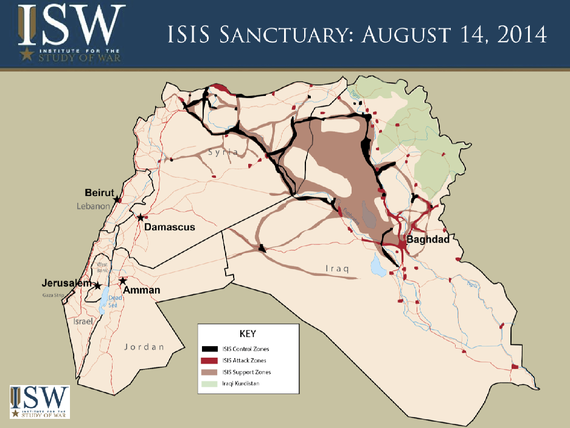
Looking at the varying maps of ISIS’s sphere of influence, such as the one above from the Institute for the Study of War, Kathy Gilsinan asks whether the group really controls all of the territory in which it operates, and whether that matters:

Crucially, while those control zones don’t amount to 35,000 square miles worth of territory, they do encompass major population centers, which tend to be concentrated along major roads. “The aims of the ‘Caliphate’ explicitly include population control, and ISIS has continued to prioritize the acquisition of populated geography,” [ISW Syria analyst Jennifer] Cafarella writes. So the key elements of the Islamic ‘State’ are its network of population centers, oil resources, and military infrastructure, connected by roads. With its territorial expansion, then, ISIS is something more than an al-Qaeda-like terrorist organization enjoying safe haven in a defined geographic area. Syria and Iraq are not sheltering the group as the Taliban did for al-Qaeda in Afghanistan. In some respects, ISIS bears more of a resemblance to the Taliban, which similarly terrorized civilians but, unlike al-Qaeda, held clear, albeit incomplete, sway over a defined territory.

Literary “Self-Segregation”

by Dish Staff

Jess Row ponders why “most white writers, like most white Americans, particularly those over 30, still feel a profound psychic distance between themselves and black people”:

[T]he defining experiences for people my age (that is, Generations X and Y) fall in the tumultous years between 1988 and 1992—the years of Tawana Brawley, Howard Beach, the Central Park Five, and the L.A. Riots—when a furious debate over canonicity and inclusion raged in the academy, when Louis Farrakhan and Al Sharpton came to prominence, Malcolm X superseded MLK, when Ice Cube talked about killing blue-eyed devils, and t-shirts everywhere said “It’s a Black thing…you wouldn’t understand.”

That era seems like ancient history now, but it has everything to do with why American fiction and poetry remain relentlessly segregated spaces, even though many of our greatest and most visible artists are artists of color. For many white Americans, the takeaway message of that complicated time, consciously or sub- or un-, was like a second, post-Civil-Rights response to “The White Negro”: that for a white person to try to say anything meaningful about race, or racism, was not only ridiculous, but shameful, and also somehow dangerous.

Row concludes by addressing a likely counterargument: So what if white writers ignore race?

It’s a valid question, and one I’ve asked myself many times: if the world is full of artists of color talking about race, why do I need to get in on that action? If there’s this vibrant, rich, visceral, scary conversation already underway, who cares if white writers choose not to participate? The best answer I can give, the only honest answer a writer can give, is a selfish one: it’s interesting to me. It’s good material: the tension, the friction, the rich possibilities of embarrassing oneself for a good cause. (As the white rapper Sage Francis says of himself, “Poorly developed, yet highly advanced / the black music intertwined with the white man’s line dance.”) It’s about writing honestly and going deeper into life, yes, but it’s also just a source of happiness. You could even take a cue from Talib Kweli and call it “the beautiful struggle.” For me, it’s been a relief, too: to realize that this bitter earth is the one place we all have standing.

The Sex Offender Next Door

by Dish Staff

Jesse Singal argues that registered sex offenders should be able to live wherever they please:

[L]aws designed to restrict where sex offenders can live are really and truly useless, except as a means of politicians scoring easy political points by ratcheting up hysteria. There are many tricky social-scientific issues on which there are a range of opinions and some degree of debate among experts, but this isn’t one of them. Among those whose job it is to figure out how to reduce the rate at which sex offenders commit crimes (as opposed to those whose job it is to get reelected, in part by hammering away at phantom threats), there is zero controversy: These laws don’t work, and may actually increase sexual offenders’ recidivism rates.

As for where sex offenders do live, Alyssa Coppelman interviews Noah Rabinowitz, who photographed a Florida religious community the majority of whose residents are part of that population:

I read that there’s quite a demand from sex offenders to live there. Have many of the community members lived there long, or do they move on at a certain point?

“The smallest infraction of the community’s rules by one the residents will get them kicked out. Though, it very rarely happens. Only a few miles away, there is a community of sex-offenders, not allowed to inhabit Miracle Village, living under a bridge. Only a small fraction of housing in the state of Florida is available for a convinced sex-offender. Application numbers are very high and admission, based on a voting system, is very selective. Moral and ethical judgments aside, the residents are trying to live out their American Dream, in the only way the law and society will allow. Some discuss their hopes for life after their time in Miracle Village, but many find it to be a safe place and wish to stay.”

A Poem For Thursday

by Alice Quinn

11628223576_21f64aa008_k

Our last selection from Samuel Daniel’s sonnet sequence, To Delia:

When winter snows upon thy sable hairs,
And frost of age hath nipped thy beauties near,
When dark shall seem thy day that never clears,
And all lies withered that was held so dear,
Then take this picture which I here present thee,
Limned with a pencil not all unworthy;
Here see the gifts that God and nature lent thee,
Here read thyself and what I suffered for thee.
This may remain thy lasting monument,
Which happily posterity may cherish;
These colors with thy fading are not spent,
These may remain when thou and I shall perish.
If they remain, then thou shalt live thereby;
They will remain, and so thou canst not die.

For background and context, read my introduction to the first poem from Daniel we featured here.

(Photo by Shaun Fisher)

The Path To Legalization In DC

by Dish Staff

Jon Walker finds a silver lining to gridlock on the Hill:

[L]ast month the House approved the Financial Services and General Government Appropriations bill with a policy rider from Rep. Andy Harris (R-MD) which would prevent D.C. from using funds to implement marijuana reform. It was designed to stop Initiative 71, a local marijuana legalization ballot measure which is expected to win with strong support from D.C. voters this November.

Because of this historic level of dysfunction in Congress this particular appropriations bill is likely to die and all its policy riders will die with it. Instead Rep. Paul Ryan (R-WI) expects that when Congress briefly returns next month they will just pass a clean (meaning policy rider-free) continuing resolution to cover all funding issues until after the election. Professional budget watcher Stan Collender expects that continuing resolution to be followed by yet another one in November to maintain the status quo well into 2015.

He adds that, “At minimum, pushing any final fight about Congress interfering in D.C.’s marijuana laws until after the election should make it politically more difficult to do so.” In a post from earlier this month, Walker laid out why he’s looking forward to DC’s legalization fight:

Racial justice will be front and center – “The overarching theme of the campaign is Legalization Ends Discrimination,” Dr. Malik Burnett, the D.C. Policy Manager from the Drug Policy Alliance told me. “We are looking to have Washington D.C. be the first jurisdiction to legalize marijuana in a racial justice context.”

The huge racial disparity in marijuana arrests has helped galvanize support for reform across the country, but while the issue has played a role in the other legalization initiative campaigns so far it hasn’t been the top message other places for a simple reason. In Colorado (4.4%), Washington State (4.0%), Oregon (2.0%) and Alaska (3.9%) the African-American population is well below the national average of 13.2%. By comparison roughly half the people living in D.C. are black. In addition D.C. has a history of some of the worst racial disparity in marijuana arrests anywhere in the country. The ACLU found that nationally Blacks were 3.73 times more likely to be arrested for marijuana than whites, but in D.C. the disparity was an incredible 8 to 1.

The Plight Of The Yazidis Isn’t Over, Ctd

by Dish Staff

While the White House views the operation to break the siege on Mount Sinjar in northwestern Iraq as a success, Spencer Ackerman, Mona Mahmood and Kenton Powell report that as many as 4,000 displaced Yazidis remain on the mountain and are looking for help in driving out the ISIS militants who still threaten their homeland:

The Pentagon estimated two weeks ago that 4,000 to 5,000 people remained on the mountain, and says it cannot offer a more current estimate. The US Agency for International Development assesses that perhaps 2,000 people do not intend to leave. The United Nations mission to Iraq pegged the residual population at “a few hundred who did not want to leave,” said spokeswoman Eliana Nabaa. Although Barack Obama said US warplanes and Kurdish forces “broke the siege of Mount Sinjar,” Isis fighters remain, confronted by a small and desperate Yazidi force. “We need weapons now more than food or water,” Salim Hassan, a Yazidi fighter on Mount Sinjar, told the Guardian.

Ford Sypher provides a grim update on the Yazidi women who were kidnapped by ISIS, who are reportedly being sold as sex slaves or subjected to gang rape in the Mosul prison where they are held:

Survivors who managed to escape from ISIS say the women held in its prison in Mosul face two fates: Those who convert to Islam are sold as brides to Islamist fighters for prices as low as $25, and ranging up to $150. Those who do not convert face daily rape and a slow death.

Accounts of the prison have come from women who managed to hide their cellular phones, calling relatives to describe their plight. Some imprisoned women have been forced by militants to call their families. The mother of one woman still held captive told The Daily Beast about the call she received from her daughter. She was forced to listen as her daughter detailed being raped by dozens of men over the course of a few hours. Still other women testified that multiple children had been born under these conditions, with the newborns ripped away from their mother’s arms to fates unknown.

Nine-Year-Olds And Uzis Don’t Mix

by Dish Staff

Uzi

Dish alum Katie Zavadski brings us up to speed on a tragic story:

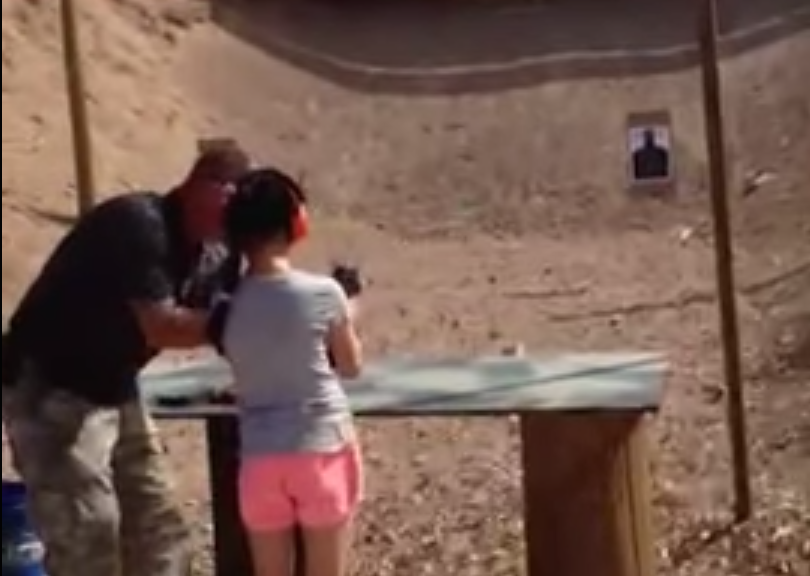
A young girl sporting pink shorts and a long braid fatally shot her gun instructor on Monday, after the weapon she was firing recoiled in her hands. Charles Vacca, 39, died at a Las Vegas hospital that night. The 9-year-old child, whose name has not been released, was on vacation with her parents when they stopped by a gun range. The range allows children as young as 8 to shoot weapons, provided that they are accompanied by an adult.

Charles Cooke, no enemy of the second amendment, observes that normally “smaller people — especially children — are restricted to smaller weapons that are commensurate with their size”:

When American children used to go to school with a rifle slung over their back, it was almost certainly a low-powered .22. There weren’t many Tommy Guns in American classrooms. An Uzi, on the other hand, seems to be the worst of both worlds – especially when it is chambered in a larger caliber. Because their recoil tends to push the weapon upwards, handguns are inherently more difficult for young people to control. This is especially so when they keep firing upon a single trigger pull. Frankly, it is difficult to imagine a gun less suited to a small girl.

Paul M. Barrett joins the conversation:

Does the Arizona episode mean we live in a whacko gun culture? Those saying yes are going to remind you of a 2008 case in which an 8-year-old Massachusetts boy—under adult supervision at a gun club—accidentally shot himself in the head with an Uzi and died. Those saying no, guns are as American as apple pie, will point out, accurately, that for years, the number of accidental shootings has been declining, along with overall gun deaths. By those measures, we’re becoming a safer country, even as some parents defy common sense and put machine guns in the hands of little kids.

The range in question is now considering (yes, merely considering) a height requirement:

Arizona has no age restrictions on firing guns, and Scarmardo’s Last Stop shooting range typically allows kids 8 and older to fire its array of automatic weapons. “It is pretty standard in the industry to let children shoot on the range,” the owner told the Times. “We are working with the Mohave County Sheriff’s Office, and we’ll make a decision if we’ll make any changes after we review all the facts.” The Guardian reports that children are temporarily barred from shooting during the investigation.

(Screenshot from a video released by the police “of shooting instructor Charles Vacca, of Lake Havasu City, moments before he was accidentally shot by a 9-year-old girl he was teaching.”)

The Media’s Racial Slant

by Dish Staff

Alexis Sobel Fitts highlights evidence of it:

In a study of the Chicago broadcast media, a research team found that black defendants were more likely than defendants of other races to be shown through a mugshot rather than a personal picture or none at all. Another study of television coverage found black suspects are twice as likely as white suspects to be shown on camera under police restraint. While it’s difficult to pinpoint whether a particular suspect is being covered more harshly because of their race, taken in tandem this data points to a dangerous precedent: Black men are easily perceived as criminals, disproportionately to the rate they may be committing crimes.

It’s a similar framing to “Missing White Girl Syndrome,” a name coined to reflect the deluge of coverage when a young, affluent, white female goes missing—and the dearth of coverage when children of color disappear. Entities like the “Black and Missing Foundation” and shows like TVOne’s Find Our Missing are attempts to fill in the gap publicizing missing children who are not white. Scanning the faces of the missing children on these sites comes closer to the reality of the racial breakdown of missing persons: About 34 percent of missing persons overall, and 37 percent of missing minors, are black, according to FBI statistics from 2013. Who media coverage chooses to cast as victims, and what victims—like Brown—don’t fit neatly into the role, has a powerful effect on the mindset of the public who watch these reports and take with them a subliminal idea of what someone who might be victimized looks like.

Yep, This Sure Looks Like An Invasion, Ctd

by Dish Staff

image_thumbnail

Evidence is mounting that Russia has launched an outright invasion of Ukraine:

In Brussels, a Nato military officer told Reuters that the alliance believes there are now more than 1,000 Russian soldiers fighting in Ukraine. Russia has repeatedly denied it is fighting in Ukraine, and speaking after the Minsk negotiations, Putin said that a solution to the crisis in east Ukraine is “not our business; it is a domestic matter for Ukraine itself”. He said all Russia could do was “support the creation of an environment of trust”. … Russia’s denials appear increasingly flimsy.

When the Guardian saw a Russian armoured column cross the border two weeks ago, the foreign ministry and local security services denied any incursion had taken place, saying it was a border patrol that had not strayed into Ukrainian territory. Earlier this week, when Russian paratroopers were captured well inside Ukraine, sources in the defence ministry also said they had been part of a border patrol that had got lost and entered Ukraine “by accident”. The head of the self-declared Donetsk People’s Republic, Alexander Zakharchenko, admitted on Thursday that there are serving Russian soldiers among his fighters, but claimed they were volunteers who were taking a holiday in the region.

The Interpreter’s live blog flags a NATO release of satellite imagery purporting to show Russian artillery in Ukrainian territory a week ago:

Dutch Brigadier General Nico Tak, director of the Comprehensive Crisis and Operations Management Centre (CCOMC), Allied Command Operations said the images confirmed what NATO and its Allies had been seeing for weeks from other sources. “Over the past two weeks we have noted a significant escalation in both the level and sophistication of Russia’s military interference in Ukraine,” said Brigadier General Tak. “The satellite images released today provide additional evidence that Russian combat soldiers, equipped with sophisticated heavy weaponry, are operating inside Ukraine’s sovereign territory,” he said. These latest images provide concrete examples of Russian activity inside Ukraine, but are only the tip of the iceberg in terms of the overall scope of Russian troop and weapons movements.

Lest anyone forget, Ilya Somin stresses that Russia already invaded Ukraine a while ago:

In the discussion over whether Russia has “invaded” eastern Ukraine in recent months, few mention that it already invaded Ukraine in a more blatant way months ago, and continues to occupy a large swath of Ukrainian territory. While Putin’s efforts to aid the brutal separatists in Eastern Ukraine are reprehensible, at least the West continues to oppose them, and Ukrainian forces may well defeat the separatists before Russia is willing or able to provide them enough assistance to save them. By contrast, little effort is being made to challenge Putin’s annexation of Crimea -a much more flagrant invasion that has largely become a fait accompli. It may be that nothing can be done to reverse it, at least in the short term. But we should at least remember the true nature of what has happened, and look for opportunities to change it in the future.

Dmitri Trenin hopes a peace deal is in the offing sooner rather than later:

Any future settlement would probably have to include Kiev engaging in a serious political dialogue with the eastern regions, and adjusting its nation-building policies to take into account Ukraine’s diversity. Wide-ranging amnesty would be granted to the participants in the conflict. It would also need to include Russia’s acceptance of Ukraine’s European choice, and specifically its association with the EU. NATO membership for Ukraine, by contrast, would remain out of reach to Kiev—more as a result of a German veto than a product of Ukraine’s federalization. Ukraine would not become a formal federation, but the “unitary nature” of its state would allow a significant degree of decentralization, including in economic, financial and linguistic issues. At some point, Russia and Ukraine would settle for a mutually acceptable gas price, with the EU guaranteeing the gas transit across Ukraine, and the case against Gazprom would be withdrawn from the Stockholm arbitrage.

A deal along the lines described above may look too unpalatable to many people. However, the absence of any deal deemed minimally acceptable to all sides would steer Europe toward an abyss.