Frum, Fallows And The Integrity Of Journalism

Well worth your while. Money quote:

Respect is called for. For all their blind spots and flaws, reporters on the scene are trying to see, so they can tell, and the photographic and video reporters take greater risks than all the rest, since they must be closer to the action. For people on the other side of the world to casually assert that they’re just making things up—this could and would drive them crazy. I’m sure that fakery has occurred. But the claim that it has is as serious as they come in journalism. It goes at our ultimate source of self-respect. As when saying that a doctor is deliberately misdiagnosing patients, that a pilot is drunk in the cockpit, that a lifeguard is purposely letting people drown, you might be right, but you had better be very, very sure before making the claim.

Headline Of The Day

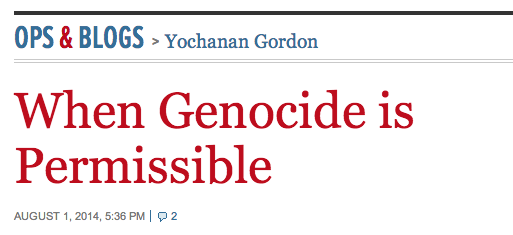
From the Times of Israel:

yochanan-gordon-headline

Money quote:

History is there to teach us lessons and the lesson here is that when your enemy swears to destroy you – you take him seriously. Hamas has stated forthrightly that it idealizes death as much as Israel celebrates life. What other way then is there to deal with an enemy of this nature other than obliterate them completely? …

I will conclude with a question for all the humanitarians out there. Prime Minister Benjamin Netanyahu clearly stated at the outset of this incursion that his objective is to restore a sustainable quiet for the citizens of Israel. We have already established that it is the responsibility of every government to ensure the safety and security of its people. If political leaders and military experts determine that the only way to achieve its goal of sustaining quiet is through genocide is it then permissible to achieve those responsible goals?

Update: The Times has now taken down that blog post. A reader notes:

I think it’s important to mention that the paper removed Yochanan Gordon’s reprehensible piece “for breaching … editorial guidelines.” You might also want to mention that this was a blog post, not an article in the paper itself. You would know better than I how much vetting papers do of such posts, but I suspect in this case that very little (if any) review was done in advance.

A Status Quo Jobs Report

Jobs By Month

Suzy Khimm summarizes today’s numbers:

The U.S. economy added 209,000 jobs in July, and the unemployment rate rose slightly to 6.2%. It was the sixth straight month that the economy added more than 200,000 jobs, suggesting that the labor market is recovering steadily, though the report was slightly below economists’ predictions of 230,000 new jobs in July.

The last time the economy added 200,000 jobs every month for six months was 1997. Nonetheless, Ben Casselman posits that the “report shows a job market on cruise control, neither losing ground nor accelerating”:

Whether that’s good news or bad is a matter of perspective. On the one hand, the job market is, by pretty much any measure, the healthiest it’s been since the recession ended five years ago. Growth has topped 200,000 jobs for each of the past six months, the first time that’s happened in the recovery. Unemployment, despite July’s modest increase, has been falling steadily, and layoffs recently hit a 14-year low. Hiring has been fairly broad-based in recent months, with sectors that have been strong throughout the recovery, such as health care and energy, remaining so, while long-time laggards such as manufacturing and construction are showing signs of a rebound. Even the government has been adding jobs in recent months.

Yet for all that progress, the job market has never found a higher gear. Employers have added about 2.6 million jobs over the past year, a rate of hiring that’s risen slowly if at all over the past two years. That growth hasn’t been enough to generate meaningful wage growth — average hourly earnings were up just a penny in July — or to put the long-term unemployed back to work.

Mark Whitehouse focuses on the lackluster wage growth:

Overall, the pace of wage growth in the private sector has been remarkably slow and steady: Hourly earnings rose at an annualized rate of 2 percent over the past three months, roughly the same as over the past year and since the beginning of the recovery in mid-2009. That’s just enough to keep up with consumer price inflation, which has run at an average annual rate of 2 percent since mid-2009. … All told, though, wage gains have been meager, and still trail far behind the pace at which workers’ output per hour has increased during the recovery. A bit more of a raise should be nothing to worry about.

Vinik gives the report a once over:

On the surface, this was a soft report, but it’s not that bad as you dig deeper. The unemployment rate rising to 6.2 percent may not seem like a good thing, but it’s completely expected. As the economy continues to recover, it will draw back in workers to the labor force who had previously given up looking for work. That’s exactly what we see in this report, as the labor force participation rate rose to 62.9 percent. … It’s important to keep this all in perspective. Monthly reports are very noisy and the BLS will revise the July numbers over the next two months. A good way to cut down on that noise is by using a three-month moving average. When you use that, you see that the past few months really have seen a slight improvement in the economy:

Rolling Average

Jordan Weissmann looks on the bright side:

[A]s the Washington Post’s Zachary Goldfard notes, we’ve now managed to add at least 200,000 jobs for six months straight—the first time that’s happened since 1997. The feat was more impressive back then, since the economy and the job market were smaller. But the employment recovery has trucked along at a fairly respectable pace through a winter during which the economy shrank, and a spring in which it grew at a surprisingly quick 4 percent rate.

Neil Irwin’s read on the report:

Nothing about these numbers should change your basic assessment of how the economy is doing, unless you had some outlandish view of how the economy was doing to begin with. Gradual, steady expansion in the job market, and the economy more broadly, continues apace.

Drum’s bottom line:

Overall, the economy still appears to be dog paddling along. GDP growth is OK but not great; jobs growth is OK but not great; and wage growth is positive but not by very much. More and more, this is starting to look like the new normal.

(Chart from Irwin)

Ceasefire

What was supposed to be a 72-hour ceasefire in Gaza was broken almost as soon as it started. Haaretz has live updates on the status of 2nd Lt. Hadar Goldin. Goldblog fears the conflict is about to get worse:

It is too early to say anything definitive about the Hamas decision to apparently break the ceasefire and attack an Israeli position, except that if it is true, as reports indicate, that Hamas militants came through a tunnel and carried underground and back into Gaza a live Israeli captive, then this moment could represent not another terrible, dispiriting incident in a terrible, dispiriting mini-war, but a fairly decisive turning point in which all swords are unsheathed.

This is assuming—as seems probable, but not 100 percent certain—that this raid is even what the Hamas leadership wanted (for what it’s worth, its leaders, at the moment, seem to be owning this raid, suggesting that they are indeed doubling down in their war on Israel). If the events of earlier today happened as initial reports depict, then Israel will consider this incident an engraved invitation from Hamas to launch something close to a full-scale invasion of Gaza.

Keating also sees the soldier’s capture as a potential game changer:

A few days ago, it seemed possible that Israel might be on the verge of simply declaring its military goals accomplished and pulling out. But rescuing a prisoner likely being held somewhere underground in Gaza is going to take a lot longer than simply destroying tunnels. The violence seems likely to continue for some time now, and a long-term reoccupation of Gaza—a scenario called for by some senior Israeli officials—now seems a lot more likely than it did a few days ago.

This iteration of the long-running Israel-Hamas conflict seemed as if it was likely to end with cease-fires and a return to the grim status quo after a few weeks, like previous iterations in 2008 and 2012 had. But it’s starting to look like we’re witnessing something much worse.

Furthermore, holding a prisoner gives Hamas newfound leverage:

[F]or militant groups like Hamas, one captured Israeli soldier is vital currency. Israel rebukes Hamas for not accepting the offer of ceasefires brokered by outside parties, but the ceasefires on offer did nothing to satisfy Hamas’s longstanding demands regarding the release of Palestinian prisoners (including some who were re-arrested after being freed in the exchange for Shalit), the loosening of border controls in heavily blockaded Gaza and the payment of salaries to some 40,000 public employees in Gaza. … Hamas was not in a particularly strong position to win any of its demands — that is, until it claimed to have captured another Israeli soldier.

But Saletan senses that Israeli mission creep was already underway:

First the IDF was just going to hit Gaza from the air. Then it went in on the ground, but Israel assured everyone that the target was just the tunnels. Then Hamas killed a bunch of Israeli soldiers in a surprise attack, and Israel retaliated with widespread shelling. This week, the Israeli air force has been hitting 100 to 200 targets a day. How does that fit a campaign against tunnels? The strikes are on suspected weapon storage sites and “homes of terrorists.” Israel keeps moving the goal post, redefining the conditions that would meet its vague objective of “sustainable quiet.” That’s the beginning of mission creep. Where does it end?

Of course, Netanyahu can do more or less whatever he wants, considering that support for the war among Israeli Jews is practically unanimous:

The Israel Democracy Institute, a non-partisan Israeli think tank and polling outfit, conducts a monthly poll of Israelis on peace and security issues. Unsurprisingly, July’s poll focused on the war in Gaza. It asked Jewish Israelis (Israeli Arabs were not polled), during both the air and ground phases of the campaign, whether they thought the Israeli operation was justified. It also asked whether they thought the Israeli Defense Forcers were using too much, too little, or the right amount of force.

The results are staggering. An average of 95 percent of Israeli respondents say they think the operation is “completely” or “moderately” justified. About 80 percent say it is “completely” justified. For some perspective, about 72 percent of Americans supported the 2003 Iraq invasion when it was launched. Israeli discontent “spiked” — to about 7 percent — just before and at the launch of the ground invasion, on July 16–17. After the ground invasion was underway, on July 23rd, Israelis supported the war by a 97 to 2 margin.

That’s almost as unanimous as the US Congress.

(Update: This tweet that was originally embedded above indicated that the Israeli soldier is the grandson of the defense minister’s uncle, something reported by Channel 4 and passed along by Newsweek. But the Channel 4 piece now has no mention of the alleged familial tie, so we removed the tweet.)

John Brennan’s Latest Lie, Ctd

Yesterday, Brennan admitted that the CIA snooped on the Senate Intelligence Committee. Froomkin, like yours truly, calls for his resignation firing:

Figuring out how to right the constitutional imbalance between the branches of government, as exposed by this CIA assault on Congress, is very complicated. But doing something about lying isn’t. You need to hold people accountable for it.

Senator Mark Udall also wants Brennan gone:

Udall’s statement is noteworthy in particular because he is fighting one of the most CIA Director John Brennan Speaks At The Council On Foreign Relationscompetitive Senate races this year. The first-term senator is neck-and-neck with Rep. Cory Gardner in a campaign that may determine control of the Senate in 2015. While the Rocky Mountain State’s electorate is certainly more libertarian-leaning than the mean and Udall has long been a vocal civil libertarian, it’s still noteworthy that a candidate in a swing state is taking such a firm stance on this issue. It shows the sea change in American political attitudes around surveillance and the general conduct of the war on terror over the past decade as both parties have become more dovish and more skeptical of the intelligence community.

Benjamin Wittes, who is generally supportive of government surveillance, chews out the CIA:

Improper access to oversight committee computers? Filing a crimes report lacking factual support—apparently misleading the lawyer who filed it in the process? Improperly accessing committee staff email? And then talking to investigators about the whole business in a fashion less than truthful? It’s an ugly picture, utterly unlike the recent NSA scandals in apparently involving all sorts of violations of the rules. And it will have repercussions, as it no doubt should.

Friedersdorf thinks Brennan knows too much to get canned (which only increases the necessity of doing it):

Perhaps Obama has always believed and continues to believe that Brennan is doing a heckuva job. But just as secret torture acted as a cancer in the U.S. government, encompassing acts so barbaric and criminal that, even recently, the CIA spied on a Senate subcommittee investigating the subject, America’s semi-secret policy of semi-targeted killing rendered everyone involved complicit in activities sufficiently dubious that all desire their secrecy. Would you fire a guy who knows as much about your most morally fraught acts as Brennan knows about who Obama has killed in secret? Yeah, me neither. This isn’t the biggest cost of presidents who hide arguably illegal actions by declaring them state secrets. But it is certainly one of the costs.

Corn wonders why Brennan lied:

Why did he put out a false cover story? Was he bamboozled by his own squad? Was he trying to stonewall?

Drum is underwhelmed by the Senate’s response:

If this affair had persuaded a few senators that maybe our intelligence chiefs are less than totally honest about what they do, it might have done some good. But it doesn’t seem to have done that. With only a few exceptions, they’re outraged when the CIA spies on them, but that’s about it.

Noah Rothman expects a major conflict:

The outrage over the CIA’s claimed abuse of authority was bipartisan. Sen. Lindsey Graham (R-SC) called the allegations against the spy agency “dangerous to a democracy.” “Heads should roll, people should go to jail, if it’s true,” Graham said at the time. “I’m going to get briefed on it. If it is, the legislative branch should declare war on the CIA, if it’s true.” War, it would seem, is imminent.

I wouldn’t hold my breath. But I’m hoping.

(Photo by Chip Somodevilla/Getty Images)

Cruz Missile Shoots Down Border Bill

The House’s modest emergency spending bill to address the child migrant crisis was scuttled yesterday after the GOP leadership failed to convince the Tea Party caucus to vote for it. I harrumphed about it last night. Cillizza breaks down how it happened, for anyone who can’t already guess:

The failure of the GOP leadership’s immigration solution fits a now-familiar pattern for congressional Republicans. Led by Boehner, the party’s top brass fight with President Obama on the parameters of a legislative solution to a problem in the country.  In hopes of answering the “do nothing” charges leveled at them by Democrats, those same GOP leaders put a proposal on the table that offers a handful of concessions but nowhere near the number the White House is demanding. The tea party faction in the House — led by Sen. Ted Cruz (yes, you read that right) — balks, demanding that the GOP make no concessions of any sort to the president. The party leaders whip support for the bill but, ultimately, find that 20 (or so) of their conference will not be for it under any circumstances. That means Boehner either has to a) pass legislation with Democratic votes or b) pull proposals off the House floor to avoid embarrassing losses.

The issues change — tax increases, immigration, the farm bill and so on and so forth — but the underlying reality remains the same: House Republicans simply cannot be led.

Chait, too, has seen this show before:

The House is a highly autocratic chamber that traditionally passes basically anything the leadership of its majority party wants to pass. The Tea Party has changed all that, by bringing to Washington a large enough bloc of Republicans who don’t want to vote for anything that they can bring down even bills that are far too conservative to be passed into law. That’s why House Republicans have had to pull bills to lift the debt ceilingextend tax cutsextend farm subsidies, and reopen the government. In Boehner’s House, failure is always an option.

This particular bill pitted the GOP’s desire to actually stop waves of illegal immigration children from streaming across the border — theoretically a point of bipartisan agreement — against their distrust of Obama in particular and legislation in general. Republicans dealt with the problem, as they often do, by crafting the most conservative possible bill — thus losing all Democratic support — yet still not often to win support from enough Republicans.

Vinik looks at the role Cruz played:

Since his election in 2012, Cruz has angered a number of his Senate colleagues. He was the architect of the “defund Obamacare” movement last year that ended in a politically toxic government shutdown and eventual Republican capitulation. In February, Cruz forced some of his Republican colleagues to take a politically-damaging vote to raise the debt ceiling. In all of these situations, Cruz has been focused on his own political future, staking out a position as far to the right as he can. He didn’t care that his antics damaged the party. They were good for Ted Cruzand that’s what mattered.

That’s what happened again on Thursday with the House GOP’s bill to address the border crisis. And it’s going to continue happening in the future, particularly on immigration-related issues where Cruz has always taken a hard line position.

Ben Jacobs remarks on what a blow this is to the party leadership:

The failure of the vote, which comes just before Congress’s August recess, means it is unlikely that any additional funds will be allocated to deal with the border crisis until September at the earliest—and also signals the official death of the Senate comprehensive immigration reform bill. It also marks yet another political defeat for Boehner and House leadership in what was the first test of new Majority Whip Steve Scalise, who recently took over the position when former Whip Kevin McCarthy ascended to Majority Leader. McCarthy replaced Eric Cantor, who stepped down after losing his primary last month to anti-immigration candidate Dave Brat.

Scalise, as whip, is responsible for party discipline and making sure that Boehner has an accurate sense of how many votes he has within the GOP caucus on a particular bill. This was the first controversial vote that the Louisiana conservative had to organize Republicans for in his new position, and it’s clear that he wasn’t able to rally as much support among GOP backbenchers as he initially thought.

After the bill failed, Boehner and his deputies suggested that the president take executive action on the crisis instead, which was pure political gold for Democrats, and pretty rich at that:

Democrats got plenty of yuks out of the House GOP’s response to the failure. In a joint statement, the party’s four House leaders attempts to move blame and the buck back over to Barack Obama. “There are numerous steps the president can and should be taking right now, without the need for congressional action,” they wrote, “to secure our borders and ensure these children are returned swiftly and safely to their countries.” Faiz Shakir, an adviser for Harry Reid, immediately tweeted the punchline: “The same people who are suing the president for taking exec action are calling on him to take exec action.” A little cute, maybe, but for the umpteenth time—the first day of a new leadership team!—the House GOP leadership has stepped on a rake.

Noah Rothman is disappointed for reasons of politics, not policy:

Lacking the authority to resolve the border crisis on their own, the House GOP sought an advantageous position for the summer in order to put the onus back on the president. That effort failed and, unless the House Republicans’ emergency scramble to craft and pass some border measure is fruitful, GOP members will spend the summer explaining to the press why they did nothing on a “crisis” but were perfectly united when it came to suing the president. And the average Democratic base voter will be that much more energized for it. …

This was an unforced error. One which serves to elevate the careers of a few while diminishing the party’s overall chances for success in November. The House Republicans may yet correct this mistake, and the damage might be mitigated if they do. But if they do not, this is going to be one long August recess.

But the Bloomberg View editors refocus on the fact that the child migrant crisis is, y’know, a crisis:

The protection of refugees — legitimate and otherwise — is both a moral crisis and a policy challenge. These children are a genuine strain on the immigration system, and adjudicating their cases will cost money. At the same time, many have fled violence and deserve a chance to make their case for asylum. Meanwhile, House leaders have delayed a planned recess, in the apparent hope that they can still achieve the goal of appearing to do something. When members return, Election Day will be that much closer. It’s not easy to imagine that this Congress could reach new lows. But it may.
Best Cover Song Ever?

The contest keeps going and going:

I hope I’m not too late for this one. My nomination is Wilson Pickett‘s cover (with Duane Allman) of the Beatles’ “Hey Jude”:

Normally, I’m a Beatles purist – the idea of a cover simply offended me. Why mess with perfection? Then I heard the Pickett cover on the radio a few months ago and I’ve been totally hooked. Dare I say he “made it better” by speeding up the tempo and getting rid of the “na-na-na-na’s,” which can get tiresome. The horn section that replaces the latter section along with Allman’s guitar riffs transport the song to another dimension.

Another points out, “The Pickett/Allman cover is merely great until about the 2:40 mark, when the two of them decide to put the accelerator to the floor.” Several more submissions after the jump:

The Clash did some amazing reggae covers, especially “Police and Thieves“:

Another throws a curveball:

Miley Cyrus cover of Dylan’s “You’re Gonna Make Me Lonesome When You Go“. She might be batshit crazy, but man if she isn’t an incredibly talented and versatile singer:

Another panders:

You can go ahead and end the contest now (I’ll take a white polo, size small), because I have by far the best cover song of all time.  I nominate Pet Shop Boys’ “Always On My Mind”, a song previously covered by Elvis Presley and Willie Nelson, among many others:

I have to say though, the Pet Shop Boys version is definitely the best one out there and there is no way you won’t declare this one a winner. Plus, this music video is just wonderful with a hilarious performance by Joss Ackland.

It’s hard to beat that Willie version.

Who Wants To Tell A Kid He’s Fat?

Not pediatricians, according to Russell Saunders, who admits, “I absolutely hate talking to patients about being overweight”:

Reading the results of a new study from the Centers for Disease Control (PDF), I couldn’t help but wonder if other medical providers are even more reluctant to talk about weight with their patients than I am. Using survey data collected from children ages 8-15 from 2005-2012, the study finds that roughly a third of children and adolescents misperceive their body status. Only 23 percent of overweight children knew they were heavier than was healthy, and 41 percent of obese respondents thought their weight was about right. …

When overweight children are roughly similar in appearance to many of their peers, it takes someone telling them their weight is unhealthy for them to realize it. Though the study does not report on the reasons for the rate of body status misperception among overweight children, I strongly suspect it’s that those conversations simply aren’t happening. Further, I suspect they’re not happening because they are so challenging. Trying to tell little girls and boys that their weight is too high without making them feel bad about themselves or their appearance is a daunting task. It’s relatively easy to give across-the-board recommendations about what comprises a healthy diet and getting enough physical activity. Discussing what changes a specific child might need to make to get back into a healthy weight range is trickier, and clearly isn’t happening nearly as often as it needs to be.

As important as fostering self-esteem in children is, medical providers cannot be so afraid of damaging it that they sidestep sensitive but clear conversations with patients and their parents when the child’s weight is unhealthily high.

One medical provider who doesn’t have such qualms:

Killing Them Loudly

Joe Zadeh explores the history of sound as a weapon of war:

The incorporation of sound into warfare may sound like a modern tactic, but the first reports have their roots in history. Back in 1944, as World War II slipped through Germany’s fingertips, it was rumoured that Hitler’s chief architect Albert Speer had set up research to explore his own theories of sonic warfare, with the intention of creating tools of death. An episode of  the History Channel’s Weird Weapons claimed that his device, dubbed an acoustic cannon, was intended to work by igniting a mixture of methane and oxygen in a resonant chamber, and could create a series of over 1,000 explosions per second.

This sent out a deafening and focused beam of sound which was magnified by huge parabolic reflector dishes. The idea, apparently, was that by repeatedly compressing and releasing particular organs in the human body, the cannon could potentially kill someone standing within a 100-yard radius in around thirty seconds. Fortunately, the weapon was never actually used in battle. The actual volume of sound frequency isn’t the only way sound has been used in war. In his  2009 book Sonic Warfare, a key body of research in the understanding of contemporary sonic thought, Goodman included a chapter titled “Project Jericho,” which explored the US PSYOPS campaigns during the Vietnam War. Goodman described a particular campaign known as Operation Wandering Soul. The Curdler, a helicopter-mounted sonic device, produced the “voodoo effects of Wandering Soul, in which haunting sounds said to represent the souls of the dead were played in order to perturb the superstitious snipers, who, while recognizing the artificial source of the wailing noises, could not help but dread what they were hearing was a premonition of their own postdeath dislocated soul.”

The Best Place To Weather Climate Change

Cliff Mass nominates the Pacific Northwest:

  • Temperatures will rise more slowly than most of the nation due to the Pacific Ocean …
  • We will have plenty of precipitation, although the amount falling as snow will decline (will fall as rain instead).  But we can deal with that by building more reservoir and dam capacity (and some folks on the eastern slopes of the Cascades have proposed to do exactly that).
  • The Pacific Ocean will keep heat waves in check and we don’t get hurricanes.
  • Sea level rise is less of a problem for us due to our substantial terrain and the general elevation rise of our shorelines.  Furthermore, some of our land is actually RISING relatively to the sea level because we are still recovering from the last ice age (the heavy ice sheets pushed the land down and now it is still rebounding)
  • There is no indication that our major storms…cyclone-based winds (like the Columbus Day Storm)… will increase under global warming.
  • Increased precipitation may produce more flooding, but that will be limited to river valleys and can be planned for with better river management and zoning.

(Hat tip: Ted Alvarez)