by Dish Staff
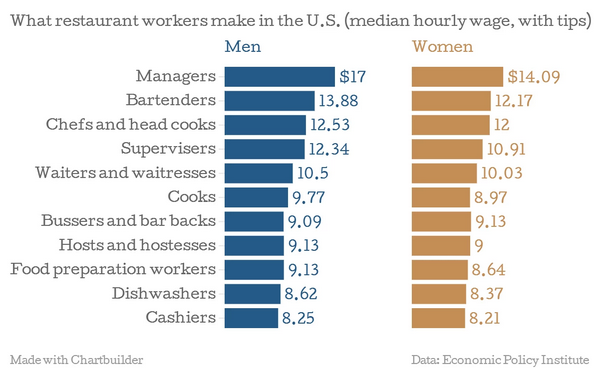
Roberto Ferdman flags a report that reveals gender wage gaps in the restaurant industry, even when tips are accounted for:
The median hourly wage paid to women is less than it is for men in all but one of the eleven jobs surveyed in a report by the Economic Policy Institute. In some cases, the gap is slight—for cashiers, dishwashers, food preparation workers, and hosts and hostesses, it’s a matter of cents. But in others, including supervisors and bartenders, the difference is well over a dollar. For managers, the highest earning occupation, the disparity was nearly three dollars per hour.
“This is what we identify as pay discrimination,” said Valerie Wilson, an economist at the Economic Policy Institute. “The work women are doing is being valued at less than the work men do in the same job.” Women, however, aren’t merely being paid less to do the same job—they’re being paid less and less compared to men as they move up in the ranks, too. Some of the highest earning occupations—managers, bartenders, and supervisors—are also the ones with the largest gender pay gap.
Drum adds his two cents:
There are other reasons besides gender for pay gaps, and the EPI report lists several of them. Whites make more than blacks. High school grads make more than dropouts. Older workers make more than younger ones. You’d need to control for all this and more to get a more accurate picture of the gender gap.
But in a way, that misses the point. There are lots of reasons for the gender gap in pay. Some is just plain discrimination. Some is because women take off more time to raise children. Some is because women are encouraged to take different kinds of jobs. But all of these are symptoms of the same thing. In a myriad of ways, women still don’t get a fair shake.
But that’s not to say that the business is especially kind to men, either. Tom Philpott pulls some other salient findings from the EPI report, which paints a grim portrait of restaurant workers overall:
Restaurant workers’ median wage stands at $10 per hour, tips included—and hasn’t budged, in inflation-adjusted terms, since 2000. For nonrestaurant US workers, the median hourly wage is $18. That means the median restaurant worker makes 44 percent less than other workers. Benefits are also rare—just 14.4 percent of restaurant workers have employer-sponsored health insurance and 8.4 percent have pensions, vs. 48.7 percent and 41.8 percent, respectively, for other workers. …
As a result, the people who prepare and serve you food are pretty likely to live in poverty. The overall poverty rate stands at 6.3 percent. For restaurant workers, the rate is 16.7 percent. For families, researchers often look at twice the poverty threshold as proxy for what it takes to make ends meet, EPI reports. More than 40 percent of restaurant workers live below twice the poverty line—that’s double the rate of nonrestaurant workers.
 The Dish