Larison suspects that it’s inevitable:
Escalation was always very likely, because that has been the pattern in U.S. interventions over the last twenty-five years. Obama already demonstrated in Libya that the U.S. would go far beyond the original stated goals of an intervention, and he is now on record saying that his greatest regret about the Libyan war was that the U.S. didn’t follow it up with a post-war military presence. That should be something to bear in mind when you next hear Obama pledge that there won’t be any American ground forces in combat in this new war. That’s why we should have expected this from Obama, but what made escalation even more likely is that our current political culture and foreign policy debate don’t really permit the U.S. to limit itself to small, achievable goals when it uses force overseas. That is especially true once administration officials irresponsibly stoke public fear about a group being an “imminent threat to every interest we have.” Sooner or later, the mismatch between the administration’s alarmist rhetoric and the initial “limited” action was going to be fixed by adopting a more aggressive policy.
Rich Lowry, for one, is ready to send in the infantry:
ISIL has occupied an enormous amount of territory in Iraq and Syria, including major population centers. That is why it declared a caliphate and why it has unprecedented resources. To defeat it, this territory must be taken back and it is unlikely to happen exclusively from the air—especially in the cities. It will take ground forces.
We hope to work with proxy forces, but they are motley groups that will almost certainly need vetting and advising by special operators working closely with them on the ground. But the president ruled out American ground forces. The cynical interpretation is that he is hoping to do enough against ISIL to satisfy domestic political opinion and keep the terror group at bay until he can hand off an incomplete campaign to his successor, who will be left with the difficult choice of whether to truly defeat ISIL.
James Jeffrey agrees that Obama was wrong to rule out boots on the ground:
[S]ometimes local forces are not enough. U.S. troops have capabilities they cannot approach, beginning with the crucial combat multipliers: “speed” and “decisiveness.” The commitment of even a few U.S. troops with actual ground combat missions signals credibility and seriousness. Such a troop presence can integrate rival local forces (as U.S. joint platoons did with the Kurds and Iraqi Army in 2010-2011), prevent friendly atrocities against civilians, and shape the goals of ground combat.
Still, local forces in Iraq and Syria should be the first choice, with commitment of our ground troops only an emergency contingency. Once in combat they introduce entirely new risks beyond those of drones or F-18 strikes, Special Forces trainers, and Navy SEALs. These risks begin with casualties. Ground combat is bloody. While overall casualty rates are down from Vietnam, thousands have died in each of America’s last two wars, and tens of thousands have suffered serious wounds.
And Dov Zakheim argues that they’re necessary to hold the coalition together:
It is one thing to offer funds or training facilities, which Saudi Arabia is apparently willing to provide. It is quite another to deploy troops. Whether the Saudis, Emiratis, Jordanians, and others will be ready to do so absent American leadership on the ground is at best an open question. It is true that America led a coalition “from behind” in Libya. But that coalition did not commit ground troops; apart from very small numbers of European special forces, it was the Libyan rebels who provided the overwhelming majority of troops conducting operations on the ground against Muammar al-Qaddafi. Moreover, the aftermath of that conflict hardly was a showpiece for coalition operations: Libya is now virtually a failed state.
Morrissey implies that Americans would come around to embrace another land war in the Middle East if only the president had the courage to give us one:
[I]t’s true that a move to send ground troops to deal with ISIS would create a large amount of political backlash, and would also call into question Obama’s endgame strategy in Afghanistan — even more so that ISIS has. If the American public won’t back a decision to put combat troops back into Iraq, then it would take a President willing to go it alone politically at home to give that order, and clearly that’s not the case with Obama. However, a lack of progress against ISIS will play badly for Obama too, and it will sap the resolve of Americans to see the job through to victory. We may end up looking weaker than we do now, especially if we can’t even get our traditional allies on board for just the 30,000-foot tactical decisions.
Highlighting some of the characteristics of the classic neocon freakout over ISIS, Chait observes that among this crowd, there’s no such thing as too much force:
The nub of neoconservatism is a belief that the only possible strategic failure is the insufficient use of military force. This is more of an atavistic reflex than a cogent form of thought. Cruz assails Obama, “Instead he suggested targeted attacks and focuses frankly on political issues that are peripheral from the central question of how we protect America from those who would take jihad to our nation.” Targeted is bad. Political is bad. Protecting is good. Here is [Jennifer] Rubin’s response:
[Obama] insisted, “This strategy of taking out terrorists who threaten us, while supporting partners on the front lines, is one that we have successfully pursued in Yemen and Somalia for years.” But if the Islamic State, which occupies vast territory and is highly trained and very well organized, than I suppose it won’t work.
That is not even an English sentence. Nonetheless, the underlying impulse is clear enough.
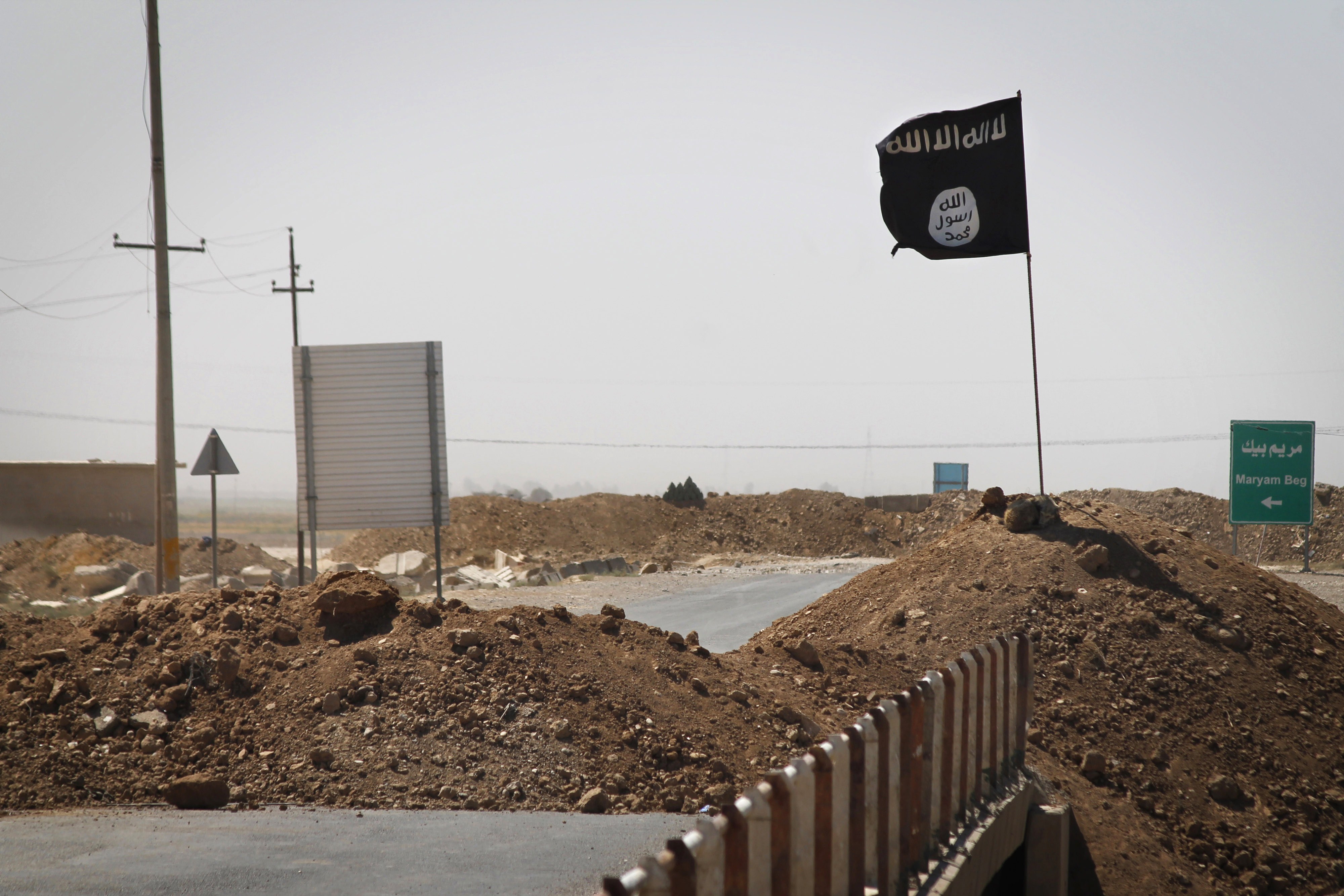
(Photo: A flag of the Islamic State is seen on the other side of a bridge at the frontline of fighting between Kurdish Peshmerga fighters and Islamist militants in Rashad, on the road between Kirkuk and Tikrit, on September 11, 2014. By JM Lopez/AFP/Getty Images)
 The Dish