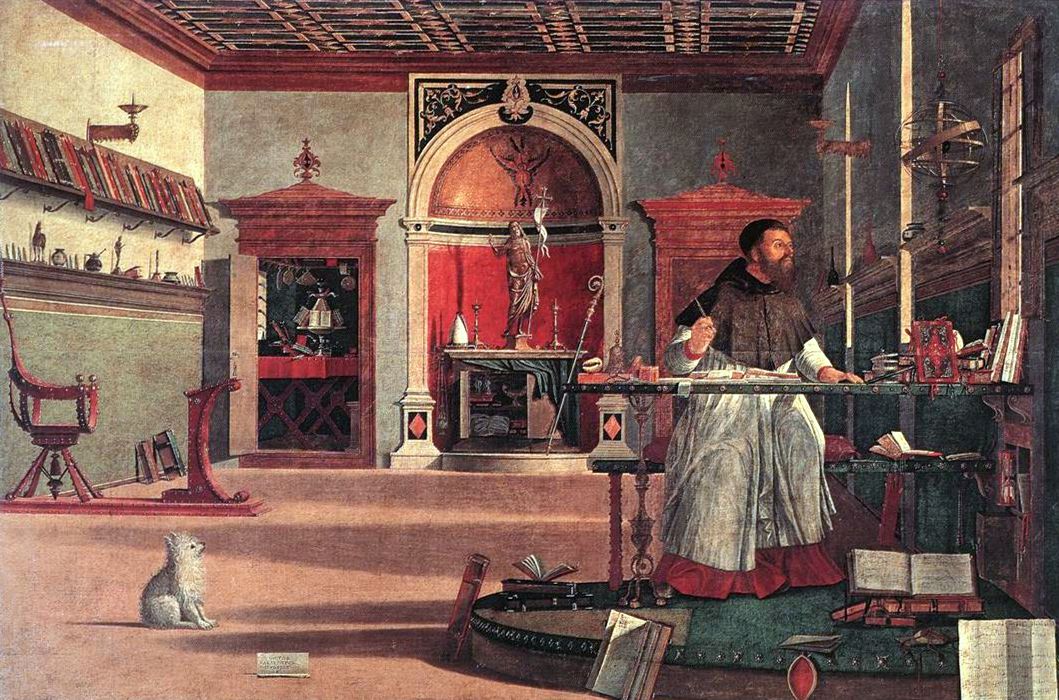
In an essay exploring how Vittore Carpaccio portrayed animal life, Jan Morris turns her eye to “the Carpaccio dog”:
Vittore has been called pantheistic. I am quite sure he revered Nature, anyway, or he could not have painted the birds and beasts as he did. He seems to have loved them in the way Montaigne loved his cat—as equals, unpatronizingly, clear-eyed, never gushingly. Consider the little dog in his celebrated painting concerning Saints Jerome and Augustine, one of the most famous dogs in all art—the Carpaccio Dog, in fact. Nearly everyone wonders what kind of dog he is. Ruskin, in 1851, thought he was exactly like his white Spitz Wisie (which he described, during a nadir in that animal’s career, as being a “poor little speechless, luckless, wistfully gazing doggie”). Pompeo Molmenti (1907) considered him “a lively little spaniel.” Terisio Pignatti (1958) believed him to be a Maltese puppy, and called his coat “fluffy.” So did Kenneth Clark (1977) in his book Animals and Man. I myself though (2014) prefer to think of him as a dog of no particular breed, a tough urchin mongrel, cocky, feisty, and fun, rescued from the street perhaps by one saint or another, and cherished by multitudes down the centuries. To me he is simply the Carpaccio Dog. Doggie indeed! Fluffy my foot! …
In a preliminary sketch for his picture about Jerome and Augustine, the Carpaccio Dog was not a dog at all, but what seems to be a cat, a crouching, weasely thing with a collar around its neck. Having failed so abysmally in this exercise, Carpaccio gave up, turned the animal into a dog and, so far as I know, never tried to paint a small feline again.
(Image: The Vision of St. Augustine, 1502, by Carpaccio via Wikimedia Commons)
 The Dish
