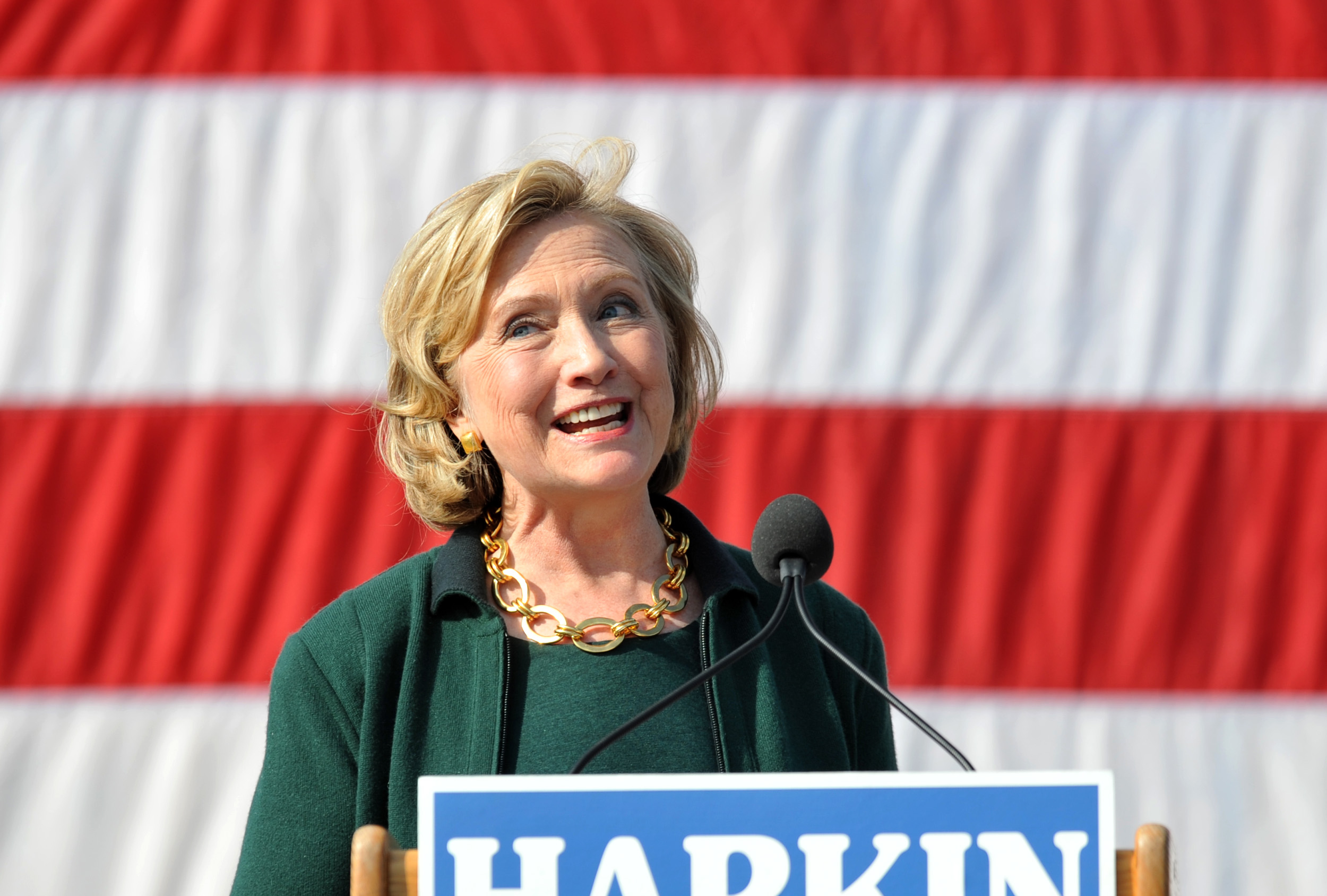
Jay Newton-Small captures the atmosphere at Iowa Sen. Tom Harkin’s Steak Fry, “a Democratic fundraiser that has become known as a presidential launchpad.” Clinton still won’t admit that she wants the presidency:
“Are you running?” reporters repeatedly shout at Hillary. She demurs. She even pretends not to notice when, the event having finally started down the hill, a speaker starts asking the crowd: “Are you fired up? Are you ready to go? Are you ready for Hillary? ARE YOU READY FOR HILLARY?” he screams as the crowd roars.
“Are you ready, Hillary?” a reporter yells. She ignores all this and chats away with Harkin and his wife Ruth.
Ben Smith answers for Clinton – “she’s running”:
Today’s Clinton campaign, like the one back [in 2008], is a tractor trailer moving down the highway, one whose driver — Hillary — can exert some control over its direction and speed, but whose stopping distance is measured in miles, and who can barely control the thing at all once it’s rolling downhill. So the question isn’t what she’s done to run; it’s whether she’s made any effort to hit the brakes, or whether anything has fallen unexpectedly across her path.
Noam Scheiber spots a big chink in Clinton’s armor:
The problem is the general caution that defines her political style.
Of Bill Clinton it was often said that if you put him in a crowded room, he would gravitate toward his harshest critic, determined to win them over. Hillary strikes you as the opposite—the sort who huddles with friends and allies while eying the detractor warily from a distance. The Harkin steak fry speech, and the political strategy it foreshadowed, was basically the rhetorical equivalent of this tic. Hillary’s impulse was to hold close the ideas that have served her well, year in and year out, while steering clear of any possible dissent from establishment opinion. Sensibility-wise, it’s about as far as you can get from where Democrats are these days.
Lexington wonders how Hillary would “govern America at a time of alarming and seemingly insoluble gridlock”:
In his own speech, Bill Clinton tackled this directly. The country was “less racist, less sexist and less homophobic” than it had ever been. It was more diverse than ever before, and more interdependent with the rest of the world (he painted word-pictures of Iowa farmers digitally studying world commodity prices in real-time). Yet more than ever before, Americans did not want “to be around people that disagree with us.” For this reason, it was vital to elect more politicians who went to work without “ears plugged up” and “blinders on”.
Is Hillary Clinton this kind of politician? The question is a serious one, and it is one she will need to answer if and when she decides to run for president. She cannot expect voters to elect her simply because it is “her time”, or because she would be the first woman president (though such arguments were made by a worrying number of those at the steak fry). The idea of being president is not enough to make Mrs Clinton president, in short.
Ana Marie Cox was alarmed by rhetoric of Hillary supporters at the event:
“It’s interesting, but it’s not the main reason I support her,” one male “Students for Hillary” member told me about the idea of a first female president. His companion, a female freshman, was even more cautious: “It’d be nice to see more women in politics,” she said, “But if you push hard for it, it becomes an issue you didn’t ask for.”
Such dry reasoning was unsettlingly common with the student contingent at the steak fry. Unprompted, they offered analysis rather than real reasons for their support. “The Democrats can’t eat their own,” said one of them, serious. “We’ve got to coalesce around Hillary because there’s really no one else, and we can’t let the Republicans win.” It sends a shiver up your spine when a guy who probably isn’t even shaving regularly basically quotes Mark Penn.
(Photo: Former Secretary of State Hillary Rodham Clinton speaks to a large gathering at the 37th Harkin Steak Fry, September 14, 2014 in Indianola, Iowa. By Steve Pope/Getty Images)
 The Dish