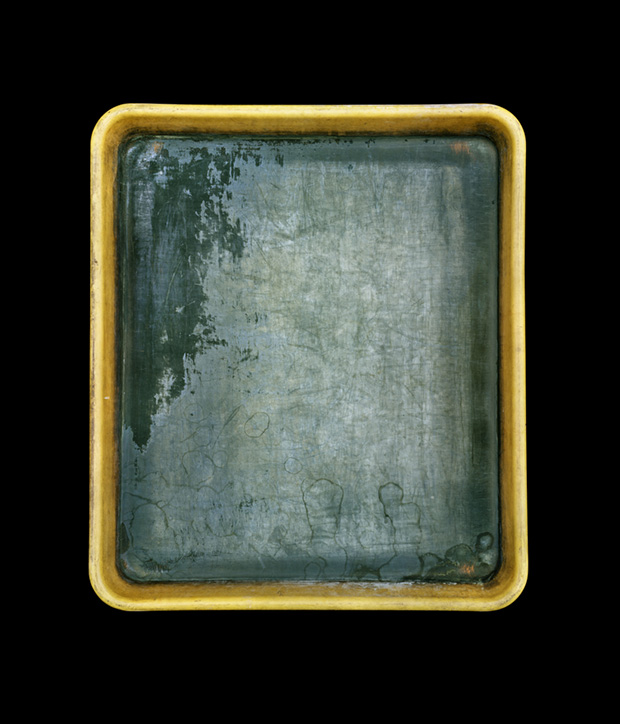
Ellyn Ruddick-Sunstein captions a project by John Cyr:
As analog photography becomes less popular, John Cyr’s Developer Trays read like a love poem to the vanishing medium. For the haunting series, he catalogues the empty developer trays of prolific and renowned photographers, each bearing the marks and stains of chemicals, which emerge like secret data points recording every serendipitous accident of the darkroom.
Through the course of the project, Cyr shot eighty-two trays, contacting photographers, institutions, and estates that held them in their possession. After cultivating a wide network of artists and studios, he turned to more obscure sources, like the relatives or former assistants of deceased photographers. Some photographers sent their developer trays in the mail to be photographed. For this labor of love, Cyr made himself available to travel at a moment’s notice; to view Sally Mann’s tray for example, he drove twelve hours to her Virginia home two days after she responded to his request. To Cyr’s dismay, many established and working photographers no longer had darkrooms and therefore no developer trays.
In a 2012 interview about the project, Cyr spoke about how digital technology has changed photography:
At this point, I can’t think of any analog photographers who haven’t done anything with digital media of some sort. With that said, those who still prefer traditional darkroom prints do so because of the materiality of a silver gelatin print. In one’s digital workflow, an extensive amount of work is performed on a digital file, which can then be printed countless times exactly the same as the first. When making a traditional print, all adjustments are made in the darkroom during the image’s exposure. This results in a unique print that will never be exactly duplicated, no matter how good your printing notes are. It is the objecthood of each silver gelatin print that keeps certain photographers interested in continuing to produce traditional darkroom prints.
Sally Mann’s tray is pictured above. See more of Cyr’s work here, and check out his book here.
 The Dish