Drum is unimpressed by it:
Here’s the nickel version: After months of bellyaching about America’s commitment to fighting ISIS, one single Arab country finally agreed to help out. Only then did anyone else also agree to pitch in. But the extent of their involvement can’t be revealed because it’s a “sensitive operational detail.” Can you guess just how extensive that involvement is? Or do you need a hint?
But Fred Kaplan thinks the coalition is a big deal:
It is highly significant that four Arab nations—Saudi Arabia, Jordan, the United Arab Emirates, and Bahrain—participated in Monday night’s airstrikes and that a fifth, Qatar, supported them. No one has yet said how many bombs the four dropped, or what Qatar’s support amounted to, but it doesn’t matter. During the 1990–’91 Gulf War, these and several other Arab nations, including Syria and Egypt, sent tank divisions and air wings to help push Hussein’s army out of Kuwait. Few of them did much, but the important thing was that they joined the coalition in active force—and, therefore, Hussein could not claim that this was purely a Western, imperialist war. Sending this message is even more important in the fight against ISIS, which bills itself as the Islamic army and its mission as a religious one—the revival of a caliphate. To have Muslim nations, especially Sunni nations, battling against ISIS helps discredit its rationale for existence.
Goldblog also talks up the coalition:
[Obama] has built a formidable alliance of Arab allies to fight Islamic State. Of course these Arab allies are all profoundly threatened by Islamic State and have an incentive to openly align themselves with the world’s only superpower. But the leaders of these countries have until very recently doubted Obama’s commitment to them, and they would not have joined forces with him if they believed he wasn’t in the fight for the long haul.
After long avoiding deeper engagement in Syria and Iraq – for the simple, understandable reason that these countries are seemingly insoluble messes – Obama has pivoted (to borrow a word from another now-dormant foreign-policy debate) in the direction of responsibility.
“Responsibility” is not the word we’d use. Christopher Dickey asks about the coalition’s mission:
Perhaps most striking of all is the absence, in this rump coalition, of the grand pronouncements we heard from earlier U.S. administrations—or from this one five years ago when President Barack Obama sought to turn a new page in Washington’s relations with the Arab and Muslim world. In the current crisis, Obama has articulated no overarching cause, no doctrine about defending freedom and democracy. This offensive is purely defensive. It is not about the future: it is about a desperate effort to hang on to the present status quo as the region, having shed the enthusiasms of the Arab Spring like a soiled party outfit, is now trying to slip back into the drab, predictable uniforms of dictatorship and monarchy.
Now that the Arab kings and princes have joined in, it’s obvious that this is a war to try to turn back the clock to before the Arab Spring of 2011, before Obama’s 2009 initiatives, before the efforts of President George W. Bush and Condoleezza Rice to graft democracy onto the invasion and occupation of Iraq. The people of the region are tired of chaos. And at this point, Obama shows every sign he’s tired, too. He appears to be settling for any tactical approach that might ward off the growing threat of new attacks on Americans and the American homeland posed not only by ISIS, but by the point men of al Qaeda in a group known as Khorasan that also came under attack by U.S. warplanes over Syria on Tuesday.
Saletan points out that the US is “hiding or downplaying the involvement of other countries whose complicity, if acknowledged, might do more political harm than good”:
The ally no one wants to acknowledge is Israel. That would play into ISIS propaganda, which frames Obama as the “mule of the Jews” and Saudi rulers as “guard dogs for the Jews.” In the first Persian Gulf War, we used Israeli intelligence but didn’t advertise it, lest we offend our Arab allies. Two weeks ago, Prime Minister Benjamin Netanyahu said of Israel’s contributions to the anti-ISIS coalition, “Some of the things are known; some things are less known.” An anonymous Western diplomat said the United States was using Israeli satellite images, “scrubbed” of their Israeli traces, to show its coalition partners damage from strikes against ISIS in Iraq.
No such role has been acknowledged yet in Syria. But the Obama administration began its surveillance flights over Syria only a month ago. In all likelihood, Israeli satellite coverage was even more thorough and useful in Syria than it was in Iraq.
Adam Taylor wonders about Turkey:
Ankara’s position has clearly been complicated by its fraught relationship with the Turkish Kurds. The People’s Protection Units, known by the acronym YPG, have been one of the strongest forces fighting against Islamic State, yet they are linked to the Kurdistan Worker’s Party, or PKK, the separatist guerrilla group that has waged a Kurdish insurgency against the Turkish state for decades. Both Ankarra and Washington consider the PKK a terrorist organization. Many observers suspect that Ankara finds it easier to tolerate the Islamic State’s rampage in Syria than cooperate with Kurdish groups like the PKK or YPG.
Ed Morrissey looks on as Egypt exploits the situation:
In an interview [yesterday] morning with CBS’ Charlie Rose, the Egyptian president whose coup took down the Muslim Brotherhood government favored by the White House says that his country would be happy to join the anti-ISIS coalition, including militarily, and expects to do so. Just as soon as the US coughs up the fighter jets that the Obama administration held up after the coup, Abdel Fattah al-Sisi says with repeated laughter, Egypt will be delighted to help fight terrorism. … There is no such thing as a free ride in this part of the world. But at least Obama doesn’t have an Islamist regime in Cairo that’s giving ISIS political cover, and for that he can thank Sisi — even if those thanks come through clenched teeth
And Michael Koplow isn’t expecting Iran to openly join the coalition anytime soon:
A large element of the Iranian regime’s ideology is opposition to the U.S.; it is the reason that the regime has harped on this point for decades on end. When you base your legitimacy and appeal in large part on resisting American imperial power, turning on a dime and openly helping the U.S. achieve an active military victory carries far-reaching consequences domestically. It harms your legitimacy and raison d’être, and thus puts your continued rule in peril. Iran wants to see ISIS gone as badly as we do, if not more so, and ISIS presents a more proximate threat to Iran than to us. Despite this, Iran cannot be seen as helping the U.S. in any way on this, and simply lining up interests in this case is an analytical mistake as ideological considerations trump all when you are dealing with highly ideological regimes. The same way that the U.S. would never have cooperated with the Soviet Union at the height of the Cold War to defeat a common enemy – despite being able to come to agreement on arms control negotiations – because of an ideological commitment to being anti-Communist, Iran will not cooperate with the U.S. against ISIS. Those naively hoping that ISIS is going to create a bond between the U.S. and Iran are mistaken.
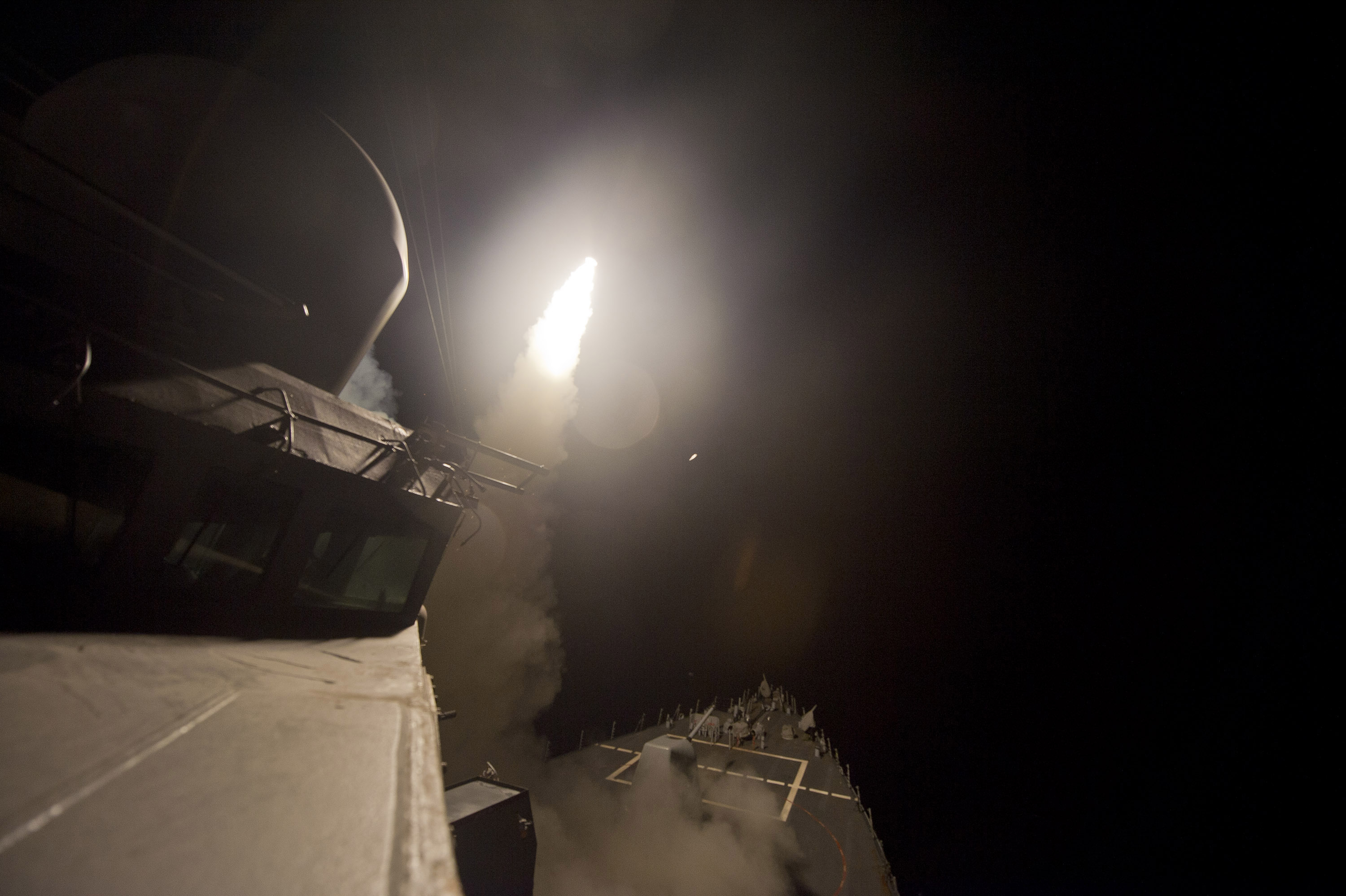
(Photo: In this handout image provided by the U.S. Navy, the guided-missile destroyer USS Arleigh Burke (DDG 51) launches Tomahawk cruise missiles on September 23, 2014 in the Red Sea. By Mass Communication Specialist 2nd Class Carlos M. Vazquez II/U.S. Navy via Getty Images)
 The Dish