Ed Krayewski heard echoes of Bush:
President Obama called ISIS a “network of death,” arguing that “there can be no reasoning, no negotiation, with this brand of evil.” In making the case for the anti-ISIS campaign President Obama has adopted the language George W. Bush deployed when first formulating the war on terror. “We face a brand of evil, the likes of which we haven’t seen in a long time in the world,” President Bush told airline employees on September 27, 2001. Later, he would place Iraq, Iran, and North Korea in an “axis of evil,” a term that coud’ve been ripped from a comic book.
Bush was a fan of using the word “evil” to describe Islamist terrorists, and it shouldn’t be surprising that President Obama has found the strong, unequivocal, and emotional word useful in defending the anti-ISIS campaign.
Zack Beauchamp’s take on the speech:
[I]t was perhaps the clearest articulation yet of what he actually believes and how he sees the world, and yet it also showed how his policies do not line up with those beliefs. The UN address — purportedly written by the president himself— laid out Obama’s fundamental worldview in especially clear terms. He’s an inveterate optimist, deeply believing that we’ve built a world with a bright future. But he’s also willing to take aggressive, even cynical actions to secure that future. That’s why his rhetoric and policy so often feel at odds.
Cassidy considers the political calculus:
On Monday night, American forces bombed ISIS targets inside Syria and also blasted buildings and installations associated with another extremist group. On Wednesday, the Gallup tracker showed that Obama’s approval rating had risen to forty-four per cent.
“It’s certainly possible the president will get a bump from this and it looks like it may be happening because his rating is a bit higher than we’ve seen before,” Gallup’s Jeff Jones told the Fiscal Times. “We want to let it play out a few more days and see if it sustains itself, as opposed to being something really temporary.” I should stress again that I am not suggesting that President Obama consciously responded to the polls by deciding to expand the campaign against ISIS. He is, though, operating in an environment that rewards certain actions and punishes others.
Jeffrey Goldberg doesn’t think politics is playing a big role:
Obama’s critics will say that he has shed his public diffidence on matters related to the conflicts of the Middle East because pollsters have been telling him that Americans want a less professorial president. But my impression from watching him in recent weeks, and from talking to people who know him well, is that two sets of recent events in particular have actually shifted his thinking about the relative importance of “soft power”; about the nature of America’s adversaries; and consequently about the role the U.S. must play in the world, in order to keep these adversaries at bay.
Thomas Wright agrees the president’s perspective has changed:
Obama’s worldview has always allowed for this shift. Influenced by Niebuhr, he believes that malevolent forces exist in the world, including within ourselves. He believes that the United States must act on occasion to stop them. But, for the past few years he has not agreed that we are at such a moment in history. He has not agreed that the international order is facing fundamental challenges that require extraordinary action. Throughout the course of the past year, which has been full of destabilizing developments, he has resisted the notion that we are at a tipping point. Until now. Today, he told a world audience that he too is worried the international order is falling apart. Today, he sees the chasm ahead. Today, he agrees that without an American push, history may be headed in a tragic direction.
And David Rothkopf puts Obama’s remarks in context:
In short, if well-turned phrases defined history’s outcomes, we might be heading to a much better, safer Middle East. But if the men and women who are working behind the scenes to make that happen are to be believed, it is even more likely that further unrest and danger are on the horizon. We may enjoy early victories in the war against IS, we may even turn them back in the months ahead, but absent a commitment to address the broader, strategic issues with the same sense of urgency we are bringing to that fight — to battle for political gains as intently as we do those on the battlefield, or for leaders like Obama and Rouhani to devote as much of their attention to the work of the back room as they do to that at the podium — it looks like in the current Middle East there may be, in the famous words of the old song by Creedence Clearwater Revival, a bad moon rising.
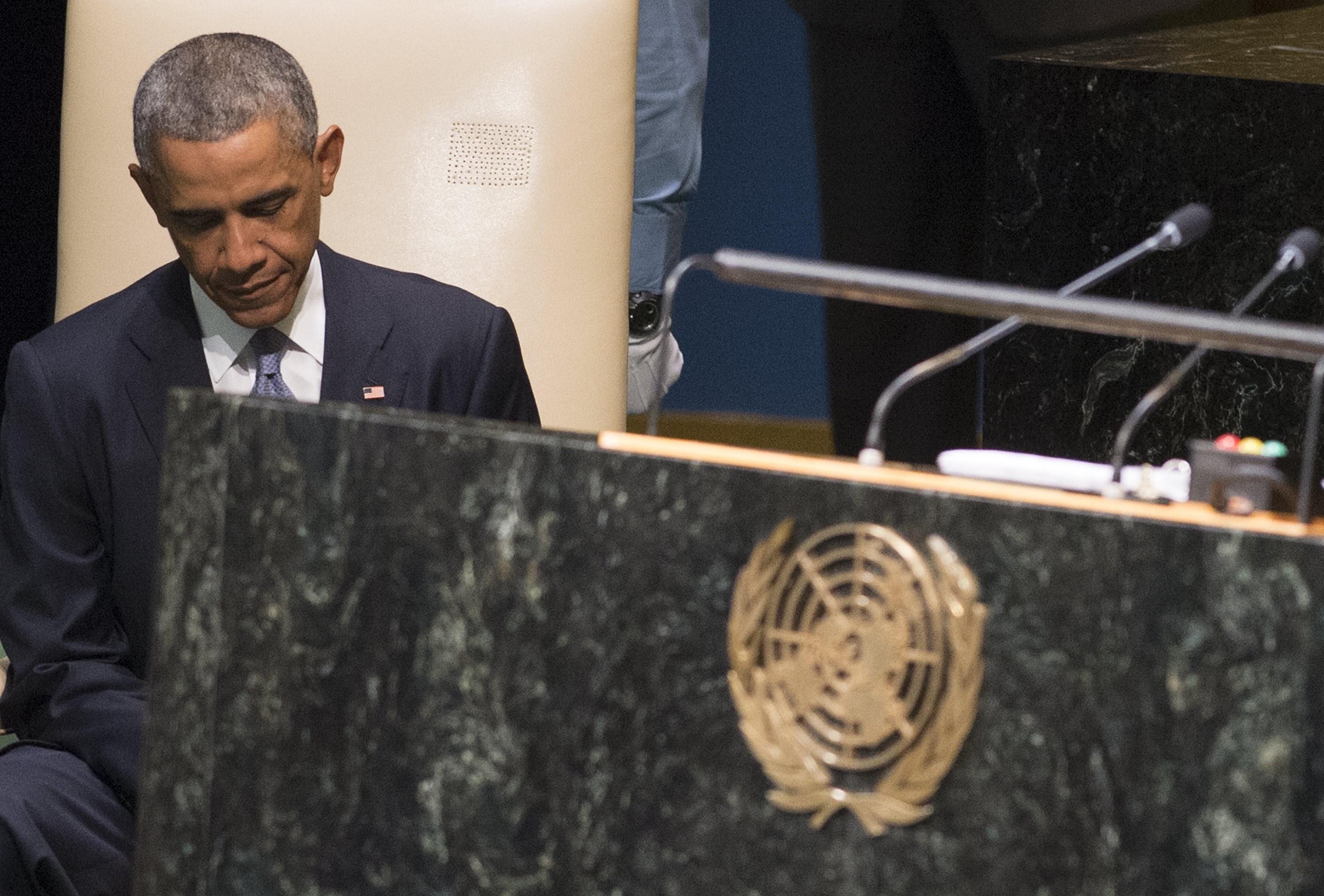
(Photo: US President Barack Obama sits after speaking during the 69th Session of the UN General Assembly at the United Nations in New York, September 24, 2014. By Saul Loeb/Getty Images)
 The Dish