Maybe it’s worth tackling one more time. Dougherty, channeling my own thoughts, thinks it’s basically on an emotion-driven whim:
Barack Obama’s exit from Iraq was as popular as his re-entry. America is against war in Iraq and then for it with the same non-committal “Um, okay.” The nation was founded by a people who made vows, who would “pledge to each other our Lives, our Fortunes, and our sacred Honor.” Now its wars are are on and off like a proposed take-out order: “Chinese or pizza? I mean, whatever you want.”
The pundits who say that President Obama has failed to demonstrate leadership have never considered whether the public is capable of following him, or even their own train of thought. The American public is not even capable of not following him in any recognizable way. We might have been dropping bombs in Syria against Assad to the benefit of ISIS a year ago had it not been for the hearty “No” vote in the British Parliament that denied Obama the fig leaf of multilateralism. A democratic people should be bewildered that their president was urging them to join one side of a civil war a year ago, and now joins them to another. But the American people are as responsive to this stimulus as a cattle herd is to the conclusion of a Dostoyevsky novel.
My own view is that any circumspection about this – indeed any sign of a working collective memory at all – can be suddenly driven from the American mind by the obvious fact of seriously foul actors doing horrifying things to Westerners. 200,000 Syrians died in a brutal civil war and there was no groundswell for intervention. And yet a handful of beheadings of white dudes in the desert (even by another Westerner!) provokes an immediate, Jacksonian rush to war.
But I don’t want to be reductionist here, and I’ve absorbed many good points from your emails. Other factors are clearly at work. Americans do not want to be the policeman of the world, but they like and are reassured by America’s untrammeled military might. And in the last couple of years, as the US has retrenched (only slightly) from its post-9/11 posture of offensive defense, there was a sense that other powers were filling the vacuum – especially Russia. This has spooked Americans, and they are conflicted about it. The resumed disintegration of Iraq – begun in 2003 – provoked further anxiety. Was this not becoming a classic Jihadist enclave from which terrorists could launch attacks on the US?
On the right, there was also a desire to pummel the president for anything and everything. So when he is not being a lawless tyrant, he is a total wuss and loser in foreign policy. And so the re-emergence of the decade-old Sunni insurgency in Iraq was too-perfect a bludgeon for them to resist. They got to trash Obama for “weakness”, cast the Iraq war as some kind of “victory” that Obama managed to turn into “defeat”, and generally use bad news from Mesopotamia as another brick to throw at the man’s head. Total American amnesia about the horrors and futility of the Iraq war helped matters – even as Obama refused to force the GOP to confront head-on the question of ground troops yet again in Iraq.
Then there is the utterly understandable revulsion at the moral abyss that ISIS represents. Fighting against evil has always stirred American hearts – even if we have come to learn that fighting it with brute force can sometimes make it stronger. And the cumulative effect of so many depressing developments – from Crimea to Donetsk to Erbil and Mosul – led to an impression of American drift and disengagement. So a call to action against evil was the natural response to the summer of our discontent.
And one also senses that the administration began to believe this summer that ISIS could actually take down the Baghdad government. They haven’t said this much in public, because it would be damaging. But John Kerry recently gaffed to Christiane Amanpour that “Baghdad could well have fallen.” Others have bruited that the situation in Iraq had approached a potential tipping point in the summer, as the uselessness of the Iraqi army in Sunni neighborhoods became clearer. For Obama, watching Baghdad fall – or be convulsed by serious sectarian urban warfare – was intolerable. So he has done what he often does: fashioned a reasonable, needle-threading strategy to prevent the worst from happening, forestall as much mission creep as possible, and attempt to rally the regional actors into action.
He has not done something obviously stupid. And I may simply be under-estimating the pressures on a president facing mid-terms when such a huge public consensus emerges that Something Must Be Done.
He has tried to do it in coalition with the Sunni Arab dictatorships – and is, in his usual way, trying to thread the needle with the other actors in the region, especially Iran. There is a good chance it might do some good in the very short term, although there is a stronger chance that it will generate ever-more unintended consequences in the long term, something the president openly conceded would be left to his successor.
My concerns are based on the notion that ISIS cannot be defeated in this manner; that the root cause is the irreparable disintegration of Iraq and the Sunni-Shiite struggle; that interposing the US in the middle of a Muslim civil war is likely to increase Jihadist terrorism against the West, without being able to remedy the situation; and that the way in which the US has had to corral the Arab dictatorships into defending themselves does nothing but perpetuate the dysfunctional relationship between the US and the Middle East – in which we are held responsible for everything and despised as a result.
But I’ve said my piece. Maybe I should end by saying that, of course, I hope I’m wrong and that Obama manages to pull off an extraordinary military and diplomatic coup over the next two years. I hope his newfound moxie against evil-doers ends up in a different place than his predecessor’s. I hope this doesn’t upend the negotiations with Iran. I hope it helps his party retain control of the Senate in November. And I hope his precedent doesn’t further empower the war machine, the CIA shadow government and the imperial presidency that drives so much of this. All I can promise readers is that I will be open to all those hopeful possibilities, even as I fear a much darker time ahead.
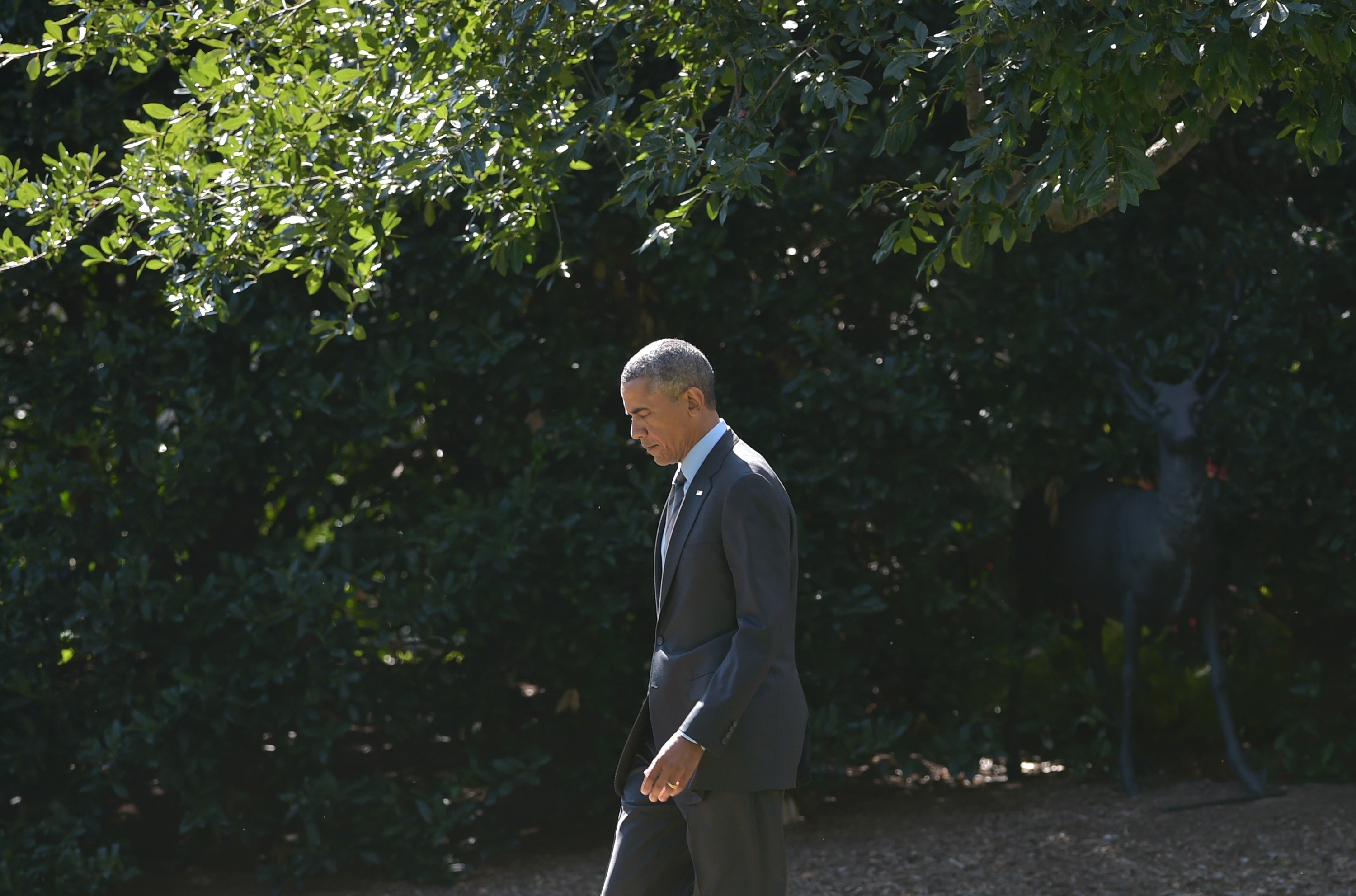
(Photo: Mandel Ngan/AFP/Getty.)
 The Dish