Dish alum Gwynn Guilford argues that Japan especially needs paid paternity leave:
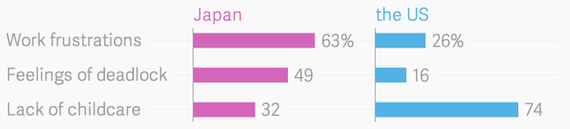
Women in Japan are already paid only 73 percent of what men make for the equivalent jobs; the fact that this gap grows during childbearing years suggests what some call a “motherhood pay penalty.” The work women can find after having a child is often part-time, and usually less well paid, so they have less incentive to go back to work. It’s telling that the better educated a woman is, the more likely she is to stay out of the workforce.
Reasons Female College Grads Leave the Workforce
Oddly enough, men don’t have it so great either. In return for job security, companies expect their male employees to work grueling hours that end in booze-drenched after-hours bonding sessions, week after week for their entire career. Until very recently, to test their commitment companies would deliberately transfer male workers away from their families. This peer pressure is also part of why Japanese men seldom take vacation days.
Gwynn has some hopes for reform but isn’t too optimistic:
To the government’s credit, in 2011 it launched the Ikumen Project (the word is a slangy play on ikemen, which means a “good-looking man,” and iku (育), which means “to raise”), an online community that 2011 encourages fathers to take a more active role in child-rearing.
Another cultural milestone occurred in Aug. 2014, when Masako Mori, the minister then in charge of the declining birthrate and gender equality, declared that she would promote men who take “paternity leave,” by which she probably meant parental leave. Abe now says he wants the number of men taking leave to rise from 1.9 percent to 13 percent by 2020.
However, it’s not clear that this is much more than rhetoric. The salary gap between men and women means it still usually makes more economic sense for fathers to keep working, especially given that they’re likely to get only half their wages during parental leave. So what the Japanese government ought to do is fix this disparity in how men’s and women’s time is valued. Instead, it’s considering making it worse, by extending maternity leave to three years. That would further entrench the traditional divide between men’s and women’s work, worsening Japan’s labor-supply problems and keeping GDP growth anemic at best.
Meanwhile, turning to the maternity front, Michelle Nijhuis reports on the slow road toward better breast pumps:
In the U.S., as Jill Lepore observed in the magazine in 2009, pumps have become a substitute for adequate maternal leave. Today, they provoke a sort of impotent consumer hatred—even high-end breast pumps are noisy, bulky, and awkward to use, and pumping is sometimes painful, often boring, and never dignified. Not surprisingly, many women who attempt to pump at work wean their infants before the six-month mark recommended by pediatricians. Research and investment into postpartum maternal health, including lactation and pumping, lags behind even other aspects of women’s health—perhaps in part because postpartum health lacks its own specialty, and is instead awkwardly partitioned into obstetrics, pediatrics, and general family medicine.
Nijhuis details a “hackathon” that stepped up to the plate. Elsewhere, on the subject of “the maternal-leave problem,” Darlena Cunha explains how women can end up fired for pregnancy, even at companies where that shouldn’t be the case:
A big challenge for women who want to take their claims to court is that discrimination can be very hard to prove, Colorado attorney Brian Stutheit says. In many states, videotaping inappropriate workplace behavior for evidence goes against privacy laws. And unless there’s a paper trail clearly indicating harassment or discrimination, the evidence is considered circumstantial. In Stutheit’s experience, eyewitnesses are hard to come by because they also work for the company and don’t want to jeopardize their own employment. …
Stutheit calls it the “halo effect”: After a complaint, the employee who filed is treated like an angel for six months or so, then fired for something unrelated. “Employers consider them troublemakers,” he said.
All recent Dish coverage of parental leave here.
 The Dish