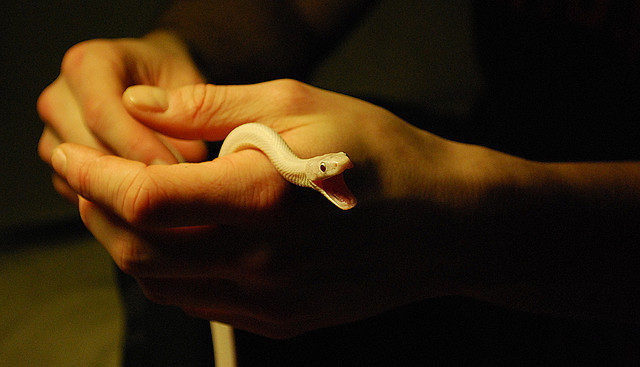
Asher Elbein paints a sympathetic portrait of Southern congregations that incorporate snake-handling into their worship rituals. “The point,” he writes, “is to have enough faith in God to take up something wild, untamed and unpredictable”:
That unpredictability, however, is the root of the danger. However acclimated to humans a snake might be, it’s never truly tame. The more often a person handles, the greater their chances for a bite. Bites aren’t necessarily fatal: Toxin is both metabolically expensive for a snake to produce and its only tool for subduing prey. So snakes often give “dry bites,” warning nips that inject none of their precious venom. A full bite from some vipers, like the copperhead, is easily survivable. Contrary to popular belief, though, it’s impossible to become immune to snake venom. Instead, successive bites often lead to worsening allergic reactions. Hensley claimed to have been bitten more than 400 times before he died. Coots was bitten eight times before he received the killing strike. Handling snakes is not a death sentence, but any handling could be your last.
Practitioners are well aware of this. There’s a constant repetition in recorded interviews: Don’t take up a serpent if you don’t feel the Spirit. Don’t handle for show. There’s death in that box, boy, and you open it at your peril. At the same time, they embrace the risk. Life and death rest entirely in God’s hands, they believe, and whatever happens while handling is His will. Sometimes He holds back the snake. Sometimes He calls them to Heaven. It’s not something they expect the rest of the world to understand.
(Photo by Chris Zielecki)
 The Dish