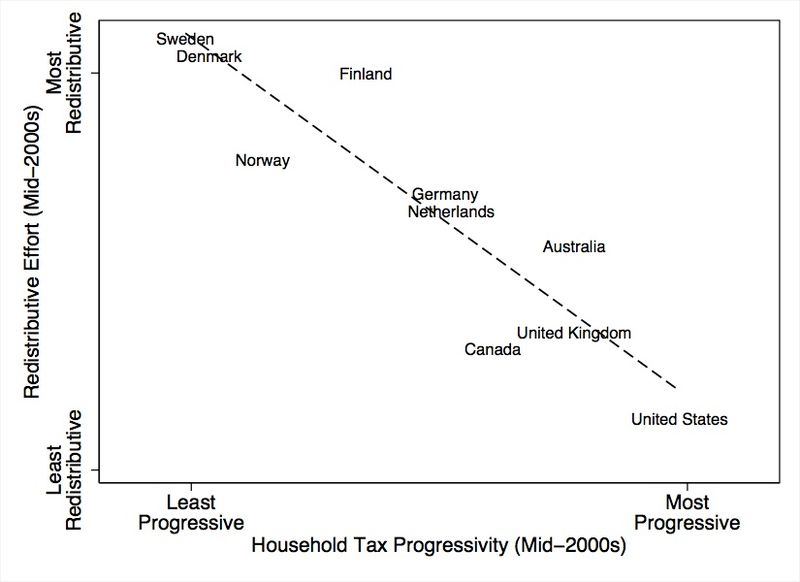
Cathie Jo Martin and Alexander Hertel-Fernandez note that countries with bigger welfare states tend to have less progressive taxation:
The reason Northern European countries with more regressive taxes achieve such high levels of labor market equality, despite less progressive tax systems, is that they spend money on increasing the skills and earning power of low-end wage earners.
Countries with the lowest levels of inequality have learned that policies to cultivate skills for all workers and to achieve full employment policies can accelerate economic growth while also reducing inequality. Large investments in human capital reduce societal conflicts over the distribution of resources, even while expanding the economic pie.
Countries like Denmark and Sweden also redistribute income, but this largely occurs through the funding of egalitarian social benefits — public health care, education — that also contribute to a productive, healthy workforce. Whereas these countries raise most of their revenue in a relatively more regressive manner, they use this revenue to fund social benefits that improve both the living standards and productive capacities of lower-class residents. In contrast, countries with the most progressive tax systems, like the United States, tend to raise most of their revenue through levies on the wealthy and on capital, and end up investing little in job training and other social benefits that reduce inequality.
 The Dish