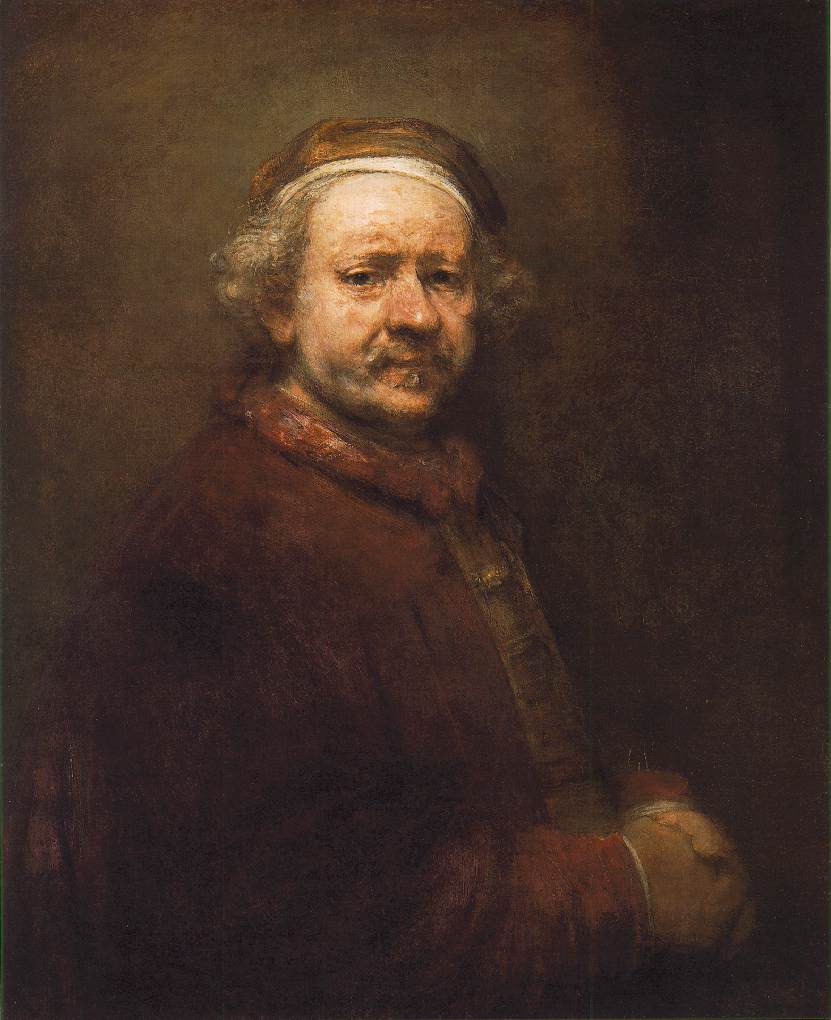
Critics are raving about the show featuring Rembrandt’s later works at London’s National Gallery:
This show is a blockbuster, make no mistake. You know it from the instant you step into the first room, housing four spectacular self-portraits. Dark, lit only by the soft spotlights that illuminate the canvases, it’s as if you’ve walked into a Dutch painting. This room, in which Rembrandts stare unblinkingly out at the spectator—painted between the ages of 53 and 63 (the final year of his life)—boldly proclaim the painter’s unwavering belief in portraying nature in all her pocked, wrinkled, hoary, fragile, unadulterated glory. …
[I]t is the emotional acuity that shines through all these works that makes your heart sing.
Jacob blessing the Sons of Joseph (1656) is such a tender depiction of age and frailty, the hesitant reach of the elderly man for the young child will be recognizable to anyone who has ever known a grandparent. Lucretia (1666), her knife in her hand and blood beginning to stain her shift, rings on a bell to call her family, to alert them to what she has done—she has stabbed herself following her rape by the Roman king Tarquin, rather than live with the shame. Her pallid young face, brow sweating with fear and pain, yet resolute and stiff with sorrow, makes you want to cry.
J.W. at The Economist maintains that “at the heart of everything were, of course, the self-portraits”:
Rembrandt painted himself throughout his career. In his late period he worked repeatedly to catch varying moods of stress and resignation. One self-portrait … done in the final year of his life, shows a man who has lived and knows suffering, who gazes at us with some irony, but with contentment too: sadness leavened by the absolute conviction that this painter knows himself and that only he is able to depict the fact.
It is this that makes late, self-reflective Rembrandt elusive. There was no commercial imperative to paint himself and questions remain. Why did he do it so often? What was he trying to find? Some answers will surely lie in this magisterial National Gallery display. At this stage of his career Rembrandt was often painting, from inside himself, what it is to be human.
In other Rembrandt news, Bendor Grosvernor recently recounted how the number of authentic Rembrandt works has plummeted – from an estimated 600-650 in the first half of the 20th century to around 250 in recent decades:
In 1968, the Rembrandt Research Project (RRP) was established with an admirable objective – to say definitively what was and was not a Rembrandt. But two key factors doomed the RRP’s approach. First, it tried to make attributions by committee, thus allowing indecision and groupthink to reign. It is easier and less risky to say “no” to a picture than to say “yes”. In such situations, the hardest-to-please scholars gain kudos for being “disciplined”, and influence others.
Second, connoisseurship itself fell out of fashion. “New art history” (which became dominant from the late 1970s onwards) believed that connoisseurship was a redundant, elitist practice, and was no longer taught as a key skill for art historians and curators. Social, economic and philosophical generalisation was the order of the day. As a result, the wide and informed debate that should have taken place every time a Rembrandt attribution was questioned didn’t happen. Few ever came to Rembrandt’s defence. As the RRP began to wield its attributional axe, others joined in too, including major museum curators. Rembrandt scholarship became gripped by doubt – if picture X was no longer “right”, then surely pictures Y and Z, which were painted in a similar manner, must be “wrong”.
(Image: Self-portrait at the age of 63 by Rembrandt, 1669, via Wikipedia)
 The Dish
