The Caliphate’s Babes In Arms

Polly Mosendz highlights ISIS’s use of child soldiers:

As more and more children roam away from schools that are no longer operational, or not safe to attend, fighters offer increasing responsibility to young boys under the guise of a new educational system. In the past, fighters frowned upon to give a boy under 15 a rifle, but now, boys much younger than this carry automatic weapons. One fighter in Aleppo explained in the UN report that, “Often young boys are braver and cleverer than adult fighters.” The boys are trained to use the weapons in makeshift educational programs: recruitment masquerading as a replacement for their schools-turned-military bases.

The kids, some under the age of 8, but most commonly 14 to 15 years old, are sent to training camps where recruitment officers offer religious education alongside weapons training. The children, in turn, are paid for attending. However, when class is over and the camp ends, the children are not allowed to return home. Instead, they are sent into active combat zones and in some cases, on suicide bombing missions.

Kate Brannen takes a closer look at what these children experience:

On the front lines of Iraq and Syria, the boys who join or are abducted by the Islamic State are sent to various religious and military training camps, depending on their age. At the camps, they are taught everything from the Islamic State’s interpretation of sharia law to how to handle a gun. They are even trained in how to behead another human and given dolls on which to practice, Syria Deeply, a website devoted to covering the Syrian civil war, reported in September.

Children are also sent into battle, where they are used as human shields on the front lines and to provide blood transfusions for Islamic State soldiers, according to Shelly Whitman, the executive director of the Roméo Dallaire Child Soldiers Initiative, an organization devoted to the eradication of the use of child soldiers. Eyewitnesses from the Iraqi towns of Mosul and Tal Afar told United Nations investigators they have seen young children, armed with weapons they could barely carry and dressed in Islamic State uniforms, conducting street patrols and arresting locals.

The Never-Ending Midterms

Last week, Harry Enten calculated a 47 percent chance that “we won’t know who controls the next Senate when the sun rises on Nov. 5.” Cassidy explains why:

All things considered, the Republicans remain favored to pick up the six seats they need for a majority. That’s what the polls are indicating, and so are the most of the mathematical forecasting models, which extrapolate from survey data. At this stage, however, it is perfectly possible that neither side will emerge from next Tuesday with victory sealed. Runoffs are likely in Georgia and Louisiana. We could have to wait until early January to find out who controls the upper chamber.

Enten examines the Georgia Senate race, which he estimates has a 70 percent chance of going to a runoff: 

We don’t have much polling evidence on which candidate might have the advantage in January. Besides how the campaign might evolve, we don’t really know who will vote in a runoff. No pollster, even those who have asked about the runoff, have tried to model the electorate in January. As I noted last week, there’s no really good precedent for a January runoff in a midterm election.

Alex Rodgers, on the other hand, figures that a Georgia runoff favors Republicans:

Republicans have won the past five statewide runoff contests by doing a better job turning out their base in the conservative-leaning state. In 2008—the last Senate runoff in the state—Republican Saxby Chambliss won the first ballot by three percent of the vote, and then a month later trounced his Democratic opponent Jim Martin in the runoff by 15 points. Republicans were boosted in part by the lower turnout, which was around 57 percent of the number of voters who cast ballots in the same Senate race a month earlier.

Aaron Blake imagines how these races will play out if they determine control of the Senate:

If that’s the case, these two states will be inundated with money from all over the country, and nobody will be able to escape the importance of their state’s runoff. And conversely, if the Senate majority isn’t at stake, these could turn into pretty sleepy contests.

The State Of The Race In Texas, Ctd

A reader flags the awful ad seen above:

After reading my fellow Texan’s rundown of this year’s elections, I thought you might be interested to know that Republican candidate for Lieutenant Governor, Dan Patrick, has been using ISIS as a weapon against his Democratic opponent, Leticia Van de Putte, in an attack ad this month. If I hadn’t already voted for Wendy Davis and Van de Putte, this ad, which I first saw this morning, would have surely energized me to vote AGAINST Dan Patrick. It’s almost comical how ridiculous the fear mongering is here. Almost. The Republicans in this state have zero shits to give anymore and, thanks to SCOTUS’s lack of a ruling on our new voter ID laws, that will likely continue through 2016.

Another Texan looks at the horizon:

There is some possible good news in this article.

What the rest of the country doesn’t understand is that a history of low voter turnout and a pathetic Texas Democratic Party organization has been as responsible for recent election results as the fact that, in some parts of the state, there are indeed voters who will elect Neanderthals like Louie Gohmert.  But 1/3 of the state’s population lives in six counties – Bexar (San Antonio), Dallas and Harris (Houston), El Paso and Tarrant (Fort Worth), and Travis (Austin).  Dallas, El Paso, and Travis are solidly “blue”.  Every county-wide elected official in Dallas is a Democrat.  Harris and Bexar are now purple, but turning bluer. The very popular, recently re-elected mayor of Houston is a lesbian.  Tarrant is the only reliably red county on this list.

There are 254 counties in the state.  I can think of 15-20 off the top of my head that have fewer people in them than my office building in downtown Dallas has in it on a typical day.  ALL THOSE PEOPLE VOTE, and they vote in primaries.  Increased turnout in the big cities and the Rio Grande Valley could make a huge difference.   Maybe Battleground Texas (which has been very active for over  a year) is having an impact.  And there is a genuine lack of enthusiasm for the GOP ticket.  Only the most partisan voters have bumper stickers and yard signs this year.

People I know back east are flabbergasted that Dallas, Texas is a reliably blue island in a sea of red suburban and rural counties, but it’s true.  Change is coming, slowly, but inevitably.

The Profile Of A White House Fence Jumper

Aaron Labaree sketches it out:

In a 1943 study of White House cases, Dr. Jay Hoffman noted, “It is the rule that these patients are, with certain notable exceptions, quiet, pleasant, congenial, cooperative and well-behaved. They accept their enforced hospitalization with a remarkable degree of passivity and frequently without even verbal complaint.” Typical cases have remained strikingly similar over the years. “People usually go to the White House to tell the president what God is telling them or to warn of some impending disaster,” says psychiatrist David Shore, who worked at St. Elizabeth’s in the 1970s and 80s. “In some cases, they think that they have come up with a great invention or performed some great deed and expect to be rewarded.”

Most are schizophrenic. Some are experiencing a temporary psychotic episode. A few are on drugs. The basic motivation—to accomplish great things or avert great danger by going right to the top—seems to have remained the same throughout the decades, although over the years, specific concerns have shifted. Case studies by a number of researchers provide snapshots both of the historical period in which they occurred, and of the delusions associated with them. Many of [Dr. Jay] Hoffman’s patients came to Washington to complain about pensions owed them from service in the First World War, to advise the president on how to steer the country out of the Depression, or to warn him about Nazi plots. …

Kevin Carr, the New Jersey teenager, told police that he had an appointment with the president to discuss the conflict in the Ukraine. And Omar Gonzalez, expressing a fear that may be inspired by global warming, said he’d come to warn the president that “the atmosphere was collapsing.” As Dr. Hoffman wrote back in 1943, “It is only the content of the delusion that changes during the years; the patient otherwise is essentially the same.”

The Best Of The Dish Today

IRAQ-CONFLICT

Here’s Rod Dreher accusing me of being unhinged. He then pivots to news about Pope Francis:

He warned against the common view in society that “you can call everything family, right?”

“What is being proposed is not marriage, it’s an association. But it’s not marriage! It’s necessary to say these things very clearly and we have to say it!” Pope Francis stressed.

He lamented that there are so many “new forms” of unions which are “totally destructive and limiting the greatness of the love of marriage.”

From the context, it does not appear he was referring to gay unions. But surely these statements only reinforce my point. Francis is not changing doctrine of any kind. He has no intention of altering the Church’s understanding of the sacrament of marriage. I have never uttered a word suggesting that either. Francis is merely trying to reach the wounded in the field hospital of the church, which means finding ways to reach and evangelize the divorced or the re-married or the gay or lesbian Catholic and not act like the Pharisees and spurn their faith or be callous toward them. What Francis is talking about is a pastoral, not a theological, revolution. He is arguing that these truths be told with mercy and humility. Here’s the passage from the mid-week Relatio that prompts Ross’s and Rod’s alarm:

Homosexuals have gifts and qualities to offer to the Christian community: are we capable of welcoming these people, guaranteeing to them a fraternal space in our communities? Often they wish to encounter a Church that offers them a welcoming home. Are our communities capable of providing that, accepting and valuing their sexual orientation, without compromising Catholic doctrine on the family and matrimony?

It is perfectly clear that this is not about changing doctrine:

It is necessary to accept people in their concrete being, to know how to support their search, to encourage the wish for God and the will to feel fully part of the Church, also on the part of those who have experienced failure or find themselves in the most diverse situations.

I honestly cannot see how this is incompatible with any formal or informal teaching of the church. That it is objectionable to so many seems to me remarkable. Ross thinks it’s wrong to value and accept homosexual orientation? It’s wrong to offer us a fraternal space in the church? So wrong, in fact, that it could force the church to a precipice or eventual schism? A reader offers his view:

The whole tenor of Douthat’s column – which aptly summarizes the criticisms of the synod by churchmen such as Cardinal Burke and Archbishops Chaput and Mueller – is so much that of the prodigal son’s older brother.  The orthodox and traditionalists are going to leave because the Church welcomes in more people (those people)?  This variety of envy is part of human nature.  But who on earth holds up the older brother as a role model?

Today, I asked if the Cheneyite right believes that the American captives of ISIS were tortured. We wondered how big the legal cannabis market could become; whether Kobani is a distraction in the Syrian civil war; and if we face a lone wolf Jihadist problem in the US. Plus: roads that actually consider our fellow animals; and Rand Paul’s encouraging foreign policy realism; and another fall Window View to take your breath away. What is it about windows and autumn?

The most popular post of the day was A Declaration of War On Francis; followed by The End of Gamer Culture?

Many of today’s posts were updated with your emails – read them all here.  You can always leave your unfiltered comments at our Facebook page and @sullydish. 20 more readers became subscribers today. You can join them here – and get access to all the readons and Deep Dish – for a little as $1.99 month. Gift subscriptions are available here. Dish t-shirts are for sale here, including the new “Know Dope” shirts, which are detailed here. A subscriber writes:

That Chicago Sun Times story is chilling. Thank you all for providing a diving board into topics of which I was unaware I even had any interest! Every single day I find something on the blog that sends me down a rabbit hole of links and thoughts which in turn allow me to open another window in my own way of viewing the world. Honestly, who wouldn’t want to be a subscriber?

One more reader for the day finally “surrenders” over the Book Club discussion:

Okay, okay: I finally caved, and bought Sam Harris’s book.

See you in the morning.

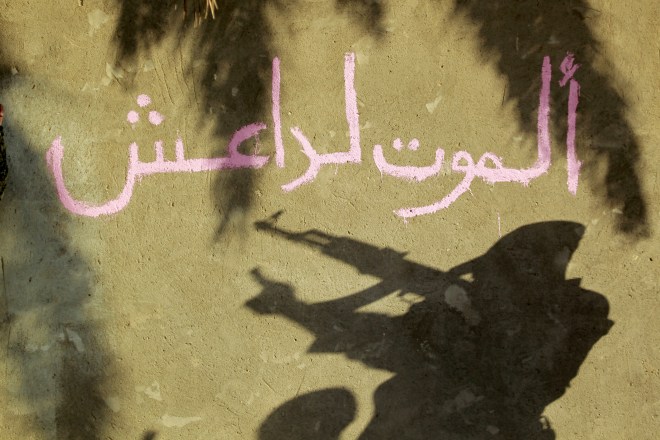
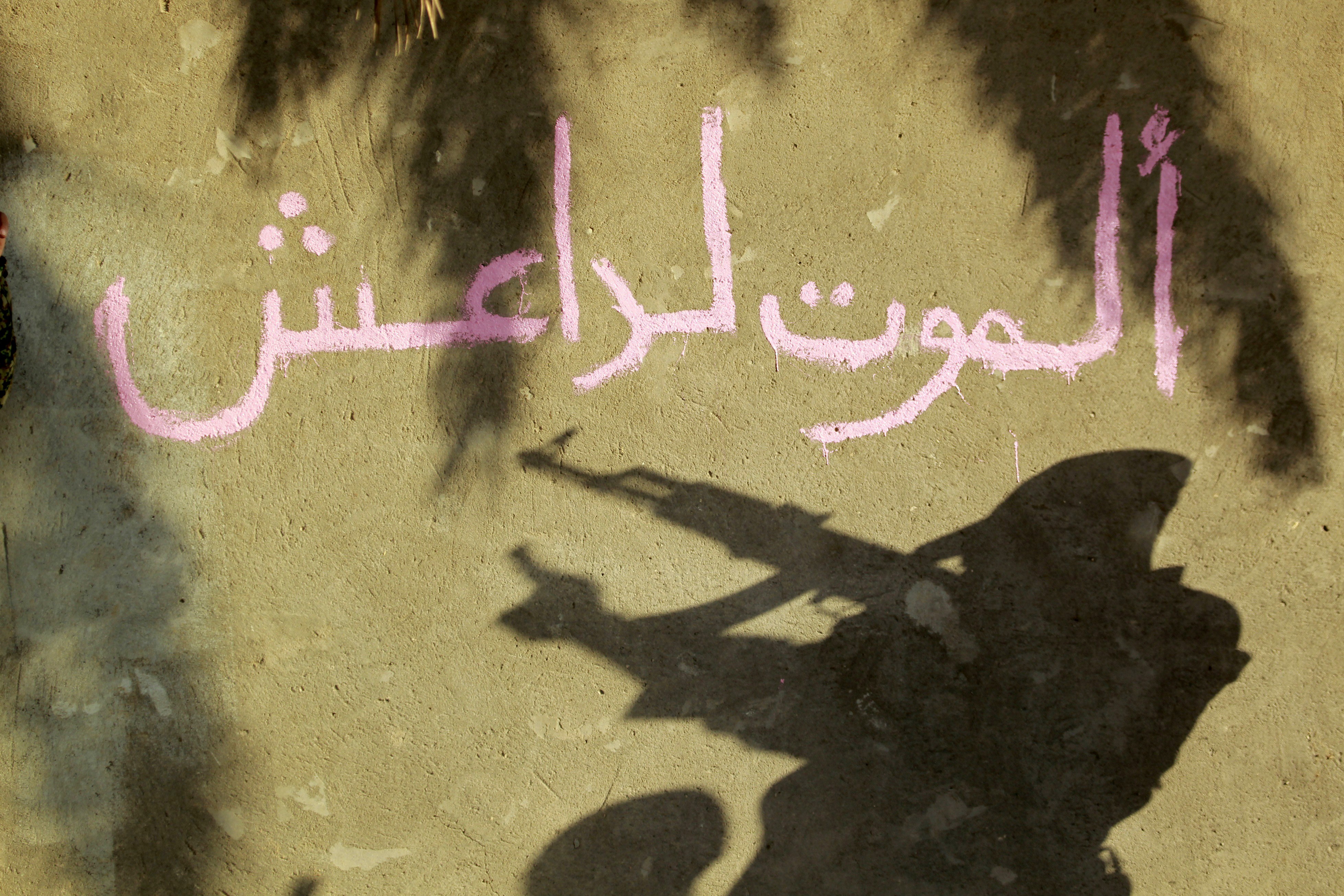
(Photo: Arabic graffiti on the wall reads “Death to Islamic State (IS)” in the Jurf al-Sakhr area, north of the Shiite shrine city of Karbala on October 26, 2014. Iraqi officials said that government forces backed by Shiite militias retook Jurf al-Sakhr, southwest of Baghdad, from Islamic State (IS) group militants on October 25. By Haidar Hamdani/AFP/Getty Images.)
Where Not Voting Is A Crime

Mandatory Voting

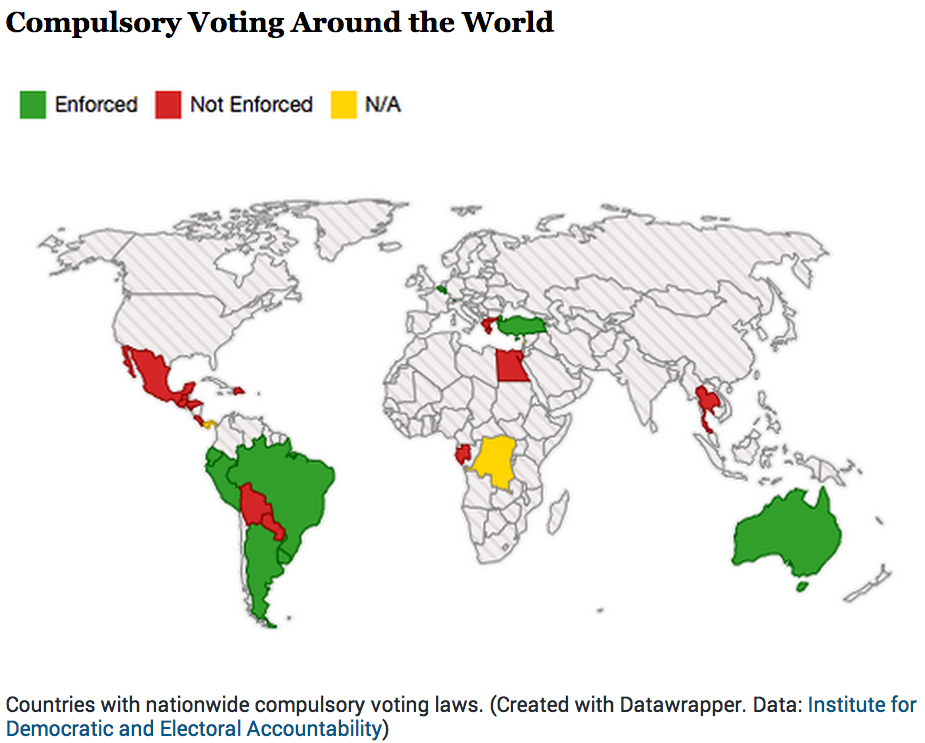
Both Uruguay and Brazil voted over the weekend. Kathy Gilsinan focuses on the fact that those “countries have compulsory voting, under which failure to vote is punishable by a fine.” She looks at why these laws came about:

In a 2010 paper, Gretchen Helmke and Bonnie Meguid of the University of Rochester investigated the origins of compulsory voting laws and the factors that could motivate a ruling party to adopt them. Comparing countries that instituted mandatory voting laws with a random sample of countries that didn’t, they found support for the theory that “the more incumbents fear that they are losing the ability to get their own voters to the polls, the more appealing an antidote compulsory voting will be. In essence, the decision to adopt [compulsory voting] is based on the incumbent’s wager that abstaining voters are the equivalent of untapped supporters.”

Ruling parties in Western European and Latin American countries, the authors write, faced the rise of unions and workers’ parties as their countries industrialized during the late 1800s and early 1900s, when many of them implemented their compulsory voting laws. “During this period, the Left’s organizational ability to mobilize—and, in particular, turn out—its potential voters was increasingly perceived as being unmatched by other parties,” they write. Ruling parties, according to this theory, were essentially trying to get out the vote for a silent majority of what one Argentine official called “the rich and content” to protect their incumbency from the growing power of the leftist opposition.

Liking Mr. Rogers Just The Way He Was

Michael G. Long remarks that when he mentions he’s working on a book about Fred Rogers, of Mister Rogers’ Neighborhood fameit’s not uncommon for him to be asked about the not-so-macho Rogers’ sexuality. Noting that he had gay friends and people he knew to be gay appeared on his show, Long emphasizes there’s no evidence Rogers had sex with another man – and that either way, such speculation distracts from Rogers’ core message, which was “I like you just the way you are”:

Unconditional acceptance, arguably the most positive and compassionate message that any gay child, youth, or adult could find anywhere on television during Rogers’ tenure. Perhaps it’s this queer- and straight-friendly message that we would do well to recall as we wonder about Rogers’ sexual orientation, revealing so many of our prejudices along the way, deep-seated prejudices about the lives of gays and straights and about our own uneasiness with sexual orientations and behaviors.

At last, perhaps we should turn the camera lens toward ourselves and assure Fred Rogers that we like him just as he was: the opposite of machismo, a loving husband and father, a close friend and employer of gays, a man who grew to support at least one friend’s desire for an openly gay relationship and, above all else, a compassionate human being who assured each of us that, no matter who we are or what we do, we are always and everywhere lovable and capable of loving…

Anyone.

Just as they are.

A Tailor-Made Gift To The World

A.A. Gill hails the modern suit as the greatest invention of the British, claiming that “nothing else that comes from this pathetically stunted island has had anything like the universal acceptance, reach, or influence of the suit”:

The suit is the polite taming, the socializing, the neutering, of riding and military kit. Those EGYPT-POLITICS-VOTE-SISIpointless buttons on the cuff were moved from lateral to vertical. You used to be able to fold the end of your sleeve over and forward and button it like a mitten, for riding in the cold. Incidentally, the buttons on the cuff should correspond to the number of buttons on the front, not for any practical reason, but just because that’s what they should do. The vents at the back are made for sitting on a horse. The slanting pockets are for easy access when mounted. …

There is not a corner of the world where the suit is not the default clobber of power, authority, knowledge, judgement, trust and, most importantly, continuity. The curtained changing rooms of Savile Row welcome the naked knees of the most despotic and murderous, immoral and venal dictators and kleptocrats, who are turned out looking benignly conservative, their sins carefully and expertly hidden, like the little hangman’s loops under their lapels.

(Photo: Egypt’s ex-army chief and leading presidential candidate Abdel Fattah al-Sisi gives his first television interview since announcing his candidacy in Cairo on May 4, 2014. Sisi is expected to win the May 26-27 election easily riding on a wave of popularity after he ousted in July Mohamed Morsi, Egypt’s first freely elected president. The 59-year-old retired field marshal, dressed in a suit and appearing composed and often smiling in what was a pre-recorded interview, is seen by supporters as a strong leader who can restore stability, but his opponents fear that might come at the cost of freedoms sought in the pro-democracy uprising three years ago. By STR/AFP/Getty Images)

Face Of The Day

AFGHANISTAN-US-BRITAIN-MILITARY-UNREST

An American Marine, sitting inside the cargo hold of a C-130J Super Hercules transport aircraft headed to Kandahar, gestures as British and US forces withdraw from the Camp Bastion-Leatherneck complex at Lashkar Gah in Helmand province on October 27, 2014. British forces on October 26 handed over formal control of their last base in Afghanistan to Afghan forces, ending combat operations in the country after 13 years. The Union Jack was lowered at Camp Bastion in the southern province of Helmand, while the Stars and Stripes came down at the adjacent Camp Leatherneck – the last US Marine base in the country. By Wakil Kohsar/AFP/Getty Images.

Outsourcing Memory

Jim Davies looks at research into how cognition is distributed throughout the brain – and throughout some of our devices, too:

Think about how many memory aids we use: We jot down phone numbers, and keep count on our fingers. Cognitive scientists Wayne Gray and Wai-Tat Fu showed that using these aids is not very different to remembering facts and figures ourselves. They gave participants a task which required access to a lot of information while varying the difficulty of retrieving that information from a computer screen. They found that the participants decided between using the screen and their own memories in a way that minimized the effort involved, without privileging one source over the other. This suggested that externalized knowledge is accessed like any other memory, and that we treat “memories” on a computer screen just like memories in our head. Something to keep in mind the next time you wonder whether your phone is making you smarter or stupider.

Meanwhile, Clive Thompson considers how the “elderly have long been masters of devising clever tricks to compensate for mental failings, turning objects all around them into cognitive props”:

Medicine might be left on the kitchen table, its presence there a daily reminder that pills need to be taken. To-do lists on Post-it notes serve as scaffolds for their memory. If you’ve already lost cognitive function, and brain training can only go so far, you find other ways to cope. It might very well be that equally promising technology for our brains will augment rather than improve them. Already technology firms are developing methods to help the elderly by offloading memory and cognition, creating digital tools more sophisticated than oversize purses. The company Vitality, for example, has created GlowCaps, pill bottles that track when they’ve been opened. If users forget to take their pills on time, LEDs in the bottle cap might light up as a reminder; if it goes unopened for hours, the bottle sends an alert by email or text. A 2010 trial found that users of these smart bottles had a 98 percent rate of taking meds on time, compared with 71 percent in a control group.