California’s Prisons Are Maxed Out

Reason spotlights the issue:

Last week, Vauhini Vara covered Prop 47, an attempt to solve these problems:

Next month, Californians will vote on Proposition 47, an initiative led by the San Francisco district attorney and a former San Diego police chief, which would try to reach the 137.5 per cent overcapacity threshold by changing certain crimes from felonies, which often result in sentences served in state prisons, into misdemeanors, for which county jail time, county supervision, a fine, or some combination of the three is more common. The crimes covered by Prop. 47 include petty theft, receiving stolen property, writing or forging bad checks, and drug possession, though the reduction wouldn’t apply to those who have previously been convicted of certain serious crimes or are registered sex offenders.

Egg Freezing On The Company Dime, Ctd

Like a reader over the weekend, Pamela Mahoney Tsigdinos casts doubt on the efficacy of egg-freezing:

Lost in all the cheerleading about empowerment and liberating women from their biological clocks is a more buzz-killing, underreported set of facts, which women and families would benefit tremendously in understanding. The American College of Obstetricians and Gynecologists and the American Society for Reproductive Medicine (ASRM) do not endorse the use of egg freezing to defer childbearing. The ASRM’s decision to lift the ‘experimental’ label from this still young procedure in 2012 only applied to medically indicated needs, such as women with cancer.

Moreover, there is no long-term data tracking the health risks of women who inject hormones and undergo egg retrieval, and no one knows how much of the chemicals used in the freezing process are absorbed by eggs, and whether they are toxic to cell development. Furthermore, even with the new flash freezing process, the most comprehensive data available reveals a 77 percent failure rate of frozen eggs resulting in a live birth in women aged 30, and a 91 percent failure rate in women aged 40.

Meanwhile, The Economist flags a new IVF innovation that is “simpler for the patient” and “obviously cheaper than the established way of doing things.” In other assisted-reproduction news, Vanessa Vitiello Urquhart urges her fellow lesbians to take a less superficial approach at the sperm bank:

For lesbian couples, there’s no getting around the fact that children aren’t the offspring of both parents, so closely matching physical characteristics has little relevance. Instead, lesbians ought to seek a fuller picture of the donor while ignoring irrelevancies that could prejudice them. Personal essays would be a great alternative starting place for women who think there’s more to a man than how tall he is and whether he squeaked out a BA in communications.

While exact numbers are hard to come by, it’s clear that lesbians make up a huge portion of the market for donor sperm. A representative from one large, mainstream tissue bank told me that 40 percent of its clients are lesbian, and at least one sperm bank has made helping lesbian families conceive its primary mission. At Pacific Reproductive Services, which proudly advertises its lesbian ownership, the preferences of lesbian clients have already had an impact on the way donors are chosen. Since lesbians tend to be upfront about their children’s origins, they’re more open to the possibility that the kids might one day wish to contact their genetic fathers. This has led PRS to better serve its client base by focusing on recruiting as many “willing to be known” donors as possible—that is, men who have declared their willingness to be contacted by adult children. Founder Sherron Mills also told me that the geneticist at PRS had convinced her that diversity in ethnic background can make for healthier children. “Mix up your child!” she said, “When you dilute those genes, you have a healthier child.” …

Relying heavily on superficial appearance may have made sense for heterosexual couples seeking donated sperm three decades ago. For modern lesbian parents, those physical descriptions come with a lot of unnecessary baggage.

The rest of the egg-freezing thread can be read here.

The Lone Wolf Era?

To Jacob Siegel, last week’s attacks in Canada and New York are examples of the new model for terrorist violence in the West:

In recent years, terrorist networks have become more connected to a Western audience at the same time that they have become more physically cut off from the West. Effective counterterrorist measures have disrupted the planning that groups like al Qaeda use to coordinate large attacks, making it harder for them to communicate directly with cells inside Western countries. But with the Internet’s instantaneous web of connections, it’s become easier to reach individual Westerners who can be coaxed or coached into conducting their own attacks. The result is the lone wolves or stray dogs who may lack connections and experience but need only an Internet connection to find inspiration.

Clint Watts, a counterterrorism expert and senior fellow at the Foreign Policy Research Institute, says the current trend started almost a decade ago. The 9/11 model, where terrorist groups would “plan and train together before going to carry out an attack, became defunct around 2005 because counterterrorism pressure picked up so much in the West,” he said.

But David Gomez observes that the Ottawa shooter, Michael Zehaf-Bibeau, didn’t exactly fit the “lone wolf” profile:

His life was a train wreck of drugs and mental illness with little or no evidence of organization. While all current evidence points to the fact that Zehaf-Bibeau was most-likely acting alone and without direction, he does not appear to be a classic organized lone wolf. Rather he more closely resembles a spree killer who acts spontaneously, without a plan, attempting to kill as many people as possible in as short a time as possible. Zehaf-Bibeau was on a suicide mission with no expectation of survival, therefore no plan for escape. And as far as we know, he left no manifesto or explanation of his actions. In short, Zehaf-Bibeau was a disorganized murderer, acting out his fantasies.

Jeet Heer has additional thoughts on the attacks:

It’s natural to see terrorism and counter-terrorism as a drama of violence and retribution played out on the international stage. Both Zehaf-Bibeau and Couture-Rouleau certainly seem to have seen themselves as part of a similarly apocalyptic saga—Zehaf-Bibeau, in particular, was said by people at the shelter where he was staying in Ottawa to have spoken in his last days about the end of the world. But it’s worth remembering that Zehaf-Bibeau talked not just about an external battle but an internal struggle with demons, spiritual beings he felt had a real existence. That was a battle he was fighting in his own mind, which may have been the ultimate source of the violence that he inflicted on the world.

Even if Zehaf-Bibeau was more an unstable nut job than a jihadist ideologue, Ben Makuch observes that this hasn’t stopped Canadian jihadists on Twitter from claiming him as one of their own:

One Canadian ISIS militant who identifies himself as Muthanna al-Kanadi online, suspected to be Ahmed Waseem of Windsor, justified Zehaf-Bibeau’s alleged attacks by citing the newest Canadian war in Iraq as reason alone to expect retaliation. “What did Canada expect? they are a nation at war with Islam & is about to kill/bomb more Muslims,” he said in a recent tweet. “What did you want in return Hugs and Kisses?” The fighter, who appears to have been injured in recent engagements in Iraq fighting anti-ISIS forces, said the attack was evidence of a growing trend of domestic terrorism.  “I did say before that the Jihad of Yesterday was across the valley but the Jihad of Today is across your doorstep. #OttawaShooting #ISIS,” he said.

In any case, Stephen Walt hopes that Canadian Prime Minister Stephen Harper doesn’t make good on his promise of a macho response:

Whenever there is some kind of terrorist incident (including failed plots), politicians seem compelled to enact more extensive surveillance regimes and promise more assertive efforts to go after the bad guys, in order to show that they can’t be cowed. But unlike security measures enacted during conventional wars, which are normally lifted once the war is over, the various measures imposed since 9/11 remain firmly in place, even after years go by without another incident. Over time, these measures keep ratcheting up, because every now and then another incident will occur and whoever is then in power will feel they have to “do something,” too. It also reinforces the rhetoric of terrorism that increasingly dominates our public discourse and makes it harder to develop a coherent set of strategic priorities.

The Euro Zone Is Not Well

The Economist warns:

Now that German growth has stumbled, the euro area is on the verge of tipping into its third recession in six years. Its leaders have squandered two years of respite, granted by the pledge of Mario Draghi, the European Central Bank’s president, to do “whatever it takes” to save the single currency. The French and the Italians have dodged structural reforms, while the Germans have insisted on too much austerity. Prices are falling in eight European countries. The zone’s overall inflation rate has slipped to 0.3% and may well go into outright decline next year. A region that makes up almost a fifth of world output is marching towards stagnation and deflation.

Matt O’Brien suspects “there will probably be another grand bargain”:

The first one said that, if need be, the ECB would buy a country’s bonds in unlimited amounts to keep their borrowing costs low, as long as they did austerity. That last part is what got the Germans to support it, and they could try the same trick again. This time, they could say the ECB will buy each country’s bonds, in proportion to their economy’s size, as long as they make structural reforms. This is a catch-all phrase that basically means making it easier to fire people. When it’s too hard to do so, as it is in southern Europe, companies are wary about adding full-time workers and only hire young people for part-time ones instead. Germany attributes its own economic success, which is actually pretty overrated, to pushing through these kinds of unpopular changes a decade ago, and it’s obsessed with making the rest of Europe do the same. Maybe so much that it’d be enough for them to let the ECB save the euro again.

But there’s a less sanguine possibility. The ECB could keep not doing enough, Germany could keep blocking them from doing more, and Europe could keep stagnating. It’s their choice.

Did Non-US Citizens Elect Al Franken?

Jesse Richman and David Earnest used data from the Cooperative Congressional Election Study to estimate how many non-citizens may have voted in the 2008 and 2010 elections. Their findings suggest that these ineligible voters turned out in numbers large enough to swing some close races:

More than 14 percent of non-citizens in both the 2008 and 2010 samples indicated that they were registered to vote. Furthermore, some of these non-citizens voted. Our best guess, based upon extrapolations from the portion of the sample with a verified vote, is that 6.4 percent of non-citizens voted in 2008 and 2.2 percent of non-citizens voted in 2010.

Because non-citizens tended to favor Democrats (Obama won more than 80 percent of the votes of non-citizens in the 2008 CCES sample), we find that this participation was large enough to plausibly account for Democratic victories in a few close elections. Non-citizen votes could have given Senate Democrats the pivotal 60th vote needed to overcome filibusters in order to pass health-care reform and other Obama administration priorities in the 111th Congress. Sen. Al Franken (D-Minn.) won election in 2008 with a victory margin of 312 votes. Votes cast by just 0.65 percent of Minnesota non-citizens could account for this margin. It is also possible that non-citizen votes were responsible for Obama’s 2008 victory in North Carolina. Obama won the state by 14,177 votes, so a turnout by 5.1 percent of North Carolina’s adult non-citizens would have provided this victory margin.

The authors acknowledge that the CCES’s samples of non-citizen respondents are quite small (339 in 2008 and 489 in 2010) and that their extrapolated guesses are not exact. They express more confidence, however, in their claim that Franken was elected with illegal votes. Interestingly, they also find evidence that voter ID laws would not have prevented all of these non-citizens from voting, as “[n]early three quarters of the non-citizens who indicated they were asked to provide photo identification at the polls claimed to have subsequently voted”. Still, this will be enough for champions of voter ID laws on the right to claim that they told you so, as Allahpundit does here:

Obama winning a state illegally in a presidential election is bad but will be dismissed on grounds that it didn’t affect the overall result. Flip North Carolina to McCain’s column and it’s still a giant blowout. Franken winning a Minnesota seat illegally is a different ballgame. He was the 60th vote for ObamaCare. Replace him in the Senate with Norm Coleman and the law probably never passes. The authors are arguing overtly that health-care reform was made possible only by illegal votes. There are a bunch of races this year that could end up with whisper-thin margins of victory as well — Perdue versus Nunn in Georgia, Cassidy versus Landrieu in Louisiana, Tillis versus Hagan in North Carolina, even Gardner versus Udall in Colorado. If Democrats eke out victories in a few of those by a few thousand or even a few hundred votes, why would you believe after reading this study that those victories were fairly earned? And remember, as a Twitter pal points out, the numbers in the study are based on non-citizens who admitted to voting when asked. How many voted and were smart enough not to cop to it?

But 

[S]ome respondents might have mistakenly misreported their citizenship status on this survey (e.g. response error). For, as Richman et al. state in their Electoral Studies article, “If most or all of the ‘non-citizens’ who indicated that they voted were in fact citizens who accidentally misstated their citizenship status, then the data would have nothing to contribute concerning the frequency of non-citizen voting.” In fact, any response error in self-reported citizenship status could have substantially altered the authors’ conclusions because they were only able to validate the votes of five respondents who claimed to be non-citizen voters in the 2008 CCES.

It turns out that such response error was common for self-reported non-citizens in the 2010-2012 CCES Panel Study … To be sure, my quick analysis does not at all disprove Richman et al’s conclusion that a large enough number of non-citizens are voting in elections to tip the balance for Democrats in very close races. It does, however, suggest that the CCES is probably not an appropriate data source for testing such claims.

Meanwhile, Rich Lowry defends voter ID laws by turning to a GAO report suggesting “that the number of voters getting locked out by voter ID laws is diminishingly small”:

According to the GAO, in Kansas in 2012, 1,115,281 ballots were cast. There were 38,865 provisional ballots, and of these, 838 were cast for voter ID reasons. In Tennessee, 2,480,182 ballots were cast. There were 7,089 provisional ballots and of these, 673 were cast for voter ID reasons. In both states, about 30 percent of these voter ID-related provisional ballots were ultimately accepted. That means in Kansas and Tennessee, altogether about 1,000 ballots weren’t counted (and perhaps many of them for good reason), out of roughly 3.5 million cast. There you have it ladies and gentlemen, voter suppression! It is of such stuff that Jim Crow was made.

Chait dismantles this argument:

The GAO also studied the impact of vote restrictions in Kansas and Tennessee and found significant reductions in the African-American vote. Lowry says that the Republicans in those states “dispute the methodology,” and takes their side. What the dispute over methodology really shows is that the impact of one change in voting laws is extremely hard to prove. A natural response would be to fall back on the intuitive premise that raising the cost of voting reduces voting. But conservatives seem reluctant to apply their normal beliefs in markets to this question. …

Is it possible that some of the prospective voters who lacked the requisite identification did not show up at the polls at all? Lowry does not consider the possibility.

Emily Badger takes on another aspect of Lowry’s reasoning:

What stands out about this argument is the idea that any disenfranchisement would be OK, when a central rationale for voter ID laws in the first place is that any voter fraud is not. Researchers have repeatedly documented that voter fraud — especially of the kind that might be caught by ID laws — is exceptionally rare. The supporters of ID laws don’t always dispute this. But they often say, as Wisconsin Governor Scott Walker does here, that the scale of fraudulent voting is irrelevant[.] … If you’re absolutist about elections and feel that a single case of voter fraud averted by ID laws justifies their existence, then it doesn’t add up to also argue that any number of people disenfranchised by the creation of those laws is just the cost of protecting democracy.

Dahlia Lithwick sees a similar error at work in the way conservative judges have decided recent cases concerning Texas’s voter ID and abortion laws:

The 5th Circuit evinced a kind of Marie Antoinette approach to individual justice in these cases. When it shut down access to both voting and abortion in Texas, it indicated without precisely saying so that as long as citizens have fast cars and flexible work schedules, they are not burdened by Texas’ regulations. And seemingly there are no Texans without fast cars and vacation time in their view. At oral argument in the case about the shutdown of 20 Texas clinics, Judge Edith Brown of the 5th Circuit heard that abortion clinic closures would leave the Rio Grande area without any providers, forcing women who live there to drive 300 miles round trip to Corpus Christi. The judge sniffed, “Do you know how long that takes in Texas at 75 miles an hour? … This is a peculiarly flat and not congested highway.” …

It’s utterly baffling, this new math. Math that holds that seven incidents of vote fraud should push hundreds and thousands of voters off the rolls. Or that hundreds of thousands of women can be denied access to safe abortion clinics, supposedly to prevent vanishingly small rates of complications. I don’t know how we have arrived at the point where members of the judicial branch—the branch trusted to vindicate the rights of the poorest and most powerless—don’t even see the poor and powerless, much less count them as fully realized humans.
The Waterboarding Of Americans

Screen Shot 2014-10-27 at 3.32.46 PM

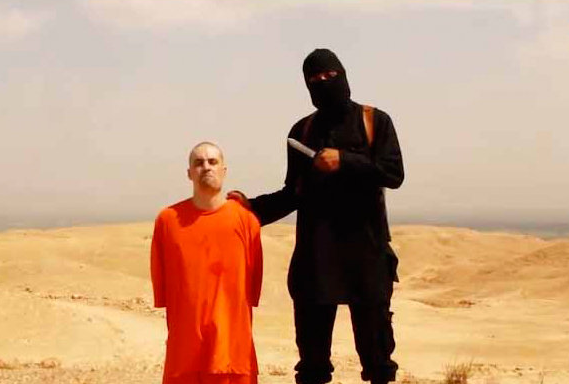
Reading the remarkably reported NYT story on the unimaginable horrors endured by the Westerners captured by ISIS makes the more harrowing scenes from this season of The Walking Dead seem tame. The sadism, the brutality, the torture, the isolation, the terrible loneliness and terror: it’s all there, a stark sign of the sheer, unbridled evil unleashed in the Iraqi and Syrian civil wars. That this despicable cruelty was visited on many who had risked their lives to help people trapped in those conflicts makes the nihilism even deeper.

And, yes, these men were tortured. They were not subject to “enhanced interrogation techniques.” And it remains an unshakable and terrible truth that what was done to them mimicked in critical features what the CIA and Special Forces did to terror suspects in US custody in the Bush-Cheney era:

At one point, their jailers arrived with a collection of orange jumpsuits. In a video, they lined up the French hostages in their brightly colored uniforms, mimicking those worn by prisoners at the United States’ facility in Guantánamo Bay, Cuba.

6a00d83451c45669e201156f95226e970c-320wiThey also began waterboarding a select few, just as C.I.A. interrogators had treated Muslim prisoners at so-called black sites during the George W. Bush administration, former hostages and witnesses said …

The person who suffered the cruelest treatment, the former hostages said, was Mr. Foley. In addition to receiving prolonged beatings, he underwent mock executions and was repeatedly waterboarded. Meant to simulate drowning, the procedure can cause the victim to pass out.

When one of the prisoners was hauled out, the others were relieved if he came back bloodied. “It was when there was no blood,” a former cellmate said, “that we knew he had suffered something even worse.”

Prolonged beatings: check. Mock executions: check. Waterboarding: check. And how many Bush apologists are now claiming that what was done to Foley and the others was not actually torture? Where are David Addington and Cliff May and Andy McCarthy now? Where is Liz Cheney? Where is Rich Lowry? The silence is, yes, eerie.

It’s worth remembering that the unofficial slogan of “Camp Nama” in Iraq (an acronym for “Nasty-Ass Military Area“), was “No Blood No Foul.” It was run by the Special Forces and visited by General McChrystal. It’s also worth recalling the entire rationale behind the Bush era torture regime: that if no blood was shed it could not really be torture, it was just “harsh interrogation.” That very “no-blood-no-foul” idea was, of course, the way in which the Gestapo managed to torture prisoners using Verschärfte Vernehmung and then argue, when hauling their victims into courts or the press, that no harm was done.

But the torture without blood was worse, as these awful testimonies remind us. And it is simply undeniable to say that the United States can no longer condemn the torture of its own citizens in captivity on impregnable moral grounds. For these foul Jihadists are now doing to us exactly what we did to some of them. And the American torturers who did it – and the men who authorized it – have never had to take any responsibility for it at all. And never will.

Ukraine Votes West, But What Next?

Fred Weir sums up the preliminary results of yesterday’s parliamentary election in Ukraine, where “the respective parties of President Petro Poroshenko and his ambitious prime minister, Arseniy Yatsenyuk, were the big winners, taking roughly 21 percent each”:

The results were a modest setback for Mr. Poroshenko, whose bloc held a commanding lead ahead of polling. He lauded the vote, noting that three-quarters of Ukrainians had endorsed Ukraine’s shift away from the Russian orbit and into Europe‘s. Preliminary results suggest that six parties cleared the 5 percent threshold to take up seats in Ukraine’s unicameral parliament. The liberal Self-Help party, based in western Ukraine and solidly pro-European, took around 11 percent. The ultra-nationalist bloc of Oleh Lyashko came in with just over 7 percent, and the party of fiery populist Yulia Tymoshenko got around 6 percent. One result that polls failed to predict was the surprising success of the east Ukraine-based Opposition Bloc, which pledged to defend the interests of east Ukrainians against Kiev‘s dictates. It received almost 10 percent of votes cast.

While this result represents a victory for pro-Western parties overall, as Weir mentions, it wasn’t the slam-dunk Poroshenko had hoped for, and it will require him to form a coalition with smaller parties and share power with Yatsenyuk, who is as much a rival to the president as he is a partner. For this and other reasons, Bershidsky cautions against getting too excited:

Yatsenyuk did better than expected and power-hungry Poroshenko did worse. That means the president suddenly has a political rival with more popular support than that of his own bloc — setting the two of them up for the kind of infighting that ruined Ukraine’s previous chance at economic and political revival 10 years ago.

Besides, Yatsenyuk, who will probably stay on as prime minister, has done nothing to demonstrate that he might have the stomach for the major spending cuts Ukraine needs, now that it faces a deficit of 10 percent to 15 percent of gross domestic product. A group of Western economists has recently called on the Kiev government to eliminate energy subsidies and shake up the pension system to reduce spending by 10 percent of GDP. After the obvious erosion of his support in the past six months, Poroshenko will be hesitant to allow this, and Yatsenyuk will be wary of jeopardizing his seemingly brilliant political prospects.

Emma Ashford isn’t quite ready to celebrate yet, either:

Until we know the final makeup of the new Rada, as well as which parties ultimately will form the coalition government, it’s difficult to assess how the results will impact the ongoing crisis. Many citizens in Crimea and the Donbas were indeed unable to vote, disenfranchising as much as 19% of the population. The overwhelmingly pro-Western nature of the parties elected may be a double-edged sword: it will be popular with Western politicians, but it is in part a reflection of the disenfranchisement of Eastern Ukraine, and will not be truly representative. Despite this, Russian leaders appear to have accepted the results, signaling, hopefully, a willingness to work with Kiev in the future. Whether any government will be able to tackle Ukraine’s myriad problems is unclear.

“Given these results,” Linda Kinstler predicts, “it will be difficult, but by no means impossible, for Poroshenko to begin to enact the reforms the Ukrainian people have been demanding for so long”:

A cadre of young activists, including former journalists Mustafa Nayyem, Sergey Leshchenko, and Svitlana Zalishchuk, are part of a new generation of politicians likely to secure seats in parliament; they helped drive the Maidan Revolution, and now they hope to carry out its aims, including changing the parliamentary system and eliminating diplomatic immunity. They have already encountered the corruption and shadiness endemic to Ukrainian politics, and have the stubbornness necessary to change it. Maybe they actually will: Sadovyi has already said that in exchange for joining Poroshenko’s coalition and giving the president the majority he badly needs, Samopomich will demand that Poroshenko awards ministerial posts to “the best industry experts” instead of to his “friends, acquaintances, and colleagues.”

Steven Pifer looks to the tasks ahead for the new Rada:

Once the coalition, prime minister and new cabinet are in place, they need to work with Mr. Poroshenko to tackle a daunting agenda of needed political and economic reforms, anti-corruption measures, overhaul of the judicial system and urgent changes to the energy sector. The distraction of the conflict in eastern Ukraine has absorbed most of Kyiv’s attention the past six months. Mr. Poroshenko also said that Ukraine needed a new parliament before it could undertake serious reforms. The president now has his new Rada. It is time to move. Urgent reforms are needed in the economic and energy sectors if Ukraine is to avoid becoming—some would say remaining—an economic basket case.

Previous coverage here.

Is Kobani A Distraction?

Over the weekend, ISIS launched a new offensive on the Syrian-Turkish border town, where Kurdish fighters are still holding on after six weeks under siege. While others have called Kobani ISIS’s Stalingrad or its Waterloo, Mark Thompson relays concerns “that the focus on saving Kobani is giving ISIS free reign elsewhere in its self-declared caliphate—that the U.S., in essence, could end up winning the battle while losing the war”:

“The U.S. air campaign has turned into an unfocused mess,” Anthony Cordesman of the Center for Strategic and International Studies wrote Friday. “The U.S. has shifted limited air strike resources to focus on Syria and a militarily meaningless and isolated small Syrian Kurdish enclave at Kobani at the expense of supporting Iraqi forces in Anbar and intensifying the air campaign against other Islamic State targets in Syria.”

Senator Joe Manchin, D-W.Va., expressed frustration that the Obama Administration believes its latest fight against ISIS will yield success when the wars in Afghanistan and Iraq didn’t. “We understand the definition of insanity: continue to do the same thing and expect something different to happen,” he said Sunday on CBS’s Face the Nation. “If we can contain them there, leave them there, I don’t know what else to do. They’re intent on destroying each other, and they’ve been doing it for 1,400 years.” The chattering classes are likewise not impressed by the fight for Kobani and the overall U.S. strategy against ISIS.

But Drum isn’t sure that we can judge the success of that strategy just yet:

The flip side of this is the obvious one: have patience. “Here we are not three months into it and there are critics saying it’s falling apart; it’s failing; the strategy is not sound,” Rear Admiral John Kirby, the Pentagon spokesman, said Friday. “The strategy is sound and it’s working and there’s no plans to deviate it from right now.” If we’re really engaged in a years-long battle against ISIS, then a few months here or there doesn’t matter much. And saving Kobani is not just a moral good, but can also demonstrate to others that ISIS is not some magical, unstoppable force destined to overrun Iraq. It’s just an ordinary group of guerrilla soldiers who can be defeated with determination and patience. Stay tuned.

Still, there are other battles going on. Dettmer calls attention to Aleppo, where commanders “from the Western-backed Free Syrian Army are calling on the United States to launch airstrikes that will help them halt Assad’s forces”:

Without such action, they fear, many of their surviving troops may be lured into the ranks of ISIS. The offensive has been building up since early October. Now, Syrian army units backed by Shia Muslim fighters from Afghanistan, Lebanon and Iran are poised to cut the one remaining land route into Aleppo used by mainly Sunni rebels to resupply their forces, ferry in reinforcements, and evacuate their wounded. If the Assad regime severs the Castillo Road, which connects the rebels with the Syrian countryside and Turkey, it would set the stage for a full-scale siege of rebel-held districts in the city. …

Rebel commanders express deep frustration with the U.S.-led coalition focusing airstrikes on the defense of the Kurdish town of Kobani in a bid to lift a month-long assault by ISIS militants. They argue that a siege of Aleppo, once Syria’s commercial hub, risks even greater ramifications, not only for the Obama administration’s objective to “degrade and defeat” the self-proclaimed Islamic State, widely known as ISIS or ISIL, but also for the course of the uprising against President Assad.

Meanwhile, fighting broke out over the weekend in northern Lebanon between the military and Sunni militants linked to ISIS:

The violence is the worst in months and has centered in Tripoli, an impoverished city of predominantly Sunni Muslims that has experienced regular unrest because of sectarian divisions over the three-year-old Syrian conflict. Ten soldiers and one civilian have been killed in the clashes, a Lebanese military spokesman confirmed in a text message, which also said soldiers had arrested 25 militants. The violence began Friday evening with militant attacks on army positions. More than a dozen troops also have been wounded in the fighting, and at least one has been reported kidnapped.

Tripoli’s Sunni and Shiite neighborhoods have served as a microcosm of the Syrian conflict’s sectarian dimension since the war began three years ago, playing host to frequent clashes. Walter Russell Mead stresses the human and social costs the Syrian war has imposed on Lebanon thus far. All things considered, it’s a bit of a miracle the country hasn’t fallen apart entirely:

In a country of less than 5 million, including some 500,000 Palestinian refugees, there are now 1.2 million registered Syrian refugees, with an unknown and possibly huge number of unregistered refugees. (Looking to hedge further exposure to the Syrian crisis and avoid a demographic disaster, Lebanon closed the border to refugees earlier this week.) To top it off, the alienation of Lebanon’s Sunnis has begun to affect even the national army, which has seen soldiers defect to join ISIS or al-Nusra. And even without the threat to morale that defections pose, the Lebanese army isn’t in the best of shape; it doesn’t have the financing to properly equip itself. … The small, poorly equipped, untested Lebanese army leaves Lebanon dangerously vulnerable to ISIS—and to the fast-growing threat from within its own borders.

As If Ebola Weren’t Bad Enough Right Now

Dan Hurley reports on a confusing new childhood illness:

More than 100 cases of a polio-like syndrome causing full or partial paralysis of the arms or legs have been seen in children across the United States in recent months, according to doctors attending the annual meeting of the Child Neurology Society. Symptoms have ranged from mild weakness in a single arm to complete paralysis of arms, legs, and even the muscles controlling the lungs, leading in some cases to a need for surgery to insert a breathing tube, doctors said.

The outbreak, which appears to be larger and more widespread than what has largely been previously reported by medical and news organizations, has neurologists and the Centers for Disease Control and Prevention scrambling to find out what is causing these cases and how best to treat it. “We don’t know how to treat it, and we don’t know how to prevent it,” said Keith Van Haren, a child neurologist at Stanford University School of Medicine. “It actually looks just like polio, but that term really freaks out the public-health people.” Instead, neurologists are now calling it acute flaccid myelitis: acute because it occurs suddenly, and flaccid because the affected limb or limbs become markedly weak.