
How Big Will Big Marijuana Grow?

Ingraham flags a new report (pdf) that estimates “legal cannabis could be an industry with revenues of $35 billion by 2020 if marijuana is legalized at the federal level”:

To put that figure in perspective, $35 billion represents more annual revenue than the NFL (currently $10 billion), and is roughly on par with current revenues for the newspaper publishing industry ($38 billion) and the confectionary industry ($34 billion).

Greenwave arrived at its numbers by considering existing and likely marijuana markets – medical and recreational – in states that already have them, as well as states that appear likely to open up such markets by 2020. According to the Huffington Post, Greenwave assumes 12 states plus DC will have legalized recreational marijuana in that time, with medical marijuana markets in 37 states. Currently 23 states have legalized medical marijuana, and two have legalized the plant for recreational use. Even without full federal legalization, Greenwave projects legal marijuana revenues of $21 billion.

The Races In Play This Year

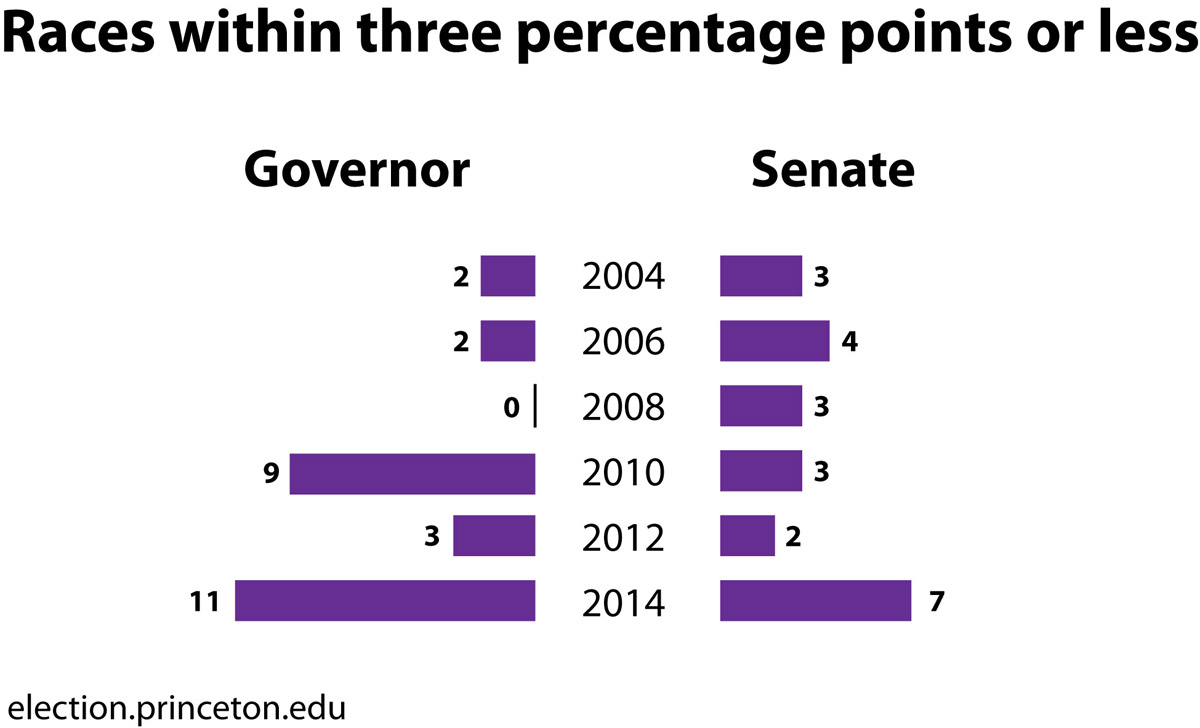
Close Races

Sam Wang compares this election to past ones:

Journalists and pundits have lavished considerable attention on the question of who will control the Senate in 2015. But a broader phenomenon has escaped notice: the sheer number of close state-level races, both in the Senate and in statehouses. At risk are many incumbents who were elected in previous wave years: in 2010 for Republican governors and in 2008 for Democratic senators.

Silver remarks upon the relative stability of his forecast:

Republicans’ odds have never been higher than 66 percent — a figure they reached late last week — or lower than 53 percent. The informal model updates we published going as far back as March also had Republicans as 55 or 60 percent favorites.

To an extent, this stability reflects the noise-reducing features of the FiveThirtyEight model. Our program examines the polls for signs of statistical bias, and weighs them more heavily when they have larger sample sizes, better methodologies and better track records — which can reduce the impact of outliers. The FiveThirtyEight model is also fairly conservative in estimating the uncertainty associated with each race and the disposition of the Senate overall. At times in the past, the polls in most swing states have been biased in the same direction (either toward Democrats or Republicans).

But this degree of stability is unusual. In pretty much every election we’ve covered, the polls have more clearly broken toward one or another party by this point.

Nate Cohn anticipates that “the results of the governors’ races may ultimately play a big role in how analysts interpret the results Nov. 4, including whether this will be viewed as a ‘wave election.'”:

On balance, Democrats seem set to pick up two or three states, mainly because the Republicans enter the elections with twice as many Republican-held seats. But it is easy to imagine the Republicans holding their advantage — there are 29 Republican governors and 21 Democratic ones — or the Democrats picking up a half-dozen seats.

The Debt Collector’s Dilemma

For his book Bad Paper, Jake Halpern investigated the world of American debt collectors. In a review, Thomas Geoghegan considers what makes people pay up:

In [debt collector and ex-con Brandon] Wilson’s case—and I admit I came to like Wilson—it’s because he knows how to “marry the debtor.” He doesn’t threaten; he doesn’t talk about bringing a suit, much less raise the specter of incarceration. It’s true that’s all illegal under the Fair Debt Collection Practices Act. But the real point here is that such measures don’t get results. No, as Wilson notes, a good collector is even and caring. The good collector will say things like “It’s the right thing to do” and “You’ll feel better about yourself.”

Here’s what collectors know: People want to pay. It’s what Porfiry knows about Raskolnikov: He wants to confess. The good collector helps the debtors get out of their mental jails.

After explaining, Wilson’s collectors dare the author to make a call; for me, and perhaps for Halpern, it’s the most unsettling part of the book.

This is not a writer who calls attention to himself unduly, so the encounter that prompts him to enter into the narrative stream of Bad Paper is significant. Halpern does try to marry the debtor. He tries to show empathy. He listens to the woman Wilson assigns him. She is not a deadbeat. She has been ill. She is bipolar, didn’t he know? But Halpern lets her go. He writes that he lacks a real collector’s rapport with people, together with Wilson’s “innate sense of when to segue from courtship back to the unpleasant matter of collecting.” But the real problem, he admits, is that he doesn’t have the drive. If he were desperate enough, if he had to do this for a living, if the alternative were to push dope out on the streets . . . well, he might be much readier to squeeze her. As he later quotes one collector, who happens to be African American, debt in America is the “white man’s dope.”

So a dealer can have only a certain amount of empathy. Or, as one collection manager tells the author: “You have to empathize with debtors but not have sympathy, because if you have sympathy you don’t get paid.”

Animal Skyways, Ctd

Andrew D. Blechman notes a collaboration between the Montana Department of Transportation and the Confederated Salish and Kootenai Tribes that “led to the creation of the most progressive and extensive wildlife-oriented road design program in the country”:

The 56-mile segment of Highway 93 now contains 41 fish and wildlife underpasses and overpasses, as well as other protective measures to avoid fatalities. As creatures become accustomed to the crossings, usage is increasing—at last count, the number was in the tens of thousands. Motion cameras have captured does teaching their young to run back and forth through the crossings, much like human mothers teach their children to safely cross a street.

Wildlife crossing structures are such a smart idea that it’s difficult to understand why they’re still a rarity in this country. But by insisting on rebuilding highway infrastructure to address the needs of wildlife, the Salish and Kootenai tribes have led the way toward a greater sensitivity to fragmented habitats. Highway departments around the country are now studying their example.

Update from a reader, who points to a “pretty extraordinary photo sequence”:

Loved that photograph of the animal high-line. I’m sure I am not your only Florida reader who will bring this up, but we’ve been helping our beleaguered Florida panthers cross the road for decades now. Back in the 1980s, the National Wildlife Federation teamed up with panther advocates to file suit against the DOT to do something to stop the carnage on I-75 (the main artery connecting Florida’s coasts that bisects the panther’s habitat).  The DOT eventually added 23 crossings, which by all accounts, has at least slowed this beautiful animal’s extinction. (Numbers are sketchy but there are less than 200 left). Here’s a photo of a panther making a safe crossing that I found in the Naples Daily News:

unnamed (12)

Pretty extraordinary photo sequence because Florida panthers are notoriously shy and rarely photographed in the wild.

Another reader:

The thread just made me think of this West Wing classic for a Wolves Only Roadway!

Previous Dish on a similar highway in Canada here.

Age Ain’t Nothing But A Bias

Bruce Grierson revisits a surprising study from 1981 that suggests as much:

The men in the experimental group were told not merely to reminisce about this earlier era [1959], but to inhabit it – to “make a psychological attempt to be the person they were 22 years ago,” [psychologist Ellen Langer] told me. “We have good reason to believe that if you are successful at this,” Langer told the men, “you will feel as you did in 1959.” From the time they walked through the doors, they were treated as if they were younger. The men were told that they would have to take their belongings upstairs themselves, even if they had to do it one shirt at a time.

Each day, as they discussed sports (Johnny Unitas and Wilt Chamberlain) or “current” events (the first U.S. satellite launch) or dissected the movie they just watched (Anatomy of a Murder, with Jimmy Stewart), they spoke about these late-’50s artifacts and events in the present tense – one of Langer’s chief priming strategies. Nothing – no mirrors, no modern-day clothing, no photos except portraits of their much younger selves — spoiled the illusion that they had shaken off 22 years. At the end of their stay, the men were tested again. … They were suppler, showed greater manual dexterity and sat taller – just as Langer had guessed. Perhaps most improbable, their sight improved. Independent judges said they looked younger. The experimental subjects, Langer told me, had “put their mind in an earlier time,” and their bodies went along for the ride.

Cari Romm relays a similar finding from a more recent study:

In a study recently published in the journal Psychological Science, [Becca] Levy and researchers from Yale and the University of California Berkeley set out to learn the answer by studying 100 volunteers between the ages of 61 and 99 (the average age was 81). One group of participants was asked to write a story about “a senior citizen who is mentally and physically healthy,” while another group completed a subliminal-messaging computer task where positive aging-related words – “spry” or “wise,” for example – flashed across the screen too quickly for them to detect on a conscious level. As a control, others were asked to complete neutral versions of the same activities, either writing a story on a topic unrelated to aging or watching a screen with flashes of nonsense strings of letters.

The volunteers completed their respective tasks once a week for five weeks. At the beginning of the experiment and once weekly for three weeks after it ended, they also took three different tests: one that measured their attitudes towards old age in general; one that measured their perceptions of themselves as people of advanced age; and one that tested their gait, strength, and balance, or what the researchers called “physical functioning.”

The Best Of The Dish This Weekend

Syrian Kurds Battle IS To Retain Control Of Kobani

And you thought I was exaggerating about the rise and rise of sponsored content:

As The Times’ readership goes mobile, the publication will phase out display ads in favor of native advertising. “Display has real value, but it feels transitional, specifically when you’re talking about a smartphone-centric world. Advertisements are going to have to be in-stream and intrinsically attractive enough to engage readers,” New York Times CEO Mark Thompson said.

It’s worth comparing that to an interview former NYT executive editor Jill Abramson gave only a year or so ago:

In a Q&A with Wired editor in chief Scott Dadich, Abramson expressed reservations about sponsored content. “What I worry about is … leaving confusion in readers’ minds about where the content comes from, and purposefully making advertising look like a news story,” she said. “I think that some of what is being done with native advertising does confuse a little too much.”

Thompson’s euphemism for deceiving readers? Advertising has to be “in-stream.”

Seven picks from the weekend Dish: why women belong on Mars – because they’re much more cost-effective as astronauts; the extremely low cost-effectiveness of art school, if you want to be a working artist; vice-presidents being mauled by octopi; the poignant beauty of shelter dogs minutes before they are euthanized; and Walker Percy on why depression makes sense.

Three videos: when environmentalists shit in the woods; a great yo mama sketch; and the sublime beauty of Matisse’s chapel.

Plus: John Gray on evil;  and Isaiah Berlin on the problem with idealism.

The most popular post of the weekend was The End Of Gamer Culture?, followed by The Right’s Lingering Palin Problem. One reader adds to the discussion about gamer culture, feminism, and the culture of the straight white male:

As a white straight guy, let me just say: Thank you. And not because “my people” deserve anybody’s pity — as Louis CK points out, it’s a damn good stroke of luck to be born a white straight male, as it spares us from the scourge of racism, homophobia and sexism. And let’s acknowledge that if someone is committing racism, homophobia and sexism, it’s usually a white straight male. Along with most mass shootings, school shootings and acts of domestic terrorism. Most of the Gamergate dudes are straight white males, too.

But here’s a theory I can offer from the safety of anonymity: The gains of social progressivism generally and feminism specifically have had a polarizing effect on straight white male culture.

Some of us — myself included — have adopted extreme caution where it concerns expressing sexuality. Because we want to be polite and respectful and most definitely NOT creepy. Long before Yes Means Yes, social mores guided conscientious straight guys to only reveal sexual attraction when the green light was unambiguous — not easy, considering straight women are masters of subtlety. In the meantime, what we’ve been asked to police is a primordial impulse that lies at the very core of our nature. Our conscious mind knows it’s rude to check out a girl’s butt. Our unconscious mind says, “What is ‘rude?'”

Now listen, this isn’t the History’s Greatest Injustice. I’m just saying that repressing one’s natural impulses is tough. So we’re trying, and we’re not always succeeding. Still it’s a helluva lot better to be a woman now than it was 15 years ago, much less 50 years ago, and at least some of the credit goes to straight guys who are willing themselves to be less aggressive and less lecherous than their father’s generation. But in doing so, we are necessarily changing part of our culture; nobody even says “metrosexual” anymore because it describes most every straight guy in a city of more than 100,000.

Then there’s the straight guys at the other end of the spectrum. They’ve reacted not with introspection but with fear and rage. For them, feminism is an adult form of bullying, and there are all sorts of vocabulary rules… and they’ve retreated to a kind of online cultural ghetto, where none of the rules apply. These guys begin to feel so alienated by society, they can justify not just misogyny but acts of extreme violence against the women  they’re attracted to — and all women, for that matter.

Obviously, I’m not saying feminism is at fault. Certainly, the positive effects of the movement far outweigh the negative. But I think we have to acknowledge some areas where it can overreach and call on feminists to communicate to straight men in a more nuanced way, not because we deserve their consideration, necessarily, but because being more inclusive will make their movement less intimidating, less polarizing and much more effective when it comes to achieving their goals of empowerment.

See you in the morning.

(Photo: A Kurdish refugee boy from the Syrian town of Kobani hugs his brother in a camp in the southeastern town of Suruc, Sanliurfa province on October 25, 2014. The Syrian town of Kobani has again seen fierce fighting between Islamic State and Syrian Kurdish forces. Since mid-September, more than 200,000 people from Kobani have fled into Turkey. By Kutluhan Cucel/Getty Images.)

The Smears Of The Matthew Shepard Foundation

It’s well worth reading a story in the Guardian/Observer today about the famous and horrifying murder of Matthew Shepard. The Guardian is a left-leaning paper, but it is not American and therefore has some interest in the actual truth of the affair, as opposed to the propaganda. And it largely echoes the superb reporting of Steve Jimenez, whose book, The Book of Matt, proved to anyone not blinded by agit-prop that this awful crime was committed not be “redneck” strangers, but by a couple of Shepard’s acquaintances, one of whom had been his lover, who were eager to get access to crystal meth they believed Shepard had access to. (For the full Dish coverage of the book see here.)

The author, Julie Bindel, does some reporting of her own. She quotes, for example, the cop who nabbed one of the killers:

“I believe to this day that McKinney and Henderson were trying to find Matthew’s house so they could steal his drugs. It was fairly well known in the Laramie community that McKinney wouldn’t be one that was striking out of a sense of homophobia. Some of the officers I worked with had caught him in a sexual act with another man, so it didn’t fit – none of that made any sense.”

Then this:

Ted Henson is a former lover and long-term friend of Matthew’s. The pair originally met when Matt was growing up in Saudi Arabia. Henson told me he believes that The Book of Matt is “nothing more than the truth” and that he was “never certain” that the murder was an anti-gay hate crime. “I don’t know why there is so much hostility towards Steve,” he told me. “Matt would not have wanted to be seen as a martyr, but would have wanted the truth to come out.”

What’s truly remarkable about this book is not that, like many before it, it exposes the truth behind a useful myth. It is the reaction of the gay establishment to these difficult truths. The Book Of Matt insists on the horrifying nature of the crime; it had no pre-existing agenda; it’s written by an award-winning reporter who is also a gay man. (The Wyoming Historical Society also gave it an award.) What it does is expose a real problem in the gay male world – especially at the time of the murder: the nexus of sex and meth that destroyed and still destroys so many lives.

So what does the Matthew Shepard Foundation say in response to the book?

I asked for a reaction regarding the book, but was sent a pre-prepared statement by executive director Jason Marsden, who was a friend of Matthew’s. “We do not respond to innuendo, rumor or conspiracy theories,” reads the statement first issued when The Book of Matt was published. “Instead we remain committed to honoring Matthew’s memory and refuse to be intimidated by those who seek to tarnish it.”

They won’t even address the book. Recently, an editorial in the Casper Star Tribune, without addressing any of the factual claims in the book, continued to smear Jimenez, equating the book’s thesis to conspiracy theories about the moon-landing and describing the paperback edition as “poison made portable.” The New York Times, for its part, refused to review it. Those who made a small fundraising fortune off the myth – like the Human Rights Campaign (natch) – will never acknowledge the truth. But the book is its own best defense. The paperback has a new Afterword by Jimemez. You can buy it here – and I highly recommend that you do.

End-Of-Life Literature

In an interview about his new book, Being Mortal: Medicine and What Matters in the End, the surgeon and writer Atul Gawande runs down the literary influences that inform his approach to medicine:

What books most influenced your decision to become a doctor, and your approach to medicine? Who are your favorite physician-writers?

I have so many: Anton Chekhov, Sir Arthur Conan Doyle, John Keats, Walker Percy. Mikhail Bulgakov was famous for “The Master and Margarita,” but his “Country Doctor’s Notebook” is fascinating, too. So is William Carlos Williams’s “Doctor Stories.” When I was in medical school, a trio of doctors who’d come out with nonfiction books around that time awoke me to the concrete, practical idea that one could be both a physician and attempt to write seriously: Oliver Sacks, Sherwin Nuland and Abraham Verghese. I reread Lewis Thomas constantly. Richard Selzer’s essays on his life as a surgeon — for instance, “Mortal Lessons,” “Confessions of a Knife” and “Letters to a Young Doctor” — can seem overwritten, but they have stayed with me for years now. These writers all transcend the term “physician-writers.” They’re just writers, telling us about the experience of being human.

What book would you most recommend to an aspiring doctor today?

Tolstoy’s “The Death of Ivan Ilyich.” It’s the best portrayal of sickness and suffering I have ever read — minutely observed, difficult and still true a century and a quarter later.

Great writing on illness and mortality extends vastly beyond works by doctors, and I can’t let the opportunity go without mentioning at least a few more of my non-doctor favorites: There’s Anatole Broyard’s amazing memoir of his own dying, “Intoxicated by My Illness,” Anne Fadiman’s “The Spirit Catches You and You Fall Down” and Joan Didion’s “The Year of Magical Thinking.” Oh, and Sylvia Plath’s “The Bell Jar,” Ken Kesey’s “One Flew Over the Cuckoo’s Nest” and William Styron’s “Darkness Visible.” And I can’t leave out Thomas Mann’s “The Magic Mountain” or Virginia Woolf’s “On Being Ill.” These all deserve readers of any kind. But about one in five of us work in health care in some way, and we have a particular responsibility to understand what people experience when their body or mind fails them. Our textbooks and manuals aren’t enough for that task.

Gavin Francis notes how Gawande’s personal story informs his perspective on end of life care:

Towards the end of the book, he tells the story of his own father’s decline and death from a tumour of the spine. His experience as a surgeon melts away and he finds himself navigating infirmity and dependency as a son, rather than as a clinician. It’s the worried son, not the Boston surgeon, who reflects on the qualities he values in the doctors treating his father: not bullish arrogance, but acknowledgement of uncertainties and a willingness to accept risks. He finds doctors communicate most effectively when they jettison the position of detached, clinical observers and talk in terms of how they feel: “I am worried about your tumour because … ” Often the bravest and most humane decision, he realises, is to do nothing at all.

When time becomes short, Gawande has the presence of mind to ask his father: “How much are you willing to go through just to have a chance of living longer?” The answer helps guide his father to a relatively peaceful death in the arms of his family, as opposed to a technologised end on an intensive care unit. The message resounding through Being Mortal is that our lives have narrative – we all want to be the authors of our own stories, and in stories endings matter. Doctors and other clinicians have to get better at helping people with their endings, otherwise more and more of us will end our lives babbling behind shining doors.

Recent Dish on end-of-life concerns here, here, and here.

The Sound Of Guilt

Reviewing Peter Sellars’ “already legendary” staging of Bach’s St. Matthew Passion, which was performed in New York City earlier this month, Alex Ross explores the distinctive theological vision that informs the oratorio:

Martin Luther, in a treatise on the Crucifixion in 1519, had grim tidings for those of his followers who wished to lay the blame for Christ’s death entirely on the Jews. You killed Jesus, Luther told them: “When you see the nails piercing Christ’s hands, you can be certain that it is your work.” Luther’s message served as a warning to those who felt secure in their faith, their virtue, their worldly position; guilt for the crime at Golgotha is ubiquitous, seeping forward in time. Dietrich Bonhoeffer echoed the point in the early twentieth century, emphasizing how the Passion story shatters the illusions of a prosperous, self-satisfied modern society: “The figure of the Crucified invalidates all thought which takes success for its standard.”

Lutherian severity lies at the core of Bach’s St. Matthew Passion, which, scholars have argued, takes that 1519 treatise as a model. The immensity of Bach’s design—his use of a double chorus and a double orchestra; his interweaving of New Testament storytelling and latter-day meditations; the dramatic, almost operatic quality of the choral writing; the invasive beauty of the lamenting arias, which give the sense that Christ’s death is the acutest of personal losses—has the effect of pulling all of modern life into the Passion scene. By forcing the singers to enact both the arrogance of the tormentors and the helplessness of the victims, Bach underlines Luther’s point about the inescapability of guilt. A great rendition of the St. Matthew Passion should have the feeling of an eclipse, of a massive body throwing the world into shadow.

Why We Long For The Zombie Apocalypse

Öèôðîâàÿ ðåïðîäóêöèÿ íàõîäèòñÿ â èíòåðíåò-ìóçåå Gallerix.ru

As Halloween approaches, Paul Pastor offers a theological gloss on monster stories, calling them “a quick route to our hearts” and holding that “our fears shed light on our loves, on our priorities, on our hopes, on the thousand things that form who we are”:

Our monster stories reveal deep-set fears, but they also unveil our hopes. In the popular modern zombie flick, for example, we see that even in the total collapse of human society, we can hope for not only survival, but for community, for beauty, for something more than the Western dreams of brainless consumption and the cannibal exploitation of our neighbors. We can find a sense of belonging, of dignity. Modern Westerners long for a satisfying level of self-sufficiency, for friends that we could trust our life with, for a sense of clear purpose, however bleak the surrounding world might be.

In America, where our folk culture is steeped in red-hot brimstone and rapture theology, we both dread and long for apocalypse. We’re afraid of being killed or “left behind,” but secretly believe that we’ll be one of the chosen few who survive the end, to help usher in a new age. This apocalyptic narrative has extended far beyond Christianity or pseudo-Christian cults. It’s embedded firmly in our cultural imagination regardless of our collective American faith or lack thereof. As such, the modern zombie tale is a classic example of apocalypse in the 20th century. We long for a reset button, for upheaval that will leave something better than what we have now when the dust settles.

(Image: The Head of Medusa by Peter Paul Rubens, circa 1618, via Wikimedia Commons)