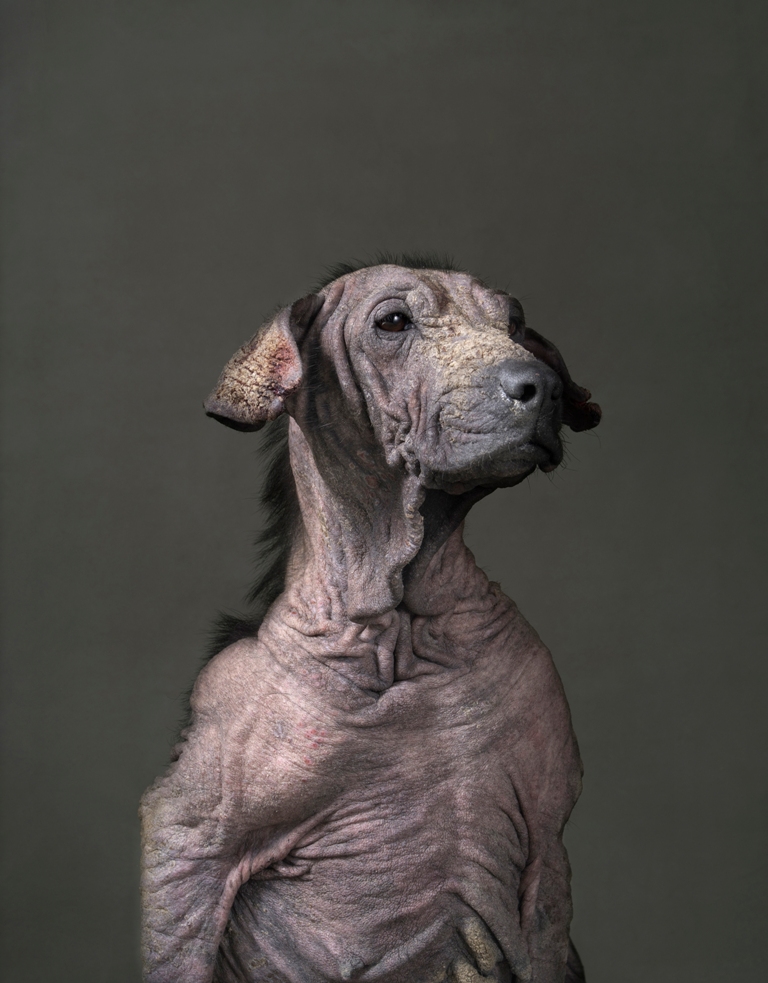
“You Have Every Reason To Be Depressed”

Art Rosman re-reads Walker Percy’s mock-self-help book, Lost in the Cosmos, noting that Percy “does not think that depression is merely a problem to be medicated away, but rather a rational response to the state of our world”:

Let’s start with how Percy takes a quick stock of modern life by answering the question why so many people are depressed:

Because modern life is enough to depress anybody? Any person, man, woman, or child, who is not depressed by the nuclear arms race, by the modern city, by family life in the exurb, suburb, apartment, villa, and later in a retirement home, is himself deranged.

We could add any number of deranged situations to the list: the growing income inequality gap, any number of looming ecological disasters, terrorism, the disappearance of the extended family, Ebola, AIDS, the fertility crash, and so on.

Rosman goes on to cite a brilliant passage from Percy’s book that elaborates on this notion:

Now, call into question the unspoken assumption: something is wrong with you. Like Copernicus and Einstein, turn the universe upside down and begin with a new assumption. Assume that you are quite right.

You are depressed because you have every reason to be depressed. No member of the other two million species which inhabit the earth—and who are luckily exempt from depression—would fail to be depressed if it lived the life you lead. You live in a deranged age—more deranged than usual, because despite great scientific and technological advances, man has not the faintest idea of who he is or what he is doing.

Begin with the reverse hypothesis, like Copernicus and Einstein. You are depressed because you should be. You are entitled to your depression. In fact, you’d be deranged if you were not depressed. Consider the only adults who are never depressed: chuckleheads, California surfers, and fundamentalist Christians who believe they have had a personal encounter with Jesus and are saved for once and all. Would you trade your depression to become any of these?
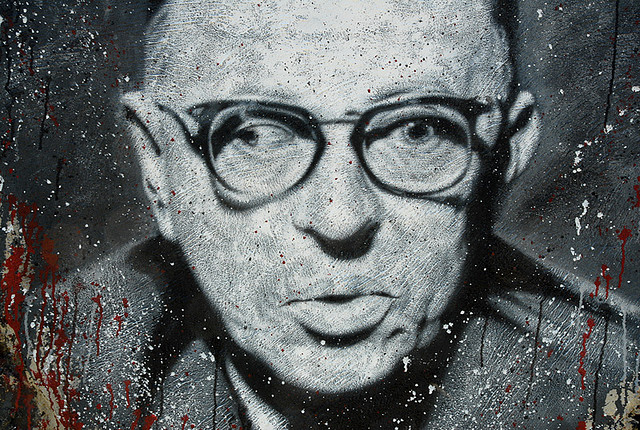
Get Sartre

dish_sartre2

We recently looked back at why Sartre turned down the 1964 Nobel Prize in Literature. Now, Stuart Jeffries elaborates on the philosopher’s refusal and considers why “so much of his lifelong intellectual struggle and his work still seems pertinent” today:

When we read the “Bad Faith” section of Being and Nothingness, it is hard not to be struck by the image of the waiter who is too ingratiating and mannered in his gestures, and how that image pertains to the dismal drama of inauthentic self-performance that we find in our culture today. When we watch his play Huis Clos, we might well think of how disastrous our relations with other people are, since we now require them, more than anything else, to confirm our self-images, while they, no less vexingly, chiefly need us to confirm theirs. When we read his claim that humans can, through imagination and action, change our destiny, we feel something of the burden of responsibility of choice that makes us moral beings. …

In his short story “Intimacy,” we confront a character who, like all of us on occasion, is afraid of the burden of freedom and does everything possible to make others take her decisions for her. When we read his distinctions between being-in-itself (être-en-soi), being-for-itself (être-pour-soi), and being-for-others (être-pour-autrui), we are encouraged to think about the tragicomic nature of what it is to be human – a longing for full control over one’s destiny and for absolute identity, and at the same time, a realization of the futility of that wish.

The existential plight of humanity, our absurd lot, our moral and political responsibilities that Sartre so brilliantly identified have not gone away; rather, we have chosen the easy path of ignoring them. That is not a surprise: for Sartre, such refusal to accept what it is to be human was overwhelmingly, paradoxically, what humans do.

(Photo of painted portrait of Sartre by thierry ehrmann)

Use Your Illusion

Daniel Dennett applauds Alfred R. Mele’s Free: Why Science Hasn’t Disproved Free Will, which picks apart a range of experiments from recent decades that purportedly show free will is an illusion:

A curious fact about these forays into philosophy is that almost invariably the scientists concentrate on the least scientifically informed, most simplistic conceptions of free will, as if to say they can’t be bothered considering the subtleties of alternative views worked out by mere philosophers. For instance, all the experiments in the [neurologist Benjamin] Libet tradition take as their test case of a freely willed decision a trivial choice—between flicking or not flicking your wrist, or pushing the button on the left, not the right—with nothing hinging on which decision you make. Mele aptly likens these situations to being confronted with many identical jars of peanuts on the supermarket shelf and deciding which to reach for. You need no reason to choose the one you choose so you let some unconscious bias direct your hand to a jar—any jar—that is handy. Not an impressive model of a freely willed choice for which somebody might be held responsible. Moreover, as Mele points out, you are directed not to make a reasoned choice, so the fact that you have no clue about the source of your urge is hardly evidence that we, in general, are misled or clueless about how we make our choices.

Similarly, Daniel Wegner’s case amounts to generalising the surprising discovery that in Ouija-board situations, people can often be made to feel they are the authors of acts that are in fact caused by the experimenter’s accomplice. Since in these rather artificial and strange circumstances we can be misled into thinking retrospectively that we chose to act when in fact we were manipulated into action, Wegner believes that it must follow (mustn’t it?) that we are never authoritative about the authorship of our acts. There are some complications to Wegner’s case, but this non-sequitur lies at the heart, and Mele has no difficulty providing evidence of cases in which our knowledge of our own reasoned choices is unassailable.

Marble In Motion

The above excerpt from Yuri Ancarani’s documentary Il Capo depicts the process of extracting marble from a quarry with unusual beauty:

Ancarani was captivated by the otherworldly landscapes of the quarry. He spent nearly a year filming on Monte Bettolgi, in the Carrara region of the Apuan Alps, in Northwest Italy, eventually deciding to focus his film on the hypnotic, and rather dramatic moment when the monumental marble blocks are freed from the mountainside, and fall to the ground with an earth-shattering thud.

Ancarani says of his work:

In a lot of documentaries about the marble quarries, the quarrymen are shown as Neorealistic archetypes, tough guys made of sweat and swear words. I, on the other hand, admire their practical intelligence: it is a form of elegance that can teach us a lot, and which my head quarryman possesses: he is a man who has style in his gestures and manners. In such a tough and dangerous environment, I wanted to highlight an aspect of delicacy.

(Hat tip: Kottke)

A Poem For Sunday

6417157733_4cb9831a04_b

Dish poetry editor Alice Quinn writes:

I found this declaration on the website of the Poetry Foundation, where so many satisfying capsule biographies of poets can be found along with reference to relevant and available scholarship. “Modern readers looking for [Adelaide] Crapsey’s work are hard-pressed to find it in any anthology printed after 1950.” That’s why the recent publication of Modernist Women Poets: An Anthology, edited by Robert Hass and Paul Ebenkamp is so significant today.

In her preface to the book, C.D.Wright notes that Crapsey, who was diagnosed with tuberculosis of the brain lining in 1911 when she was thirty-three, “was not afforded a long lifeline. She went to college, studied in Rome and taught at Smith, but mostly she watched the world from her Brooklyn window and kept a bracing seasonal vigil over her own dying. She applied an economy of words uncommon for her time coupled with a stoic yet revealing level of restraint.” We’ll be featuring selections from Verse, a well-regarded collection of sixty-three poems, published shortly after her death in 1915.

Three short poems from Adelaide Crapsey:

“November Night”

Listen..
With faint dry sound,
Like steps of passing ghosts,
The leaves, frost-crisp’d, break from the trees
And fall.

“The Guarded Wound”

It it
Were lighter touch
Than petal of flower resting
On grass, oh still too heavy it were,
Too heavy!

“The Warning”

Just now,
Out of the strange
Still dusk.. as strange, as still..
A white moth flew. Why am I grown
So cold?

(From Modernist Women Poets: An Anthology © 2014 by Robert Hass and Paul Ebenkamp. Reprinted by permission of Counterpoint Press. Photo by Martin Fisch)

Quote For The Day

“Justice has always been a human ideal, but it is not fully compatible with mercy. Creative imagination and spontaneity, splendid in themselves, cannot be fully reconciled with the need for planning, organization, careful and responsible calculation. Knowledge, the pursuit of truth—the noblest of aims—cannot be fully reconciled with the happiness or the freedom that men desire, for even if I know that I have some incurable disease this will not make me happier or freer. I must always choose: between peace and excitement, or knowledge and blissful ignorance. And so on.

So what is to be done to restrain the champions, sometimes very fanatical, of one or other of these values, each of whom tends to trample upon the rest, as the great tyrants of the twentieth century have trampled on the life, liberty, and human rights of millions because their eyes were fixed upon some ultimate golden future?

I am afraid I have no dramatic answer to offer: only that if these ultimate human values by which we live are to be pursued, then compromises, trade-offs, arrangements have to be made if the worst is not to happen. So much liberty for so much equality, so much individual self-expression for so much security, so much justice for so much compassion. My point is that some values clash: the ends pursued by human beings are all generated by our common nature, but their pursuit has to be to some degree controlled—liberty and the pursuit of happiness, I repeat, may not be fully compatible with each other, nor are liberty, equality, and fraternity.

So we must weigh and measure, bargain, compromise, and prevent the crushing of one form of life by its rivals. I know only too well that this is not a flag under which idealistic and enthusiastic young men and women may wish to march—it seems too tame, too reasonable, too bourgeois, it does not engage the generous emotions. But you must believe me, one cannot have everything one wants—not only in practice, but even in theory. The denial of this, the search for a single, overarching ideal because it is the one and only true one for humanity, invariably leads to coercion. And then to destruction, blood—eggs are broken, but the omelette is not in sight, there is only an infinite number of eggs, human lives, ready for the breaking. And in the end the passionate idealists forget the omelette, and just go on breaking eggs,” – Isaiah Berlin, “A Message to the 21st Century.”

Robinson’s Revelatory Prose, Ctd

Reviewing Marilynne Robinson’s Lila, Rowan Williams claims it “is, at one important level, a novel about the inadequacy of goodness”:

The world of Gilead is full of virtue and kindness; but it survives by denying something. When Lila, newly baptized, hears Ames and Boughton having a mild theological dispute about the fate of un­believers, she suddenly grasps that all the people who have kept her alive up to this point are “outsiders” to faith and grace, strangers to the kindly old pastors; and she is filled with revulsion at her own “insider” status. She goes to the river and rubs water over her body to “cleanse” herself from baptism, from the pollution of her betrayal of Doll and her graceless friends and traveling companions.

What Lila discovers and slowly formulates for herself is what finally emerges in the last pages of the book, where, almost for the first time, a strong, lyrical passion infuses her reflections: if there is heaven, it has to be filled with those who are there because others could not bear to be without them, whatever they have done or been. There cannot be anyone who is not needed somewhere, in some way. The longing for safe goodness is trumped by the hunger of and for solidarity.

And this is what the merely good do not know. The Lilas of the world are those who challenge the ways in which the good refuse to know what they do not know. This is why Lila in the earlier, but chronologically later, novels can function as a point of (near-silent) reference by which the rhetoric of others is to be judged; why she is an absolving as well as a disturbing presence, aware of the irony of being who she is where she is, but neither rebelling nor colluding, simply stating by her presence that things might be different.

Anne Helen Petersen, who was raised Protestant, calls the novelist’s writing “the closest thing I have to return to those rhythms of early belief, the best at translating their palpability and comfort and challenge”:

There’s been a lot of writing about Robinson in the weeks leading up to the release of Lila, the third in what could be called her “Iowa trilogy,” which traces life in the small town of Gilead from the perspective of a dying Congregationalist pastor (Gilead), his Presbyterian best friend (Home), and his young wife (Lila). They’re deceptively simple novels, offering voice to a small cast of characters in a tiny town, as they wrestle, without pomposity, with what can only be described as the most important questions of life. What does it mean to be good? To forgive? To die? And what might a life of striving toward those answers look like?

If that sounds like a slog through the worst of self-help or the most impenetrable of philosophy, that’s because there’s no suitable language for a text that manages to simultaneously function as a novel and a piece of profound meditation. The trilogy has been called one of the “unlikeliest” in American literary history, but it’s also one of the most indescribable: an unapologetically religious, profoundly lyrical text that is the opposite of “preachy.” Still, the way I’ve always gushed about the books has been a variation on “she makes me miss church.” Church, but not religion. My pastors, not men issuing commandments on how I should live my life. The rhythms and imagination of theology, not the constraints thereof.

Previous Dish on Robinson’s latest novel here and here.

Face Of The Day

yun_fei_tou_05

Ellen Ruddick-Sunstein highlights Taiwanese photographer Yun-Fei Tou‘s Memento Mori, a series of photographs that “captures the final minutes in the lives of hundreds of shelter dogs awaiting euthanasia”:

For each, he visits on the day of their predetermined deaths. In the last instants of their existence, he often plays with them, feeds them, and gives them a voice that has eluded them for much of their troubled lives.

Inspired by philosopher Peter Singer, Tou explains that the rights of animals are not the product of sentimentality but of moral fortitude and integrity. We are bound ethically to these silent creatures, and Tou frames them as he would any human subject, imbuing each with a palpable sense of soulful tenderness and dignity. Freed from the cages that have become their final homes, the dogs are immortalized on life-sized prints.

Coming Around To Kierkegaard

Pankaj Mishra admits he thought there was “something haughty” about Kierkegaard’s The Two Ages when he first read it as a young man. Revisiting the text this summer, however, he better understood the insights of a book that “deplores the mass society that in the mid-19th century was coming into being across Europe, and what he saw as the general diminishment of the individual by the very means — public opinion, press — devised to enlighten and unify individuals into an equitable society”:

My beliefs have not fared well during the past decade’s lowering display of disingenuous political and business leaders; meek, if not blinkered, journalists; and easily frightened and manipulated publics. The last few months alone have confirmed Arendt’s fear of a “tremendous increase in mutual hatred and a somewhat universal irritability of everybody against everybody else.”

Kierkegaard’s arguments about the modern world’s negatively unifying principles had seemed overwrought because my own perception was shallow. The process of leveling has reached an advanced stage, accomplished not only by the imagined communities of the nation-state and the statistical majorities of public-opinion polls but also the idea of sociality and community promoted by the digital media.

Kierkegaard anticipated the confining fun-house mirrors of Facebook and Twitter when he wrote that the seeker of true freedom must “break out of the prison in which his own reflection holds him,” and then out of “the vast penitentiary built by the reflection of his associates.” And though I am as far from being a Christian as ever, I am better prepared to comprehend Kierkegaard’s insistence that a genuine union of human beings required a greater spiritual strenuousness from “the single individual”: that he or she establish “an ethical stance” regardless of general opinion. “Otherwise,” he warned, with steely accuracy, “it gets to be a union of people who separately are weak, a union as unbeautiful and depraved as a child-marriage.”

(Hat tip: Paul Elie)