Face Of The Day

unnamed (9)

A reader submits the above screenshot:

For your FOTD, might I suggest Kevin Vickers, Sergeant at Arms in the Parliament of Canada, walking the halls and making sure everything’s ok after having calmly left his office to shoot and kill a terrorist.

More on the hero here. Watch him get a standing ovation entering the House of Commons here.

Marijuana Doesn’t Make You Stupid

Ingraham draws attention to a new study on teen pot use and IQ:

Even heavy marijuana use wasn’t associated with IQ.

“In particular alcohol use was found to be strongly associated with IQ decline,” the authors write. “No other factors were found to be predictive of IQ change.”

The UK study does find evidence, however, of slightly impaired educational abilities among the very heaviest marijuana users. This group of students scored roughly 3% lower on school exams taken at age 16, even after adjusting for confounding factors.

In a press release accompanying the study, lead author Claire Mokrysz noted that “this is a potentially important public health message- the belief that cannabis is particularly harmful may detract focus from and awareness of other potentially harmful behaviours.” Reviewer Guy Goodwin of Oxford University agreed: “the current focus on the alleged harms of cannabis may be obscuring the fact that its use is often correlated with that of other even more freely available drugs and possibly lifestyle factors. These may be as or more important than cannabis itself.”

“Being A Nerd Is Not Supposed To Be A Good Thing” Ctd

An “actual nerd” joins this reader in stating his case for true nerdom:

Female nerds take a stand against the reader:

He is a perfect example of everything that is wrong with this particular sordid corner of NerdCulture. As a woman, I earned my nerd status in exactly the same way as every other picked-on kid in school ever did: by being labeled that by my peers. I was bullied, I was mocked for reading too much SFF, for playing Dungeons and Dragons, and for not being very good at sports. Now this guy and folks like him want to tell me I didn’t earn that nerd card? That I don’t belong with the only group where I have ever belonged? I have some choice four letter words for him, as well as advice on where he can stick them.

The wonder of it all is that he clearly can’t even see his hypocrisy – that he is doing exactly the same thing to women that has been done to him. And while I may sympathize with his situation, I 1979474_354805564678076_7909139515221880476_ndon’t need his permission to lay claim to territory that has been mine since the first time I read The Hobbit at age five or discovered Batman comics at fourteen. Nerd territory is the domain of the outcast and the iconoclast, and it has never been about needing anyone’s approval. Watching these men try to say that they suddenly have some kind of say in who gets to wear the label would be hilarious if it wasn’t so infuriating.

Another is a tad more direct:

Speaking as a female nerd, your reader can definitely go fuck himself over that thought train.  I’ve spent my entire life dealing with assholes like him and how I’m a “fake nerd” simply because I have breasts and a vagina.  News flash dude: my adolescence was probably half as fun as yours.

I was also introverted, awkward with people and interested in stuff no one else cared about, but the community I should have been able to band together with, the people who you found and clearly bonded with, rejected me out right.  And yeah, if I wasn’t slightly obsessive (and a stubborn little cuss, as my mother use to say), I probably would have dropped all of it years ago and followed something else more appropriately “female”. But I love what I love and I make no bones about it to anyone, even if they do think I’m a little outside the lines.

Another also reflects on her adolescence:

It’s fucking miserable being a smart, nerdy 12-year-old girl. No one likes it that you’d rather play Civ or fine tune your Magic deck. Boys are angry that you are in their thing, or worse, better than them at it. Girls don’t care about your thing and soon care less for you when you talk about your thing.

Luckily I had my mother, a scientist, devoted Star Trek fan (sorry, enthusiast) and careful curator of my voracious reading habits. She made sure I had plenty of female role models, almost all of the fictional ones ostracized underdogs fighting for justice. Some people have religion. I had Alanna and Aerin.

And another:

I sincerely hope you are getting a significant amount of pushback on this “apologia of sorts” because, as a woman who is sick and tired of demands that I verify my nerd credentials to countless men throughout my life, this genuinely disturbed me.

Like your reader, I too immersed myself in video games, comics, science fiction and all things nerdom as young person and continue to embrace them well into adulthood. But unlike this guy, I do not have an “imbalance of personality” or any other such “personality defect”. I did it because I liked it, and I still do. I’m 36 years old, I have 6 game consoles, and thousands of comic books I collected throughout the ’80s and ’90s, among other artifacts like props and costumes.

But where I diverge the most from your other reader is the impact of our shared pursuits becoming more mainstream. The things I used to think made me a loser are now things that I think make me pretty cool. It’s really done wonders for my self esteem; I was the nerdy bookworm and now I’m the cool smart chick. It’s too bad that he can’t embrace the fact the changes in the industry mean we’re no longer outcasts even if we are still weird.

One last related comment. Any female gamer who has ever tried to enter the hyper-masculine confines of the XBox live community and any male gamer who has encountered a female gamer there, should be unsurprised by the GamerGate fiasco. Make no mistake, this is an exclusive club and his allusion to this exclusivity (“Frankly, I do question the claim of many women who say they are nerds”) is extremely mild compared to what I’ve experienced. He saying we don’t belong or rather we must prove to me that we belong before being accepted, most say much worse.

Well, thanks again for getting me all fired up on Thursday morning! What would I do without The Dish? (Probably work more, but work isn’t everything, you know.)

Follow the whole thread on gaming culture here.

(Photo of two actual nerds at Comic Con via Leah Zander)

Vote Early, Vote Often?

John Fund argues against early voting:

Consider that for all of the hullabaloo about early voting, studies have shown it hasn’t increased overall voter turnout. Curtis Gans, director of the Committee for the Study of the American Electorate, notes turnout is down even in states that have made it easier to vote through Election Day registration or early voting.

Gans and other observers are also concerned that early voters won’t have the same information as those who vote on Election Day. They may miss out on candidate debates or be unable to factor in other late-developing election events. “Those who vote a month in advance are saying they don’t care about weighing all the facts,” says Adams, the former Justice Department official. One secretary of state I interviewed compared early voting that takes place before debates are finished with jurors in a trial who stand up in the middle of testimony and say they’ve heard enough and are ready to render a verdict.

In response, Chait proposes “a perfect solution that would address Fund’s professions of deep social commitment to a single national voting day while also addressing concerns about the inconvenience”:

You’d simply have to make Election Day a national holiday.

Sadly, Fund — who does not mention this idea in his most recent article — has previously dismissed it on the grounds that creating a holiday on a Tuesday would lead to people skipping work on the preceding Monday. (It “might do little more than create a de facto Saturday to Tuesday four-day weekend,” he wrote, in 2005.) So that’s out, too.

Furthermore, Ian Millhiser notes that efforts to cut back on early voting often have discriminatory effects, and sometimes even discriminatory intentions:

[A]s Judge Peter Economus explained in a decision suspending the Ohio cuts to its early voting days that were later reinstated by the Supreme Court, “a greater proportion of blacks not only cast [early] ballots than whites but do so on early voting days that” were eliminated by the new voting schedule. Additionally, some states have made early voting cuts that seem designed to diminish minority voting. After Florida’s early voting cuts helped produce six hour voting lines in 2012, one GOP consultant admitted that voting was eliminated on the Sunday prior to Election Day because “that’s a big day when the black churches organize themselves.” (Additionally, low-income voters are particularly likely to use early voting. As a federal court noted in 2012, “early voters have disproportionately lower incomes and less education than election day voters.” Thus they are likely to have less flexibility to show up to the polls on a particular day.)

Phyllis Schlafly, meanwhile, wants to end it simply because it benefits Dems. Nicole Hemmer attributes the Republican preoccupation with voter ID laws and other means of restricting voting to “a broader conservative discomfort with mass democracy”:

Take the recent push to repeal the 17th Amendment. Ratified in 1913, the 17th Amendment established the direct election of senators, who had previously been appointed by state legislatures. Since 2010, a number of big-name conservatives have arrayed themselves behind the repeal, including Justice Antonin Scalia, Sen. Ted Cruz and radio talk-show host Mark Levin. Proponents of repeal placed states’ rights ahead of democratic processes. In justifying his call for repeal, one conservative writer explained, “The Constitution did not create a direct democracy; it established a constitutional republic. Its goal was to preserve liberty, not to maximize popular sovereignty.” …

Yet this skepticism about democracy and universal suffrage never receives top billing when conservatives call for voter ID laws. In part, that’s because open opposition to voting doesn’t go over well with the general public, as conservative writer Matthew Vadum discovered in 2011 after his piece “Registering the Poor to Vote Is Un-American” generated intense backlash. And in part it’s because conservatism’s anti-democratic strain coexists uneasily with its anti-establishment populism, a contradiction that the movement has never reconciled.

Lastly, Yglesias contends that it’s time we amended the Constitution to establish an affirmative right to vote:

A constitutional right to vote would instantly flip the script on anti-fraud efforts. States would retain a strong interest in developing rules and procedures that make it hard for ineligible voters to vote, but those efforts would be bounded by an ironclad constitutional guarantee that legitimate citizens’ votes must be counted. A state that wanted to require possession of a certain ID card to vote, for example, would have to take affirmative steps to ensure that everyone has that ID card, or that there’s a process for an ID-less citizen to cast a ballot and have it counted later upon verification of citizenship. …

But beyond the politics, it’s a good idea on the merits. It would enshrine in our Constitution a principle that we already believe: that the right to vote is an inherent attribute of citizenship and a cornerstone of civic equality.

What The Hell Just Happened In Ottawa? Ctd

The Globe and Mail reports on Michael Zehaf-Bibeau, the suspected shooter. He had been named a “high risk traveller” and blocked from leaving the country because of fears that he might become a jihadi:

“He wanted to go back to Libya and study,” [friend Dave] Bathurst said. He urged his friend to make sure study was on his mind and “not something else.” Mr. Zehaf-Bibeau insisted he was only going abroad with the intent of learning about Islam and to study Arabic. Mr. Zehaf-Bibeau was blocked from fulfilling those plans. Sources say he intended to travel abroad, but he had not been able to secure a valid travel document from federal officials, who have been taking measures to prevent Canadians from joining extremists overseas.

Reid Standish notes that the “attack comes as Canada has ramped up its role in the fight against the Islamic State militant group, though it remains unclear whether the attack has any connection with these recent decision”:

Canada has sent 26 special forces troops to Iraq to serve in an advisory role, and on Oct. 7 Parliament voted in favor of joining U.S.-led airstrikes against Islamic State militants in Iraq. In late September, a video released by the Islamic State’s spokesperson, Abu Muhammad Al-Adnani urged the group’s supporters to kill Canadians and commit domestic attacks on Canadian territory.

Joe Friesen has more context:

For a country that lived through more than a decade of Western anti-terror wars largely without domestic bloodshed, Wednesday’s attack was a potential turning point.

It was the second targeted killing of a Canadian Forces soldier on home soil in a matter of days, raising further questions about the country’s security and intelligence regime, the rise of domestic radicalism and the impact of Canada’s military deployment to the Middle East to combat the Islamic State.

Keating takes a look at gun ownership in Canada:

Canada’s gun laws are still strict compared with America’s—gun owners must get a license from the federal government which requires a gun safety course, and there are more stringent restrictions for more powerful weapons—but by international standards the country is relatively gun-friendly.

Canada has the 13th-largest civilian firearms arsenal in the world according to the 2007 Small Arms Survey, with 30.8 firearms per 100 people. (The U.S. is first with 88.8 per 100.) It suffers about 0.51 firearm homicides per 100,000 people compared to 2.97 in the United States. While safe by the standards of the U.S. or Latin America, Canada does have significantly more gun violence than countries like Germany, France, and Australia.

He suspects that yesterday’s incident, “involving a shooter armed with a double-barreled shotgun, may prompt another round of soul searching”:

Ironically, what the Conservative government calls a “common sense” package of gun control reforms that would “ease restrictions on transporting firearms, make firearms-safety courses mandatory for first-time gun owners and prevent people convicted of spousal assault from legally owning guns,” was on the docket to be debated in the House of Commons [yesterday], before the shooting started.

Arthur Bright provides his own rundown on Canadian gun laws:

Unlike the US, where Washington sets some gun laws and others are set by the individual states, Canada’s gun laws are predominantly the domain of the federal government in Ottawa.

Under Canadian law, there are three categories of firearms: prohibited, restricted, and non-restricted. Prohibited firearms include short-barreled handguns, sawed-off shotguns and rifles, and automatic weapons. Restricted firearms include all handguns that do not fall under the “prohibited” class, as well as semi-automatic weapons with barrels shorter than 47 cm (18.5 inches). In addition, specific guns can be designated by regulation as prohibited or restricted. Large-capacity magazines are generally prohibited, regardless of the class of firearm they are used in.

Note that despite the use of the term “prohibited,” prohibited firearms are not illegal. Rather they are governed under a stricter set of regulations. Non-restricted firearms are any rifles and shotguns that do not fall under either of the other categories.

A Canadian reader joins the thread:

I work at a government building downtown, and it was definitely a sad, surreal day. Most of downtown was in lockdown mode until mid-late afternoon, with some sections just opening up in the evening. A few thoughts, outside the real tragedy of the soldier who was killed and the shock running through people in the city:

Twitter can be great, but it can also be terrible. Throughout the day, we were monitoring the news and numerous media outlets were reporting just tons of unconfirmed shit that was really unnerving that turned out to be false or at best unsubstantiated. A shooter on a roof somewhere, a shooting inside and/or near a shopping mall downtown, a shooter or two at large, a high-speed motorcycle chase on a highway, etc. etc. I get it, and it’s so customary now … everyone wants to report in real time, but there was so much noise that just served to stress people out even more.

It’s hard to understand how this guy got inside the Parliament building with a gun, especially at this time. I trust more will be written about this in the days to come, but one reporter tweeted that the British Columbia Legislature along with other Legislatures had received information “from Ottawa” earlier in the week that they should be more safety aware. In our building, we experienced noticeably more stringent ID checks starting on Monday this week, which may have been a coincidence, but something I am going to check with colleagues in other government departments. You have to believe relevant security forces were aware of the latest reporting on that unbelievable White House breach. In the press conference this afternoon, the police were a bit vague on the threat level, only saying Parliament Hill was at the same level it has been for a long time now. It just makes me feel like governments can institute all the measures in the world but it comes down to people doing their jobs at the optimal level (and there was a really positive example of that today as well).

I really hope there’s not an over-reaction to this. Politicians are going to try and exploit this for various purposes, which is inevitable. The Prime Minister made a point of saying that an attack on soldiers and our institutions (in this case, attempted attack on politicians) is an attack on ALL Canadians, and I understand why he’s saying that, but the public mood is necessarily going to be less fearful than it would have been had the attack(s) targeted civilians (for example at a mall). He also said Canada will not be intimidated, which is great, but I’m pretty sure he’s at least partly foreshadowing an attack on any opposing politician who criticizes Canada’s proposed engagement in Iraq, ongoing engagement in Afghanistan, etc. That stuff is going to happen, but I at least hope that Ottawa won’t go into some hyper security mode that makes it a less open and accessible city.

Basically, it was a sad, shitty and confusing day. But it could have been a lot worse, and I just hope the people who live here and in the rest of the country won’t give into the fear that so much of the media and politicians thrive on.

“Empowertising”

Ann Friedman raises an eyebrow at empowerment conferences:

These conferences all follow a similar formula. Take a vintage feminist icon (Gloria Steinem, Jane Fonda), a Clinton, a media maven (Arianna Huffington or Tina Brown, but probably not both), and three or four celebrities with a conscience (Oprah, Angelina, Geena, Meryl). Throw in Sandberg — who is absolutely mandatory — along with a half-dozen women who run Fortune 500 companies. With only 24 CEOs to choose from, organizers can’t be too picky. Book a five-star hotel (Ritz-Carlton or similar) in Southern California or, if you’re keeping it simple, Manhattan. Choose a hashtag. Pay a few entry-level bloggers to flood the internet with 30-second video clips of the world-changing conversations taking place in front of a logo-spattered backdrop. And watch the sponsorship money roll in. …

For as long as there’s been a mainstream feminist movement, there have been corporations eager to capitalize on women’s desire for empowerment.

And simply saying men and women should be treated equally isn’t the slightest bit risky in an era when the economy demands that nearly all women work outside the home and the biggest pop stars in America embrace the term feminist.  But empowerment conferences are less a product of this friendly brand of modern feminism than they are the result of changing media business models and the rise of superficial corporate do-gooderism. Consumers are so wary of traditional advertising that one of the only ways for brands to make an end-run around skepticism is to claim, “Hey, we’re doing some good here.” As Unilever has learned with all the free press its “body-positive” Dove ads have gotten, women’s empowerment is a great theme for conscientious advertising — Bitch Magazine co-founder Andi Zeisler calls it “empowertising.”

From Zeisler’s piece:

[I]t’s reasonable to give a healthy bit of side-eye to these new ads, coming as they do after decades of frozen-pizza pandering and push-up bra “empowerment.” The contradictions at the heart of ads like Dove’s and Pantene’s sloganeering have certainly not gone unnoticed, with both feminist critics and ad-world chroniclers noting that, for instance, it’s difficult to take Dove’s championing of “real beauty” seriously when one considers that parent company Unilever is one of the largest purveyors of skin-whitening cosmetics in South Asia. And I wasn’t the only one to cringe at Dove’s recent attempt to “make armpits into underarms” with its Advanced Care deodorant; the obvious creation of a problem that the brand had just the product to fix doesn’t exactly speak the language of body acceptance.

Furthermore, the images and messages don’t go beyond the safe, upwardly-mobile striving of mainstream feminism. Verizon and GoldieBlox’s focus on how girls are discouraged from STEM studies is about as specific as the messaging gets; elsewhere, the lens is feel-good but safely generic. Most likely, we won’t be seeing ads from multinational brands that urge girls to help close the wage gap, battle colorism in media, or advocate for better labor conditions for the workers who make many of the products they’re being sold.

How Did The Ferguson Shooting Really Go Down?

Activists March In Ferguson On Nat'l Day Of Action Against Police Brutality

The WaP0 reports on the autopsy of Michael Brown. It “suggests that the 18-year-old may not have had his hands raised when he was fatally shot”:

Experts told the newspaper that Brown was first shot at close range and may have been reaching for Wilson’s weapon while the officer was still in his vehicle and Brown was standing at the driver’s side window. The autopsy found material “consistent with products that are discharged from the barrel of a firearm” in a wound on Brown’s thumb, the autopsy says.

Another key piece of evidence:

Seven or eight African American eyewitnesses have provided testimony consistent with Wilson’s account, but none have spoken publicly out of fear for their safety, The Post’s sources said.

But Trymaine Lee relays some pushback on the WaPo’s reporting. He writes that “one of the experts whose analysis was central to those claims told msnbc that her analysis of the findings had been taken out of context”:

“You cannot interpret autopsy reports in a vacuum. You need to do it in the context of the scene, the investigation and the witness statements,” Dr. Judy Melinek said. “Sometimes when you take things out of context they can be more inflammatory.”

Danny Vinik analyzes the news:

How much stock you put in these results depends, in part, on how much you trust the county medical examiner’s office and the sources who spoke to the Post. The Brown family didn’t trust local authorities at allthat’s why they asked for a private autopsy in the first place. “The family has not believed anything the police or this medical examiner has said,” a lawyer for the family told The Washington Post. “They have their witnesses. We have seven witnesses that we know about that say the opposite.”

In addition, we don’t know much of the evidence that has been presented to the grand jury. These leaks are only part of the story. The Department of Justice, for its part, also condemned the leaks Wednesday, saying, “There seems to be an inappropriate effort to influence public opinion about this case.”

John Cole argues that the “leaks are about one thing, and one thing only- prepping the field for no indictment”:

I think my favorite part was the reefer madness bullshit, in which it was stated he had enough THC in his system to cause hallucinations. Reminded me of the DARE days when cops with straight faces told kids that if they smoked pot they would jump out of windows thinking they could fly.

Jonathan Cohn adds that a “decision to charge Wilson was never that likely, given the broad leeway that Missouri law gives to police who say they are acting in self-defense”:

If these new reports are correct, an indictment is even more improbable. That’s unlikely to sit well with Ferguson residents, whose grievances reflect long-simmering resentment over the treatment of a largely black population by a largely white police force. Brown’s killing instigated protests and, eventually, confrontations with police. But the problems existed long beforehand.

Allahpundit wonders what happens next:

[Benjamin L. Crump, a lawyer for the Brown family] says he has seven witnesses who’ll say that Wilson gunned Brown down unjustifiably. Great, says the defense, we have seven witnesses who say the opposite plus a pile of forensic evidence that shows Brown, who’d just committed a robbery at the local convenience store, not only assaulted a police officer but attempted to seize his firearm. There’s little doubt, barring some bombshell evidence that the public doesn’t know about, that Wilson’s not going to be convicted. The question now is whether he’ll be charged. One theory for all the leaks lately is that law enforcement is trying to prepare the public for the fact that grand jury is unlikely to return an indictment, but I don’t know: Given what Crump said in the excerpt above plus protesters vowing that “it’s going to be a war” if Wilson isn’t charged, sounds like releasing the evidence early isn’t going to calm anyone down. On the contrary, it may be that this is being leaked because Wilson supporters fear that he’ll be unfairly indicted anyway for political reasons, even though there’s no probable cause to think he murdered Brown. That’s probably the outcome city leaders would prefer — indictment followed by acquittal so that they can say the system took the incident seriously enough to force Wilson to defend his actions in open court. Think that result would calm people down? Me neither.

(Photo: Josh Williams walks beside a memorial built on the spot in Ferguson, Missouri where 18-year-old Michael Brown was shot to death by police officer Darren Wilson. The photo was taken on October 22, 2014. By Scott Olson/Getty Images)

Many Genetic Roads, One Destination?

Emily Singer introduces the innovative research of Harvard biologist Michael Desai, who “has created hundreds of identical worlds in order to watch evolution at work”:

Each of his meticulously controlled environments is home to a separate strain of baker’s yeast. Every 12 hours, Desai’s robot assistants pluck out the fastest-growing yeast in each world — selecting the fittest to live on — and discard the rest. Desai then monitors the strains as they evolve over the course of 500 generations. His experiment, which other scientists say is unprecedented in scale, seeks to gain insight into a question that has long bedeviled biologists: If we could start the world over again, would life evolve the same way?

Many biologists argue that it would not, that chance mutations early in the evolutionary journey of a species will profoundly influence its fate. “If you replay the tape of life, you might have one initial mutation that takes you in a totally different direction,” Desai said, paraphrasing an idea first put forth by the biologist Stephen Jay Gould in the 1980s. Desai’s yeast cells call this belief into question. According to results published in Science in June, all of Desai’s yeast varieties arrived at roughly the same evolutionary endpoint (as measured by their ability to grow under specific lab conditions) regardless of which precise genetic path each strain took. It’s as if 100 New York City taxis agreed to take separate highways in a race to the Pacific Ocean, and 50 hours later they all converged at the Santa Monica pier.

Where The Laws Of Supply And Demand Evaporate

Screen_Shot_2014-10-17_at_1.59.15_PM.0

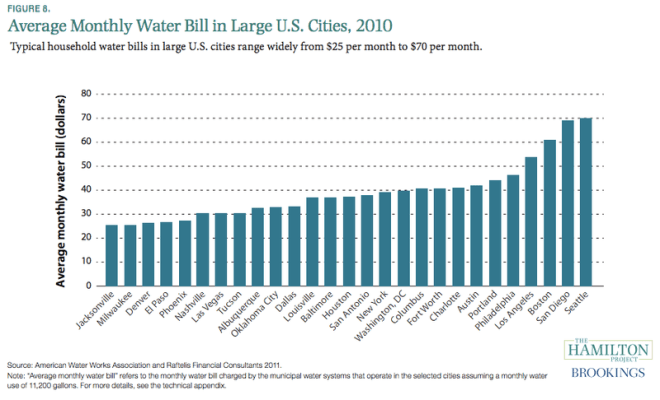
As the West suffers from an ongoing drought, Brad Plumer flags a sobering chart from The Hamilton Project’s “Nine Economic Facts about Water in the United States“:

What’s interesting is that many cities in dry areas – Denver, El Paso, Phoenix, Las Vegas – have some of the lowest water bills around, whereas a wet city like Seattle has much higher bills. Some of that can be explained by provisions in the Clean Water Act that required cities like Boston to upgrade their sewage-treatment systems. Still, the disparity is notable. Other surveys have also found that there’s little relationship between the price of water and how scarce it is.

The report notes that some cities, like Phoenix and Los Angeles, have begun to reform their pricing schemes so that heavier water users get charged more. But this is hardly universal. In most parts of the United States, the price of water doesn’t reflect the infrastructure costs of delivering that water or the environmental damage that excessive water withdrawals can cause. As long as that’s the case, there are few market incentives to conserve or allocate water more efficiently.

A Diploma Wrapped In Red Tape

Albert H. Teich urges legislators to chuck a part of the student visa process:

The United States is in a worldwide competition for the best scientific and engineering talent. But its regulations and procedures have failed to keep pace with today’s increasingly globalized science and technology. Rather than facilitating international commerce in talent and ideas, they too often inhibit it, discouraging talented scientific visitors, students, and potential immigrants from coming to and remaining in the United States.

Many elements of the visa and immigration system need attention, as I discuss at length in an article for Issues in Science & Technology. But one critical reform involves reconsidering the requirement that STEM students demonstrate intent to return home.

Under section 214(b) of the Immigration and Nationality Act, all persons applying for a U.S. visa are presumed to be intending to immigrate. In practice, this means that a person being interviewed for a student visa must persuade the consular officer that he or she does not intend to remain permanently in the United States. Simply stating the intent to return home after completion of one’s educational program is not enough. The applicant must present evidence of strong ties to the home country, such as connections to family members, a bank account, a job or other steady source of income, or a house or other property.

Teich explains why this requirement poses a problem for the US economy:

Foreign graduate students and postdocs, especially in STEM fields, make up a large and increasingly essential element of U.S. higher education. According to recent data from the National Science Foundation, for example, more than 70 percent of full-time graduate students in electrical engineering and 63 percent in computer science in U.S. universities are international students. …

What is needed is a more flexible policy that provides the opportunity for qualified international students who graduate with bachelor’s, master’s, or Ph.D. STEM degrees to remain in the United States if they choose to do so, without allowing the student visa to become an easy way to subvert regulations on permanent immigration. It makes no sense to try to make such distinctions by denying the fact that people who are applying to study in the United States may be uncertain about their plans four (or more) years later.