Because journalists will make far more money from it than the old, ethical variety. Because no one has come up with a business model that can compete with it for moolah. And, above all, because readers don’t really give a shit:
If people are offended by content marketing, why would a single Purina brand, Beggin’ Strips, have nearly 1.2 million Facebook fans, as Michael Meyer reports in his provocative piece on the subject, when Purina’s hometown paper, the St. Louis Post-Dispatch, can boast a relatively modest 120,000 fans? What’s more, some of the larger corporate newsrooms are producing exponentially more content each day than traditional news outlets.
That doesn’t mean this content is all good, or accurate, or honorable in its alleged attempt to serve its audience. But then again, plenty of work coming out of actual newsrooms doesn’t meet that standard either.
You know, I wish this could be supplemented by videos of what it’s like for women to walk down the street who don’t conform to “pretty” norms. Quite frankly, plain women, or ones not compliant with “available chick” visual norms, get just as many cat calls – often more aggressive because “ugly women should be both available and grateful for the attention” and have added in an equal or greater load of criticisms. Dog barks, bitter comments about how ugly they are, suggestions where they should go and what they should do – many obscene, and many suggesting that a man approaching them would be doing them a favor screwing them or letting them go down on the idiots.
If you’re beautiful, it’s bad. If you’re NOT beautiful, it’s hell: all the come-ons, then a layer of vicious critique, all of it from sulky men insisting on their entitlement to women: their bodies, their attention, their sexual favors, even the right to insist on the “right” appearance. Jeez-Louise, it gets old.
Another references the above image:
The reader who wrote “It all smacks of white privilege to me” might be interested in Tatyana Fazlalizadeh’s art project “Stop Telling Women To Smile.” Would that reader tell her portrait subjects (who are largely women of color) that they’re in neighborhoods where they don’t understand the social mores?
Much more commentary below:
I think a very important point has been missed, thus far, in the discussion of the catcall video.
The problem (for many women, at least) is not with the words themselves. The words themselves, as other commenters have pointed out, are First Amendment expression whether we like them or not. The problem is the context in which they are being spoken. I’ve never bristled at a “Looking good today, baby” or “Smile, honey!” comment when I’m at the post office or walking through a mall.
However, catcalls are incredibly threatening (or at least feel that way) while walking by myself or in a sketchy area or at nighttime. In those situations, my goal is to move as quickly and as unnoticed as I can through the environment. Being noticed brings with it the threat of assault, violence, or something worse. In those situations, therefore, a “Looking good, baby!” is not just a “Looking good, baby!” It’s implicitly saying, “You have been noticed. I am watching you. I am looking at your body.” The communication has a very predator-prey feeling to it regardless of how it is intended by the speaker.
Another remarks on the complex mix of feelings involved:
When I get catcalls on the street, I’m not reacting to the actual interaction most of the time. What I am reacting to is the power dynamic that is happening and the possibilities of future violence. My stress levels rise when I imagine what is going to happen next, whether I ignore the words or whether I engage. I feel powerless and afraid. I feel pissed off at them for bothering me and at myself for “letting” them. I feel a flush of pleasure at being complimented, and then guilty that I should actually like that kind of attention. I feel afraid of opening myself up to the guy who really does just want to say “Good morning” because then the next guy I smile at will take that as an opening to talk about my big juicy tits.
And this happens to me ALL THE TIME. It’s a whirlwind of fear, anxiety, relief, pleasure, and mindlessness.
Another turns to the “elephant in the room,” as our reader put it:
In response to those worrying that the catcalling is mostly done by black men: The first catcall I ever received was from a white man in a suit. I was twelve years old, wearing a miniskirt, on my way home from a party in lower Manhattan. I was also lost, and I was grateful to find a subway station. As I walked into the subway, a man in his 20s or 30s coming up the stairs whispered, “Sexy.” I had no idea how to react. I was so alarmed at being sexualized by this adult that I turned around, left the subway, and took a cab home.
I have been catcalled countless times since then. Sometimes it’s truly offensive, and occasionally, rarely, it’s flattering. (A man once yelled at me, “This is why I love New York! The most beautiful women in the world, and you’re one of them!”) Mostly, it’s just tiring. It becomes one more thing to deal with: Should I respond to that guy, or ignore him? Is he honking because there’s an emergency, or is he just trying to get my attention? Is he scary or just a nuisance?
The value of the flawed Hollaback tape is that it shows men how pervasive catcalls are. For a lot of women, they are just a fact of life – and we forget that men don’t see that. I don’t think catcalling should be criminalized (would that even be constitutional?) or that it’s anywhere near the most serious issue facing women. But it’s worth noticing how often catcalls happen.
More on the racial angle:
Your reader who is concerned about the “inconvenient truth” revealed in the video – that the majority of the catcallers were Black and Latino men – needs to confront an inconvenient truth, as well: he or she (despite the caveats that were offered) is overreading it. First of all, a number of the white guys were edited out of the video. Second, let me tell you something: Right now, I live in South Dakota, and the men who have catcalled me, to a person, are white. If Hollaback had shot a similar video here, and if the overwhelming majority of the woman’s catcallers had been white, I wonder if your reader would have characterized the problem along racial lines. I suspect that the answer is “No.”
Another reader:
As a mixed-race woman, living in NYC for over 15 years, I can testify from personal experience it is the United Nations of Perverts out there. I have been harassed in similar ways (and worse) as the woman in the video, by men of EVERY race. So have most of my female friends in this city. Where I lived previously (Florida), I was also unfortunately harassed by men of all races (from white rednecks to white men in sportscars to Latin and black men). But in New York, the incidence of harassment is higher because it’s a walking city, and our population is more diverse than most public spaces in America.
This is probably a good moment to post a trailer for the classic documentary of street harassment, “War Zone.” It’s filmed in Chicago. Plenty of white harassers on the video, which makes sense given the population there:
And another:
I worked on a garbage truck for the County Parks Maintenance Department one summer when I was in college. All the guys in the shop were Archie Bunker types, and I worked with two drivers – one Irish, one Italian (the Italian guy assumed I was also; when I told him I’m Jewish, he thought about it and said “there’s nothing wrong with that”). The Irish driver would whistle and call women from the truck as I was riding shotgun while I’d squirm, since the last thing I wanted was to call to the attention of pretty women the fact that I was riding shotgun in a garbage truck.
During one whistle/catcall event towards the end of the summer, he turned to me as I was sinking down in my seat and said, “What’s the matter with you, don’t you like girls?”. It was just kind of taken for granted that this is what you do if you like girls. Clearly this man in his 60s with a strong brogue, who’d been a laborer all his life and looked it, couldn’t have hoped for any kind of positive reaction from the women, and I don’t think he meant to harass or threaten. It’s just what you do to express your appreciation for the female form.
He and the other guys had no idea how dumb they made themselves look doing this. Telling them how threatening they are is probably futile, since they don’t see themselves as threatening and would say that you should just lighten the F up. A better strategy might be to help them realize how completely ridiculous they look.
One more:
It seems to me that part of what women are saying is the constant everyday-ness of the catcalls. It’s like African Americans who say it’s not the OPEN discrimination, it’s the thousand tiny cuts, i.e., being followed in stores, being asked for ID along with your credit card when your white friend does not get asked, being stopped by cops for no seeming reason, etc etc. It just wears you down after a while and I suspect young women feel the same.
Read the whole discussion thread here. Another long thread on catcalling from 2012 is here. More reader feedback on our Facebook page. Update from a reader:
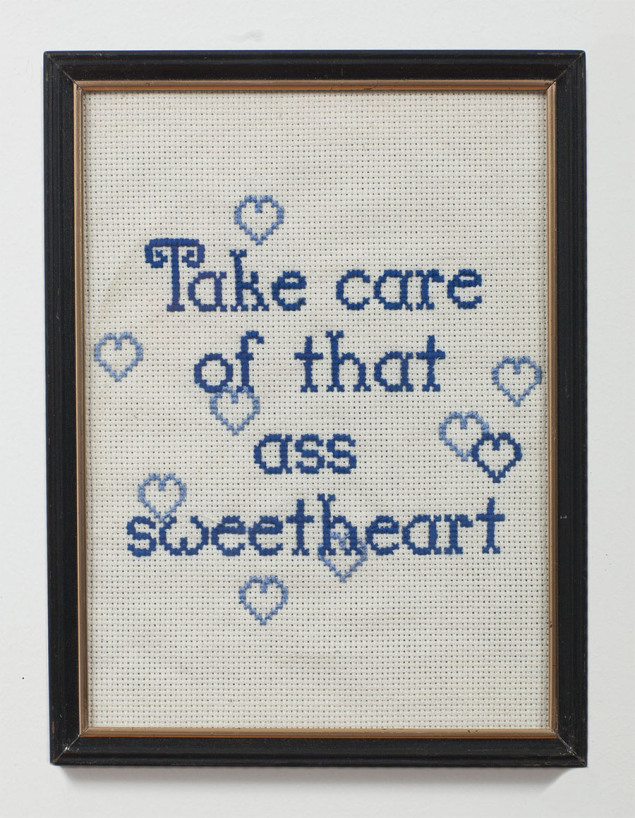
I haven’t read through all the commentary, but as a woman I naturally am very glad to see it being discussed. I’m not sure if this has been sent your way, but rather than catching the catcalls on camera, a Brooklyn artist found another unique way of catching them – she does it in cross stitch:
And it’s really discomforting to see the “compliments” or the insults captured in this medium. Sort of perverse folk art.
Another reader:
You know, Andrew, your female readers are reacting to racial aspect of the video (by insisting that white men catcall too, which I’m sure is true) but utterly and completely ignoring the class aspect – or in some cases, as with the story of the Irish guy on the garbage truck, actually making the case that this may indeed be class thing.
I live in a middle class/upper-middle class suburban (and yes, mostly white) neighborhood, and women are not being catcalled here. It’s just not happening. My 13-year-old son has several friends who live in a newer neighborhood with sidewalks and lots of pedestrians about a half-mile away; women are not being catcalled there, either.
The suggestion by your readers seems to be that if a woman were to walk around these neighborhoods she’d get just as many “Hey, baby” catcalls as the woman in the video did. I’ll tell you right now, that suggestion is false.
What we have, then, are women who legitimately feel creeped out or even threatened when something like this happens, but who in turn attempt to suggest that “all men” are either guilty of such behavior, or at least responsible for it in some way. And I reject that; I don’t do collective guilt. I don’t teach my sons to behave this way, the people I hang out with tell their children that this behavior is wrong and offensive. I’m responsible for my behavior, for my kids’ behavior, maybe even to an extent my neighbors’ behavior. But the guys in that video, catcalling the woman? I’m not responsible for their behavior. It’s not my responsibility to change it.
Or should it be my responsibility to tell them they’re wrong – me, the upper middle class white guy, telling impoverished blacks, Latinos and whites that they’re being boorish? That’d be received real well, don’t you think?
But first, a Halloween movie mashup to get you in the spirit:
Samira Kawash details the rise of Halloween candy:
Would you believe the earliest trick-or-treaters didn’t even expect to get candy? Back in the 1930s, when kids first started chanting “trick or treat” at the doorbell, the treat could be just about anything: nuts, coins, a small toy, a cookie or popcorn ball. Sometimes candy too, maybe a few jelly beans or a licorice stick. But it wasn’t until well into the 1950s that Americans started buying treats instead of making them, and the easiest treat to buy was candy. The candy industry also advertised heavily, and by the 1960s was offering innovative packaging and sizes like mini-bars to make it even easier to give out candy at Halloween. But if you look at candy trade discussions about holiday marketing in the 1920s and 1930s, Halloween doesn’t even get a mention.
She elaborates on another reason for the rise of branded sweets:
One of the biggest casualties of the poison treats scares of the 1970s was homemade sweets.
In the 1960s and before, it was totally fine to give out something you’d made yourself. But once people got it in their heads that maniacs were out there trying to kill their children with Halloween treats, everything homemade was suspect. After all, you didn’t know whose hands had touched that cookie and what scary ingredients might be hidden under the chocolate chips. Same for unwrapped candies and off-brand candies: If it wasn’t sealed in a recognizable, major brand factory label, then it was guilty until proven innocent. National advertised candy brands were familiar and trusted, unlike that spooky neighbor who just might be an axe murderer. It’s one of the huge successes of processed food marketing, to make us trust and feel good about the factory food, and to distrust and denigrate the homemade and the neighborly.
I think this is starting to swing back in the other direction though, at least in urban areas. Today, consumers are pretty obsessed with the artisanal and the small batch, and will pay a huge premium for candy that is nothing like Hershey or Mars. On the other hand, every year the candy that’s wrapped for Halloween treating gets more and more homogeneous, and the national brands rule.
Elsewhere, The Daily Meal dished out an infographic comparing the unhealthiness of different candies.
Lauren Sherman checks in on the place of sponsored content in fashion blogging:
[W]hile fashion has been slow to adapt digitally in so many ways, it was one of the first group of marketers to embrace native advertising. When fashion bloggers emerged in the mid-2000s as the new influencers, brands developed “gifting” programs to seed their products. A handbag line, for instance, would send a top 10 blogger the latest style in hopes that she might write about it, or post a photo of it on her blog with a link back to the brand’s e-commerce site. It wasn’t so different than the business of celebrity placements, when brands give a star a pair of jeans or a leather jacket in hopes that she’ll wear it in a well-publicized paparazzi photo.
However, as blogs transformed from diaries to media properties, bloggers began asking for more.
If they were going to post about the product, they wanted to be compensated for the post as well– in addition to the commissions they were making via affiliate links. Today, native advertising can be quite sophisticated. One of my all-time favorite examples of native advertising is a Juicy Couture-sponsored video, where stylist/Glamourai blogger Kelly Framel interviews Carlyne Cerf de Dudzeele [seen above]. This was soon after “In Vogue: The Editor’s Eye” had come out: Cerf de Dudzeele waxed on about why she loved track suits, and Framel — a genuine fan of the famous stylist — asked her the right questions. Sure, it didn’t save Juicy Couture from combustion, but it was a nice little Hail Mary moment. Nars’s video series with Garance Doré and the Man Repeller are more recent examples of likeable native advertising. Both Dore and TMR founder Leandra Medine are believable Nars customers, which makes the already fun videos — watch them here and here — all that more compelling.
But as more and more bloggers find their audiences fleeing URLs for other platforms — namely Instagram — and brands have begun to think harder about what they want from these partnerships, frustration has bubbled up on both sides. Bloggers argue that brands aren’t upfront about what they’re looking for in terms of tangible results, and brands argue that bloggers are unable to deliver anything tangible. The champagne might still be flowing, but the party is wrapping up for unhappy brands and frustrated bloggers.
Fashion journalism, of course, has always been less a conflict of interests than a mashup of them. But it’s all so subjective that any idea of objectivity is remote. Nonetheless, it’s always great to find a writer who is indifferent to all this payola, whose taste is her own, whose prose caters to no subsidy. But how on earth can they make a living these days? The internet lets a thousand flowers bloom, but, in the end, only a handful get the water and the fertilizer, let alone the care and attention of the experienced gardener/editor.
Megan McArdle proclaims that employers “shouldn’t just give their employees vacation days; they should force them to actually leave the office and go on vacation”:
I don’t really need to extol the benefits to an employee of a few days off, but I will say that everyone needs to take a break. Over time I’ve noticed that if I go too long between holidays — more than about three months — I start to feel like I’m forcing it, plodding through the day’s stories rather than actually attacking something I’m interested in. That’s a pretty common experience among the people I know. Periodically, you have to stop and give the well a chance to refill. I don’t think it’s an accident that creative people frequently report having breakthroughs after they’d stopped working for a bit and started thinking about something else.
She insists that “even the most upstanding, outstanding employee should not be so vital to your firm’s operations that you cannot afford to let them go for a week or two”:
What if this person leaves the firm? What if they are killed in a car crash? Periodically preparing to do without this person means that if and when they do depart, you will not be plunged into an instant crisis.
For years, I’ve been open with many people about my sexual orientation. Plenty of colleagues at Apple know I’m gay, and it doesn’t seem to make a difference in the way they treat me. Of course, I’ve had the good fortune to work at a company that loves creativity and innovation and knows it can only flourish when you embrace people’s differences. Not everyone is so lucky.
While I have never denied my sexuality, I haven’t publicly acknowledged it either, until now. So let me be clear: I’m proud to be gay, and I consider being gay among the greatest gifts God has given me.
Leonid Bershidsky points out that “Cook is the first chief executive of a Fortune 500 company to come out in public”:
Members of this exclusive club are still unsure whether that’s wise, and just a few years ago, it wasn’t. In 2007, John Browne resigned as chief executive of BP after being outed by a British tabloid. He has since written a book about being a closeted gay in big business. “To a headhunter I would have been seen as ‘controversial,’ too hot to handle,” Browne wrote. “Sadly, there were some people, mostly from the business world, who never again displayed any warmth to me.”
Browne regretted choosing to live a double life rather than setting himself up as a role model for other gay executives — something Cook has done now with his candid, touching essay. Still, he had strong motives for staying in the closet — stronger ones than an inclination toward privacy, which Cook, no publicity hound either, has successfully overcome. As head of a large corporation, one has to deal with important people from cultures where homophobia is a way of life. Under Browne, BP had a major joint venture in Russia, where President Vladimir Putin has approved laws against the “propaganda of non-traditional sexual orientation.”
Along those lines, one Russian lawmaker has already proposed banning Cook from the country. And Chinese social media users widely ridiculed the announcement:
Crude puns and derogatory remarks relating Cook’s orientation to Apple products often seemed to drown out praise for his courage and support for his company’s wares. One particular joke, repeated so often in the hours immediately following the release of Cook’s article that the state-run Guangming Dailyreported it as a typical netizen reaction, played on the Chinese term “bent man,” slang for gay man. “No wonder the iPhone 6 bends so easily!” wrote user after user. (Tales of the ultra-slim iPhone 6 bending under light pressure have circulated both in the United States and abroad since the iPhone’s release in September.)
Tim Teeman wonders how Cook will deal with such intolerance:
His most radical statement of intent, and one which will be fascinating to see if he holds true to—and if so how practically and volubly, comes at the end: “We’ll continue to fight for our values, and I believe that any CEO of this incredible company, regardless of race, gender, or sexual orientation, would do the same. And I will personally continue to advocate for equality for all people until my toes point up.”
If Cook is serious, then arguably he has just become—indeed made himself—the single most powerful and highest-profile advocate for gay equality globally. How he intends to practically parlay that will be fascinating to watch.
Apple, for example, is in talks to sell the iPhone in Iran, a country where homosexuality is a crime punishable by death. Incidences of gay men being hanged in public have been graphically reported upon. If Cook is to be taken at his word, one would expect him to make some public statement about Iran’s record, as he prepares to do business with the country. His stirring essay makes clear his desire to be an advocate and activist, but it does not specifically lay out how he intends Apple to do business with deeply homophobic countries like Iran.
Issie Lapowsky hopes that Cook’s announcement will help other business managers and employees to come out:
The problem is more acute than you might think. With a recent study, Deloitte University’s Leadership Center for Inclusion examined a phenomenon that sociologists refer to as “covering,” where people will attempt to mask part of their identity in the workplace, and it revealed just how pervasive—and potentially damaging—the practice is among members of the LGB community.
The study surveyed more than 3,000 employees at businesses across the country to determine what percentage of them admit to covering at work, and why they feel the need to do it. The study included people of a variety of races, genders, and sexual orientations, and found that while 61 percent of all respondents said they had covered, a whopping 83 percent of gay respondents said they had. That’s more than black respondents, female respondents, and any other minority group surveyed (the transgender sample size was too small to be included).
Claire Cain Miller makes clear why Cook’s statement matters:
Though there have been chief executives at the upper tiers of corporate America who are gay, they have consistently declined to be identified as such. That sent a similarly strong message to young people, said Sam Altman, president of Y Combinator, a prominent Silicon Valley start-up investment firm and incubator.
“Shame is the wrong word, but there’s some sense of lack of comfort when it goes widely acknowledged and not said,” said Mr. Altman, who is 29 and gay. He said he remembers thinking in high school that as a gay person, he could never become a venture capitalist because the industry was too much of a traditional old boys’ club for him to be included. Mr. Cook has become “an incredibly important role model, and I think people underestimate how important that is in what people think they can do with their lives,” Mr. Altman said.
There was a time when I struggled to come to terms with myself; when I felt alone; when I scanned the horizon looking for someone to point the way forward for me. There was a time when the only other gay men I knew were the ones I saw in TV and movies, and they seemed nothing like me. It feels embarrassing to say now that what I wanted back then was a role model — someone confident in himself, powerful, a real leader — to give me permission to be myself. But I very much did.
And many still do, particularly younger people, and particularly younger people growing up in the more rural and religious parts of America. Someday, maybe someday soon, we’ll hear about how Cook’s essay today helped someone there through a difficult time. And then we’ll hear it again, and again, and again.
Update from a reader:
I guess I’m all alone here. To me, Tim Cook is the Jodie Foster of corporate America. Unlike Ricky Martin who said something to the effect of “If I knew back then how good telling the truth feels, I would have done it a long time ago,” Cook and Apple are spinning their message for maximum exposure and publicity. Despite last June’s “outing” on CNBC, Cook and Apple remained coy, and even yesterday’s announcement proclaimed that Cook has never denied who he is. The whole thing seems fishy to me. We have a wealthy and powerful leader of an adored company making a safe announcement once he’s in a comfortable position. Rather than showing that Apple is an open and tolerant organization what this seems to say is that like Jodie’s path to stardom and success, the closet can be a useful career strategy if you play it right.
We should all be glad that Cook is now feeling safe, open, and proud about who he is and let the homophobes know they need to get over themselves, but as a role model, Cook‘s credentials are somewhat weak. He played it safe on the way up, and now he wants to play the hero and get the admiration. Until his role moves beyond symbolism, I am withholding my praise.
(Photo: Apple CEO Tim Cook announces the Apple Watch during an Apple special event at the Flint Center for the Performing Arts in Cupertino, California on September 9, 2014. By Justin Sullivan/Getty Images)
“The black-market prices are definitely lower than recreational prices,” says Michael Elliott, executive director of Colorado’s Marijuana Industry Group. “The taxes are a big reason why, the new testing requirements, the packaging requirements, and basically this whole hurdle of the extraordinary expenses people have had to go through to open these businesses. Another reason is that the businesses have had limited supply.”
But, as prices fall, the black-market is going to shrink:
Kayvan Khalatbari, co-owner of Denver Relief, a medical dispensary that started serving recreational consumers in July, says after-tax prices in that market average $50 to $60 per eighth. He expects those prices to plummet by next year, however, as growers ramp up production and new suppliers enter the market. As of October 1, dispensaries no longer have to grow 70 percent of their inventory, and businesses dedicated to cultivation will be allowed.
“I would not be surprised, given the flood that’s going to happen, if we see $10 and $15 eighths by early next year,” Khalatbari says. “I would believe that. I could see ounces being sold for $50. I truly see that happening, because there is going to be so much competition [and] people are becoming so efficient in their production. They’re automating much more. We’re seeing best practices settle in. There’s less risk in operating because people are operating at a higher level. I think we’re going to become a very efficient industry very quickly. We’re going to see competition, and we’re going to see prices hit rock bottom early next year.” At that point, he predicts, the black market will dwindle away.
Criminologist Scott Bonn concludes that “the image of the evil genius serial killer is mostly a Hollywood invention”:
Hollywood has established a number of brilliant homicidal maniacs like John Doe in the acclaimed 1995 film Se7en. Doe personifies the stereotype of the evil genius serial killer who outsmarts law enforcement authorities, avoids justice and succeeds in his diabolical plan. … Real serial killers generally do not possess unique or exceptional intellectual skills. The reality is that most serial killers who have had their IQ tested score between borderline and above average intelligence. This is very consistent with the general population. Contrary to mythology, it is not high intelligence that makes serial killers successful. Instead, it is obsession, meticulous planning and a cold-blooded, often psychopathic personality that enable serial killers to operate over long periods of time without detection.
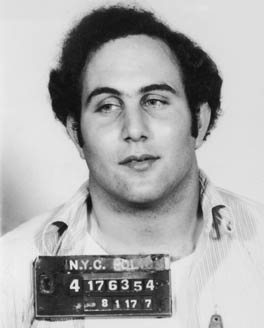
David Berkowitz is one of the most infamous serial killers of all time, though he is more commonly referred to as the Son of Sam. In the 1970’s, the Son of Sam terrorized the people of New York City, murdering six people and prompting a police operation known as Operation Omega, comprised of 200 detectives trying to stop him before he could kill again.
So how did they finally catch the infamous murderer? A parking ticket. Berkowitz had parked his car in front of a fire hydrant before heading off to get his murder on, and a woman witnessed him tearing up the parking ticket and later reported it to the police. Just think about the fact that the Son of Sam may very well never have been caught were it not for his easily avoidable mistake of parking in front of a fire hydrant.
Brian Merchant flags a study claiming that salt degradation “has caused tens of billions of dollars worth of damage, mars an area of cropland the size of Manhattan every week, and has hit nearly one-fifth of the world’s farmland so far”:
“Salts have damaging effects whether they are in excess amounts in the human body or in agricultural lands,” Manzoor Qadir, the lead author of an eye-opening new study on the subject, published by the United Nations’ Institute for Water, Environment and Health, told me in an email conversation. “If salt degradation goes on unchecked, more and more land will be highly degraded leading to wasteland,” he said. “Restoring such lands will not be economically feasible at all.”
Rainfall and irrigation systems designed for lots of drainage usually keep salt from building up in the soil. But as climate patterns shift and more farmers irrigate without sufficient drainage, evaporated salt is crusting on top dirt clumps around the world — especially in places like Central Asia. Normally, soil has anywhere from zero to 175 milligrams of salt per liter. Once that level exceeds 3,500 milligrams per liter, it’s next to impossible to grow anything, including major crops like corn, beans, rice, sugarcane and cotton. …
No one had really studied the economic impacts of salt-damaged land, says Qadir. But now that the UN Food and Agriculture Organization has projected that we need to produce 70 percent more food by 2050, the salinity problem is becoming a much higher priority issue. On the 1-to-10 scale of land sustainability problems, “erosion is an 8 … high-saline soils is a 2 problem,” Chuck Benbrook, research professor at the Center for Sustaining Agriculture and Natural Resources at Washington State University, tells The Salt in an email.
Hillary Kelly muses on an exhibit at the Metropolitan Museum:
Mourning clothes—along with other facets of grief—were highly regimented in Victorian England and nineteenth-century America. As the curator’s note explains, “Mourning through sartorial display, a duty chiefly assumed by women, followed a series of stages marked by changes in fabrics and colors.” Exacting codes defined which fabrics and colors were acceptable at particular stages of grief: For the first months after a death, only “lusterless” black dresses were acceptable. As time passed—and for a widow one expected to wear mourning clothes for a full two years—the strictures slowly loosened, and the severity of the attire deceased.
The loss of such traditions has its drawbacks:
The mourning period is a nebulous and tricky thing to navigate in modern life. The boyfriend of a very close friend died in an accident the summer after our freshman year of college. The most agonizing conversations I remember having with her revolved around the expectations others placed on her grief rather than the death itself: When would she “get over it”? How long was she going to remain single? Did she ever think she’d get married? When she began dating another person, she confronted all kinds of unkind judgment from those who thought she’d “moved on” too quickly and wondered (yes, out loud) if she’d really loved the boyfriend who had died.
Would mourning clothes have helped her or hindered her? So often we think of the strictures of the Victorians as constraining, but there is a sense in which their very formal propriety feels appropriate and even comforting. If you exclude certain religious traditions—sitting shiva, for example—in which the processes immediately following death are heavily prescribed and demand an explicit and relatively lengthy interruption of everyday life, modern grief is missing a sense of etiquette and deliberateness—a set of outward signs for the bereaved to use as signals.


 The Dish