How We Feel About Islam

islamA

A new YouGov survey sheds some light on Americans’ attitudes toward the religion:

Most Americans (59%) have an unfavorable opinion of Islam, while only 18% say that they have a favorable view of the religion. Republicans (74%) have the most unfavorable view of Islam, while under-30s (32%) have the highest favorable attitudes towards Islam.

Perceptions vary greatly as to how many Muslims sympathize with ISIS and Al Qaeda. 19% of Americans believe that most Muslims sympathize with the two extremist groups, while at the opposite end of the spectrum 31% believe that less than 10% of Muslims support ISIS and Al-Qaeda. 27% say that between 10% and 50% of Muslims around the world back the two groups. Democrats are much less likely to say that significant numbers of Muslims support the two groups, with 43% of Democrats estimating that the percentage of Muslims that support ISIS and Al-Qaeda is under 10%, something only 20% of Republicans agree with.

Looking back at how Americans’ views of Jews evolved over time from hostile to welcoming, Jon Fasman predicts that feelings toward Muslims will follow a similar path:

As with much social change, finding a single, directly attributable cause for the decline in American anti-Semitism is more or less impossible. Many nebulous things happened at once. Jews grew more “American” and less “foreign”, not least because, as the 20th century wore on, an ever-greater share of them were American-born.

… America will inevitably reach the same accommodation with Islam that it has reached with Judaism. It will take time, of course—most American Muslims are foreign-born, so are in roughly the same xenophobia-provoking demographic position as American Jews were three generations ago. But already there are encouraging signs: Muslims appear to be far better integrated in America than in Europe, as measured by their share of non-Muslim friends and by the intermarriage rate. Their worldviews more closely resemble those of non-Muslim Americans than they do Muslims outside the United States.

A reader sounds off at length:

I’m a 30-year-old atheist who deconverted from Islam on my 15th birthday. Some friends and I (all of us secular liberals from various religious backgrounds who grew up in the Persian Gulf region, then moved to the West) have been having a great online debate about the very matters you have been covering in your Islam thread. I have found a lot of the discussion online quite invigorating, notwithstanding what I have to say here.

I think there is a huge overlap in the beliefs and opinions of Bill Maher, Reza Aslan, Sam Harris, and yourself. The primary difference lies in the strategies employed and the goals of the discussion. Maher/Harris, ultimately, want to advance atheism, and that’s what sets them apart from the others. I also want to advance atheism, at least in theory, but I am also a realist and it is my realism that makes me part ways with them and, frankly, you, on this matter.

Yes, open dialogue and discussion is a principle that must be protected and advanced … except when doing so actually hinders the cause in the long-run. There are a lot of things we just. don’t. talk. about. For instance: I have met Muslims throughout my life who, in their effort to explain some of the injustices Palestinians face, are obsessed with talking about which companies have Jewish CEOs or the proportion of Jews on the board of directors of Whatever, Inc. To those people I say: I don’t know if you are right or wrong, and frankly I don’t care. It doesn’t advance the cause of Palestinian human rights to point these things out. All it does is elicit strong emotional reactions from Jewish people, and further alienates them from the fucking cause you are fighting for.

I am one of those liberals who complains within my circle of Arab/Muslim friends and family that our community needs to confront the extremism that is spreading like a cancer in our region’s politics and culture. Yet I also recognize, because I have my legs glued to the ground, that the millions of Muslims who could be fighting extremism will defend their identities and their religion first, if it is under attack. This is basic human nature, like it or not. When Bill Maher (whom I adore, BTW) condemns Islam as a religion, whatever the nuances of his argument, he is perceived as attacking the identities of literally millions of potential allies in the liberal project. These millions, instead of focusing on the scourge of extremism, expend valuable airtime and resources in defending their faith, which as Azlan rightly noted, is an integral part of their identity.

The vast majority of Muslims are like the vast majority of all human beings: they just want to eat, fuck, sleep, and work. Non-Muslim people need to STFU about Islam so that normal, everyday Muslims can begin the fight against extremism in earnest. It’s the only strategy that makes any sense and the only one that has any chance of working. Muslim extremists don’t have to answer to white liberals, but they do need to answer to people who identify as Muslim.

The reforms that took place within Christianity were not easy, but the ones that are necessary within Islam have at least one greater hurdle to overcome. The transformation of Christianity did not have to contend with accusations that reformists were trying to “Islamize” or “Easternize” Christianity; reformist Christians, to my knowledge, weren’t accused of following the “corrupt example” of a powerful, foreign, dominant culture (and one that has meddled in the affairs of the region, to its detriment). In contrast, today, any effort to reform Islam will naturally be viewed as bowing down to a dominant, powerful western culture. Considering the fact that humans will do anything to distinguish themselves from external cultural forces, you can’t possibly think of a more powerful obstacle to reform than living in the shadow of a powerful liberal-Christian culture that has already embraced those reforms.

The good news is that enough Muslims live in liberal societies. Muslims who do not live in those societies, for the most part, do view their liberal counterparts as their brethren. If we give the Muslims in our part of the world the fucking space to speak for liberal values, for reforming Islamic institutions, for advancing the good parts of the religion while downplaying or reinterpreting the ugly parts, these views will be transmitted to their counterparts in the Middle East. In order for that to happen on a bigger scale, those liberal Muslims must be given the psychological space to do so, and it is my view that when westerners from Christian or Jewish backgrounds attack even small aspects of Islam on national TV, they are lessening that psychological space. I know it sounds somewhat irrational, but issues of identity and religion rarely are.

In my non-expert opinion, Islam is probably more violent than all the other major faiths. But insofar as you want to live in a more peaceful, stable world, who the fuck cares? Non-Muslims: STFU; Muslims: SPEAK.

Marriage Equality Update

A reader provides it:

Not even two years ago, I worked to help the town of Bisbee, Arizona set up municipal-level domestic partnerships – essentially a package of trusts and contracts that would grant couples all the rights they could grant each other under existing law. There were press conferences by the Attorney General and angry editorials.

This morning a federal judge struck down an amendment to Arizona’s constitution denying same-sex couples the right to marry. It’s not even really news at this point.

Inching Closer To An Agreement? Ctd

KhameneiRedLines

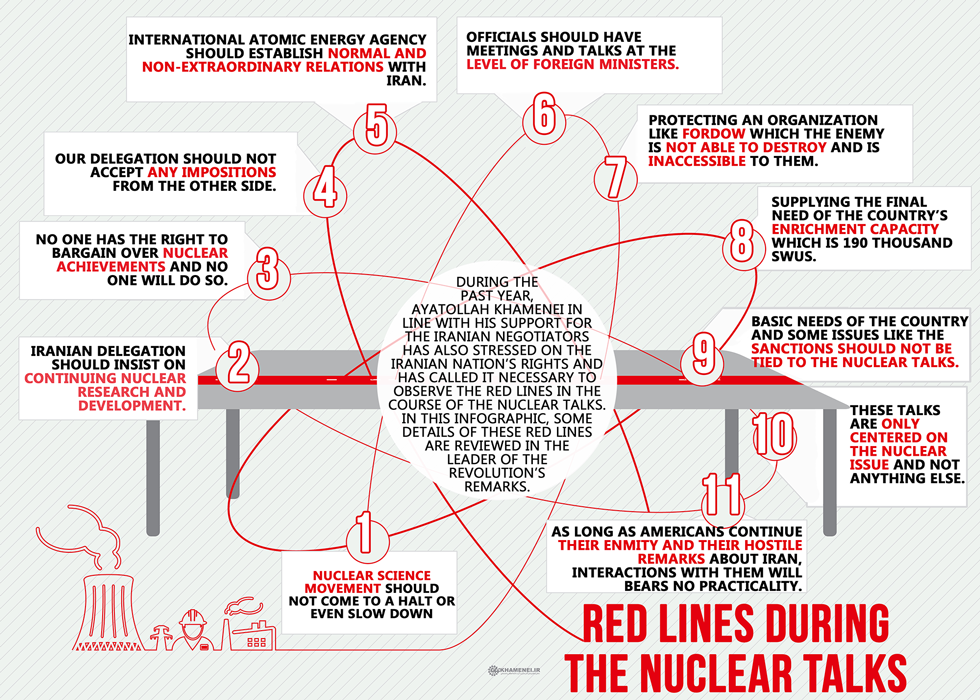
Suzanne Maloney provides “an anatomy of Iran’s eleventh-hour nuclear negotiating strategy.” She admits that, by “sticking to its guns, Tehran has gone from supplicant to sought-after in the talks, with Washington and its allies scrambling to devise formulas that might meet the supreme leader’s imperious mandates”:

Still, it seems unlikely to me that Washington will acquiesce to Iran’s obstinacy on enrichment. The Obama administration has already extended major concessions to Tehran in devising a formula that Tehran could claim acknowledged its nuclear rights and in backing away from previous American insistence on a suspension or end to all enrichment on Iranian soil. Any deal that fails to redress the breakout timeline would gainsay a decade of efforts to deter Iran from nuclear weapons capability, as well as the strong preferences of America’s regional allies.

And more importantly, I think the presumption that the Obama administration is so desperate for a foreign policy victory, so feeble in its assertion of American interests and the security of our allies, or so eager for Iranian cooperation on other regional challenges that it will accept a hollow deal represents a profound misinterpretation of this administration’s foreign policy and the capabilities of the United States.

For that reason, I believe that Tehran’s four-point hedging strategy is a dangerous bluff, and one that will ultimately fail. I suspect that will not prove the end of diplomacy with Iran, but neither will it facilitate the end of Iran’s self-imposed forfeiture of its rightful place in the world.

Gareth Porter maintains that the “key to understanding Iran’s policy toward nuclear weapons lies in a historical episode during its eight-year war with Iraq”:

The story, told in full for the first time here, explains why Iran never retaliated against Iraq’s chemical weapons attacks on Iranian troops and civilians, which killed 20,000 Iranians and severely injured 100,000 more. And it strongly suggests that the Iranian leadership’s aversion to developing chemical and nuclear weapons is deep-rooted and sincere.

A few Iranian sources have previously pointed to a fatwa by the Islamic Republic’s first supreme leader, Ayatollah Ruhollah Khomeini, prohibiting chemical weapons as the explanation for why Iran did not deploy these weapons during the war with Iraq. But no details have ever been made public on when and how Khomeini issued such a fatwa, so it has been ignored for decades.

Now, however, the wartime chief of the Iranian ministry responsible for military procurement has provided an eyewitness account of Khomeini’s ban not only on chemical weapons, but on nuclear weapons as well. In an interview with me in Tehran in late September, Mohsen Rafighdoost, who served as minister of the Islamic Revolutionary Guard Corps (IRGC) throughout the eight-year war, revealed that he had proposed to Khomeini that Iran begin working on both nuclear and chemical weapons — but was told in two separate meetings that weapons of mass destruction are forbidden by Islam.

Yesterday, Drezner worried that Iranian and American legislatures won’t agree to a deal. Larison adds his two cents:

Since the Senate GOP is opposed to a final agreement with Iran that doesn’t include their impossible conditions, the prospect of their takeover could adversely affect the final stage of the negotiations this year. If the Iranians see that Republicans are poised to win control, they might be more likely to stall or walk away from the talks all together. In the worst case, there might be no deal because the Iranian side assumes that the U.S. won’t be willing to fulfill the rest of its side of the bargain, or there could be a deal reached that is then blown up a few months later as it becomes clear that there will be no action on sanctions relief from Congress.

“2016’s Premier Novelty Act”

Phil Mattingly covers Carson’s budding presidential campaign:

[S]upporters launched the National Draft Ben Carson for President Committee. It raised more than $7 million in less than a year of existence. It has deployed staff members to Iowa and South Carolina and purchased tables at Republican events throughout the country. The group, according to Federal Election Commission filings, is gathering reams of supporter, fundraising and digital data that could be purchased and utilized by Carson’s campaign should he decide to give the green light. It’s a little like Ready for Hillary, the outside group pushing for the former secretary of State to jump into the 2016 race.

Except the Carson group actually outraised Ready for Hillary last quarter.

Francis Wilkinson remarks that Carson’s candidacy “promises to be a (traditional) marriage of Michele Bachmann’s personal loopiness and Herman Cain’s professional ignorance of public policy”:

In his book, Carson called the Affordable Care Act “the biggest governmental program in the history of the United States.” (So much for Social Security, Medicare, the Pentagon.) And if he can’t be bothered to learn much about government, he has an all-purpose rationale: “I would choose common sense over knowledge in almost every circumstance,” he wrote. It’s just too much to ask for both.

Carson, who is poised to be 2016’s premier novelty act, is already following the script from Cain’s 2012 Republican presidential run. He is a successful black man who tells conservative white audiences that there are no meaningful structural impediments to success: There are only character failings. That should be enough to keep him on the stage, at least until the Iowa caucuses.

Update from a reader:

Loopiness?  Professional Ignorance?  Premier Novelty Act? REALLY? I’d expect better from the Dish. For many of your readers, who may not even know who Ben Carson is, how about being fair, rather than simply trashing him? His resume is second to none:

  • Raised by a single mom in Inner City Detroit.
  • Director of Pediactric NeuroSurgery at Johns Hopkins Hospital at age of 33.
  • In 2001, CNN and Time magazine named Ben Carson as one of the nation’s 20 foremost physicians and scientists.
  • In 2001, the Library of Congress selected him as one of 89 “Living Legends.”
  • In 2006, he received the Spingarn Medal, the highest honor bestowed by the NAACP.
  • In February 2008, President Bush awarded Carson the Ford’s Theater Lincoln Medal and the Presidential Medal of Freedom, the U.S. highest civilian honors.
  • In 2009, actor Cuba Gooding, Jr. portrayed Carson in the TNN television production Gifted Hands.
  • Because of his unflagging dedication to children and his many medical breakthroughs, Carson has received more than 50 honorary doctorate degrees and is a member of the Alpha Honor Medical Society, the Horatio Alger Society of Distinguished Americans and sits on the boards of numerous business and education boards.

Find me 10 Americans alive today that are more admired, successful and accomplished. Yet you lead with Novelty Act, Loopy and Professional Ignorance.

Carson is clearly an incredible physician and humanitarian. But politician? On the Dish alone, we’ve seen Carson call Obamacare “the worst thing since slavery“, champion creationism, and compare homosexuality to bestiality and pedophilia.

When Does Spanking Become Child Abuse? Ctd

The popular thread continues with a new angle – sexual shame:

I can only remember one time I was spanked. It’s an early memory of running away and cowering in the corner while my very sweet and kind father came towards me. I was so scared. The spanking wasn’t terrible but that image will stick with me forever. That and the humiliation. I still can’t reconcile it with my father’s otherwise extraordinarily loving personality. And I have no memory of why I was punished. Clearly the “lesson” didn’t stick. But that image always will.

As an absolute aside, has anyone noticed that hitting someone’s buttocks is an oddly sexual place to hit someone? Could it, even unintentionally, be a form of sexual abuse? Certainly that element adds to the humiliation of being spanked.

Another can relate to that humiliation:

My parents never paddled me with an implement, or whooped me with a switch, or a belt.

My father spanked me, bare-bottom, bare-handed over his knee until I was about six. For some reason, the recent discussion about child abuse and corporal punishment treats spanking as a lesser act, like a kindly “slap on the butt”. I couldn’t disagree more.

My earliest emotional memories are the terror and shame I felt as my dad tore down my pants and spanked my bare bottom. The anger and rage he expressed terrified me. I didn’t understand. It didn’t teach me anything, except to fear my father, who surely had loving thoughts of his son. It took ten years before I could get to know my dad, and I wonder often how it might have been different. And he wasn’t otherwise a frightening figure. He was a bookish lawyer from a good family.

There’s a sexual element to corporal punishment that is difficult to confront. Society nearly admits as much when witnesses are required for female students to be spanked. Maybe small children haven’t formed sexual identities yet, but I am certain the sexual shame of bare beatings is felt, even if it can’t quite be articulated.

Update from a reader:

Without delving into the question of whether spanking across the buttocks constitutes sexual abuse, intentional or otherwise, there is a practical reason for striking someone there. The sciatic nerve runs over the gluteus muscles in the buttocks, meaning that a blow delivered to that spot can deliver a fair amount of pain without causing lasting damage.

The Basics On Basic Bitches

If you’re not familiar with the cultural meme yet, College Humor has you covered:

Noreen Malone looks closer:

It seems to me that while what it pretends to criticize is unoriginality of thought and action, most of what basic actually seeks to dismiss is consumption patterns — what you watch, what you drink, what you wear, and what you buy — without dismissing consumption itself. The basic girl’s sin isn’t liking to shop, it’s cluelessly lusting after the wrong brands, the ones that announce themselves loudly and have shareholders they need to satisfy. (The right brands are much more expensive and subtle and, usually, privately owned.)

The basic girl is also someone who isn’t into androgyny.

She likes being a woman, or at least she buys the products that are so inherently female-skewing they don’t even NEED to be explicitly marketed to women, like low-calorie margaritas invented by Bravo heroines. She delights in all the things that men dismiss as unserious or that don’t often even register for them as existing — celebrity gossip, patterned disposable cocktail napkins that mean something sentimental. She expresses traditionally feminine desires, like wanting to get married or to have kids. She doesn’t have a poker face when it comes to those things, and doesn’t see the point in trying to develop one. She likes what she likes and she doesn’t care if it doesn’t make her outwardly special.

The word basic has become an increasingly expansive stand-in for “woman who fails to surprise us,” as seen in this Vice tournament of basic bitches that includes Gwyneth Paltrow and Mother Teresa and Shirley Temple and both Michelle Williamses, among others. And so the woman who calls another woman basic ends up implicitly endorsing two things she probably wouldn’t sign up for if they were spelled out for her: a male hierarchy of culture, and the belief that the self is an essentially surface-level formation.

Republicans Get A Cash Infusion

Nate Silver analyzes the latest Senate fundraising totals:

Among the most hopeful signs for Democrats this year have been the strong fundraising totals for their Senate candidates. Through June 30, the Democratic incumbent Mark Udall of Colorado had raised $7.9 million in individual contributions to $3.2 million for his Republican opponent, Cory Gardner. In Iowa through the same date, Democrat Bruce Braley had raised almost three times as much ($5.6 million) as his opponent, Republican Joni Ernst ($2.1 million).

But the latest numbers show Republican fundraising catching up with, and sometimes surpassing, Democratic totals in Iowa, Colorado and other key states. … FiveThirtyEight’s Senate forecast model uses fundraising totals as one of the “fundamentals” factors it analyzes along with the polls. The fundamentals receive little weight in the model at this stage of the race, but they nevertheless help to explain some of the polling movement we’ve seen in certain states.

At this point, should the Democrats pull off an upset, Charlie Cook will largely credit their ground game:

There is no question that while the 2004 Bush-Cheney reelection campaign had the most sophisticated voter-identification and get-out-the-vote presidential campaign operation in history, the GOP’s state-of-the-art capabilities atrophied over the next eight years, with the Obama-Biden campaign outgunning the Republicans greatly in both 2008 and 2012. Earlier this year, Senate Democrats announced a $60 million voter-ID and GOTV program (labeled the Bannock Street Project) with the goal of paying 4,000 workers to use techniques employed by DSCC Chairman Bennet in his 2010 race in Colorado—techniques that were greatly expanded by the Obama campaign in 2012. While some Republicans have scoffed at Democrats’ ability to mount such an effort, they concede that the Democratic ground game was superior two years ago and that, in midterm elections, if Democrats can crank up turnout among young, female, and minority voters—with young, single women a prime target—their chances of success increase.

Short of some “black swan” event that changes the dynamics, the result of this election may come down to whether Democrats can replicate their past successes in midterm elections—in many cases in non-swing states, with candidates who, for all their fine qualities, are not inspirational, aspirational, or charismatic.

Why Do Invasive Species Take Over?

1189715136_31bc46ad06_b

Carl Zimmer considers the question:

[Last] week in the New York Times, I write about new research on why invasive species thrive. Some scientists argue that native ecosystems have to be weakened for aliens to take hold. Some favor the idea that alien species gain an advantage by leaving their parasites and predators behind.

But a pair of ecologists, Jason Fridley and Dov Sax, argue that something else may be going on. It may simply be that the invasive species are superior. …

Fridley and Sax have drawn on some remarks by Darwin to develop what they call the Evolutionary Imbalance Hypothesis. They argue that species in different parts of the world have adapted to similar physical conditions. East Asia is a lot like Connecticut, for example, in terms of its climate. The species in both places have evolved, as natural selection improved their ability to survive, grow, and reproduce. It’s conceivable that a species in one place might get better at all that than a species somewhere else. It would be, in other words, superior. That doesn’t mean that this species would be some kind of Platonic ideal, or that it was a kind of Aryan paragon. It simply produced more offspring under identical conditions than another species.

The possible implications of this research:

One of the things that make ecosystems worth saving is the services they provide us with. If a superior species swoops in, it may do a better job at some of those services than native ones. An alien plant might draw more carbon dioxide out of the atmosphere and store it away in the soil, for example. Maybe we’ll be better off with an invaded ecosystem? I may not be fond of the barberry infiltrating the New England forests, but maybe our decisions about managing the wilderness have to be based on more than aesthetics.

(Photo by Katie Ashdown)

A Sandwich Shop With A Noncompete Clause

This story has been making the rounds:

Noncompete agreements are typically reserved for managers or employees who could clearly exploit a business’s inside information by jumping to a competitor. But at Jimmy John’s, the agreement apparently applies to low-wage sandwich makers and delivery drivers, too.

By signing the covenant, the worker agrees not to work at one of the sandwich chain’s competitors for a period of two years following employment at Jimmy John’s. But the company’s definition of a “competitor” goes far beyond the Subways and Potbellys of the world. It encompasses any business that’s near a Jimmy John’s location and that derives a mere 10 percent of its revenue from sandwiches.

Neil Irwin comments:

What’s striking about some of these labor practices is the absence of reciprocity.

When a top executive agrees to a noncompete clause in a contract, it is typically the product of a negotiation in which there is some symmetry: The executive isn’t allowed to quit for a competitor, but he or she is guaranteed to be paid for the length of the contract even if fired.

Jimmy John’s appears to have demanded the same loyalty as the price of having a low-paid job hourly job making sandwiches, from which the worker could be fired at any time for any reason.

However, Clare O’Connor reports that Jimmy John’s noncompete clause is probably unenforceable:

“There’s never a guarantee, but I can’t see any court in the world upholding this,” said Sherrie Voyles, a partner at Chicago firm Jacobs, Burns, Orlove & Hernandez. “Every state law is different on this issue, but the general idea is that it’d only be upheld if it’s reasonable. The test would be, is there a near-permanent customer base? No. Customers at Jimmy John’s are probably also customers at Subway.”

Voyles said she can’t imagine any Jimmy John’s outlet actually enforcing this non-compete clause (indeed, there’s no evidence any have tried), but can’t see any reason it’d hold up in court.

Drum is puzzled:

[W]hat’s the point? I’ve not heard of a single case of Jimmy John’s actually taking someone to court over this, and it seems vanishingly unlikely that they would. That seems to leave a couple of options. First, it’s just boilerplate language they don’t really care about but left in just in case. The second is that they find it useful as a coercive threat. Sure, they’ll never bother going to court, but maybe their workers don’t know that—which means they’re less likely to move across the street to take a higher-paying job. In other words, it’s a handy tool for keeping workers scared and wages low.

Matt O’Brien’s sees the noncompete clause as the kind of thing that happens “when workers have zero bargaining power”:

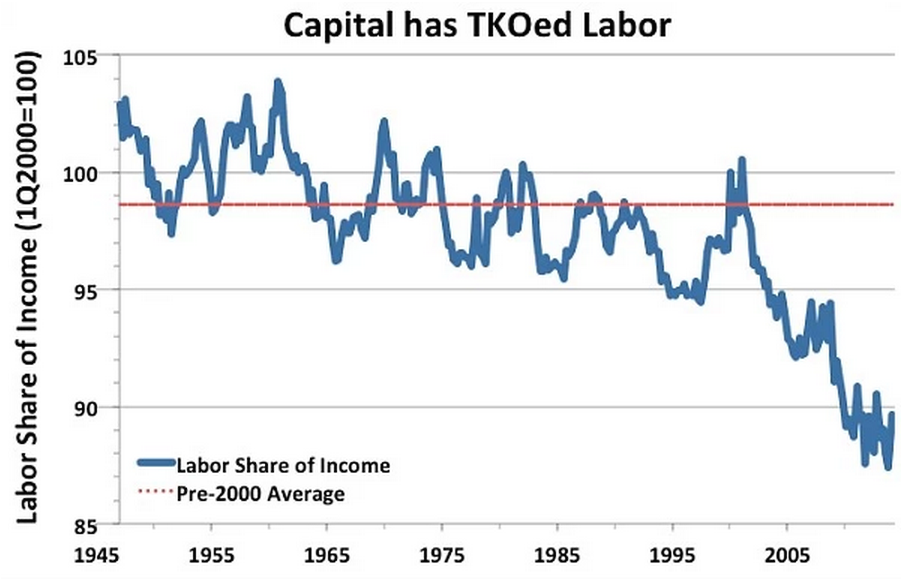
Now, economists used to think that the balance of power between labor and capital was pretty fixed. In other words, workers would always get a certain share of their company’s earnings, and owners would get the rest. For most of the postwar period, this certainly seemed to be the case: the split between labor and capital stayed roughly the same throughout, although it did start to slowly shift in management’s favor during the 1970s. Despite that, labor’s share of income was still close to its longer-term average in the late 1990s.

But, as you can see below, labor’s share plummeted at the turn of the century. What changed? Well, for one, globalization really got going. China joined the World Trade Organization in 2001, and the cost of its increased trade with the U.S. was an estimated 2 to 2.4 million jobs here, mostly in manufacturing. All this offshoring, of course, let U.S. multinationals pay their shareholders more at the expense of U.S. workers. And then the financial crisis all but finished labor off. That’s because the government did enough to save the economy, but not the unemployed, so companies could squeeze their workers even more while booking record earnings. Not only that, but, for reasons that aren’t entirely clear, the middle-class jobs we lost during the Great Recession have just been replaced by low-paying ones during the not-so-great recovery. That’s kept labor from catching up at all the past few years.

Capital And Labor

So the crisis has let Corporate America gobble up an even bigger slice of the income pie for itself, while the rest of America is stuck hoping for some wage crumbs.

Caffeine In The Genetic Code

OLYMPUS DIGITAL CAMERA

Andrew Giambrone flags new research on why you might be craving that cup of coffee this morning:

By analyzing DNA as well as data on 120,000 adults of European and African-American heritage, the researchers identified eight genetic variants that predispose individuals to seek out and drink caffeine. “Our results show that people are naturally consuming the amount of coffee that allows them to maintain their optimal level of caffeine” to get that good caffeine feeling without becoming jittery, Cornelis told me. “If we need more, we’re reaching for it.”

Six of the genetic variants examined in the study were newly discovered by the researchers. According to Cornelis, individuals whose DNA expressed all the variants tended to drink around half a cup of coffee more than those without them. Additionally, the new genes can explain about 1.3 percent of all coffee-drinking behavior, or about the same amount that genes can explain other habits, like smoking and alcohol consumption. While those effects may seem small, Cornelis said the study sheds light on why individuals’ bodies and brains react differently to caffeineand how some people feel anxious after a single cup of coffee, whereas others can down a Starbucks Venti and feel just fine.

(Photo by Flickr user Alan)