The View From Your Window Contest

VFYWC-226

You have until noon on Tuesday to guess it. City and/or state first, then country. Please put the location in the subject heading, along with any description within the email. If no one guesses the exact location, proximity counts.  Be sure to email entries to contest@andrewsullivan.com. Winner gets a free The View From Your Window book or two free gift subscriptions to the Dish. Have at it.

Browse all our previous window view contests here.

Just Read The Fun Stuff?

Benjamin Hale suggests someone has to stand up for pleasurable reading:

Some part of me is afraid of the reason why the college kids who want to be writers are still anxiously forcing themselves to slog through The Recognitions: because the accepted knowledge that this is a “smart” book has been handed down to them by their literature professors, who in their time were told this is a “smart” book. And how do the “smart” books become the “smart” books that get handed down to you?

Could it be that the books that become the “smart” books are the ones that are fun to teach? The ones that give the English professor something to do? You can’t say much about a fairly straightforward narrative, but one that requires a lot of critical unpacking is one that will get a lot of play in the classroom, and probably survive in the classrooms of the future. There are some ponderously overrated, heaps of pretentious gobbledygook that have been kept alive for decades this way. I’m not saying smart is bad.

Smart is good … but what about pleasurable? [John] Gardner shouted and banged on the table trying to remind everyone not to forget about morality and the “true purpose” of art, but all I want to do is something much more humble: please do not forget to please. Something about your book must on some level give pleasure. This is not a low virtue.

Similarly, Nick Hornby recently argued that readers should ditch difficult books if they’re not captivated:

Battling through them, he said, would only condition people to believe reading is a chore, leaving a “sense of duty” about something you “should do”. Instead, Hornby argued, reading should be seen more like television or the cinema, and only undertaken as something people “want to do.” Speaking at the Cheltenham Literary Festival, about his new novel Funny Girl, Hornby argued even children should not be compelled to read books they do not want to, saying setting targets of books they “should” read is counterproductive.

Laura Thompson is ambivalent:

My instant reaction to this was a sense of laughing relief, that somebody had not only admitted to doing such a thing, but had portrayed it as a positive act. Why on earth should anybody read a book if it is not fulfilling its most basic requirement, which is to entertain? Then doubt crept in. Advising people to cast aside a book, simply because they are not “loving” it? Comparing the sacred act of reading with that of box-setting one’s way through Lewis? Is this not a certain way to render the classics obsolete?

Who, taking on such a mindset, would grind their way through the opening chapters of Bleak House or The Return of the Native, or refrain from skipping to the more obviously attention-holding passages in D. H. Lawrence? As for books such as Clarissa, To The Lighthouse or Ulysses: surely their continued life depends upon a touch of masochism in the reader? Nick Hornby knows this quite as well as anybody, of course. What he is actually saying is serious and sensible. There is absolutely no point, no long-term gain, in turning reading into a duty, when it can be one of life’s greatest pleasures.

At the same time, I am extremely glad that I read “difficult” books when I was young. They form part of my internal furniture, as it were. I am glad that I was obliged to think about Jane Austen rigorously, and therefore do not subscribe to the idea that Pride and Prejudice is simply Bridget Jones’s Diary in bonnets. … In other words, I think that there does need to be a degree of benign compulsion when it comes to young people’s reading.

A Poem For Saturday

20141008_LJaff_MarkTwain_Installation-39_1240px_Photo_by_Paul_Takeuchi

Dish poetry editor Alice Quinn writes:

There is an extraordinarily elegant and moving exhibition of paper sculptures by the artist Liz Jaff, which will be up until close of day this Sunday, October 12th, at the Robert Henry Contemporary Gallery at 56 Bogart Street in Brooklyn. It’s anchored by two exquisite works inspired by Elizabeth Bishop’s early poem “Casabianca” (below) and the Victorian poem of the same title by Dorothea Hemans, which inspired Bishop’s. The poem by Hemans falls under the category of “parlor poem” as it was so often recited in homes and also served duty as an elocutionary exercise. In this essay by English poet Carol Rumens, I discovered that it was “the most loved and widely anthologized poem of the 19th century.”

I interviewed the artist this week — her title for the piece that directly references both poems is “The Good Boy” – and I intend to share that conversation shortly on The Dish, but in the meantime, please allow this image and Bishop’s poem (and Mrs. Hemans, too, included in the essay by Rumens), to hurry you along to see the show before it closes on Sunday. If you’re near New York, make this your weekend outing to Bushwick, a neighborhood humming with art and good cafes.

“Casabianca” by Elizabeth Bishop:

Love’s the boy stood on the burning deck
trying to recite “The boy stood on
the burning deck.” Love’s the son
stood stammering elocution
while the poor ship in flames went down.

Love’s the obstinate boy, the ship,
even the swimming sailors, who
would like a schoolroom platform, too,
or an excuse to stay
on deck. And love’s the burning boy.

(From Poems by Elizabeth Bishop, © 2011 by the Alice Methfessel Trust. Used by permission of Farrar, Straus and Giroux. Image courtesy of the artist)

“The Boko Haram Of AIDS”

Cole-Ebola-ISIS-2-690 (1) 2

Teju Cole deftly sends up CNN’s characterization of Ebola as “the ISIS of biological agents”:

Is Ebola the ISIS of biological agents? Is Ebola the Boko Haram of AIDS? Is Ebola the al-Shabaab of dengue fever? Some say Ebola is the Milosevic of West Nile virus. Others say Ebola is the Ku Klux Klan of paper cuts. It’s obvious that Ebola is the MH370 of MH17. But at some point the question must be asked whether Ebola isn’t also the Narendra Modi of sleeping sickness. And I don’t mean to offend anyone’s sensitivities, but there’s more and more reason to believe that Ebola is the Sani Abacha of having some trouble peeing. At first there was, understandably, the suspicion that Ebola was the Hitler of apartheid, but now it has become abundantly clear that Ebola is actually the George W. Bush of being forced to listen to someone’s podcast. Folks, this thing is serious. …

We’ll go to the phones in a moment and get your take on this. But first let me open the discussion up to our panel and ask whether Ebola is merely the Fox News of explosive incontinence, or whether the situation is much worse than that and Ebola is, in fact, the CNN of CNN.

Going, Going, Gone

Ruth Graham explores the world of conservation science, where a precise tally on the number of extinct species is hotly debated:

Actual documented extinctions are vanishingly rare. “If you ask any member of the public to name 10 species that have gone extinct in the last century, most would really really struggle,” [conservation scientist Richard] Ladle said. “Then you’ve got the world’s most famous conservationists telling you that 27,000 are going extinct every year. The two don’t tally up.” The International Union for Conservation of Nature, which keeps the most definitive list of extinct and threatened species, has counted just over 800 total confirmed animal extinctions since the year 1600.

Graham continues:

The huge numbers of extinctions being thrown around may be overstated, or they may be understated. They may also, some say, be the wrong thing entirely to focus on. “It bothers me, and you can quote me on this, that we are still talking about species-level extinction,” said Ross MacPhee, a paleontologist at the American Museum of Natural History who studies extinction. There are other vital questions: Is there a wild population diverse enough to be healthy? Does the animal exist only in zoos? Is a threatened species a linchpin in a large ecosystem? Is it particularly unusual genetically? As Ladle pointed out in a 2010 paper, “extinction” isn’t as binary as it seems: There’s local extinction, extinction in the wild, extinction of subspecies, theoretical extinction of unknown species, and so on—each of which can grab headlines, depending on the fame of the animal.


The Cultural Side Effects Of Prozac

Retro Report dusts off coverage of the antidepressant:

John M. Grohol celebrates the marketing legacy of the drug, despite it not being “as great an antidepressant as its makers claimed”:

Prozac showed how a mainstream marketing effort targeted toward a specific mental illness could change the entire conversation. Before its introduction, depression was stigmatized, people were embarrassed to admit they had it, and they often hid it from others. It was because of Prozac’s marketing campaign that, for the first time in American society, we could have a serious and real discussion about mental disorders like depression.

Not only was it suddenly O.K. to be taking an antidepressant, for many it became a badge of honor. Its marketing let everyone know, “hey, depression isn’t a personal failing or due to poor morals or bad parenting. It’s a biochemical thing that a medication can help with.”

Lisa Schwartz and Steve Woloshin differ:

Prozac has clearly been effective in its marketing campaign but may have faltered, remarkably, in treating depression – especially mild depression, that muddy realm between normal sad emotions and disease. Here, Prozac-type drugs are barely better than placebos and no better than talk therapy, which has a longer-lasting effect, no sexual side effects or withdrawal symptoms.

It’s also unclear if these drugs reduce suicide, the worst outcome of depression. The F.D.A. actually requires a black box warning because of increased suicidal thoughts in young adults.

The pharmaceutical treatment of severe depression has undoubtedly helped many people. But many more have been overtreated for symptoms that don’t require drugs.

Jerry Avorn looks at the broader impact:

Prozac helped usher in the era of the blockbuster drug – a product that brings in over $1 billion of annual sales. With broadening expectations of what medications can do to increase life satisfaction, and the allowance of direct-to-consumer advertising in the mid-1990s, sales of these drugs went into orbit. Psychotherapy withered on the reimbursement vine (“a pill is worth a thousand words” and is much cheaper), and weltschmerz became reason for patients and doctors alike to seek solace from the pharmaceutical industry.

The Straights Leaving The Closet

Christine Grimaldi visited a support group for the straight spouses of formerly closeted gays and lesbians:

Straight spouses are largely absent from the national conversation about gay marriage and the modern family. Certainly, it’s easier to talk about two moms or two dads who have been together from the start than to talk about why Mom left Dad for another woman, or why Dad left Mom for another man. (Forget about it if Mom or Dad is elsewhere on the sexuality and/or gender spectrum.) But we need to include straight spouses in that conversation, because as tolerance for LGBTQ people spreads throughout the culture, more closeted spouses will undoubtedly come out. While for them, the light beyond those doors can be liberating, for the straight partners stumbling out behind them, it can be quite harsh.

The Straight Spouse Network is attempting to kick-start the discussion by creating a safe place for straight spouses to share their stories.

Grimaldi also talks with psychotherapist Kimberly Brooks Mazella, who treats straight spouses:

​“Straight spouses are often struggling with competing emotional experiences—their own feelings of grief and loss, anger at the gay spouse’s betrayal, and compassion for their partner’s own painful journey,” she says. Empathy for gay spouses is not unusual among the straight spouse community. Degrees vary based on personal experience, as in any divorce. But ask a straight spouse, any straight spouse, what awaits him or her on the other side of the closet door. The most common answer is a deep sense of isolation.

“Most [straight] spouses endure their pain in silence on their side of the closet, while their gay, lesbian and bisexual partners find support from their respective communities,” SSN founder Amity Pierce Buxton wrote in her 1991 book The Other Side of the Closet: The Coming-Out Crisis for Straight Spouses and Families. From her years treating straight spouses, Mazella adds a few more factors to the mix. The straight spouse can be blamed as complicit in the closet. A gay spouse’s infidelity can be viewed as an expression of his or her true self instead of an act of unfaithfulness. “How did you not know?” is a common question. There are those who are dismissive of the entire marriage, as Mazella encountered. “People said to me, ‘Oh, it wasn’t really a marriage anyway,’ ” she says.

Go To Congress, Mr. President, Ctd

Screen Shot 2014-10-10 at 11.39.43 AM

Aaron Blake passes along the results of a new CBS News poll showing that 62 percent of Americans think the ongoing campaign against ISIS in Syria requires congressional authorization. But that doesn’t mean it will happen:

Similarly, 80 percent think member of Congress should desert the campaign trail, come back to Washington, and debate the use of force against the Islamic State. Those are pretty strong numbers. But it’s highly unlikely they’ll force any kind of action.

That’s because, however many Americans feel Congress should approve military action, very few of them are speaking out against the decision to go into Iraq and Syria without congressional approval. To be sure, Americans would like for their duly elected representatives to sign off, but they’re not exactly incensed that Congress hasn’t been asked. And people largely approve of what they’ve seen so far, as far as the airstrikes go.

The latest Reason-Rupe poll turns up a similar result, with 78 percent saying Congress should return to Washington to vote on this war:

Fully 63 percent of Americans say members of Congress haven’t voted on the authorization of military force because they don’t want to put their vote on the official record. Only 15 percent of Americans think Congress hasn’t voted because it believes President Obama does not need their authorization for military action, and 8 percent felt Congress simply hasn’t had enough time yet to hold the vote. This is a rare non-partisan issue in which overwhelming majorities of Democrats (77%), Independents (78%), and Republicans (83%) feel Congress should weigh in on this important decision.

Noting that Obama’s 60 days are up, Jack Goldsmith infers that the White House’s shifting legal basis for the operation is meant to avoid a Congressional vote:

Section 5(b) of the [War Powers Resolution (WPR)] requires the President to “terminate any use of United States Armed Forces” 60 days after he introduces such forces into “hostilities” unless Congress “has enacted a specific authorization for such use of United States Armed Forces.”  Senator Cruz is thus right that the WPR requires the President to seek new congressional authorization from Congress unless the 2001 and 2002 [Authorizations For Use of Military Force (AUMFs)] are specific authorization” for the airstrikes against the Islamic State. Recall that the President originally (in August and September) relied on Article II alone as a basis for the strikes against IS.  He then switched about a month ago to say that the strikes are also based on the 2001 and 2002 AUMFs.  The switch in legal rationales has enormous significance for – and in my judgment was likely motivated by – compliance with the WPR.  For if the AUMFs are a proper basis for the strikes against the Islamic State, then there is no issue under the WPR because Congress has authorized the conflict.  Only if the President is wrong about the applicability of the AUMFs to the Islamic State is there a problem under the WPR.

The Greatest Show In Your Butt

Martha C. Nussbaum advocates forgoing anesthesia for colonoscopies, arguing that the painless procedure is worth being awake for:

Yesterday I saw my appendix.

It was pink and tiny, quite hard to see, but how interesting to be introduced to it for the first time. In for a routine colonoscopy (my fourth, on account of a family history), I refused sedation as I always do, and I had the enormous thrill of witnessing parts of myself that I carry around with me every day, but never really know or acknowledge. I chatted with my doctor about many things, including the various justices of the Supreme Court, the details of my procedure, and, not least, the whole question of sedation and anesthesia. He told me that 99 percent of his patients have either sedation or, more often now, general anesthesia, since that is increasingly urged by the hospitals. (In Europe, he said, about 40 percent refuse sedation.) He listed the costs of this trend: financial costs that are by now notorious, lost workdays for both patient and whoever has to drive the patient (whereas a non-sedated patient needs no caretaker and can go right back to work), lost time for nurses and other hospital staff, and, of course, the risks of sedation and the even greater risks of general anesthesia.

And, I’d add, the loss of the wonder of self-discovery. You are only this one body, it’s all you are and ever will be; it won’t be there forever; and why not become familiar with it, when science gives the chance? I began refusing sedation out of a work ethic; I continued through fascination.

Our Outstanding Student Loans

StudLoans2

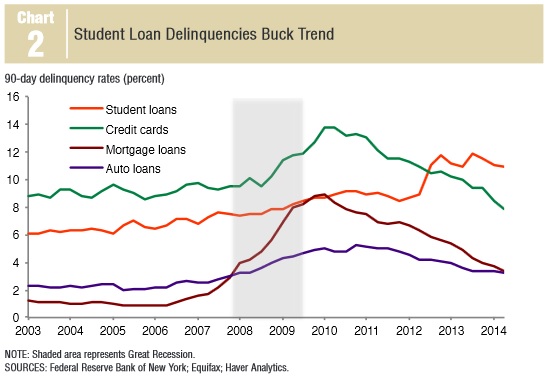
J.D. Tuccille flags a report from the Dallas Fed, showing that America’s student loan delinquency rates are still high, even as we get other forms of household debt under control:

Unshockingly, while defaults decline for credit card debt, mortgages and auto loans, they’re on the rise for student loans. “At 10.9 percent, the second quarter 2014 delinquency rate on student loans was more than three times that of mortgages and auto loans, and more than 3 percentage points higher than the rate of serious delinquencies on credit cards.” Apparently, young grads with overpriced sheepskins and no decent jobs in the offing have trouble meeting the tab.

And they’re certainly not about to take on mortgages. John Aravosis points to another new study estimating the impact of student debt on the housing market:

8% fewer homes will transact than normal in 2014, purely due to student debt. … Our conclusion is that 414,000 transactions will be lost in 2014 due to student debt. At a typical price of $200,000, that is $83 billion per year in lost volume.

Meanwhile, an analysis from Pew shows that more students of every class background are graduating college in debt today than 20 years ago:

In the early ’90s, only among graduates from low-income families did a majority of graduates finish college with student debt. Now, solid majorities of graduates from middle-income families (both lower-middle and upper-middle) finish with debt, and half of students from the most affluent quartile of families do the same. … Among recent college graduates who borrowed, the typical amount of cumulative student debt for their undergraduate education increased from $12,434 for the class of 1992-93 to $26,885 for the class of 2011-12 (figures adjusted for inflation). The increase in the median amount of debt by newly minted borrowers between the class of 1992-93 and the 2011-12 varied somewhat by the graduates’ economic circumstances. But regardless of family income, the typical amount owed at graduation increased about twofold over this time period.