Rand Paul Stands Up For Emergency Contraception

 has details:

While on a college tour in South Carolina [last] week, a red-headed woman in a baseball cap asked Paul if drugs that prevent conception, like Plan B, should be legal. Paul, leaning gracelessly on the side of the podium, stated matter-of-factly: “I’m not opposed to birth control.” He paused and shrugged. “That’s basically what Plan B is. Plan B is taking two birth control pills in the morning and two in the evening. I’m not opposed to that, or don’t think there should be any laws opposing that.”

As reported by The Daily Beast, Paul’s statement resulted in the prominent social conservative Tony Perkins, president of the Family Research Council, attacking him on Twitter — which left Team Paul “fuming.”

Suderman puts Paul’s remarks in context:

The GOP probably won’t come out as the party of gay rights and the pill in time for the 2016 election, but those issues won’t be front and center. If anything, judging by the Summit, most Republican politicians are likely to try to avoid talking about gay marriage whenever possible. And when it comes to contraception, many will emphasize support for greater access by making it available over-the-counter.

The causes behind the Republican party’s shift are complex—changing social norms, the shifting demographics of the electorate, and the decline of religiosity in American life are all factors. But rather than trace the reasons for the transformation, I think it’s worth dwelling briefly on how rapid and drastic the shift on these issues, especially gay marriage, has been, and what that shift suggests about the stability of internal power dynamics in political parties.

But Ryan Lizza has a hard time squaring Paul’s comments with his support of the Life at Conception Act:

In my recent Profile of Senator Rand Paul, Dr. John Downing, the Senator’s friend and former medical partner, expressed his worries about Paul’s sponsorship of the Life at Conception Act, also known as the personhood law. The bill would ban abortion and grant the unborn all the legal protections of the Fourteenth Amendment, beginning at “the moment of fertilization.” To Downing, who is an ardent Paul supporter, this seemed like political madness. Downing said that he believed Paul’s personhood law would make some common forms of birth control illegal, and thus doom Paul’s Presidential hopes. “He’s going to lose half or more of women immediately once they find out what that would do to birth control,” Downing told me. …

As with so many other issues—the Middle East, civil rights—Paul has placed himself in a political vise on the question of when life begins. His views on personhood will be savaged by Democrats if he runs for President; and his casual endorsement of Plan B has antagonized leading social conservatives who were already highly skeptical of his pro-life bona fides.

The Politics Of Fear And Hysteria

Republicans are rolling out a new line of attack for the midterms, conflating the issues of immigration and national security to make Democrats look like surrender monkeys on both. Zeke Miller flags the above ad from the National Republican Congressional Committee, which claims that ISIS militants are coming to America “through Arizona’s backyard” – with help from Dem Congresswoman Ann Kirkpatrick, of course:

[T]he ad relies on a Sept. 10 writeup of a congressional hearing by the conservative Washington Free Beacon in which a Department of Homeland Security official was understood as telling lawmakers that ISIS “supporters are known to be plotting ways to infiltrate the United States through the border.” But a review of the testimony by DHS Under Secretary for Intelligence and Analysis Francis Taylor tells another story. Instead, he said, “there have been Twitter, social media exchanges among [ISIS] adherents across the globe speaking about that as a possibility.” But that is a far cry from a direct threat, and light years away from a direct plot against the homeland.

Greg Sargent looks at a similar claim from Arkansas Senate candidate Tom Cotton:

Congressman Cotton’s version seems to go a step further, envisioning an active, ongoing collaborative effort between the Islamic State, and Mexican drug cartels who are looking to diversify by branching out into terrorism, whose end goal is to kill Americans on U.S. soil.

New York Times columnist Charles Blow has performed an anatomy of this developing story on the right. Blow concluded that it originated on a conservative website, which suggested that ISIS may be “working to infiltrate the U.S. with the aid of transnational drug cartels.” A Republican Congressman from Texas similarly said ISIS and Mexican drug cartels have been “talking to each other.” And from there, it was onward to Fox News. Some of the sources Blow found overlap with the Cotton campaign’s back-up materials from conservative media.

GOP politicians aren’t the only people wilding exaggerating the ISIS threat. As Zack Beauchamp notes, the jihadists themselves are only too happy to do the same. Zack offers up “a by-no-means complete list of some of the crazier threats”:

• Take over the White House. Abu Mosa, an ISIS spokesman, told Vice that “we will raise the flag of Allah in the White House.”

• Conquer most of Syria, Jordan, Israel, Lebanon, Kuwait, and Iraq. An ISIS map shows the group controlling an implausibly large chunk of the Middle East.

• Ally with Russia to get Iranian nuclear secrets. A plan allegedly written by Abdullah Ahmed al-Meshedani, an ISIS leader with responsibility for foreign fighters, involves ISIS giving Russia access to Syrian natural gas to persuade Moscow to turn against Iran and Syria, as well as to help ISIS get nuclear weapons.

• Conquer Rome and then the world. In an address, ISIS chief Omar al-Baghdadi told his followers that “you will conquer Rome and own the world.” Rome.

• Destroy Iran using cheap Afghan carpets to undercut the Persian market. Also from the Meshedani document, this plan involves waging economic war on Iran by lowering prices in the rug market. The document also lays out designs on the Iranian caviar industry.

Quote For The Day

“[W]hat we need is honest talk about the link between belief and behavior. And no one is suffering the consequences of what Muslim “extremists” believe more than other Muslims are. The civil war between Sunni and Shia, the murder of apostates, the oppression of women—these evils have nothing to do with U.S. bombs or Israeli settlements. Yes, the war in Iraq was a catastrophe—just as Affleck and Kristof suggest. But take a moment to appreciate how bleak it is to admit that the world would be better off if we had left Saddam Hussein in power. Here was one of the most evil men who ever lived, holding an entire country hostage. And yet his tyranny was also preventing a religious war between Shia and Sunni, the massacre of Christians, and other sectarian horrors. To say that we should have left Saddam Hussein alone says some very depressing things about the Muslim world,” – Sam Harris.

My thoughts on Sam’s recent Real Time appearance here.

The Power Of Francis’ Glasnost

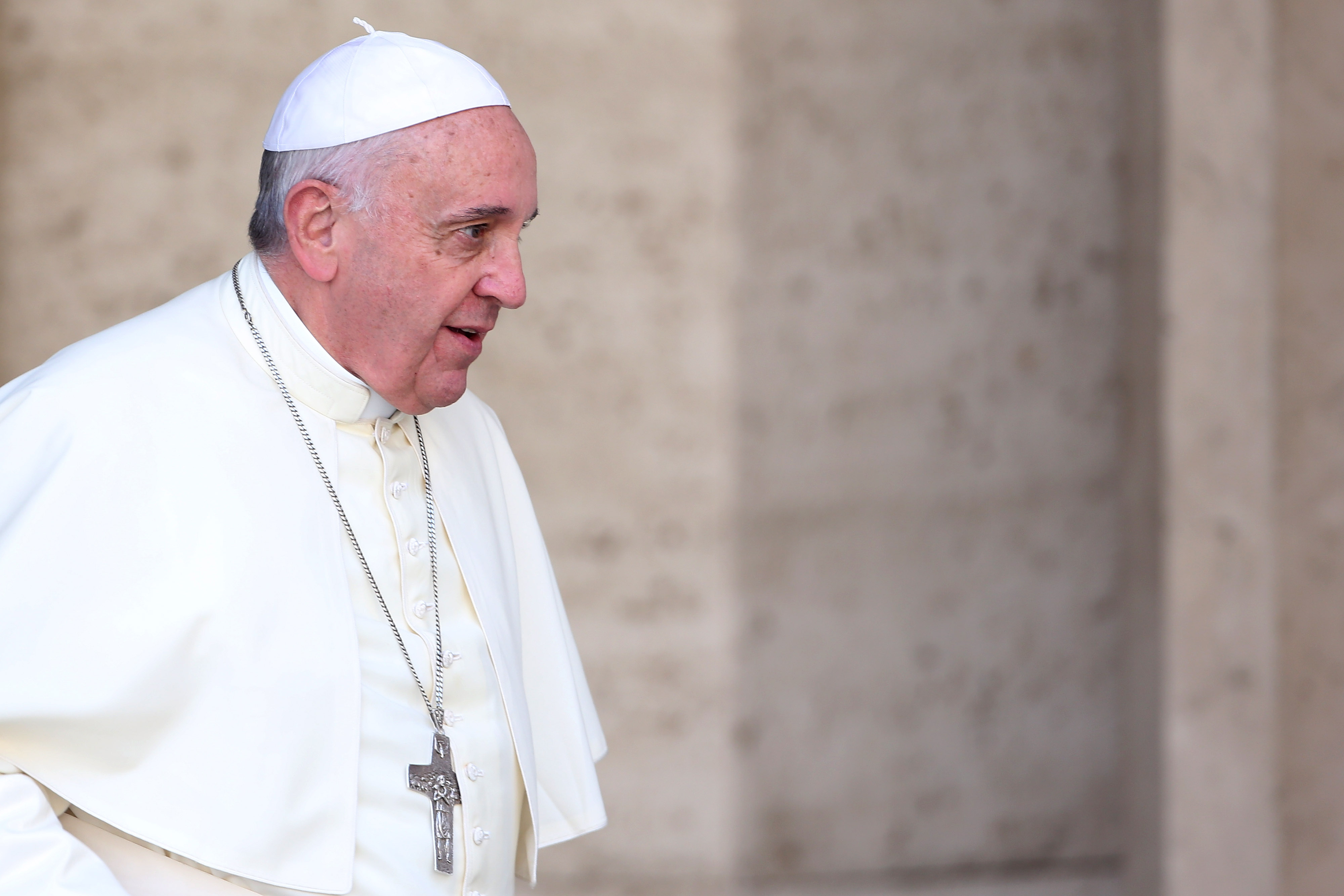
Synod On the Themes of Family Is Held At Vatican

Both John Paul II and Benedict XVI understood the power of open dialogue, which is why they did all they could to shut it down within the Catholic church. The sensus fidelium, the insight that ordinary Catholics may have into the Christian life, was all but banished in favor of top-down control and increasingly fastidious theological certitudes. And perhaps the most striking thing so far about the Synod now going on in Rome is simply that: a venting of reality in that airless context, that, while not in opposition to church teaching, is nonetheless frank about its challenges in the modern world.

And language matters. Ed Morrissey notes:

The most intriguing part of that discussion, at least as noted in the briefing, was a call to change the language associated with those teachings [on marriage and sexuality] and find more inclusive and welcoming language instead. The specific terms that some bishops wish to stop using are “living in sin,” “intrinsically disordered,” and “contraceptive mentality.”

Each of these terms is designed to define human beings in ways that can only wound and alienate. A couple co-habiting before marriage cannot be reduced to “sin” without obliterating everything else that may be wonderful about their relationship – and that may well lead to a successful marriage that is perfectly orthodox. Suggesting that all couples who use contraception can be reduced to endorsing a “culture of death” is equally likely to push flawed human beings away from Jesus rather than toward him. And, as for “intrinsically disordered”, Ratzinger’s prissy prose was impossible for a gay Catholic to read without feeling punched in the gut. The key to a renewal of Christianity in our age will be a shift in language, a reintroduction of the core truths of the faith with words that are not designed to wound, hurt or alienate, and that can convey truth in a positive manner for a new generation.

Then there is the remarkable testimony of an Australian married couple – about the central role that sex plays in supporting their marriage vows:

The couple explained that “gradually we came to see that the only feature that distinguishes our sacramental relationship from that of any other good Christ-centred relationship is sexual intimacy and that marriage is a sexual sacrament with its fullest expression in sexual intercourse.” “We believe,” they added, “that until married couples come to reverence sexual union as an essential part of their spirituality it is extremely hard to appreciate the beauty of teachings such as those of Humanae Vitae. We need new ways and relatable language to touch peoples’ hearts.”

Well: good for them. And wouldn’t Catholic marriages be better if more were able to tell their sexual story in ways currently repressed? There is, after all, an obvious and almost painful limitation on the clerisy’s ability to understand sexual intimacy, because they have all taken vows of celibacy. (Another gigantic obstacle, of course, is that of the nearly 200 voting participants in the Synod, only one is a woman. Of the 253 total participants, only 25 are women.) But the Australians had another point to make on the question of homosexuality:

“The domestic church” represented by the family, “has much to offer the wider Church in its evangelizing role,” the couple continued. “For example, the Church constantly faces the tension of upholding the truth while expressing compassion and mercy. Families face this tension all the time.” The couple went on to illustrate this with an example relating to homosexuality. “Friends of ours were planning their Christmas family gathering when their gay son said he wanted to bring his partner home too. They fully believed in the Church’s teachings and they knew their grandchildren would see them welcome the son and his partner into the family. Their response could be summed up in three words, ‘He is our son’.”

This, Ron and Marvis explained, “is a model of evangelization for parishes as they respond  to similar situations in their neighbourhood!” “The Church’s teaching role and its main mission is to let the world know of God’s love.”

This is what so many Catholics are already doing – because Christianity is about, among many things, a defense of human dignity and a love of the family. The hierarchy – which again has no such direct experience of actually navigating the challenges of parenting, and which seems incapable of seeing gay people as “first-class citizens” – has lost sight of this. They are still bound by fear – fear of actual gay people, of our happiness and self-worth, of our living example of the complexity of human love and sexuality. They cling to arid doctrine with little appreciation of how anyone can actually live it and not, in the heterosexual world, be cruel or dismissive or discriminatory or callous, or in the homosexual world, be uniquely alone, isolated, and without the sexual intimacy that the Australian couple celebrated as integral to their relationship.

What were seeing, I think, is how the mere fact of open discussion can shift the very direction of such discussion. We saw this in Vatican II, when new currents in the world and church transformed the meeting in ways no one quite expected. And Francis’ leadership in this contrasts so powerfully with his predecessor’s. He is not telling the church what it should do or how it should change. He has simply made it impossible for the lived reality of most Catholics to be ignored or dismissed any longer.

Some things cannot be unsaid. Some testimony from actual, broken but struggling Christians can never be forgotten. Dialogue shifts minds and hearts from the bottom up, not the top down.

“There is a crack in everything. That’s how the light gets in.”

(Photo: Pope Francis leaves the Synod Hall at the end of a session of the Synod on the themes of family on October 7, 2014 in Vatican City, Vatican. By Franco Origlia/Getty Images)

The Right To Grow A Beard

Yesterday, SCOTUS heard oral arguments for Holt v. Hobbs, which involves a prisoner who wants to grow a beard for religious reasons. Dahlia Lithwick unpacks the case:

Gregory Holt, also known as Abdul Maalik Muhammad, is an inmate serving a life sentence in a maximum security prison in Arkansas after being convicted of cutting his girlfriend’s throat and stabbing her in the chest. He is a devout Muslim who, under the dictates of his religion as he understands them, is required to grow a beard. Arkansas’ prison policy states that prisoners may not have beards unless a doctor has diagnosed a dermatological problem, in which case the beard can only be one-quarter of an inch long. …

The truth is, as Justice Stephen Breyer points out, [Arkansas Deputy Attorney General David] Curran is having a hard time providing any examples of dangerous things dropping out of half-inch beards. He just wants us to know that they might be there. Dangerously. Hidden among the stubble.

Alito had the question of the day:

Why can’t the prison just give the inmate a comb, and say comb your beard, and if there’s a SIM card in there or a tiny revolver, it’ll fall out?

Damon Root sees no problem with a prisoner having a beard:

In this case, the law is squarely on Holt’s side. As his lawyers at the Becket Fund for Religious Liberty observe in their main brief, “forty-four other state and federal prisons with the same security interests allow the beards that Arkansas forbids.” In other words, while prison security is undoubtedly a “compelling government interest,” the no-beard policy is far from the “least restrictive means” of achieving it.

For its part, Arkansas maintains that its correctional officers are entitled to broad deference from the courts. But that argument not only fails to satisfy the strict requirements of the [the Religious Land Use and Institutionalized Persons Act (RLUIPA)], it also runs counter to an important 19th century precedent set by Justice Stephen Field, one of the Supreme Court’s first great conservative jurists. In the 1879 Circuit Court case of Ah Kow v. Nunan, Justice Field confronted a San Francisco ordinance which required all male prisoners in the county jail to have their hair “cut or clipped to an uniform length of one inch from the scalp.” City officials claimed it was a public health regulation, but in fact the law’s real purpose was to humiliate male Chinese immigrants, who commonly wore their hair in long braided ponytails known as a queues. This “queue ordinance” (as it was known throughout the city) was just one of the many racist and xenophobic regulations passed by California officials in response to the arrival of Chinese immigrants.

Noah Feldman ponders the beard-friendliness of the various justices:

Unlike his older colleague Justice Antonin Scalia, Justice Samuel Alito has never worn a beard on the bench. But to Alito, the court’s emerging leader on religious liberty exemptions, beards are ground zero.

Feldman also provides context for Alito’s likely support for the hirsute:

[T]he fact that the Department of Corrections makes an exception for men who can’t shave must be evidence that it hasn’t adopted the least restrictive means of maintaining safety by banning beards. If a few people can have short beards, why can’t all?

Justice Alito actually dreamed up this logic in a 1999 case, Fraternal Order of Police v. City of Newark. The city banned not inmates but police officers from wearing beards — it made an exception, however, for officers suffering from folliculitis. Supreme Court precedent ordinarily denies constitutional exemptions when there is a neutral, generally applicable law in place. (Justice Scalia set that precedent, Employment Division v. Smith.) In a subversively brilliant reinterpretation of the Smith precedent, then-Judge Alito said that the exemption must be granted because the city had created a system of individual exemptions. Because it allowed medical beards, the city had to allow religious ones.

Previous Dish on the beard case here.

The Battle For Kobani, Ctd

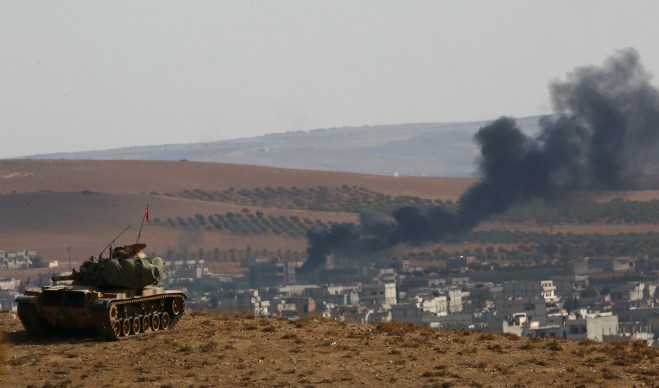
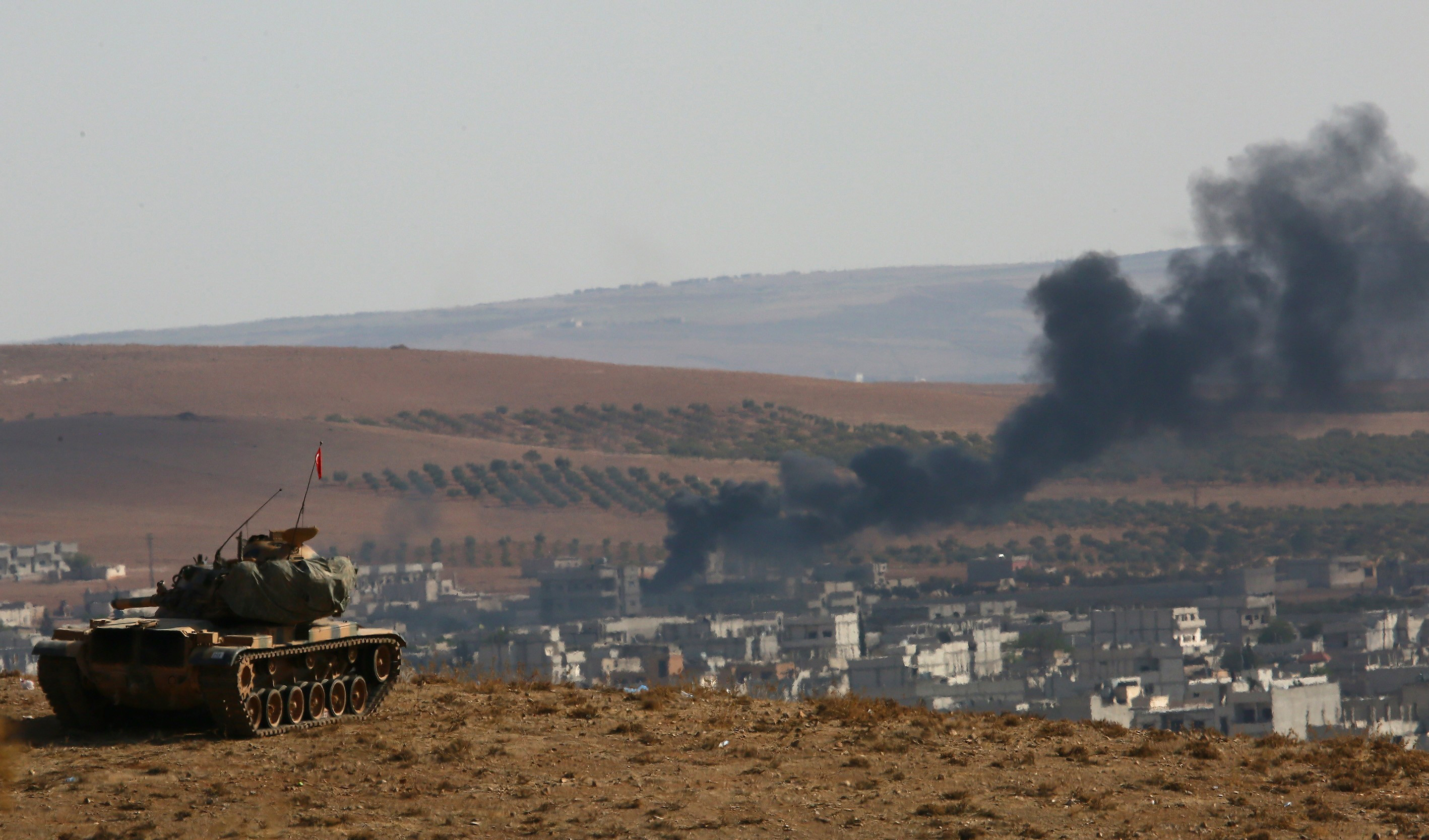
US-led coalition strikes ISIL in Kobane

Stepped-up air strikes have apparently begun to drive back ISIS fighters from the Syrian Kurdish border town, which they had all but captured as of yesterday, though it’s not clear whether this will be enough to turn the tide in the battle:

“They are now outside the entrances of the city of Kobani. The shelling and bombardment was very effective and as a result of it, IS have been pushed from many positions,” Idris Nassan, deputy foreign minister of Kobani district, told Reuters by phone. “This is their biggest retreat since their entry into the city and we can consider this as the beginning of the countdown of their retreat from the area.” Islamic State had been advancing on the strategically important town from three sides and pounding it with artillery despite fierce resistance from heavily outgunned Kurdish forces. Defense experts said it was unlikely that the advance could be halted by air power alone.

The Obama administration, meanwhile, is getting fed up with Turkey:

“There’s growing angst about Turkey dragging its feet to act to prevent a massacre less than a mile from its border,” a senior administration official said. “After all the fulminating about Syria’s humanitarian catastrophe, they’re inventing reasons not to act to avoid another catastrophe. “This isn’t how a NATO ally acts while hell is unfolding a stone’s throw from their border,” said the official, who spoke anonymously to avoid publicly criticizing an ally.

Steven Cook turns a critical eye on Ankara’s reasoning here:

The Turkish analysis of the situation is different from that of the United States and the Europeans. Ankara believes that IS emerged as a result of the Syrian civil war, which in turn is the result of Syrian President Bashar al-Assad’s intransigence and brutality. The Turks thus insist that getting rid of Assad is the only way to get rid of IS. This is both simplistic and self-serving: Given that Ankara has been vocal in its support for regime change in Syria, anything less would be a profound embarrassment to Erdogan and Davutoglu. Inasmuch as Erdogan does not believe that the United States is going to do in Assad and may even sometime down the road tacitly agree to some sort of deal that leaves the Syrian dictator in place, the Turks remain cool to taking part in the anti-IS coalition.

Finally, though it may be hard to believe, there are elements of the AKP’s constituency that regard IS as a legitimate group seeking to protect Sunni interests in Syria and Iraq amid ongoing sectarian bloodshed.

Semih Idiz solicits some expert views, which all coalesce around the notion that Erdogan wants the coalition war to be against Assad rather than ISIS:

“Davutoglu is saying in effect that IS is the product of rage and if the source of that rage, namely the Syrian regime, goes, then such groups will also go. I don’t know if he believes this himself, though,” [lecturer on international politics at Istanbul’s Kadir Has University, Soli] Ozel told Al-Monitor. Ozel also wonders if there is an ulterior motive to Ankara’s insistence on a no-fly zone and buffer zone in Syria even though there is no international support for them. “If IS engages in a massacre in northern Syria this will provide an excuse for Ankara doing little to prevent it. It can say, ‘I warned the international community, but it refused to act.'”

Nihat Ali Ozcan, a security expert at the Ankara-based Economic Policy Research Foundation of Turkey and a columnist for Milliyet, believes the real problem for the Turkish military in Syria is that it cannot decide who the enemy is. “If the target is Assad, the answer to this question is simple,” Ozcan argued in his Oct. 7 column. “Otherwise it is not clear who and where the enemy is. It wears no uniform and is a part of the civilian population.”

Larison reminds us, again, of how dangerous it would be for the US to start a two-front war in Syria:

If “destroying” ISIS is already an unrealistic goal, and it is, setting out to defeat both ISIS and the Assad regime at the same time is even more fanciful. Destroying the latter would probably be relatively easier, and we know that the U.S. is capable of overthrowing established foreign governments by force, but in doing so the U.S. would plunge all of Syria into even greater chaos. If the war against ISIS also requires the U.S. to go to war with the Syrian government now or later, there is no way that the outcome will be worth the costs to the U.S., and those costs continue to grow with each new goal that hawks want to tack on to the ever-expanding war.

Kurds in southeast Turkey are protesting the government’s inaction. Some of the protests have turned violent:

Nineteen people have been killed in fighting between supporters of the Kurdish PKK party and police and local Islamist groups, according to media reports. Turkey’s Agriculture Minister Mehdi Eker said ten were killed and 45 injured in Diyarbakir, the main city in Turkey’s mostly Kurdish southeast. The city of Diyarbakir is “calm” as citizens “generally abide by the curfew,” imposed last night, Eker said today at a televised press conference.

Jamie Dettmer channels more outrage from the Kurdish refugees and fighters amassed on the Turkish side of the border:

“There will be consequences for this,” an activist with Turkey’s outlawed Kurdistan Workers’ Party, or PKK, tells me. “We aren’t going to forget,” the curly-haired woman, who declines to give a name, says sitting cross-legged on a blanket pulled up under Pistachio trees. PKK activists and defenders in Kobani claim the course of battle could have been changed with just some modest assistance: if they could have gotten anti-tank missiles the Americans have been handing out to rebel battalions in Aleppo and Idlib provinces, and if Turkey had allowed Kurdish reinforcements to cross the border.

Cale Salih examines how the US has dealt with the Kurds differently in Syria and Iraq, which she argues “is reflective of Washington’s general mistaken tendency to presume distinctions between the two countries that do not actually exist”:

In Iraq, the US not only carried out air strikes but also armed the Iraqi Kurdish peshmerga and sent military “advisors”. As a result, the peshmerga were able to provide ground intelligence to guide US air strikes, and, in conjunction with Kurdish fighters from Turkey and Syria, they followed up on the ground to retake important territories lost to Isis.

In Syria, the US has been more hesitant to develop such a bold Kurdish partnership. At first glance, the Kurdish fighting force in Syria – the People’s Defence Units (YPG), linked to the Kurdistan Worker’s Party (PKK), which the US designates as a terrorist group due to its decades-long war with Turkey – is a less natural partner than the widely recognized Kurdistan Regional Government (KRG) in Iraq. Yet it was YPG and PKK forces that provided the decisive support on the ground to the Iraqi Kurds, allowing KRG peshmerga to regain territory lost to Isis in Iraq. The US in great part owes the limited success of its airstrikes in north Iraq to the PKK and YPG.

But Jake Hess reveals that Washington has held back-channel talks with the Syrian Kurds:

The United States has rejected formal relations with the Democratic Union Party (PYD), the party that is essentially the political wing of the YPG. The PYD, which has ruled Kobani and other Kurdish enclaves inside Syria since President Bashar al-Assad’s forces withdrew in July 2012, is affiliated with the Kurdistan Workers Party (PKK), a militant organization that has fought Turkey since 1984 — and has consequently been listed as a terrorist organization by both Turkey and the United States. But interviews with American and Kurdish diplomats show that Washington opened indirect talks with the PYD years ago, even as it tried to empower the group’s Kurdish rivals and reconcile them with the Free Syrian Army (FSA).

Though Washington has declined PYD requests for formal talks, the United States opened indirect talks with the group in 2012, former U.S. Ambassador to Syria Robert Ford told Foreign Policy.

Meanwhile, Canada will be launching its own airstrikes soon, and another report suggests coalition ground troops are being discussed:

Military chiefs from more than 20 countries — many already involved in the fight against the Islamic State and some who are considering joining the group — will meet in Washington early next week to discuss progress on airstrikes in Iraq and Syria as well as plans to create a ground force to consolidate gains against the group.

(Photo: A photograph taken from Suruc district of Sanliurfa, Turkey, shows that Turkish army forces patrol while smoke rising from the Syrian border town of Kobani (Ayn al-Arab) after US-led coalition airstrikes against the Islamic State of Iraq and the Levant (ISIL) on October 8, 2014. By Emin Menguarslan/Anadolu Agency/Getty Images)
In Defense Of Gordon College

Here’s a possibly troubling story out of Massachusetts:

The regional body that accredits colleges and universities has given Gordon College a year to report back about a campus policy on homosexuality, one that may be in violation of accreditation standards. The higher education commission of the New England Association of Schools and Colleges met last week and “considered whether Gordon College’s traditional inclusion of ‘homosexual practice’ as a forbidden activity” runs afoul of the commission’s standards for accreditation, according to a joint statement from NEASC and Gordon College.

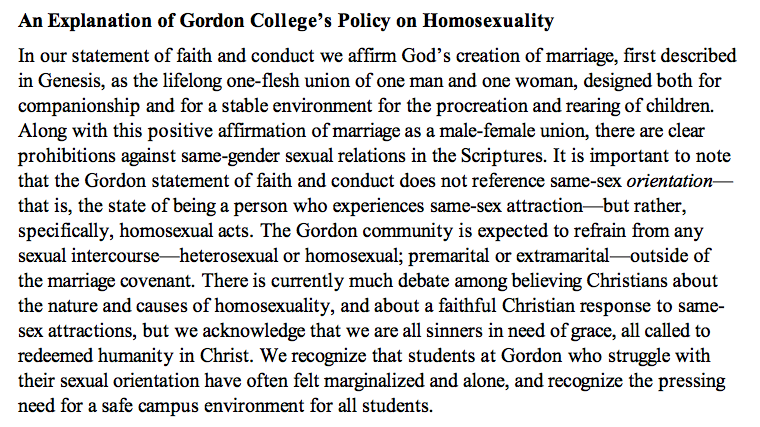
Here is that college’s public statement about its policy on homosexuality:

Screen Shot 2014-10-08 at 10.58.37 AM

They key issue here, it seems to me, is whether the college’s orthodox views about sex are being fairly implemented. If the prohibition against non-marital sex is enforced only on gay students, we have a problem. But there is no evidence that it is. And the college – which implemented its own review of this policy – seems attuned (see the last sentence) to the problems for gay students in such a setting.

In a liberal society, a college should not be denied accreditation because of its religious teachings, as long as they do not endorse double standards for different individuals who are enrolled.

I’ve spent most of my adult life challenging the notion that the distinction between a homosexual person and “homosexual acts” makes sense – but I am not omniscient, and I respect those who sincerely disagree with me. I certainly don’t want them penalized for such religious convictions. This is something called “liberalism” – the toleration of different faiths in a civil society, and the conviction that the best long-term way to discern the truth is not to suppress such faiths but to allow them to flourish (or not) in the free marketplace of ideas and beliefs. You don’t have to agree with Rod Dreher that this is about “hatred” of Christianity, just as you don’t have to agree that all difference of opinion on homosexuality is about “hatred” of gays. But Damon Linker is onto something:

Contemporary liberals increasingly think and talk like a class of self-satisfied commissars enforcing a comprehensive, uniformly secular vision of the human good. The idea that someone, somewhere might devote her life to an alternative vision of the good — one that clashes in some respects with liberalism’s moral creed — is increasingly intolerable. That is a betrayal of what’s best in the liberal tradition.

Our Eight-Armed Friend?

Silvia Killingsworth, after running through all the wondrous traits of the octopus, questions the ethics of eating one:

After all this research, I find myself suffering from what Michael Pollan, in his book “The Omnivore’s Dilemma,” calls “ethical heartburn.” Is an animal’s marked intelligence really reason enough not to eat it? Many arguments have been made against eating pigs on the same grounds. But, unlike domesticated animals, octopuses don’t have what Pollan calls a “bargain with humanity,” wherein they are dependent on us rearing them as either food or pets. (Though I do wonder what’s become of Tracy Morgan’s pet octopus.) Candace Croney, an associate professor of animal sciences at Purdue University, told Modern Farmer earlier this year, “If we’ve decided to eat pigs despite the fact that they are smart, should we not at least use the information that we have to make their lives as positive as possible up until the point when we decide, ‘Well now they’ve become food?’”

Previous Dish threads on the question of eating pigs vs dogs here and horses here.