He Did The Crime, But She’s Doing Time

Sometimes staying in an abusive relationship means enduring more than beatings. Alex Campbell reports on the horrifying case of Arlena Lindley, a domestic violence victim who was sentenced to 45 years in prison after her child, Titches, was killed by her abusive boyfriend, Alonzo Turner, for failing to prevent the child’s death:

Lindley’s case exposes what many battered women’s advocates say is a grotesque injustice. As is common in families terrorized by a violent man, there were two victims in the Lindley-Turner home: mother and child. Both Lindley and Titches had suffered beatings for months. But in all but a handful of states, laws allow for one of the victims — the battered mother — to be treated as a perpetrator, guilty not of committing abuse herself but of failing to protect her children from her violent partner. Said Stephanie Avalon, resource specialist for the federally funded Battered Women’s Justice Project, “It’s the ultimate blaming of the victim.”

Lindley’s not the only woman to suffer this injustice, either:

No one knows how many women have suffered a fate like Lindley’s, but looking back over the past decade, BuzzFeed News identified 28 mothers in 11 states sentenced to at least 10 years in prison for failing to prevent their partners from harming their children. In every one of these cases, there was evidence the mother herself had been battered by the man.

Almost half, 13 mothers, were given 20 years or more. In one case, the mother was given a life sentence for failing to protect her son, just like the man who murdered the infant boy. In another, the sentences were effectively the same: The killer got life, and the mother got 75 years, of which she must serve at least 63 years and nine months. In yet another, the mother got a longer sentence than the man who raped her son. In one more, a father fractured an infant girl’s toe, femur, and seven ribs and was sentenced to two years; for failing to intervene, the mother got 30.

Amanda Hess comments:

Campbell’s story demonstrates how the criminal justice system is scapegoating domestic violence victims in order to cover for its failures to properly investigate and prosecute instances of child and intimate partner abuse. Shortly before he began dating Lindley, Turner was charged on two separate occasions, first with burglary and later “unlawful restraint,” after he broke into an ex-girlfriend’s home, pushed her, and stole her belongings, then returned three weeks later, grabbed her by the neck, covered her mouth, and forced her outside. The woman escaped after a neighbor stabbed Turner in the leg; months later, Turner was out on probation from the burglary charge and was still awaiting trial on the restraint charge when he murdered the boy. On the day of Titches’ murder, another neighbor called police after she witnessed Turner kicking Titches on the floor, but when police arrived and couldn’t locate Turner or the toddler, they failed to pursue the report. It is outrageous that the justice system in this case only took a hard line against domestic violence after a child was killed.

A Great Vanishing Sea

New satellite images from NASA show that the Aral Sea, a once-vast lake on the border of Kazakhstan and Uzbekistan, has almost completely dried up. At first glance, the sea looks like another victim of climate change, but in fact its depletion originated in ill-considered Soviet agricultural policies:

Actually a freshwater lake, the Aral Sea once had a surface area of 26,000 square miles (67,300 square kilometers). It had long been been ringed with prosperous towns and supported a lucrative muskrat pelt industry and thriving fishery, providing 40,000 jobs and supplying the Soviet Union with a sixth of its fish catch. The Aral Sea was fed by two of Central Asia’s mightiest rivers, the Amu Darya and the Syr Darya.

But in the 1960s, Soviet engineers decided to make the vast steppes bloom. They built an enormous irrigation network, including 20,000 miles of canals, 45 dams, and more than 80 reservoirs, all to irrigate sprawling fields of cotton and wheat in Kazakhstan and Uzbekistan. But the system was leaky and inefficient, and the rivers drained to a trickle. In the decades that followed, the Aral Sea was reduced to a handful of small lakes, with a combined volume that was one-tenth the original lake’s size and that had much higher salinity, due to all the evaporation.

Anna Nemtsova explains how the events of the past decade finished it off:

The final chapter began in 2005, when the World Bank gave Kazakhstan the first $68 million credit to build a 13-kilometer-long dam to split the Aral Sea into halves: the Northern Aral Sea in Kazakhstan and the Southern Aral Sea in Uzbekistan. The dam prevented water from Kazakhstan’s Syr Darya from flowing into Uzbekistan’s half of the sea.

By 2008, Kazakhstan had managed to complete take control over the Syr Darya water, reviving 68 percent of the northern sea, reducing the salinity by half, and once again developing the fishing industry. On the southern, Uzbek side, however, the sea dried up that much faster. Uzbekistan, largely dependent on cotton, the industry of white gold, could not afford to re-channel water to its half. Also, with the water vanishing, the Russian oil company Lukoil found a silver lining in the disaster, setting out in 2006 to explore for oil and gas on the bottom of the Aral Sea in the Uzbek sector.

While climate change is not primarily responsible for the shrinking sea, it’s making the problem worse:

Recent studies suggest only 14% of the shrinking of the Aral Sea since the 1960s was caused by climate change, with irrigation by far the biggest culprit. Researchers looking at what will happen to Aral Sea levels with global warming over the next few decades have combined several model predictions together and expect net water loss to increase as more evaporation leads to less river inflow. However, if irrigation of the rivers continues, then net water loss will be even greater as river flow into the Aral Sea will essentially cease.

Faces Of The Day

Well this is just weird:

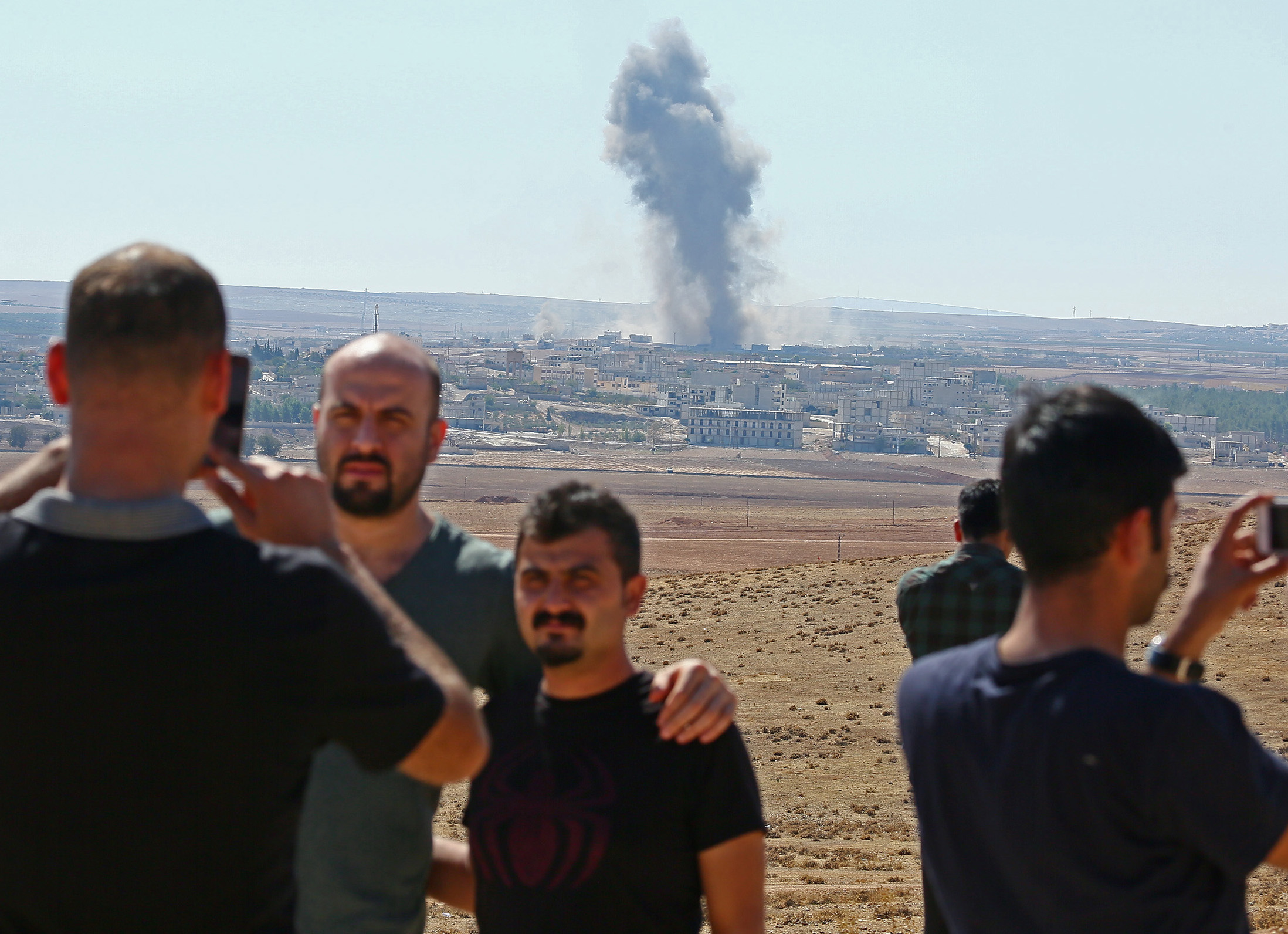
US-led coalition bombs ISIL targets in Kobani

People pose for a photo in Suruc district of Sanliurfa as the smoke rises from Ayn al-Arab city (Kobani) of Syria after the US-led coalition bombed the targets of the Islamic State of Iraq and the Levant (ISIL) in Ayn al-Arab, on October 7, 2014. By Emin Menguarslan/Anadolu Agency/Getty Images.

Europe’s Native Foreigners

Jennifer Fredette is troubled by the depiction of French Muslims:

It is true that we need to consider immigration when talking about the Muslim experience in France. That said, it is inaccurate to conflate “Muslims” with “immigrants.” Exact numbers are difficult to obtain because the French government refuses to collect or store statistics based on religion (or race or ethnicity). Nevertheless, we do know that many Muslims in France today are the children of immigrants, or even the grandchildren of immigrants; additionally, some have only one immigrant parent. And increasingly, French people are converting to Islam. Recognizing that immigration has directly or indirectly affected the lives of many Muslims in France is not the same as assuming (fallaciously) that all Muslims are foreigners.

But the real answer to our question about “permanent foreignness” does not lie in sloppy demography. French Muslims continue to appear foreign largely because today’s political debates are premised on an assumption of Muslim “different-ness,” and structured in a way that emphasizes this difference. For all of the discrimination, educational inequality, violence, and hostility that Muslims experience in France, political discourse concerning Muslims in the country overwhelmingly focuses on narrow religious issues it attributes to all Muslims: the hijab, the niqab, halal meat, the construction of mosques and the oppression of women.

She regrets how this creates “a flattened, homogenous view of Muslims in France” and “sidelines other political concerns that French Muslims have.” Meanwhile, Sara Wallace Goodman considers Muslim integration in the UK:

Muslim youth are born into British society and socialized in British schools, or naturalized after years of residence and integration, but endure frustrating barriers to socioeconomic mobility and face discrimination as members of an ethnic minority. And though a majority identify as British, a 2006 Pew survey shows how British Muslims maintain attitudes of disaffection and alienation more than Muslims in other European countries. Opportunistic imams can then mobilize a minority of impressionable youth toward a fundamental practice of religion. In fact, former Foreign Office Minister Kim Howells directly attributes the threat from British-born Islamic State militants in Syria and Iraq to not dealing with their radicalization in the U.K.

Yet blame is ascribed not merely for the absence of tough responses to radicalization at home, but also in providing weak tropes of belonging in the first place. As David Cameron stated in a speech criticizing state multiculturalism, “We have failed to provide a vision of society to which they feel they want to belong.”

What Counts As A Cult?

Ross Douthat wrote a recent column noticing how “the cult phenomenon feels increasingly antique, like lava lamps and bell bottoms.” Drawing on the thinking of religious historian Philip Jenkins and entrepreneur Peter Thiel, Douthat argues that the decline of cults “might actually be a worrying sign for Western culture, an indicator not only of religious stagnation but of declining creativity writ large”:

The implications of Jenkins’s argument are specific to religion. Cults can be dangerous, even murderous, but they can also be mistreated and misjudged (as Koresh’s followers were, with fatal consequences); moreover, spiritual experiments led by the charismatic and the zealous are essential to religious creativity and fruitful change. From the Franciscans to the Jesuits, groups that looked cultlike to their critics have repeatedly revitalized the Catholic Church, and a similar story can be told about the role of charismatic visionaries in the American experience. (The enduring influence of one of the 19th century’s most despised and feared religious movements, for instance, is the reason the state of Utah now leads the United States on many social indicators.)

cult_mac_big_0Thiel’s argument is broader: Not only religious vitality but the entirety of human innovation, he argues, depends on the belief that there are major secrets left to be uncovered, insights that existing institutions have failed to unlock (or perhaps forgotten), better ways of living that a small group might successfully embrace.

Suderman argues that Douthat probably “understates the ways in which semi-cult-like behavior has come to infuse daily life and mainstream culture”:

Yes, there are probably fewer cults in the aliens-and-messiahs sense, but there are more subcultures, in a wider variety, than ever before, more regimented lifestyle trends and minority beliefs about how to improve personal productivity or fitness, about how to become a better person and live a purer, more interesting, more connected and compelling life. Some of these subcultures remain distinctly fringe (dumpster-diving freegans, gently quirky bronies, furry fans, Juggalos [seen in the above video), while others are embraced, to varying degrees, by the mainstream:

At its height, Occupy Wall Street was as much an alternative lifestyle and belief community as a political movement. What is Crossfit if not a ritualized system that offers its highly dedicated, tightly-knit cells of followers a better and more meaningful existence?

None of these are cults in the specific sense that Douthat describes, with gated compounds and secret songs, but they are all experiments in behavior, taste, and belief intended to help adherents find meaning and connection in their lives.

In response, Douthat wonders if these subcultures really can take the place of religion:

I’m only slightly exaggerating when I say that this raises the most important question facing Western culture and society right now. Suderman is right, I think, that these “individualized and custom-tailored” forms of association are where creative/questing/artistic/religious impulses are increasingly being channeled, thanks to the internet and various broader economic and social forces; what’s more uncertain, to my mind, is whether they really encourage the kind of intense, enveloping commitment that I tend to think that deep creativity (among other goods) requires.

To the extent that like-minded people finding one another in ways that weren’t previously possible are creating cultural experiments that are as immersive, if not more so, than anything in the human past, then Suderman’s case for optimism makes a lot of sense. But to the extent that these experiments are more, well, dilettantish than past cultural groupings, more like hobbies than real commitments, more of a temporary identity that can be shaken off the moment it no longer completely pleases, they seem more likely to skim the shallows of creativity (to borrow an image from one of online culture’s more persuasive critics) than plumbing the true depths, more likely to cycle through pastiches and remixes (often fun and entertaining ones!) without stirring up something fully-realized and new.

(Image from the cover of Leander Kahney’s book Cult of Mac)

Polls Are Far From Perfect

Sabato contends that “the truly remarkable thing is that polling is as accurate as it is.” But he fully admits their predictive limits:

First, we can probably expect up to a baker’s dozen of Senate contests to remain highly competitive right up to Election Day. Second, polling averages are likely to mislead us about the eventual winner in one or two cases. And finally, if there should be multiple Senate contests where the pre-election polling average has the candidates separated by three percentage points or less, the polling leader in about a third of these cases may well lose.

Therefore, if we’re headed for an election that produces a Senate divided by only a seat or two, don’t expect polls to precisely predict the outcome. Even well-conducted, large-sample surveys are blunt instruments with a margin of error.

Enten keeps an eye on the Kentucky and Georgia Senate races:

FiveThirtyEight’s forecast still gives McConnell a little better than a 77 percent chance of winning. Most people aren’t looking at Kentucky as a place where the Senate will be decided. Nor are many people looking at Georgia, where Republican David Perdue is a 71 percent favorite to beat Democrat Michelle Nunn.

But consider the chances of a Republican victory in races more often placed in the middle of the 2014 board. FiveThirtyEight has the Republican candidates in Alaska, Arkansas and Louisiana holding between a 72 percent and 75 percent chance of winning — the same range as Georgia and Kentucky.

Georgia and Kentucky remaining on the table for Democrats significantly hurts Republicans’ overall chances of winning a Senate majority.

Bernstein examines the big picture:

[C]urrent polling averages are within four percentage points for Senate races in Alaska, Arkansas, Colorado, Georgia, Iowa, Kansas, Kentucky, New Hampshire and North Carolina. Some of those contests (such as Colorado, which is a dead heat) could go either way — even if the polling is correct. But if something is systematically wrong, then 4-point contests such as New Hampshire (where the Democrat leads) or Kentucky (where the Republican leads) could turn out very differently, even if the polls don’t change before Election Day. I wouldn’t bet on Republican Scott Brown in New Hampshire or Democrat Alison Lundergan Grimes in Kentucky based on the polling to date, but I also wouldn’t be surprised if the trailing candidate ended up winning in any of these closely contested races.

Bottom line? The polls are still likely to be correct. And the uncertainty makes relying on polling averages even more important. But I don’t expect to know which party will have a Senate majority — however large — until the votes are counted (or even later).

A Well-Timed Mishap

The was a mysterious explosion near Tehran on Sunday, allegedly at the Parchin military facility. Some observers are wondering whether it was an accident or an act of sabotage:

According to the BBC, one Iranian opposition site described the event as a massive explosion that lit up the sky and shattered windows over nine miles away. The semi-official Islamic Republic News Agency dubbed the episode a “fire [that] broke out in an explosives producing factory in eastern Tehran,” neglecting to include the name Parchin and adding that two people had died. Neither source mentioned or even speculated upon the cause of the incident.

It’s widely believed that the United States and Israel have engaged in a heavy regimen of sabotage against the suspected Iranian nuclear program including, but not limited to, crippling computer viruses, the assassination of nuclear scientists, and a series of mysterious explosions that have killed high-level targets and damaged facilities. This development comes just hours before Iran and the International Atomic Energy Agency (IAEA) were reportedly set to meet in Tehran. The Parchin complex, which has long been a site that the U.S. and Israel say might be part of an illicit Iranian nuclear program, has not been inspected by the IAEA since 2005. If the episode in Iran is some kind of sub-rosa attack, the timing couldn’t be better.

Jim White speculates:

Another possibility that I haven’t seen mentioned is the potential of a semi-intentional accident that would destroy the building that is at the heart of the negotiations.

It is only a matter of days before satellite imagery of the blast site become public, so we will know fairly soon whether the particular building with the blast chamber in question was destroyed. If the site is completely destroyed, that would be a convenient way for Iran to prove, without saying it, that no further work of this type will take place.

Allahpundit finds this story suspicious:

If Parchin really is a test site for atomic weapon technology, go figure that a test might occasionally go bad. Which raises the question of just what sort of explosion this was. If it broke windows miles away and emitted a bright glare, that could mean either a really large conventional blast (e.g., if the fire reached the base’s weapons depot) or a small atomic blast — and of course western governments who detected it would have an interest in hushing it up too, lest they’re forced to admit that they failed to stop Iran from getting the bomb. But if there really was a huge explosion, how come social media wasn’t instantly inundated with “whoa!” tweets from Iranians living in and around east Tehran and Parchin? Seems hard to believe Iran’s Internet censorship could be so thorough that no trace of a reaction like that was detected online by western media. Which means maybe there was no such reaction, and thus no explosion.

To Frum, the fact that the IAEA hasn’t inspected Parchin in nearly a decade “reminds us how limited and defeated U.S. inspection rights have been in Iran, through this year of negotiation”:

Here’s the key point: The rulers of Iran clearly want sanctions relief. They have got a considerable measure already, and will likely soon obtain more from the Obama administration. The rulers of Iran are not, however, looking “to come in from the cold.” They are not looking to rebuild a more normal relationship with the United States. They are looking for the maximum economic benefit consistent with not abandoning their pursuit of a nuclear weapon. Any inspection rights the U.S. may ultimately obtain will be inspection rights within the context of persistent and profound Iranian rejection of the goals of an inspection regime.