
Roma Norte, Mexico City, Mexico, 9.25 am
Roma Norte, Mexico City, Mexico, 9.25 am
Before our discussion thread continues, here’s a followup from the reader who sparked it:
I could have never sent that email without having read the post from your reader about her rape – the courage to say what happened, what it felt like, what it set in motion … and the trust to send it. No, I wouldn’t have had the personal courage without her example.
And I’d have to guess that neither of us could’ve done it without what you and your Dish team have made. No matter what else is true, how often I disagree with you, I know The Dish is a place of real integrity, staffed by people of real integrity. And unlike the reader who responded that she learned to respect her mother while being “punished,” I learned no such thing. For me, power and force aren’t the cornerstones of personal (or familial) authority, and my genuine respect can’t be either demanded or commanded. (I perform that respect in my social and professional lives, of course, but that’s different.) You and your team, and what you do every day, how you do it: that I respect and trust.
Thank you for making a safe and honorable place for me – and so many others – to share the personal details buried beneath these important debates. It boggles the mind, how much work and care it must take to maintain The Dish’s culture. It’s why I subscribed on day one, and why I will continue to support you all however I can.
My thoughts on the matter here. Meanwhile, another reader points to some gray area:
The stories about spanking and whipping and beating children have been awful and difficult to read. As the father of two children, I spank both of them, so I feel compelled to write in.
This message is difficult to convey without the context of my life history. I come from a solid middle-class family. I was spanked as a child. My brother was spanked as a child. It was never a beating. I never felt like I was abused. I was spanked with a paddle – actually a converted cutting board that hung on the kitchen wall.
I recall only one time I was spanked in anger, by my father, and I was probably nine or ten. What I remember most about that incident is that he was so frustrated because he, as an only child, always had a difficult time understanding why my brother and I fought so loudly and frequently; we were indeed duking it out downstairs in the playroom. And so he came downstairs, yanked me off my brother, popped my on the bottom one good time, got my brother up and popped him one good time – and then it happened. The paddle broke.
I tell you this in all honesty: it was incredibly funny and my brother and I stifled laughter. There was my father – proud, wonderful, loving, incredibly frustrated at that particular point in time, and completely deflated because his prop – the one he was using to make his point – literally fell apart in his hand. He just looked at the paddle, saw the stifled laughs on our faces, threw the paddle to the ground and implored, “Why can’t you two just get along?” and sent us to our rooms where we could mercifully laugh in private.
Let me tell you, I have told that story many times (and with a good bit of embellishment) while my brother and I wiped tears of laughter from our faces. We were always loved. We were never beaten. We were never abused. But boy were we spanked. And I’ll defend it as effective to my dying day.
And I spank. I spank my five year old because he’s five and he needs a daggum spanking to get his attention sometimes. Every once in awhile, so does my three year old. I have never spanked them multiple times in an episode. I have never left a mark. I have never spanked them with the intention of striking fear into their little hearts. It doesn’t happen on a daily, or even weekly basis. I’ve never used a belt or a switch or a paddle or anything other than my open palm. But I have occasionally spanked hard enough that it hurt a little.
And I am a damn good parent. I love my children immeasurably. Unconditionally. Unabashedly. I live for my kids. They are wonderful kids. They get spankings. And I’m not the only parent I know using spankings to discipline children (in an appropriate way, in my opinion). So I think it’s vitally important to distinguish between spankings and abuse. Certainly, spankings can be used in an abusive manner, but there is a difference. The stories you have shared are horrific and I cannot imagine ever inflicting that kind of pain and suffering on any child. They weren’t spanked. They were abused. Plain and simple. To lump spankers like me (and so many I know) with the parents described by your readers is completely unfair. Can we have a conversation about whether there are more appropriate ways to punish kids than by spanking? Sure! And I’m happy to have it – until you accuse me of abusing my kids simply because I admit I spank, and will continue to spank, my kids.
Another reader who defends spanking:
You wrote, “Hitting people, especially when those people are small and defenseless and dependent on your care, is such a lazy and cruel way to discourage bad behavior.” Really?
I am a mental health therapist who has worked for some 14 years primarily with children and families. When I first started, I worked for a foster care agency providing mental health services to foster children and their biological families. Many of the children I worked with entered care with severe conduct problems, including repeated incidents of running from home, stealing, sexually abusing others, using drugs and alcohol, prostitution (i.e., submission to sexual abuse for money or a place to stay because the child is on the run), etc.
While some of the children were victims of substantiated abuse and neglect, there were other children who had not only never been physically abused, they were never really even disciplined. And I noticed that some of these children were among the ones with more severe cases of conduct problems both in terms of severity and chronicity.
It turns out that there is research that shows that for children ages 2 to 7 especially, spanking is an effective disciplinary technique. And this is especially true for children who have strong personalities and are difficult to discipline because, among other things, they refuse to submit to whatever consequence they are given as a result of their misbehavior. When normative spanking is defined as two swats on the butt with an open palm, administered to get the child to comply with, say, a time out, children rapidly learn to comply with time out such that the parent can actually successfully use disciplinary techniques besides spanking.
Every child is different. Some are compliant, some are not. Some will work for praise; others could care less.
So a lazy parent is not one who spanks to obtain control over their child (and by the way, control over your child is a prerequisite to effective parenting if you are to successfully guide your child through childhood to adulthood). It is in my experience that a lazy parent is one who simply allows the child to do what they please in lieu of actually having to discipline, especially when discipline means the parent having to take steps they would prefer not to take, such as a spanking.
Indulgence is not a kindness. It is a parent’s job to raise an adult, not a life-long child incapable of tolerating frustration or following rules. If you think the results of spanking are bad, you should visit some of my former indulged clients in prison.
Those who are interested in knowing more about the impact of spanking on children may want to look at Robert E. Larzelere and Diana Baumrind’s article “Are Spanking Injunctions Scientifically Supported?“, 73 Law and Contemporary Problems 57-88 (Spring 2010).
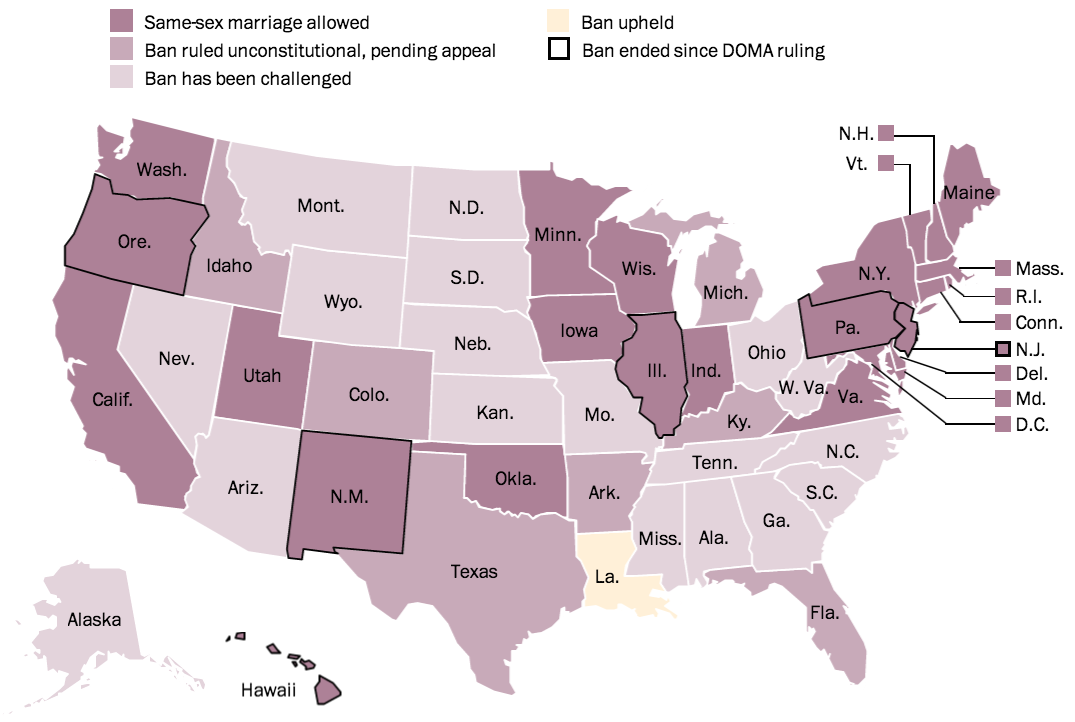
Amy Howe summarizes the incredible news:
[T]he Court denied review of all seven of the petitions arising from challenges to state bans on same-sex marriage. This means that the lower-court decisions striking down bans in Indiana, Wisconsin, Utah, Oklahoma, and Virginia should go into effect shortly, clearing the way for same-sex marriages in those states and any other state with similar bans in those circuits.
The Supreme Court had issued the first round of orders from the September 29 Conference last Thursday, adding eleven new cases to its docket for the new Term. Many people had anticipated that one or more of the same-sex marriage petitions might be on that list, but the Court did not act on any of them at the time. Last month Justice Ruth Bader Ginsburg had suggested that the Court might not step into the controversy at this point, because there was no disagreement among the lower courts on that issue. Today her prediction proved true[.]
Geidner explains what this means going forward:
The decision not to take on the appeal in any of the pending certiorari petitions brings marriage equality to Indiana, Oklahoma, Virginia, Wisconsin, and Utah — meaning 24 states in the country have legal marriage equality.
It also makes the appeals court decisions striking down the marriage bans in those states the law of the land in the 4th Circuit, 7th Circuit, and 10th Circuit courts of appeals — a result that makes marriage equality likely to come in short order in all states within those circuits. This is so because the controlling precedent in those circuits now is that bans on same-sex couples’ marriages are unconstitutional.
Among the other states in the 4th Circuit without marriage equality currently that would be impacted are North Carolina, South Carolina, and West Virginia. Among the other states in the 10th Circuit without marriage equality currently that would be impacted are Colorado, Kansas, and Wyoming. That, once resolved, would bring the total number of states with marriage equality to 30.
Ari Ezra Waldman takes a minute to recognize “the magnitude of this win”:
The Fourth Circuit includes Maryland, West Virginia, Virginia, North Carolina, and South Carolina. The Seventh Circuit includes Indiana, Illinois, and Wisconsin. The Tenth Circuit covers Oklahoma, Kansas, New Mexico, Colorado, Wyoming, and Utah. Those jurisdictions cover nearly 74 million people.
Ian Millhiser adds an important detail:
One thing that should be noted is that there are still marriage equality cases pending before conservative circuits that could rule against equality. Nevertheless, the fact that marriages are likely to begin very shortly in the states currently subject to court orders will make it very difficult for the Supreme Court to reverse course — and retroactively invalidate those marriages — in a subsequent opinion.
Mark Joseph Stern considers another possibility:
If no circuit court ever rules against gay marriage, the gay marriage question will be effectively settled, and the Supreme Court will never have to wade in again. It may be that the justices are hoping the lower courts rule uniformly on the issue—thereby making United States v. Windsor stand for a fundamental constitutional right for gay couples to marry. The tea leaves, at this point, remain hazy. But the court’s startling decision today suggests that no option is off the table.
More to come soon.
(Image: The WaPo’s updated marriage equality map)

But not any more:
A Federal District Court judge on Friday ordered the public disclosure of 28 classified military videotapes showing the forced cell extraction and forced feeding of a hunger-striking Guantánamo Bay detainee, rejecting the Obama administration’s arguments that making the videos public would endanger national security. The New York Times and 15 other news organizations had petitioned to unseal the videos. In a 28-page opinion, Judge Gladys Kessler of the United States Court for the District of Columbia cited the First Amendment in overriding the government’s arguments for keeping them secret, most of which, she said, were “unacceptably vague, speculative,” lacking specificity or “just plain implausible.”
In order to judge whether the government is engaged in a form of torture, it’s essential that we see what it is doing to prisoners. Words are not enough. If the photos from Abu Ghraib had never been released, we would have only the euphemisms of “long-time standing” or “stress positions” to understand the brutality and inhumanity involved. And we know why the CIA destroyed the video evidence of its brutal torture of José Padilla (an American citizen) or Khaled Sheikh Muhammed (one of the masterminds of 9/11). They would have shocked the conscience and made the reassurances of our highest officials that the United States has not committed offenses usually associated with dictatorships transparently false.
There are credible claims that the kind of force-feeding inflicted on prisoners goes beyond medical needs to brutality. Here’s part of what is alleged:
At Gitmo, they began to use tubes that were too big for Hassan’s nostrils. Rather than leaving them in place, they would insert and remove them twice a day. Prisoners were force-fed in what Hassan called “the Torture Chair.” Hands, legs, waist, shoulders and head were strapped down tightly. The men were also force-fed constipation drugs, causing them to defecate on themselves as they sat in the chair being fed. “People with hemorrhoids would leave blood on the chair and the linens would not always be changed before the next feeding.” They’d be strapped down amid the shit and blood for up to two hours at a time–though quicker wasn’t always better.
There are claims that this agony was on display to deter others from hunger-striking. It seems to me particularly important for a president committed to ending torture to prove that he isn’t continuing it – even if it is for the sake of keeping someone alive. For my part, I see suicide by hunger strike to be a perfectly rational response to the Kafkaesque vortex these men are in – and a violation of their core human dignity to prevent them from seeking the only way out of their nightmare that Gitmo can give them.
Lots of previous Dish debate on force-feeding here. The above photo is from a series of government photos from the Gitmo hunger strike.
The jihadists released another video on Friday, showing the beheading of British aid worker Alan Henning:
As in the other videos, a masked militant speaking with a British accent appears against a desert background with the hostage. The militant is dressed in all black with his face covered, while Henning kneels in the same orange outfit worn by ISIS’s other prisoners. … ISIS’s threats against Henning came under widespread criticism, especially after reports that he had been cleared of espionage charges by an ISIS-founded sharia court. A British Imam known for being a supporter of ISIS, Abdullah el-Faisal was among those who spoke up for Henning, saying that the 44-year-old was a“sympathizer to Muslims.”
The next threatened victim is Peter Kassig, a 26-year-old American aid worker. On Saturday, Kassig’s parents issued a videotaped statement pleading for their son’s life:
In the three-minute video, Ed and Paula Kassig address ISIS directly, highlighting his humanitarian work and his conversion to Islam, which took place while he was in captivity. (A family spokesman said Kassig’s name has been changed to Abdul Rahman.) Kassig, who spent a couple of years in the Army, is the founder of Special Emergency Response and Assistance, a small group that provided food, medical supplies, and other help to Syrian refugees. He was abducted near the Syrian city of Deir Ezzor in October of last year.
Saletan believes ISIS is signing its own death warrant with these beheadings, which appear to be driving up support for war in the US, Britain, and France:
[I]t’s noteworthy how much of the surge in enthusiasm for military action occurred during the period in which the videos were released, as opposed to the period in which Obama declared ISIS a threat to U.S. interests and launched strikes against it. In the June ABC/Post poll, only 45 percent of Americans endorsed “U.S. air strikes against the Sunni insurgents in Iraq.” Fewer than half of these supporters (20 percent of the total sample) said they supported such airstrikes strongly. By Aug. 13–17, a week after Obama’s announcement, support had increased by about 10 points: 54 percent supported air strikes, and 31 percent supported them strongly. But by Sept. 4–7, after the Sotloff video, support had climbed much higher. Seventy-one percent of Americans supported air strikes, and 52 percent supported them strongly. From these numbers, one could argue that the ISIS videos were twice as effective as Obama in rallying American support for war.

Yglesias uses the above chart as evidence that the labor market isn’t “driving American politics anymore”:
The labor market is not only stronger in 2014 than it was back in 2012, but the pace of improvement is markedly superior. But while 2012 growth was obviously good enough to get Barack Obama elected, in the fall of 2014 his approval numbers are bad and the Democratic Party’s midterm aspirations rest on Greg Orman’s efforts to avoid answering questions about his ideology.
Megan Thee-Brenan compares Americans’ views on the economy to Obama’s approval ratings:
The economy outpaced all other issues in importance to voters in a New York Times/CBS News poll in mid-September, and 44 percent of Americans rated the economy as good. This marked the highest positive reading since 2007. Even as Americans are feeling better about the economy, they decline to credit the president with its improvement. The Times/CBS News poll found 53 percent of Americans disapproved of Mr. Obama’s handling of the economy, and his overall job approval rating was under water, with 40 percent approving and 50 percent disapproving.
How Waldman explains this disconnect:
[D]espite the healthy job growth, incomes aren’t rising.
A good economy isn’t just one where you’ve got a job, it’s one where you’ve got a job and you’re being paid what you’re worth. The income benefits of the recovery have all gone to the top. Millions of people are also still digging themselves out of the holes they got into during the Great Recession, whether it was foreclosure, credit card debt, or what have you. Even if you now have a reasonably good job, if you lost your home and cashed out your 401K on the way, it isn’t like things are looking spectacular.
Cassidy agrees:
Rising incomes are what really distinguished the Reagan recovery from the Obama recovery, and that, I suspect, is why the two Presidents enjoyed such different political fortunes. (According to Gallup, Reagan’s average approval rating during his second term was 55.3 per cent. That’s about ten points higher than what Obama has averaged so far in his second term.)
… At some point, one would hope, Americans will give President Obama and his party (and the Federal Reserve) at least a bit of credit for digging the economy out of a deep ditch and getting it back on the road. In the past five years, the U.S. economy has substantially outperformed most other advanced economies. Now that the unemployment rate has dipped back into the fives, maybe—just maybe—public perceptions will change. But until the recovery feeds into higher wages and rising living standards for ordinary Americans, the political payoff is likely to be limited.
Last but not least, Harry Enten explains why so little attention has been paid to the economy this election season:
The reason is simple: Accounting for the state of the economy doesn’t hold much, if any, predictive value for congressional elections. It’s not that the economy doesn’t affect House or Senate races — Democrats might be doing even worse if the economic recovery wasn’t somewhat decent. It’s just that other variables already sufficiently account for the economy’s effect.
Colum Lynch relays the nauseating findings of a new report on ISIS:
By the end of August, the U.N. documented the abduction of up to 2,500 civilians, mostly women and children, from the northern Iraqi towns and regions of Sinjar, Tal Afar, the Nineveh Plains, and Shirkhan. Once they were in captivity, fighters from the Islamic State sexually assaulted the teenage boys and girls, witnesses told the United Nations. Those who refused to convert to the groups ran the risk of execution. “[W]omen and children who refused to convert were being allotted to ISIL fighters or were being trafficked … in markets in Mosul and to Raqqa in Syria,” according to the report. “Married women who converted were told by ISIL that their previous marriages were not recognised in Islamic law and that they, as well as unmarried women who converted, would be given to ISIL fighters as wives.”
A market for the sale of abducted women was set up in the al-Quds neighborhood of Mosul. “Women and girls are brought with price tags for the buyers to choose and negotiate the sale,” according to the report. “The buyers were said to be mostly youth from the local communities. Apparently ISIL was ‘selling’ these Yezidi women to the youth as a means of inducing them to join their ranks.”
Previous Dish on ISIS’s use of rape and sexual slavery here.
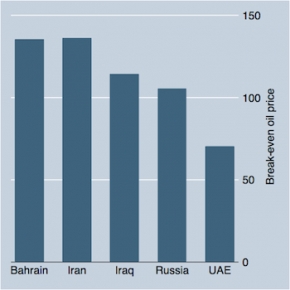
Looking over Russia’s budget for the coming year, Callum Williams observes how many of its assumptions depend on oil prices remaining pretty high:
In 2015 Russia will need an oil price of about $105 a barrel to balance its budget (see chart). But crude is currently trading in the mid-$90s, down by about 10% since May. Weak demand from China and healthy supply from America help explain the drop.
Lower dollar-denominated oil prices are not so bad for Russia, given that the rouble has weakened so much. But over the past few years the budget’s reliance on oil revenues has increased. When excluding oil, there was a shortfall of 3.6% of GDP in 2007, but now it is more like 10%. Russia expects to run a small budget deficit (about 0.6% of GDP) this year. That prediction is optimistic—the Kremlin is banking on an oil price of $100. The latest predictions from Energy Aspects, a consultancy, show that the price of Brent is not expected to pass $100 for about nine months.
Steven Mufson details how the dip in demand and surge in US production is bad news not only for Russia, but Iran as well:
Crude oil and oil products made up 46 percent of Russia’s budget revenues in the first eight months of this year. At a time when the West is trying to sanction Russia for its incursions in Ukraine, a 10 to 20 percent drop in oil prices could prove powerful. Still, it’s still a far cry from the 1980s, when Saudi Arabia produced enough oil to flood the market and drive prices down so far that many experts say it sped up the fall of the Soviet Union. That’s not going to happen now, but Russia could be squeezed a bit.
Iran, whose oil exports are limited by sanctions related to its refusal to limit its nuclear program and open it up to greater international scrutiny, will also suffer a setback. Iran’s oil minister Bijan Namdar Zangeneh late last month called on the Organization of the Petroleum Exporting Countries to keep oil prices from falling any further. “Given the downward trend of the oil prices, the OPEC members should make efforts to offset their production to keep the prices from further instability,” Zangeneh said according to Shana, a news agency supported by Iran’s oil ministry.
But according to Keith Johnson, the other Gulf petrostates are much less vulnerable:
“In the short term, the Saudis are the last ones who need to worry. They can sit it out for a couple of years, even with oil below $90,” said Laura El-Katiri, a research fellow at the Oxford Institute for Energy Studies. Other Gulf states, such as Kuwait and the United Arab Emirates, can also resort to deficits or spending tweaks to weather a price storm, she said. That may partly explain the deaf ears turned by Saudi Arabia and other big OPEC members to Iran’s pleas. Of the big producers, Iran by far requires the highest prices to remain fiscally sound, by some estimates as much as $130 a barrel. Further, Iran has been hammered by Western sanctions that have cut its oil exports — and earnings — almost in half.
Yet Saudi Arabia, still the world’s swing oil producer and a visceral opponent of Shiite Iran, has little interest in slashing output. Quite the contrary: Saudi Arabia on Wednesday suddenly started offering discounts to maintain its market share, even if it undermines overall crude prices.
In his latest Ethicist column, Chuck Klosterman advises a camp counselor to let a Mormon teenager sample coffee, disregarding the parents’ wishes:
As an authority figure, you have an obligation to approach the camper and ask, “Are you aware that your parents requested that you not drink coffee?” You might follow that with a second question: “Do you understand why your parents don’t want you drinking coffee?” This seems like a prime opportunity to have a meaningful discussion that might affect the rest of his life.
But regardless of the teenager’s response, you should not physically stop him from consuming a beverage that is legally and ethically within his right to consume. It’s not as if you’re forcing him to drink coffee against his parents’ wishes or placing him in a position where there’s no alternative; he is choosing to do this, despite his spiritual upbringing. A 16-year-old has the intellectual ability to decide which aspects of a religion he will accept or ignore. He’s not an infant, and you’re not living in the town where “Footloose” happened. It’s the responsibility of a secular camp to respect the principles of any religion but not to enforce its esoteric dictates.
Coffee, of course, has also stirred secular objections over the years. Dan Piepenbring unearths the “rhetorically marvelous if scientifically unsound” advice of one J. M. Holaday, who strongly advocated against the beverage in his 1888 paper “Coffee-Drinking and Blindness“:
Children that are allowed to partake freely of coffee will become restless, fussy and noisy, half wild with mischief. They probably advance in their school studies with abnormal rapidity. But they hate work. At times they are indifferent about education. Their strength goes to the brain. They grow rapidly, but not aright. They develop into men and women three years too soon. Yet their eyes dance with angelic splendor, and their cheeks glow with vermilion, providing that they started in life with robust constitutions. If they began life with puny physiques, however, coffee will make them slim and ghostly, and their eyes and features flat. Coffee … gives a sentimental strength—the strength that pertains to runts. The best thing that can be said of coffee is, that it has a tendency, like opium, to make lawless persons tame.
First up, a classic eggcorn from our friends at TPM:
The No. 2 official at the Israeli Embassy in Washington, D.C., is scheduled to speak Sunday at an event co-hosted by Concerned Women for America—a group with a long history of fermenting the “creeping Sharia” conspiracy theory.
And a quote from today:
The humble are they that move about the world with the love of the real in their hearts.
More gems from the weekend: Rembrandt’s genius with intimacy; Nabokov’s amazing love letters; Facebook as a Kafkaesque “accusation aggregator“; a butterfly chart that flutters; an unforgettable portrait painted with microbes; the desolation of those who lose their faith; and the surprising short lengths of most addictions. Plus: a pretty wonderful devastation of Richard Dawkins.
25 more readers became subscribers this weekend. You can join them here – and get access to all the readons and Deep Dish – for a little as $1.99 month. Gift subscriptions are available here. Dish t-shirts are for sale here. From a reader who saw me speak at Claremont McKenna College last week:
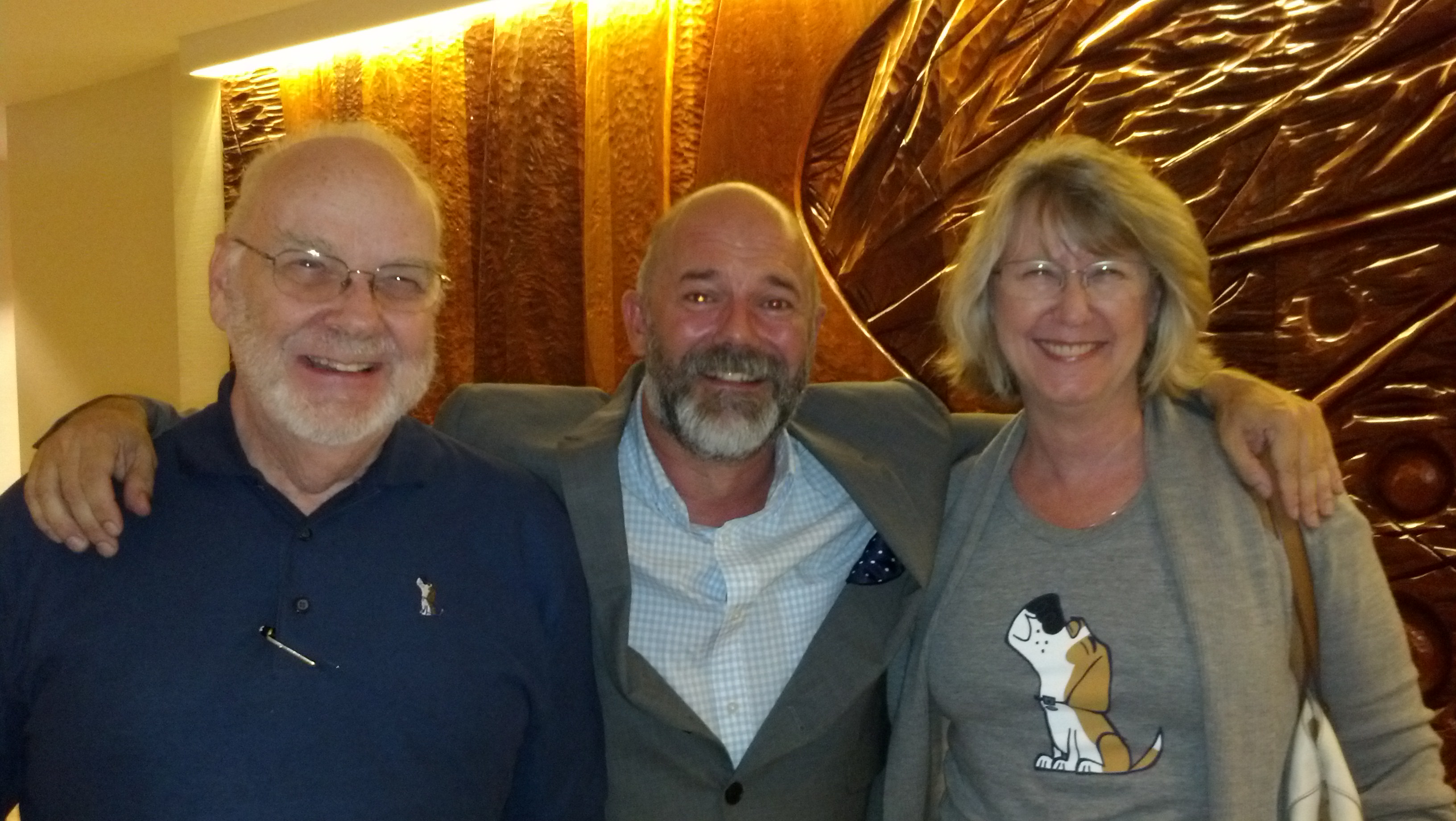
Thanks for all you are doing! Becca insists that you will like the pic attached – with our Dish
shirts prominent. You spoke about having 30,000+ subscribers, but little hope for growing that number significantly in the near term. Here’s just an observation: we put this pic on Facebook on Tuesday night. The response from many of our friends has been “Who’s Andrew Sullivan?”
Most of those are people who should be seeing your work (and probably a few who would just think you’re another crackpot – yes, we know some of them too!) and, having seen it would subscribe. At the risk of committing the very sins you spoke about at CMC – monetizing every post a la Buzzfeed, etc – it seems that you need to find a way to market The Dish that goes beyond word-of-mouth from your dedicated fans.
All ideas are welcome. Another subscriber from Claremont:
I was the guy in the grey suit and white hair. My daughter sat at your table. I’ve been reading the Dish since 2001 and actually contributed to you for 2 or 3 years before you moved to a different platform. (I subscribed for $40 just now.) She’s been reading your blog since high school. I spoke to many of the students in attendance. None of them ever read your blog or knew very much about you. However, they were intensely interested in the subject matter. That’s why they chose to attend. Very unusual to get a sell-out for one of these dinners unless it is a celebrity.
So, I just want to let you know that you are really on to something. What you had to say last night really connected with that audience of young people.
These trips are always a mix of exhilaration and exhaustion. But one thing I always discover: the passion of Dishheads. It’s the elixir of a blogging life.
See you in the morning.
(Photo: Pope Francis leads a vigil prayer in preparation for the Synod on the Family on October 4, 2014 at St Peter’s square at the Vatican. By Gabriel Buoys/AFP/Getty.)
 The Dish