A Slightly Less Horrible Humanity

A new paper suggests that Stanley Milgram’s 1963 “obedience” experiments – which, infamously, involved volunteers delivering what they believed to be painful electric shocks to strangers on the instructions of an authority figure – might not be as damning as previously thought. Josie Glausiusz runs down what was found when the paper’s authors revisited the Milgram archive at Yale, noting that the participants were not “passive conformists blindly following malevolent orders, but rather ‘engaged followers’ who identified with the noble goals of Milgram’s research”:

Forty-four percent of respondents were “very glad” to have participated in the study. Sixty-four percent indicated that, once the experiment was over, it had not bothered them at all. One volunteer wrote, “I am very delighted to be apart of this project. … I sure hope my efforts, and cooperation have been somewhat useful.” Another replied, “I did not like the idea of giving the shocks, but had complete confidence in the instructor and the nature of the experiment.” While the experiment had prompted depressing thoughts and nightmares in some, others expressed satisfaction that they had been “of some small help,” and a firm belief in “experiments that will help to understand people.”

[Alex] Haslam and colleagues’ statistical analysis of the responses revealed that participants were “highly engaged” in the science, seeing it as a social good to which they were pleased to contribute. Milgram himself had convinced them of this when he wrote to them, at the conclusion of his study, that “the experiments you took part in represent the first efforts to understand [obedience] in an objective, scientific manner.” Their investigation, the researchers say, “supports the view that people are able to inflict harm on others not because they are unaware that they are doing wrong, but rather because—as engaged followers—they know full well what they are doing and believe it to be right.”

A Short Story For Saturday

The critic Dwight Garner recently contended that reading Donald Antrim’s books “is like driving 90 miles an hour while in third gear, in the back seat of a jalopy the author has stolen, while he disposes of his drugs by throwing them out the window.” That sounded like an endorsement to us, so this weekend’s short story is Antrim’s “The Emerald Light in the Air,” which appeared in The New Yorker earlier this year. Here’s how it begins:

In less than a year, he’d lost his mother, his father, and, as he’d once and sometimes still felt Julia to be, the love of his life; and, during this year, or, he should say, during its suicidal aftermath, he’d twice admitted himself to the psychiatric ward at the University Hospital in Charlottesville, where, each stay, one in the fall and one the following summer, three mornings a week, Monday, Wednesday, Friday, he’d climbed onto an operating table and wept at the ceiling while doctors set the pulse, stuck electrodes to his forehead, put the oxygen meter on his finger, and then pushed a needle into his arm and instructed him, as the machines beeped and the anesthetic dripped down the pipette toward his vein, to count backward from a hundred; and now, another year later, he was on his way to the dump to throw out the drawings and paintings that Julia had made in the months when she was sneaking off to sleep with the man she finally left him to marry, along with the comic-book collection—it wasn’t a collection so much as a big box stuffed with comics—that he’d kept since he was a boy. He had long ago forgotten his old comics; and then, a few days before, he’d come across them on a dusty shelf at the back of the garage, while looking for a carton of ammo.

Read the rest here. This selection provided the title for Antrim’s latest collection, The Emerald in the Light Air: Stories, which the Dish profiled here. Check out previous SSFSs here.

Face Of The Day

dish_fotdsat4

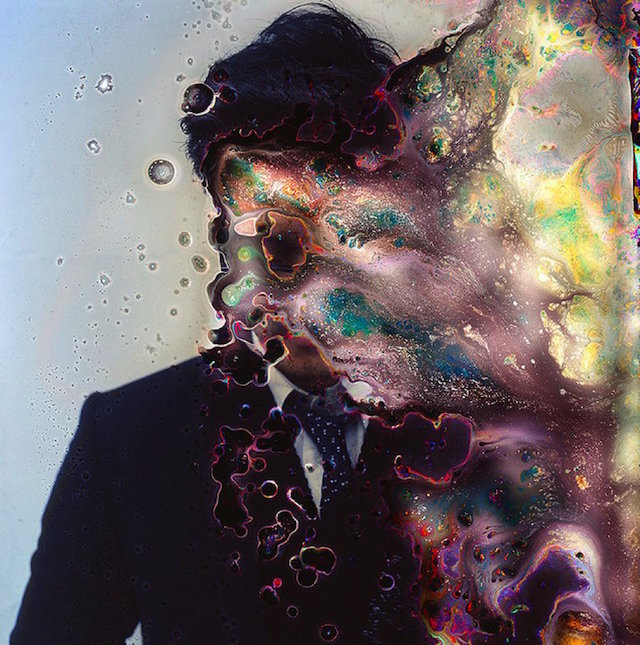
Gannon Burgett explains the process behind Seung Hwan Oh’s project Impermanence:

[I]t’s a series of microbe-mauled portraits that hardly resemble what they were originally captured as. Seung-Hwan gets these results by immersing developed film into water and then adding in various collections of microbes. Over the course of a few weeks, months or years, the microbes destabilize and eat away at the silver halide particles in the emulsion. The final images are what remains of the organic process taking place, where the dyes and emulsion run off and change color over time.

Stephanie Chan comments:

It’s an interesting approach to photography that takes a normally still medium and adds a dimension of something active, live, and dynamic. When you view Oh’s photographs, the question is no longer the significance of what is depicted; instead, what catches your eye is the tension between what is shown and what is already lost. Though art is naturally created to be consumed, in this case, the art itself is the act of consumption, the parts of the photographs that have been literally eaten away by a relentless force of nature. The result, in Oh’s word, can be witnessed as something that is “entangled creation and destruction that inevitably is ephemeral”.

See more of Oh’s work here.

Love Letters From A Literary Great

Reviewing Letters to Vera, Philip Hensher marvels at what Vladimir Nabokov’s correspondence with his wife reveals about his talents as a writer:

The letters are full of rapturous comment, of course, but their substance, and the reason they are so absorbing, is Nabokov’s intense interest in the world around him. He knows that when you are in love, the slightest detail of the beloved’s world and days are interesting: what he might have learnt, through writing these letters, is that the specific is always interesting for readers, too. All through those 1926 letters, he remembers to tell Véra what he has eaten — it’s slightly comic, because Vladimir is not an adventurous eater, and it becomes a litany of good plain food — ‘lamb chop, and apple mousse… meatballs with carrot and asparagus, a plain brothy soup, and a little plate of perfectly ripe cherries… broth with dumplings, meat roast with asparagus and coffee and cake… chicken with rice and rhubarb compote’. The point is that Véra will be interested, because it’s her man eating his meals far away from her; we are interested because the writer evokes and specifies.

Nabokov is such a great letter writer because he wants to interest, not just pour out his emotions. These letters must have been a joy to receive. He keeps his eyes open, and concentrates on recording what he sees:

Alongside the paths coloured stripes are daubed on beech and oak trunks, and sometimes simply on the rocks, like little flags to show the way to this or that hamlet. I noticed too that peasants put red earflaps on their percherons and are cruel with their geese, of whom they have plenty: they pluck off their breast feathers when the geese are still alive, so that the poor bird walks around as if in a décolleté.

Love, and intense care for what will interest his readership of one, directed Nabokov’s writing, and shaped it for the future. The clarity of observation here about a moment of terrible animal sadness holds in it the flash of insight at the beginning of Lolita, the parable about the monkey learning to draw and producing an image of the bars of its own cage.

Can You “Age Out” Of Addiction?

Maia Szalavitz looks at research that suggests many people do. She protests the idea that we should treat addiction as a progressive disease that only gets worse over time:

According to the American Society of Addiction Medicine, addiction is “a primary, chronic disease of brain reward, motivation, memory and related circuitry.” However, that’s not what the epidemiology of the disorder suggests. By age 35, half of all people who qualified for active alcoholism or addiction diagnoses during their teens and 20s no longer do, according to a study of over 42,000 Americans in a sample designed to represent the adult population.

The average cocaine addiction lasts four years, the average marijuana addiction lasts six years, and the average alcohol addiction is resolved within 15 years. Heroin addictions tend to last as long as alcoholism, but prescription opioid problems, on average, last five years. In these large samples, which are drawn from the general population, only a quarter of people who recover have ever sought assistance in doing so (including via 12-step programs). This actually makes addictions the psychiatric disorder with the highest odds of recovery. While some addictions clearly do take a chronic course, this data, which replicates earlier research, suggests that many do not.

She continues:

So why do so many people still see addiction as hopeless? One reason is a phenomenon known as “the clinician’s error,” which could also be known as the “journalist’s error” because it is so frequently replicated in reporting on drugs. That is, journalists and rehabs tend to see the extremes: Given the expensive and often harsh nature of treatment, if you can quit on your own you probably will. And it will be hard for journalists or treatment providers to find you.

Beard Of The Week

172120-9208884-000_1087_jpg

Genista flags a photo series:

The Singh Project is a wonderful, celebratory look at a modern, multicultural Britain and features members of the Sikh community. British photographers Amit and Naroop are exhibiting 35 very different portraits as a visual exploration of faith, style and identity. These intimate images highlight two very important symbols of the Sikh lifestyle – the beard and the turban (Dahar). The turban in particular is a representation of honor, self-respect, courage, spirituality, and piety. Sikh men (and women) wear the turban to cover their long, uncut hair (kesh), and are also seen in this series brandishing a traditional Sikh sword (kirpan).

Previous BOTWs here.

Kafka On The Web

“Kafkaesque” refers not just to bureacratic nightmares, notes Joshua Rothman, but “his novels and stories are actually about justice, which he saw as aloof and possibly unobtainable, and punishment, which he saw as endless and omnipresent.” In other words, he continues, Kafka “described an aspect of life that the online world makes more visible and acute”:

There’s a surreal humor to the Kafkaesque—a sense of lurid, unhinged exaggeration. But, at heart, it’s a sensibility based on straightforward observations of human behavior. One observation is simply that punishment is pervasive. … A second, related observation is that, in many cases, innocence and guilt are determined by context. Often, the punishers are guilty, too—perhaps not of the crimes in question but almost certainly of other, more personal “crimes” not recognized by the law. If the court had a wide enough jurisdiction, everyone would be guilty of something.

To read a headline designed for the social-media age is to see these Kafkaesque aspects of life expressed in a new idiom. (From the Washington Post: “Stop congratulating yourself for opposing the Redskins’ name. You’re not helping the real problem. We’re finally paying attention to Native Americans, but it’s for the wrong reason.”) Stories like this aim to startle you with your own guilt—and to enable you to blindside others with theirs. They employ a paranoid style of accusation: you may think you know what you did wrong, but what you’re about to find out will surprise you. Facebook, like much of the Web, is officially designed to encourage positivity; there is no “dislike” button, and the stated goal is to facilitate affiliation and belonging. But, over time, the site’s utopian social bureaucracy has been overwhelmed by the Kafkaesque churn of punishment. … Facebook has become a dream space of judgment—a place where people you may know only in the most casual way suddenly reveal themselves to be players in a pervasive system of discipline. The site is an accusation aggregator, and the news feed is the docket—full of opportunities to publicly admire the good or publicly denigrate the bad, to judge others for their mistakes or to be judged for doing it wrong.

A Poem For Saturday

9722024610_f768258614_k

“Hunger for Something” by Chase Twichell:

Sometimes I long to be the woodpile,
cut-apart trees soon to be smoke,
or even the smoke itself,

sinewy ghost of ash and air, going
wherever I want to, at least for a while.

Neither inside nor out,
neither lost nor home, no longer
a shape or a name, I’d pass through

all the broken windows of the world.
It’s not a wish for consciousness to end.

It’s not the appetite an army has
for its own emptying heart,
but a hunger to stand now and then

alone on the death-grounds,
where the dogs of the self are feeding.

(From Horses Where the Answers Should Have Been © 1998, 2010 by Chase Twichell. Used by permission of Copper Canyon Press. Photo by Nick Harris)