How Creative Is Coding?

abovefog

Jacob Silverman mulls over whether coding counts as art:

Coding, some of its practitioners claim, is an art form. This argument often hinges on the notion, promulgated by prominent industry figures like the venture capitalist Paul Graham, that coders are “makers.” They produce remarkable things — essays crafted out of the programming languages C# or Javascript that, like a literary essay, depend on elegance, precision, and a knowledge of form. Their creations sometimes affect humanity on a massive scale. According to this calculus, the operating system designed by Steve Wozniak for the Apple II might be as important as Macbeth.

For the novelist Vikram Chandra, who spent years working as a computer programmer and consultant, this comparison holds some appeal. But, as he argues in Geek Sublime: The Beauty of Code, the Code of Beauty, his first nonfiction book, it’s a rather facile argument, one that incorporates some unacknowledged biases, including the American tech industry’s particular blend of nerdy arrogance and latent machismo.

Yes, Chandra acknowledges, “coders – like poets – manipulate linguistic structures and tropes,” he says, and coders also “search for expressivity and clarity.”

But the virtues of what might be called “beautiful code” are different than those of beautiful art. “Beautiful code,” he writes, quoting Yukihirio “Maz” Matsumodo (the creator of the Ruby programming language), “is really meant to help the programmer be happy and productive.” It serves a purpose. Art, by its very nature, serves no purpose. Code is practical and logical. Art is about affect, associations, and emotional responses — part of what Chandra calls dhvani. The term, developed by Anandavardhana, a ninth-century Indian literary theorist, derives from a word meaning “to reverberate.” Dhvani is resonance or “that which is not spoken,” as Chandra says. Code is explicit. Art can be irrational and leave some of the most important things unsaid.

(Image by Kim Dong-Kyu after Caspar David Friedrich)

The View From Your Window Contest

VFYW-C-225

You have until noon on Tuesday to guess it. City and/or state first, then country. Please put the location in the subject heading, along with any description within the email. If no one guesses the exact location, proximity counts. Be sure to email entries to contest@andrewsullivan.com. Winner gets a free The View From Your Window book or two free gift subscriptions to the Dish. Have at it.

Browse all our previous window view contests here.

More Than The Sum Of Our Neurons

Alan Lightman talked to neuroscientist Robert Desimone about attention, memory, and life’s big questions:

I asked Desimone about the strange experience of consciousness, to me the most profound and troubling aspect of human existence. How does a gooey mass of blood, bones, and gelatinous tissue become a sentient being? How does it become aware of itself as a thing separate from its surroundings? How does it develop a self, an ego, an “I”? Without hesitation, Desimone replied that the mystery of consciousness was overrated. “As we learn more about the detailed mechanisms in the brain, the question of ‘What is consciousness?’ will fade away into irrelevancy and abstraction,” he said. As Desimone sees it, consciousness is just a vague word for the mental experience of attending, which we are slowly dissecting in terms of the electrical and chemical activity of individual neurons. As an analogy, he said, consider a careering automobile. A person might ask: Where inside that thing is its motion? But the viewer would no longer ask that question after he understood the engine of the car, the manner in which gasoline is ignited by spark plugs, the movement of piston and crankshaft.

I am a scientist and a materialist myself, but I left Desimone’s office feeling bereft. Although I cannot say exactly why, I do not want my thoughts, my emotions, and my sense of self reduced to the electrical tinglings of neurons.

I prefer that at least some parts of my being remain in the shadows of mystery. I think of a comment by Einstein: “The most beautiful experience we can have is the mysterious. It is the fundamental emotion which stands at the cradle of true art and true science.”

Your Saturday Morning Cartoon

Sadly, a half-century-long tradition of Saturday morning cartoons has come to an end:

The CW has aired its last batch of Vortexx programming, leaving American kids without any animated broadcast TV to start their weekends for the first time in decades. From here on out, young ones glued to the tube will mostly be watching educational shows.

As for why this longstanding television staple has vanished? It’s a combination of regulation and technological progress. A 1996 FCC rule required that stations offer at least three hours of educational programming every week; to avoid interrupting affiliate programming, the networks scheduled most of that content on Saturday morning. Meanwhile, kids’ viewing options have increased dramatically. On top of dedicated cable and satellite channels like the Cartoon Network, they can now watch plenty of animation on Hulu, Netflix and other streaming services. In that sense, today’s children aren’t missing out — if anything, they’re making your inner 8-year-old a little jealous.

Your inner 8-year-old can enjoy the above cartoon, a Looney Tunes classic. Watch even more here, and check out previous cartoons on the Dish here.

Afghanistan’s Missing War Lit

“Afghanistan veterans are writing and publishing,” observes Brian Castner, noting the many memoirs inspired by the conflict, but “they just aren’t publishing fiction”:

What impulse … is missing, that would cause a veteran to write fiction, as opposed to memoir? “Deep brooding dissatisfaction,” [Lieutenant Colonel Peter] Molin said, “more indicative of Iraq than Afghanistan. People have got to believe in what a novel can do, that more official forms of speech can’t.” In addition to teaching literature at West Point, Molin is an infantry officer who served as an advisor to the Afghan National Army in 2008 and 2009. And while he says that at times the Afghan War can feel endless,

the lived experience of average soldiers there is invigorating. They can come home feeling good about themselves. There were some horrible things that happened on my deployment, and yet my sense of satisfaction, maybe regrettably so, is actually pretty safe and solid.

The war itself in Afghanistan lacks the standard fiction catalyst that has propelled such writing since Vietnam, namely, in Molin’s words, “that little seed of despair and futility” that informs our understanding of Iraq.

“Iraq was such a disaster,” Molin continued, saying many veterans seem to come back with a “plague on both your houses” mentality.

The whole enterprise was overlaid with defeat and futility and amazement on the part of its participants, that they were involved in such a messed up endeavor. It was such a botched operation from the top down. People generally don’t feel good about their service in Iraq, and the writerly types and artistically minded types are left to question: what is my culpability, how has this affected me, I’ve been witness to all this and I’ve been subjected to all this, and it’s troublesome.

Previous Dish on American war literature since 9/11 here.

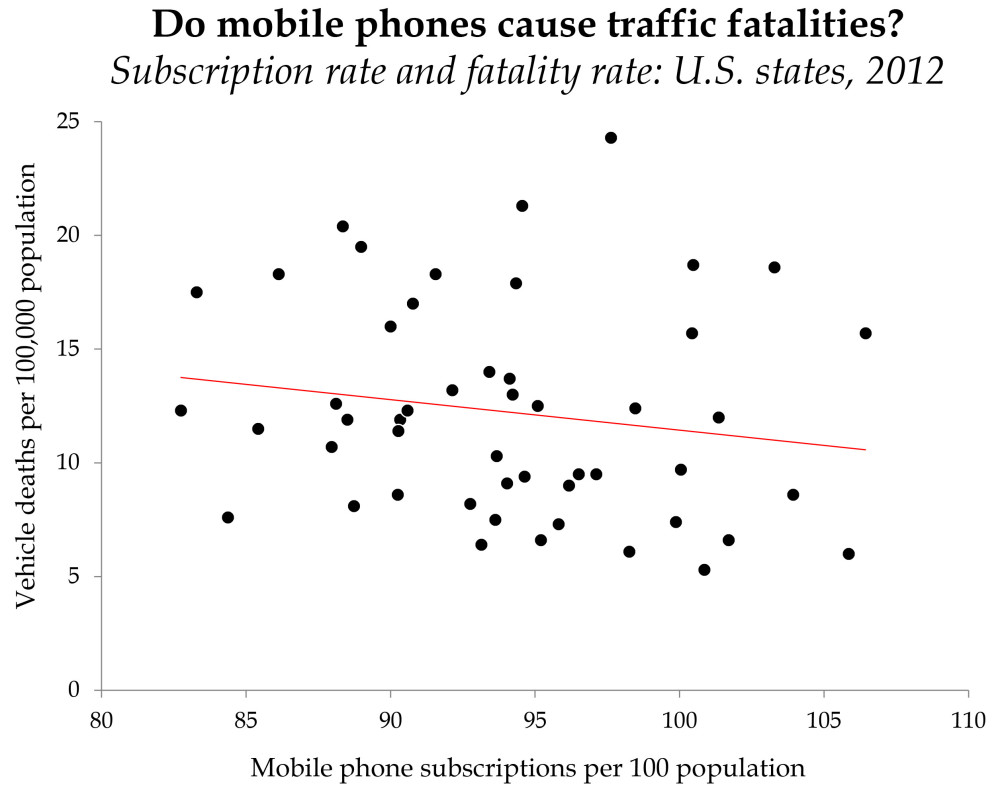
The Texting-While-Driving Epidemic That Isn’t

cellphones traffic deaths with NEJM.xlsx

In a take-down of Matt Richtel’s new book, A Deadly Wandering: A Tale of Tragedy and Redemption in the Age of Attention, Philip N. Cohen maintains that Richtel needs to chill out about a so-called “texting-while-driving epidemic.” He collected the “data on mobile phone subscriptions by state, to compare with state traffic fatality rates, only to find this: nothing,” as seen in the above chart:

What does predict deaths? Driving. This isn’t a joke. Sometimes the obvious answer is obvious because it’s the answer…. I also put both of these variables in a regression, along with age and sex composition of the states, and the percentage of employed people who drive to work. Only the miles and drive-to-work rates were correlated with vehicle deaths. Mobile phone subscriptions had no effect at all. … [T]exting while driving is dangerous and getting more common as driving is getting safer, but driving still kills thousands of Americans every year, making it the umbrella social problem under which texting may be one contributing factor.

Doug Hartmann nods along, adding that Cohen’s analysis “reminds me of a thought experiment Joseph Gusfield posed in his brilliant, if under-appreciated 1981 book on drinking driving and the culture of public problems”:

Gusfield asks his readers to imagine that some all-powerful god has come to America and offers to give us a new technology that will make our lives immeasurably better by allowing us to go wherever we want, whenever we want, faster than we have ever gone before. The only catch? The god demands that we as a society sacrifice 5000 of our citizens every year for the privilege of this great technological innovation. Do we take that bargain? Would you? With our reliance on the automobile, Gusfield says, we already have. In rejecting the conventional wisdom and moralistic outrage about texting and bringing new data to bear on the dangers of just being in traffic on the roads, I think Cohen is just trying to force us to grapple with this consequences of this collective decision more honestly and directly.

Read the Dish thread on driving with cell phones here.

The Other Dylanologists

Five Swedish scientists are competing to see who can sneak the most Bob Dylan references into their publications. Scott Neuman has more:

As Sweden’s edition of The Local reports, it all started back in 1997, when John Jundberg and Eddie Weitzburg, two professors from the Karolinska Institute in Stockholm, published an article on flatulence titled “Nitric Oxide and inflammation: The answer is blowing in the wind.” … A few years later, two others scientists, Jonas Frisen and Konstantinos Meletis, picked up the riff in a research paper on the ability of non-neural cells to generate neurons, which they called “Blood on the Tracks: A Simple Twist of Fate” …

That’s when, The Local says, a librarian spotted the Frisen and Meletis article and pointed it out to Jundberg and Weitzburg. The four scientists decided to make a bet: Whoever could squeeze the most Dylan song references into articles before retirement gets a free lunch at a restaurant in Solna, north of Stockholm, where the university is based.  A fifth inductee, Kenneth Chien, a professor of cardiovascular research, joined the group when the four others discovered his classic title: “Tangled up in blue: Molecular cardiology in the postmolecular era.”

The Guardian says: “With five competing rivals, the pace of Dylan references accelerated: Lundberg and Weitzberg’s “The Biological Role of Nitrate and Nitrite: The Times They Are a-Changin’,” in 2009; “Eph Receptors Tangled Up in Two” in 2010; “Dietary Nitrate – A Slow Train Coming,” in 2011.”

Connecting Online

James Poniewozik has mixed feelings about nostalgia over the Internet:

News outlets have always loved the convenience of anniversaries, of course; we’re in the middle of experiencing the 50th birthday of everything that happened in the ’60s. But lately we’ve been buried in “Wanna Feel Old?” listicles and “___ Turns 20″ features. (Some of them, I fully admit, written by me.) A lot of this material is aimed at millennials (see the outpouring of love for cultural landmark Saved By the Bell), but I wouldn’t want to overstate this as a generational phenomenon. My own people, Gen Xers, grew up on Happy Days and gave the world the Schoolhouse Rock Live! musical. Premature nostalgia may just be our general way of dealing with our society’s extended nether-zone between childhood and independent adulthood.

Whatever the explanation, though, online sharing and social media have positively weaponized nostalgia.

Others are nostalgic for life offline:

In an era where people flock to Facebook to find friends or communicate solely via text, a growing niche of entrepreneurs is building businesses that help people meet the old-fashioned way: in person.

As digital connections have blossomed, so too has a sense of loneliness among some users. Patrick Janelle, a founder of Spring St., is one of them. He said he started the society, in part, because his digital life, which includes an Instagram account with about 276,000 followers, lacked the human contact he craved.

Guests now depend on him, not a computer algorithm, to do the social sorting for them, betting his parties will create an atmosphere that fosters meaningful relationships. “I want to be remembered for bringing these people together,” said Mr. Janelle, of the get-togethers he plans with his Spring St. partner, Amy Virginia Buchanan. He added: “It resonates right now because there is a mystery and surprise, and you are discovering new things.”

Cody C. Delistraty, meanwhile, insists on the authenticity of online relationships:

The question, then, is whether these relationships in the virtual world are still the same as relationships pursued in the real world or is there a fundamental difference, as Baudrillard would have claimed? Can we still call love “love” if it’s passing through a screen?

For the past decade, Paul J. Zak, a professor of neuro-economics at the Claremont Graduate University who sometimes goes by “Dr. Love,” has been conducting studies on how relationships maintained over social media differ from relationships in real life. What he has found is that there’s hardly any difference at all.

“It’s as if the brain doesn’t really differentiate between you posting on social media and you being there in person,” he told me. “We’re such hyper-social creatures that we have a large release of dopamine when we’re with other people. But we can also get that release through Twitter or any social media, really.”

Face Of The Day

Hong Kong Chief Executive Agrees To Hold Talks With Protest Leaders As Sit In Continues

People clean the face of a protester after he was sprayed with pepper spray during a pro-democracy protest in the Kowloon district of Hong Kong on October 4, 2014 in Hong Kong. Thousands of pro-democracy supporters continue to occupy the streets surrounding the city’s financial district. By Thomas Campean/Getty Images.