Arabs And Democracy: It’s Complicated

Lindsay Benstead takes a second look at poll data from the Arab world showing widespread support for democratic governance:

According to polls from 2006 to 2008, at least 80 percent of residents in Yemen, the Palestinian territories, Algeria and Jordan agreed or strongly agreed that, “Democracy may have its problems, but it is the best form of government.” This figure exceeded 90 percent in Morocco and Lebanon.

Yet, in a recent article published in “Democratization,” I revisited these Arab Barometer data and found that support for democracy is not as widespread as received wisdom suggests. I found that 27 percent of citizens of six countries surveyed by the Arab Barometer believed that democracy is best but unsuitable for their country. The reasons citizens saw democracy as unsuitable stem not from religion or economic modernization – the focus of many studies of Arab public opinion – but from concerns about economic problems and political instability that could accompany free elections.

Why this matters:

First, scholars have long suggested that public support for democracy is a key driver of democratization. So, it is important for the long-term development of democracy that citizens have confidence in democracy as the best way to achieve a better life. Second, the conditions that appear to threaten public confidence in democracy in the Arab world – instability, violence and upheaval – are an unfortunate byproduct of the transitions taking place in the region. And, this appears to be hampering citizen confidence in democracy.

On a related subject, Steven Cook puzzles over the Egyptian “liberals” who now back the coup government of Abdel Fattah al-Sisi:

We have all come to believe in the alleged axiom of Egyptian politics: Faced with a choice between democratically elected Islamists and the authoritarianism of the military, the liberals will choose the officers, revealing themselves to be not so liberal after all. That seems self-evident, but liberal supporters of the post-July 2013 political process argue that the coup and their support for it were actually quintessentially liberal. To them, the military’s intervention precluded Egypt’s slide into a new authoritarianism of a particular religious bent from which there could be no hope for the survival of liberalism. These folks also make the case that their (mostly Western) critics mistakenly fuse liberal principles and democracy, failing to recognize that democracy can bring about both its own demise as well as that of liberalism.

Moreover, the first concern of many of those Egyptian intellectuals who opposed Mubarak but support Sisi is preserving and advancing liberal ideals, which is more important—for now—than the ballot box. It’s an interesting and informed argument, steeped as it is in John Locke. Yet the argument seems like a leap of faith. It is hard to imagine that as Egypt’s authorities go about re-engineering the political institutions of the state to ensure that something like the January 25 uprising never happens again that they are simultaneously creating an environment where liberalism can not only be sustained, but also thrive.

Against Mindless Automation

In an excerpt from his new book, The Glass Cage: Automation and Us, Nicholas Carr tackles the increasing automation of our society:

Glass CageMachines are cold and mindless, and in their obedience to scripted routines we see an image of society’s darker possibilities. If machines bring something human to the alien cosmos, they also bring some­thing alien to the human world. The mathematician and philoso­pher Bertrand Russell put it succinctly in a 1924 essay: “Machines are worshipped because they are beautiful and valued because they confer power; they are hated because they are hideous and loathed because they impose slavery.”

The tension reflected in Russell’s description of automated machines—they’d either destroy us or redeem us, liber­ate us or enslave us—has a long history. The same tension has run through popular reactions to factory machinery since the start of the Industrial Revolution more than two centuries ago. While many of our forebears celebrated the arrival of mechanized production, seeing it as a symbol of progress and a guarantor of prosperity, others wor­ried that machines would steal their jobs and even their souls. Ever since, the story of technology has been one of rapid, often disorient­ing change. Thanks to the ingenuity of our inventors and entrepre­neurs, hardly a decade has passed without the arrival of new, more elaborate, and more capable machinery. Yet our ambivalence toward these fabulous creations, creations of our own hands and minds, has remained a constant. It’s almost as if in looking at a machine we see, if only dimly, something about ourselves that we don’t quite trust.

In another excerpt, Carr fears that automation is damaging the labor market:

The science-fiction writer Arthur C. Clarke once asked, “Can the synthesis of man and machine ever be stable, or will the purely organic component become such a hindrance that it has to be discarded?”

In the business world at least, no stability in the division of work between human and computer seems in the offing. The prevailing methods of computerized communication and coordination pretty much ensure that the role of people will go on shrinking. We’ve designed a system that discards us. If unemployment worsens in the years ahead, it may be more a result of our new, subterranean infrastructure of automation than of any particular installation of robots in factories or software applications in offices. The robots and applications are the visible flora of automation’s deep, extensive, and invasive root system.

Nick Romeo lays out some of the book’s primary arguments:

We are increasingly encaged, [Carr] argues, but the invisibility of our high-tech snares gives us the illusion of freedom. As evidence, he cites the case of Inuit hunters in northern Canada. Older generations could track caribou through the tundra with astonishing precision by noticing subtle changes in winds, snowdrift patterns, stars, and animal behavior. Once younger hunters began using snowmobiles and GPS units, their navigational prowess declined. They began trusting the GPS devices so completely that they ignored blatant dangers, speeding over cliffs or onto thin ice. And when a GPS unit broke or its batteries froze, young hunters who had not developed and practiced the wayfinding skills of their elders were uniquely vulnerable.

Carr includes other case studies: He describes doctors who become so reliant on decision-assistance software that they overlook subtle signals from patients or dismiss improbable but accurate diagnoses. He interviews architects whose drawing skills decay as they transition to digital platforms. And he recounts frightening instances when commercial airline pilots fail to perform simple corrections in emergencies because they are so used to trusting the autopilot system. Carr is quick to acknowledge that these technologies often do enhance and assist human skills. But he makes a compelling case that our relationship with them is not as positive as we might think.

But, after reading the book, Josh Dzieza remains unafraid of such technologies:

Carr takes a broad approach to automation, so any technological abbreviation of a task would qualify. Google’s auto-completing searches automates inquiry, Carr says, while legal software automates research, discovery, and even the drafting of contracts. CAD automates architectural sketching. Thanks to an explosion in computing power, more and more things are getting automated, and Carr worries that it’s all combining to degrade our skills and insulate us from the world. “When automation distances us from our work,” Carr writes, “when it gets between us and the world, it erases the artistry from our lives.”

I think Carr is probably right about much of this, but I have a hard time mustering his concern. I too am nostalgic for the romance of early flight, when pilots were intuitively attuned to their surroundings through the shuddering of their plane’s throttles and levers; but as Carr himself notes, a great many of those early pilots died in crashes, and personally I’m glad my captain isn’t flying by unaided gut feeling. Pilots might be less manually skilled now, but flying is far safer. For my part, I’m probably less engaged with my surroundings because of Google Maps, but it also allows me to explore more new places without getting lost. Every tool, automated or not, opens new possibilities and closes others, fosters new skills and lets others lapse. Most of the problems Carr points to either seem like good trade-offs or fixable shortcomings. He even suggests some possible design solutions, including taking cues from game makers and designing tools that are always slightly challenging to use.

A Gun Restraining Order

Jacob Sullum disapproves of a new California law, according to which a cop or family member “can seek a ‘gun violence restraining order’ that prohibits an individual from possessing firearms and authorizes police to seize any he currently owns”:

If the applicant is a cop, he must have “reasonable cause” to believe “the subject of the petition poses an immediate and present danger of causing personal injury” to himself or someone else. If the applicant is a relative or roommate, he must show there is a “substantial likelihood” that “the subject of the petition poses a significant danger, in the near future, of personal injury” to himself or someone else. Either standard suffices to take away someone’s right to arms for three weeks, after which he has an opportunity for a hearing where the petitioner has to show by “clear and convincing evidence” that he “poses a significant danger of personal injury” to himself or others. If the judge decides that test has been met, he issues a one-year restraining order than can be renewed annually.

Bloomberg View’s editors, meanwhile, welcome the reform:

The law enables people to temporarily prevent mentally disturbed family members from possessing or purchasing guns. A so-called gun-violence restraining order, akin to the one used to obtain restraining orders in domestic violence cases, will allow police to search for and seize firearms.

The impetus for the law, which also allows law-enforcement officials to ask for a restraining order, was the shooting in May in which a mentally disturbed man killed six and wounded a dozen near the University of California at Santa Barbara. Although the killer’s parents had expressed grave concerns about his mental state, nothing prevented him from purchasing guns.

But Sullum doubts the law would have prevented that shooting:

[A]s far as I know no one in his family was aware that he owned guns. In a case with different facts, of course, it is conceivable that one of these new restraining orders might stop a would-be mass murderer. But it’s more likely this law will become a tool of meddling and harassment that mostly affects people with no homicidal intent.

Patrick Kulp compares the law to others across the country:

Under current California law, officers are only allowed to confiscate weapons if their owner has been convicted of a violent crime, deemed mentally unstable or is subject to a restraining order for domestic violence. Connecticut, Indiana and Texas all have laws in place that allow police to seize firearms with a judge’s order, but California is the first state to extend this right to immediate family members.


Turkey’s Stake In The ISIS War

TURKEY-SYRIA-KURDS

As expected, Turkey’s parliament today authorized the government to take military action against jihadists in both Syria and Iraq, but Ankara has yet to say what, if anything, that action will be. With ISIS on its border, though, we might find out soon:

Kurdish fighters backed by US-led air strikes were locked in fierce fighting Wednesday to prevent the besieged border town of Ain al-Arab from falling to the Islamic State group fighters. “There are real fears that the IS may be able to advance into the town… very soon,” the Syrian Observatory for Human Rights warned, with the jihadists within three kilometres (two miles) of the strategic town.

Or an attack on the tomb of Suleiman Shah, a Turkish enclave in northern Syria, might be what finally draws Ankara into the war:

Deputy Prime Minister Bulent Arinc said Tuesday that the militants were advancing on the white stone mausoleum, guarded by several dozen Turkish soldiers and perched on a manicured lawn under a Turkish flag on the banks of the Euphrates. The tomb was made Turkish under a treaty signed with France in 1921, when France ruled Syria. Ankara regards it as sovereign territory and has made clear that it will defend the mausoleum if it is attacked.

Jamie Dettmer relays the suspicions of diplomats in Ankara that “Turkey will limit its military role—doing a bare minimum as a NATO member to avoid embarrassing the Western alliance but not enough to undermine the anti-Western narrative that thrills Erdogan’s Islamist supporters and other religious conservatives in the country”:

“As much as Turkey enjoys the protection of NATO’s Patriot missiles against the Syrian regime, Ankara is perhaps not willing to appear an active member of a war operation against what was initially a Sunni insurgency movement in Syria,” according to Marc Pierini, a former ambassador of the European Union in Ankara. “Turkey under the Justice and Development Party (AKP) has never wanted to appear to be aligning itself with Western policies.”

Erdogan’s domestic critics say he has to some degree helped the rise of ISIS, as well as other Islamic militants. At the very least Turkey has turned a blind eye to them as they emerged in the Syrian civil war and increasingly formed the vanguard in the fight to topple Syrian President Bashar Assad. Some critics argue that Turkey’s intelligence agencies have gone farther and actively channeled arms supplies to the jihadists.

Koplow also explores how the spillover effects of the conflict in Syria stand to influence Turkey’s domestic politics. For one thing, the government’s non-response is alienating the country’s Kurdish population, threatening to undo what had been a fairly successful rapprochement:

Many Kurds blame Ankara for allowing ISIS to fester and even for empowering the group through its previous see-no-evil-hear-no-evil border policy. The more half-hearted the Turkish government has been about getting rid of ISIS, the harder it is to successfully conclude the Kurdish peace process. In southeastern Turkey, funerals for Kurdish fighters who have been killed fighting ISIS across the border are a regular occurrence, and they contribute to growing discord between a naturally restive population and the Turkish government. The ongoing battle between ISIS and Kurdish fighters for the town of Kobane on the Syria-Turkey border — and Turkey’s apparent reluctance to get involved for fear of empowering Kurdish militants in Turkey — is inflaming passions and contributing to antigovernment rhetoric in ways that will reverberate well beyond this particular fight. …

An economy burdened by refugees, renewed unrest among Turkish Kurds, resurgent nationalism, and policy run by unaccountable intelligence services makes for an unstable brew. ISIS has presented the United States and the entire Middle East with a new set of problems, but its immediate legacy may be an end to what has been a remarkable period of Turkish domestic stability.

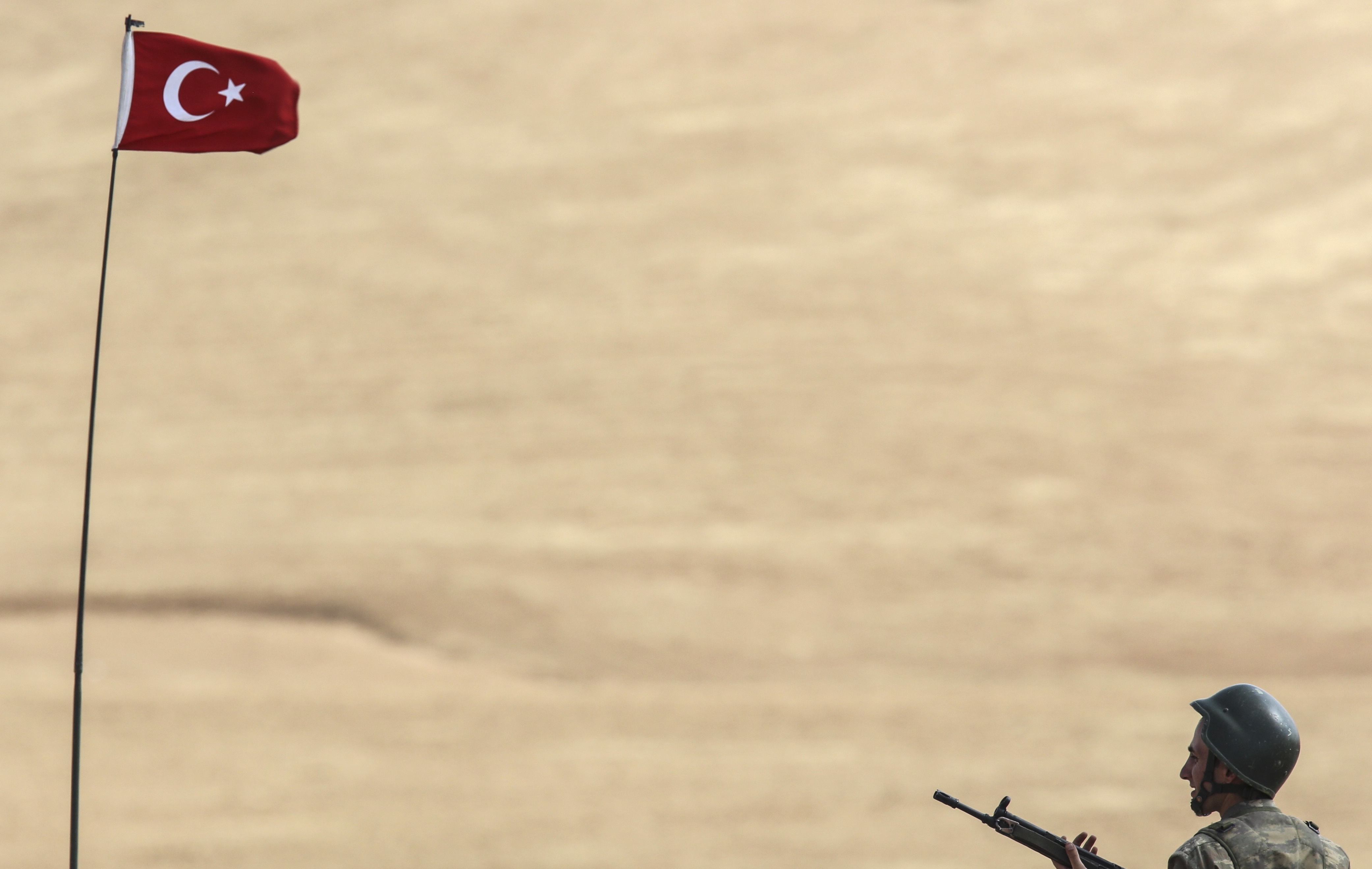
(Photo: A Turkish soldier stands on a hill in Suruc, Turkey on October 2, 2014, facing the Islamic State (IS) fighters’ new position, 10km west of the Syrian city of Ain al-Arab (Kobani). By Bulent Kilic/AFP/Getty Images)

Ripples From Kowloon Bay?

As Beijing worries over the Hong Kong protests emboldening democrats and separatists in the hotspots of China’s periphery, Isaac Stone Fish interviews a leading Uighur independence activist about how she views the past week’s events:

According to Rebiya Kadeer, the exiled leader of the movement for Uighur rights, the ideals of the Hong Kong movement are already influencing the northwestern Chinese region of Xinjiang. “Because of the brutality and wrongfulness of the Chinese government, the Uighur people have concluded that their only option is independence,” she said in a Sept. 30 interview with Foreign Policy. The protests in Hong Kong “are very inspiring” to Xinjiang, she said. Uighurs, a Turkic-speaking Muslim group who make up roughly 43 percent of the population in Xinjiang, think that “if Hong Kong wins, it will benefit Uighurs as well, and then the Uighurs can strengthen their own movement.” …

“I saw what happened in Hong Kong and Taiwan,” she said, referring to protests in Taipei this spring, and “I wished” that Xinjiang could also have Western journalists reporting there. “Our people can’t do what the Hong Kong people are doing because they’re getting killed by the Chinese government,” and there are no outsiders to observe it.

Alexa Olesen looks to Macau, the former Portuguese colony and current gambling mecca just up the coast from Hong Kong with a somewhat similar governing arrangement. For now, at least, a battle for democracy doesn’t seem to be in the cards there:

[O]ver the past year or so, Macau has seen the emergence of an aggressive labor movement fond of protests and strikes and the stirrings of a political opposition with democratic ambitions. It remains to be seen how Hong Kong’s experience — massive protests over many days that police have tried to beat back with pepper spray and tear gas — will color those developments. What’s clear is that Macau is watching intently. …

Is Macau ripe for a Hong Kong-style Umbrella Revolution? Alex Choi, an assistant professor in public administration at the University of Macao, told FP that while the territory’s labor movement gathered steam, he doesn’t expect them to shift their focus from better wages to universal suffrage any time soon. Choi said it would be “a big jump” to go from labor issues to “a fight for democracy and against Beijing.” So far, he said, the labor movement hasn’t appeared eager to take that leap.

Taiwan, of course, is not part of China, but Beijing would like it to be, and so Taipei is also keeping a watchful eye on the Hong Kong standoff. Taiwanese activist Lin Fei-Fan explains why:

The main goal of the “one country, two systems” policy by which China governs Hong Kong is to provide a template for Taiwan, but the developments of recent years clearly show China placing increasingly tight restrictions on Hong Kong’s self-governance. It’s not just that China has reneged on its promise that Hong Kong’s system would remain “unchanged for 50 years.” A more serious problem is that conflicts within Hong Kong society have proliferated. The wealth disparity there cannot be solved via existing structures, and the huge influx of mainland tourists, as well as mainlanders who become Hong Kong residents, have also created even more social problems. Taiwan faces similar concerns. We have seen that Taiwan and the Chinese government have signed a number of trade agreements exposing Taiwan to industrial outsourcing, falling salaries, increases in the disparity between rich and poor, national security risks, and other crises.

A New Eugenics?

 troubled by the sky-high abortion rate for Down syndrome pregnancies:

If the numbers on abortion and Down syndrome are even remotely accurate, the birth of a Down baby is something already against the norm. As medical costs are more and more socialized, it is hard to see how the stigma attached to “choosing” to carry a Down syndrome child to term will not increase. Why choose to burden the health system this way? Instead of neighbors straightforwardly admiring parents for the burden they bear with a disabled child, society is made up of taxpayers who will roll their eyes at the irresponsible breeder, who is costing them a mint in “unnecessary” medical treatment and learning specialists at school. Why condemn a child to a “life like that,” they will wonder.

He contends that “the ingredients still exist for a more explicit return to eugenics in our culture and politics: inequality, fear, detestation of the other”:

But if it comes back, it is unlikely to come in the explicitly racialist terms of the biodiversity-obsessed right. Liberal societies have the antibodies against that. Instead, it will come to us in terms of “quality of life,” and “health and safety.” We will be urged that every child deserves the best society can grant, and stigmatize those for whom “the world is a difficult place.” And thereby we legitimize the destruction of those who would merely “live” in society rather than thrive in it.

Whom Exactly Are We Bombing In Syria? Ctd

SYRIA-CONFLICT

David Kenner has more on our Syrian allies, who for some reason aren’t all that grateful for the bombs we’re dropping on their country:

Foreign Policy interviewed six FSA commanders from [Deir Ezzor] who are currently exiled by the Islamic State and hiding out in southeastern Turkey. All of them were arrested at some point by the jihadist group; some were tortured. They all agree that the U.S. airstrikes in their home country are a bad idea. FSA fighters and commanders complained to Foreign Policy that they have received no increase in support since the international effort to combat the Islamic State began, despite promises from the Obama administration that the United States would begin supplying arms to the rebels. The FSA fighters also disparaged the airstrikes, saying they would mainly kill civilians and give the Assad regime a chance to gain ground.

Anti-Assad Syrian civilians have echoed this opposition. While Islamists have seized on the attacks to brand U.S. President Barack Obama as an “enemy of God,” even the traditionally secular protesters in the town of Kafr Anbel held a poster blasting the coalition for killing civilians.

Zack Beauchamp calls these civilian deaths “not an inevitable feature of any sort American involvement in Iraq and Syria” but rather “a direct product of the maximalist goals the Obama administration has set for its war on ISIS”:

By choosing only to provide limited help to Iraq in critical situations, the United States had enormous control over targeting. It could focus only on ISIS targets where airpower was likely to be effective, such as disrupting supply convoys between Iraq, that also were unlikely to kill a lot of civilians.

But now, the United States has committed itself to helping both Iraqi and Syrian rebel soldiers take back all of ISIS-held territory. That’s a more ambitious strategy that takes on a lot more risk, including toward civilians. If and when Iraqi military and Syrian rebel forces move on ISIS positions in heavily populated areas, they will expect and may very well depend on American close air support. The US will be forced to rely on sketchy Syrian intelligence and strike dangerously close to civilian population centers. It’s this simple: the more aggressive the American objectives are in the war against ISIS, the more likely American forces are to kill civilians.

Erika Solomon and Geoff Dyer back up previous reports that our targeting of the Nusra Front is alienating our friends and encouraging the al-Qaeda franchise to seek out Western targets:

[M]oderate rebels on the ground fear Washington’s decision to widen its attacks could not only weaken them, but create a larger pool of fighters who believe the west – and its partners on the ground – are their enemy as much as Mr Assad. Nusra fighters insist they had no interest in foreign attacks before the coalition strikes. But since then the group appears to have shifted its position: Jabhat al-Nusra’s leader, known as Abu Mohammed al-Golani, recently put out a statement warning western civilians to demand an end to strikes to avoid becoming victims of attacks in their own countries. Nusra fighters have been a critical partner to other rebels fighting to end four decades of Assad family rule. Their targeting by the US outraged some opposition forces.

And Joshua Hersh observes that most of the pro-democracy activists who launched the 2011 revolution are no longer there, having been killed, silenced, or driven into exile either by the regime or by ISIS:

Not all revolutionary civil activity has ceased inside Syria. In the town of Kafranbel, in Idlib province, a clever and merry band of activists continue to create humorous banners that comment on recent events, and seek to bring attention to their ongoing plight. (Recent banners have quoted Robin Williams, honored the murdered journalist James Foley, and mocked the world’s obsession with the World Cup.) And in Aleppo, there are revolutionary councils and civilian activists networks, not to mention a noble brigade of volunteer rescuers who risk their lives daily to pull survivors from the rubble of regime airstrikes. But for so many other would-be do-gooders, the rebel-held countryside, not to mention the major cities still under government control, has long proven unwelcome terrain. Going home remains a distant illusion.

“The sense of despair and the sense of loss is so powerful,” one longtime Syrian activist and humanitarian worker told me by Skype last week from his asylum in London. “For the people still inside, even if they are activists, they are under so much pressure—the pressure of the war, the militarization, the abuse.” He added, “At this point, if you want to be an activist, it’s basically to call for the fighting to stop, the bloodshed to stop.”

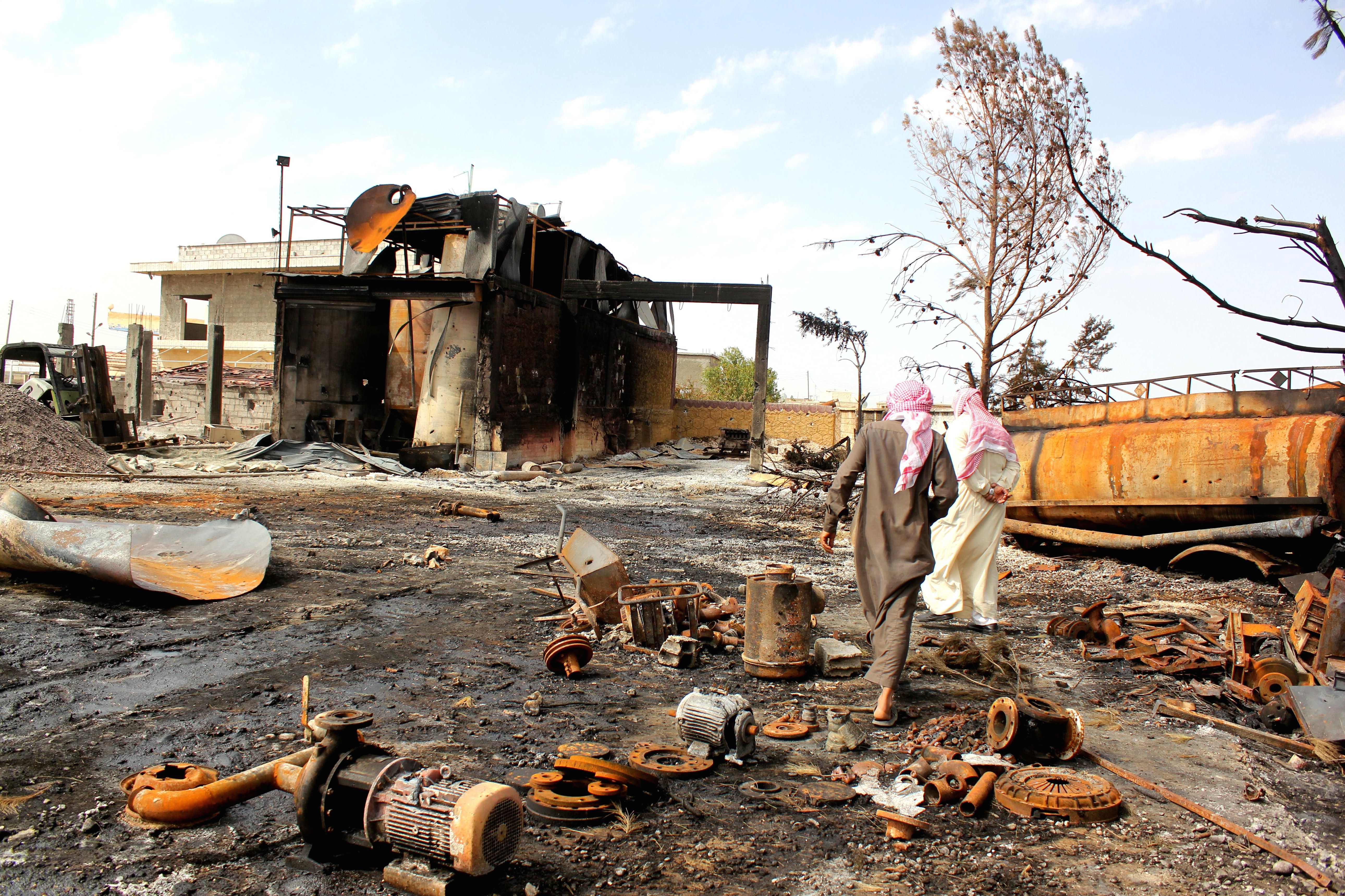
(Photo: On October 2, 2014, men walk through the rubble of an oil refinery that was reportedly targeted by the US-led coalition on September 28, in the northern Syrian town of Tal Abyad near the border with Turkey. By AFP/Getty Images)

Should Washington “Speak Out” On Hong Kong?

Pace the WaPo editorial board, Larison doesn’t want the US to involve itself in the standoff, which he calls “exactly the sort of tense, potentially explosive situation in another country that the administration shouldn’t be talking about publicly”:

It would be appropriate for the administration to convey its concerns to Beijing through diplomatic channels, and perhaps they have already been doing this, but there is absolutely no need for public declarations or “explicit support” for the protesters. How could that benefit the protesters? The Post doesn’t even pretend that it would. As ever, the desire to have our government “speak out” in support of foreign protesters trumps all other considerations. It’s not as if Beijing will react well to be warned by Washington about how it conducts its own affairs. We know very well that the Chinese government reacts angrily to any hint of foreign interference in their internal politics. Indeed, there are few governments in the world less likely to respond well to statements from U.S. officials about its internal affairs than the Chinese government.

Before meeting with John Kerry yesterday, China’s Foreign Minister Wang Yi warned Washington to back off and respect Chinese sovereignty. There is also a conspiracy theory, encouraged in the pro-Beijing press, that the protest movement is an American plot. David Wertime situates this theory within the context of negative reactions to the demonstrations on the mainland:

A vocal but not negligible minority genuinely believes that foreign forces are behind recent events. A widely circulating article, originally penned in June and republished Oct. 1 on 163.com, a major news portal, ably summarizes the attitude of some Chinese conservatives toward Hong Kong. The accusation-packed piece, called “Who really is the black hand behind Hong Kong independence?” begins, “Recently, gangdu – Chinese for Hong Kong separatists, who do not appear to actually be a driving force behind the current protests — “have been happily making trouble, and behind it is an America hoping to push [the movement] to its height.” It goes on to name a great many bogeymen: Paul Wolfowitz, the National Endowment for Democracy, George Soros, and the CIA. The article accuses the West of making “cultural products” in a “war of ideals” that it then foists on unsuspecting overseas populations. The goal, the article declares, is to then “stimulate Taiwanese independence, Xinjiang independence, and Tibetan independence” to cause “multiple troubles for China, making China unable to pay attention to its great power struggle with the United States.”

Noting that Russian state television is also on board with this theory, Bershidsky compares it to similar mutterings about the massive protests in Moscow in 2012 and the Euromaidan revolution in Kiev:

The problem with the U.S. conspiracy theory is that it’s impossible to buy if, like me, you experienced the Moscow and Kiev demonstrations first hand. The leaders were weak and non-essential. The protests would have gone on without them. If not through the leaders, how could any puppeteer exert influence? People took to the streets because they felt cheated, and in every case the deception was real. In Moscow, Putin’s party blatantly stole a parliamentary election. In Kiev, the president reneged on his promise to sign a trade pact that would have put Ukraine on a path toward European integration. In Hong Kong, a plan to vet candidates for the city’s chief executive nullified Beijing’s promise of universal suffrage.

The U.S. neither perpetrated the deceptions nor opened people’s eyes to them. People aren’t as dumb as authoritarian leaders think. The creation of symbols, organization against common ills and the desire to keep protest camps clean are instinctive and universal. They require no more conspiracy or outside influence than a swarm of bees does to organize a new hive.

Burn After Investing

Start Ups

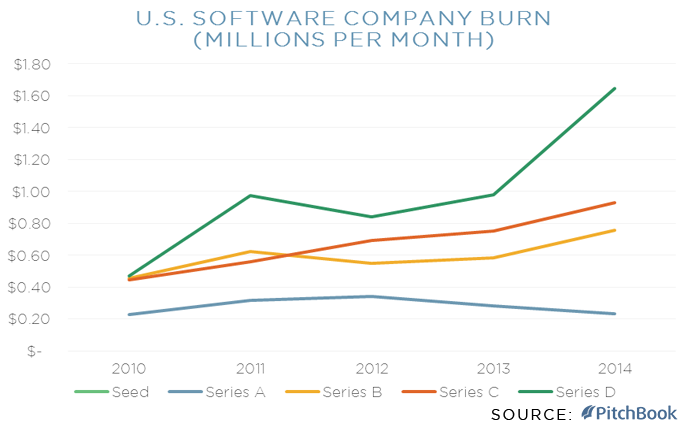
Timothy B. Lee keeps an eye on the burn rate of startups:

This chart shows that young [software] startups are burning through cash at about the same rate they did four years ago: around $200,000 per month. But older startups today are burning through cash a lot faster than startups the same age were four years ago. The average startup in its fourth round of venture financing is now burning through $1.6 million per month, about three times the burn rate seen at startups in the same position in 2010. Pitchbook, the company that compiled the data, says that “the burn rate has increased for Series B and later rounds to the highest levels since the height of the tech bubble.”

Do these high burn rates mean that we’re on the verge of another 2000-style crisis?

It’s hard to say. It’s certainly possible that the high burn rates simply reflect a return to the irrational exuberance of the late 1990s. But it’s also possible that companies are spending more money because the markets these new companies are pursuing will be bigger and more lucrative than the ones companies were pursuing 15 years ago.

Relatedly, Ben Casselman flags data showing that entrepreneurship is still in the doldrums:

Last week, the Census Bureau released new data on so-called business dynamics (startups, failures, hirings and firings) for 2012. Entrepreneurship did rise in 2012, but barely. Americans started 410,000 businesses in 2012, up just 2 percent from a year earlier and still more than 20 percent below prerecession levels. The startup rate — the number of new businesses as a share of all businesses — was essentially flat at 8 percent.