“The Rick Scott Is Perfect”

Jessica Roy calls this College Republican National Committee ad “just a teensy bit tone-deaf”:

Esther Breger piles on:

The ads, which somehow cost $1 million dollars, are part of CRNC’s campaign to reach young voters in a “culturally relevant way,” as CRNC’s Alex Smith told the Wall Street Journal. (Smith, by the way, is a woman.) And to be fair, Democratic campaigns have also struggled painfully in their attempts to be hip and with it, though at least their gifs and co-opted memes show some awareness of a cultural world beyond basic cable. (Note to Alex Smith: The median age of “Say Yes to the Dress” viewers is 44.)

Bernstein spots perhaps a bigger problem with the ad – it is being used in multiple states:

Making cookie-cutter ads is just asking for trouble.

See, not only does Brittney the “undecided voter” “think that “The Rick Scott is perfect,” she feels the same way about “The Rick Snyder,” “The Tom Corbett” and three other dresses. The ads are identical, only the candidate names change (never mind that Brittney can’t vote in six states in November).

But whatever their quality and however mockery-worthy they are, the ads are open invitations for Democratic opponents to hammer the dreaded Outside Interests Who Don’t Care About [insert name of state here]’s Values. It’s a classic example of the way elections are conducted in the U.S.: Candidates’ campaign organizations are seemingly in charge, but decentralized party and quasi-party organizations step in and help — or embarrass — them.

Waldman also discusses ad strategy more generally:

[W]hen you’re trying to reach out to a particular group, it’s important to communicate to them that you respect them and you understand their concerns. And these ads do precisely the opposite. Instead of talking about the things that are important to women, they take the same message they’d offer to anyone else, and just put in what they consider a womanly context (wedding dresses! boyfriends!). Imagine that a candidate went before an audience of Hispanics and said, “Let me explain this in a way you can relate to: My economic plan is like a really good tamale. My opponent’s economic plan is like the worst tamale you ever ate. Understand?” And he’d expect everyone in the audience to turn to each other and say, “I may not care for his position on immigration, but that tamale analogy showed me that he really gets us.”


The Censor As Literary Critic

Drawing on his new book Censors at Work: How States Shaped Literature, Robert Darnton declares that censorship is “essentially political; it is wielded by the state” – but also finds that its historical use has gone far beyond just banning certain texts:

Reading was an essential aspect of censoring, not only in the act of vetting texts, which often led to competing exegeses, but also as an aspect of the inner workings of the state, because contested readings could lead to power struggles, which sometimes led to public scandals. Not only did censors perceive nuances of hidden meaning, but they also understood the way published texts reverberated in the public.

Their sophistication should not be surprising in the case of the GDR [East Germany], because they included authors, scholars, and critics. Eminent authors also functioned as censors in eighteenth-century France, and the surveillance of vernacular literatures in India was carried out by learned librarians as well as district officers with a keen eye for the folkways of the “natives.” To dismiss censorship as crude repression by ignorant bureaucrats is to get it wrong. Although it varied enormously, it usually was a complex process that required talent and training and that extended deep into the social order.

It also could be positive. The approbations of the French censors testified to the excellence of the books deemed worthy of a royal privilege. They often resemble promotional blurbs on the back of the dust jackets on books today. Column 16 in the secret “catalogues” of the India Civil Service sometimes read like modern book reviews, and they frequently lauded the books they kept under surveillance. While acting as censors, East German editors worked hard to improve the quality of the texts they vetted. Despite its ideological function, the reworking of texts had resemblances to the editing done by professionals in open societies. From start to finish, the novels of the GDR bore the marks of intervention by the censors. Some censors complained that they had done most of the work.

Jonathan Yardley offers more details on the situation writers faced in East Germany:

As for East Germany between the end of World War II and the fall of the Berlin Wall in 1989, “censorship was not supposed to exist,” because “it was forbidden by the constitution, which guaranteed freedom of expression.” Like so much else during the hegemony of communism there and elsewhere, that was institutionalized hypocrisy pure and simple. The system of book censorship was elaborate and rigidly hierarchical, starting at the top with Erich Honecker, general secretary of the central committee of the Communist Party, who took an active interest in the system’s quotidian operation, but becoming somewhat less rigid lower in the ranks. Darnton was able to talk to two “veterans of the state machinery for making books conform to the Party line,” who did not like being called censors and who insisted that “most censorship took place in the heads of writers, and what the writers failed to cut usually got filtered out by editors in publishing houses.” Anyone who has written for an institution is familiar with the practice of self-censorship, but it is a far more risky and ambiguous task when performed within an institution as inflexible as the Communist Party than it is when performed by a writer for an American newspaper or magazine.

The Shake-Up At The Secret Service

Secret Service Director Julia Pierson Testifies To House Committee On Recent Security Breaches At White House

After a series of security breaches, Secret Service director Julia Pierson resigned yesterday. Bryce Covert doesn’t fault Pierson:

This is the first year since 2010 that the agency isn’t operating with a budget below what it requested. And since that year, personnel levels have seen a severe decline. In her testimony before Congress, Pierson said that the agency’s current 550 employees is below “optimal level.”

The understaffing, for which Pierson was not responsible, could have played a significant role in the breach that led to her losing her position. Former secret service agents told the Washington Post that the incident may have been related to the severe staffing shortage in the division responsible for securing the White House. It’s gotten so bad that the agency has had to fly agents in from around the country, who are less familiar with the grounds and response plans.

Ron Fournier mostly blames the state of the Secret Service on the decision “fold it into the fledgling monstrosity that would come to be known as the Homeland Security Department”:

Secret Service personnel, particularly those in uniform, are often paid less today than law-enforcement officials in other agencies. More than the money, the agency’s declining reputation in the law-enforcement community—a trend that goes back to 2003—has hurt morale and recruitment. Also diminished are efforts to develop the agency’s “brand,” the little-known marketing efforts that supported books and movies and other pop-culture references to the Secret Service, which in turn made the presidential detail an iconic, aspirational profession.

People used to worry that the Secret Service had too much independence, that its agents and leaders were bureaucratic cowboys who answered to almost nobody. There was something to those concerns, but at least presidential security wasn’t a laughing matter.

Ed Morrissey agrees:

Fournier called the reorganization in 2003 a “Bush-era mistake,” which made some conservatives bristle, but that’s accurate. George W. Bush could have, and should have, resisted the creation of DHS entirely. Many conservatives, myself among them, opposed the creation of even more bureaucratic overhead in this consolidation as well as the later consolidation of intelligence agencies into the [Director of National Intelligence].

Ambinder recommends some reforms. Among them:

Employees of the Secret Service should never, ever face repercussions for bringing to the attention of their superiors any observation, fact or suggestion that challenges received wisdom about how we protect people. It seems inconceivable that anyone would be afraid to speak their minds, especially about security problems affecting the president or his family. But recent events, including the decision of some employees to speak directly to Congress and to the press, are plain proof that this stigma exists within the Secret Service. Every manager must be held responsible for ensuring that every direct report feels empowered to speak out.

Jelani Cobb examines the big picture:

The Secret Service that was antsy about the prospect of a newly inaugurated Obama walking along Pennsylvania Avenue in January, 2009, is, as Voxreported, handling three times the number of death threats that attended other Presidencies. It is doing so on a severely limited budget. Speaking before a House inquiry into the security lapses, Pierson remarked that the budget sequester has left the Service nearly five hundred and fifty people short of their optimum number of personnel. This at a time when the factions we need to be most concerned with are driven not only by the President’s identity but by American foreign policy and the dictates of the interminable war on terror. What signal does Secret Service ineptitude send to foreign adversaries?

And Cillizza considers why stories about the secret service resonate:

[T]he creeping question in most Americans’ minds that is raised by all of this: If people with, at best, uncertain intentions can get that close to the president of the United States, what does that mean for my safety and the safety of my family? It’s a conversation — or at least a strain of thinking — that has been active in the American consciousness since the terrorist attacks of Sept. 11, 2001. That’s when the idea of all the horrible things we saw happening in far off places weren’t so far off after all hit home. It fostered a sense of vulnerability that we had previously not known for decades — if ever.

(Photo: Secret Service Director Julia Pierson. By Chip Somodevilla/Getty Images.)

How We Fund Injustice

Mike Konczal and Bryce Covert take a close look at our huge prison population:

Many will seek to make our system of incarceration more “fair.” But as Naomi Murakawa argues in her new book The First Civil Right, it’s precisely this response that feeds an unjust system resources and lends it legitimacy. Many of the initial sentencing acts were meant to provide fair, predictable guidelines, but prosecutors took advantage of them instead to rapidly escalate incarcerations. Money that President Clinton earmarked for “community policing” ended up being used by police for zero-tolerance programs like “stop-and-frisk.” As a result, we incarcerate too many people, for too long, and for the wrong reasons. The necessary agenda—from stopping the “war on drugs” to rejecting carceral force as our first response to social problems—requires not investing more in the existing criminal-justice system, but simply doing less.

“Sorrow Casts Its Shadow, And Joy Lives Under It”

Marilynne Robinson’s much-anticipated Lila returns to the small town in Iowa where two previous novels, Gilead and Home, were set – but this time, she focuses on the woman who drifted into the life of the much older Rev. John Ames and gave him an unexpected son. Reviewing the book, Leslie Jamison marvels at the story Robinson tells, which grapples with “what makes grace necessary at all—shame and its afterlife, loss and its residue, the limits and betrayals of intimacy”:

The novel weaves together two narrative threads: the present arc of courtship, marriage, and Lilapregnancy; and the entire past life that delivered Lila to Ames’s church in the first place. Ames, marked by early grief after his first wife and their baby died in childbirth decades earlier, is no stranger to loss himself. “I had learned not to set my heart on anything,” he tells Lila, and she is drawn to this. “He looked as if he’d had his share of loneliness, and that was all right. It was one thing she understood about him.” When you’re scalded, touch hurts: one of the scalded recognizes another, and touches carefully, always. They are both haunted—Lila by the ghost of Doll, the wild woman who cared for her, and Ames by the specter of the life he never got to live with his first family. Part of the beauty of their bond is a mutual willingness to honor the integrity of their former lives. He prays for the “damned” souls of her past, and she begins to tend the grave of his late wife, clearing weeds and pruning the roses.

Lila takes as its core concern what might have constituted, in another narrative, a happy ending: two lonely souls who never expected happiness somehow finding it. But Robinson’s quest is to illuminate how fraught this happiness is, shadowed by fears of its dissolution and the perverse urge to hasten that dissolution before it arrives unbidden.

Jamison adds these thoughts about the grace suffusing Robinson’s writing:

Sorrow casts its shadow, and joy lives under it, surviving in its shade. This bleed between joy and sorrow doesn’t mean happiness is impossible, or inevitably contaminated; instead it reveals a more capacious vision of happiness than we might have imagined—not grace will never deliver you from this mess, but grace is this mess. Or at least, grace is in the mess with you.

Robinson’s grace is all the things we don’t have names for: the immortal souls we may or may not have, a doll with rag limbs loved to tatters. It’s sweet wild berries eaten in a field after a man baptizes the woman he will someday marry. Grace is money for a boy who may have killed his father; it’s one wife restoring the roses on the grave of another. Grace here isn’t a refutation of loss but a way of granting sorrow and joy their respective deeds of title. It offers itself to the doomed and the blessed among us, which is to say all of us. “Pity us, yes, but we are brave,” Lila realizes, “and wild, more life in us than we can bear, the fire infolding itself in us.”

If you can’t wait a few weeks until the novel’s publication date, read an excerpt from it here.

The Forty-Niners Of The 21st Century, Ctd

A reader adds to the natural gas thread:

The relative merits of methane, coal, and other energy sources should not be considered in a vacuum. As on practically any other issue, real-world practices and legal-institutional incentives have a great influence. The North Dakota energy boom is taking place in a location without the infrastructure (insufficient gas pipeline or local refining capacity) to make a lot of the natural gas yield usable – and without regulations requiring emissions capture. So a lot of the gas is being “flared” – burned off in the oilfields. This flaring adds CO2 to the atmosphere equivalent to that emitted from a million cars a year.

These pictures of the Bakken field from space are pretty dramatic.

Speaking of the Bakken region, Maya Rao took a job at a North Dakota truck stop this summer to get an inside look at booming regional economy and the motley cast of characters fueling it:

In the truckers’ lounge one day, two of the regulars, Blackneck and Fish, regaled the other men about how they had talked their way past a patrolman just over the border in Montana.

“I’m glad we didn’t get weighed. We’d be in jail!” said Blackneck, cursing. His nickname was short for black redneck, the phrase he used to described himself; he had traveled here after work prospects at his West Virginia coal mine withered. Blackneck had the height and build of a loan shark’s enforcer. Fish had screws in his ears and a topless image of his wife tattooed on his leg. He’d decided to become a truck driver here because he thought it had to pay better than his old job maneuvering bomb-sniffing dogs in the Middle East for only $50,000 a year.

They were paid by the quantity of water they delivered, rather than the hours they worked, and had every incentive to load up the truck heavier than a stampede of corn-fed hogs. That was the only way they could make money on a three-hour turnaround between the water depot and fracking site. The men also fudged the numbers of how long they had been driving in their trucker logs, surpassing the federal limits on driving shifts, and they bet on nobody stopping them.

Previous Dish on life amid the North Dakota oil boom here.

The Best Of The Dish Today

by Dish Staff

Andrew is still on his speech circuit in California, so he’s not able to wrap up the Dish tonight. But if you missed his longer posts, Andrew, above all, laid into the president and various members of his administration for covering up alleged torture at Gitmo. He also took aim at the NYT’s sponsored content guru, Meredith Kopit Levienat, for spreading more “re-purposed bovine waste”, and then blasted Roger Cohen for playing the Godwin card with ISIS. But Andrew himself caught shit from readers over his incessant whining about NYC. More importantly, another reader shared a long and heartbreaking story of child abuse – a post that’s already getting a lot of feedback from readers, so stay tuned for followups.

Many of today’s posts were updated with your emails – read them all here.  You can always leave your unfiltered comments at our Facebook page and @sullydish. 21 more readers became subscribers today. You can join them here – and get access to all the readons and Deep Dish – for a little as $1.99 month. One writes:

I finally subscribed. Despite some gripes, your coverage of Obama’s war on ISIS finally did it. Excellent debate.

(If I may put in a small gripe/request on the side: can we please do without horse-race speculation of the “Hillary vs X” type until we actually have declared candidates? Please? Honestly don’t give a hoot about hypotheticals. It’s just noise. Let’s focus on actual events.)

Much more Dish in the morning.

Marijuana Is Good Medicine

WASHINGTON, DC - JULY 29:   A man purchases medical marijuana,

In a survey, 92 percent of medical marijuana patients said it “alleviated symptoms of their serious medical conditions, including chronic pain, arthritis, migraine, and cancer”:

“Our study contradicts commonly held beliefs that medical marijuana is being overused by healthy individuals,” the authors write. “The most common reasons for use include medical conditions for which mainstream treatments may not exist, such as for migraines, or may not be effective, including for chronic pain and cancer.”

In considering the efficacy of any kind of medical treatment, we should listen first and foremost to the patients. The debate over medical marijuana has largely been dominated by vested interests and advocacy groups on either side – patients’ voices have been either silent or ignored completely.

This study provides a helpful corrective, and in this case the patients are speaking loud and clear in near-unanimity: medical marijuana works.

(Photo: A man purchases medical marijuana, the first legal sale, at Capital City Care in Washington, DC on July 29, 2013. By Linda Davidson / The Washington Post via Getty Images)

Obama’s War Budget

Jessica Schulberg reads a new report that attempts to tally the cost of the ISIS war so far:

Due to the vaguely defined scope of the conflictPresident Barack Obama has vowed not to deploy U.S. combat troopsit has been hard to put a dollar amount on the operation. But a Center for Strategic and Budgetary Assessments (CSBA) report released Monday estimates that the U.S. has already spent between $780-$930 million in Iraq and Syria. In just the past month, the cost was $250-$400 million, or $9-$14 million per day. …

Because Obama has yet outline any long-term plan for U.S. efforts in Iraq and Syria, CSBA’s long-term cost estimates are based on likely hypothetical levels of warfare. If the U.S. draws down airstrikes to approximately 100 targets a month (there have been 200 targets this month, but air campaigns usually peak early because targets learn to hide) and caps U.S. personnel at 2,000, the cost is estimated to be between $2.4 and $3.8 billion a year. But if the administration follows recommendations to deploy 25,000 ground forces and raises the number of air strikes to 200 a month, it will be closer to $13-$22 billion annually.

“To put this in perspective,” she adds, “the U.S. spent approximately $1.1 billion in total direct expenditures in the 2011 NATO-led intervention in Libya.” But  notes that these estimates are “far less than the roughly $150 billion the U.S. spent during the peak years of the Afghan (2011) and Iraq (2008) wars.” Business Insider looks at where the money to fight ISIS is coming from:

The Pentagon has said that financing for the ISIS fight will come from the Overseas Contingency Operation fund, an account exempt from budget caps that was created for the wars in both Afghanistan and Iraq last decade.

Earlier this year, Obama sought to dwindle the budget for that account down to about $59 billion from $85 billion, reflecting the decline of operations in Afghanistan. But the spending bill passed by Congress last month continues to fund the OCO at the $85 billion level.

Meanwhile, Kate Brannen tries to see through the fog over the $5 billion counterterrorism fund the White House proposed in June, including the $500 million Congress has already approved to arm the Syrian rebels:

According to multiple sources — both inside the military and on Capitol Hill — the fund’s purpose is murky because it was mostly conceived by National Security Council staff within the White House with little input from budget or policy experts at either the Pentagon or Foggy Bottom. A few days after the West Point speech, while visiting Poland, Obama announced another new fund. This one was $1 billion for a European Reassurance Initiative, again taking Pentagon officials by surprise, Defense Department and congressional sources told Foreign Policy.

In both instances, the Pentagon was given pots of money and was basically told to figure out how to spend the money, rather than asked what it really needed, one Pentagon official said. If the Pentagon had proposed the counterterrorism fund, it would have been “dead on arrival” at the White House, a former senior Defense Department official said.

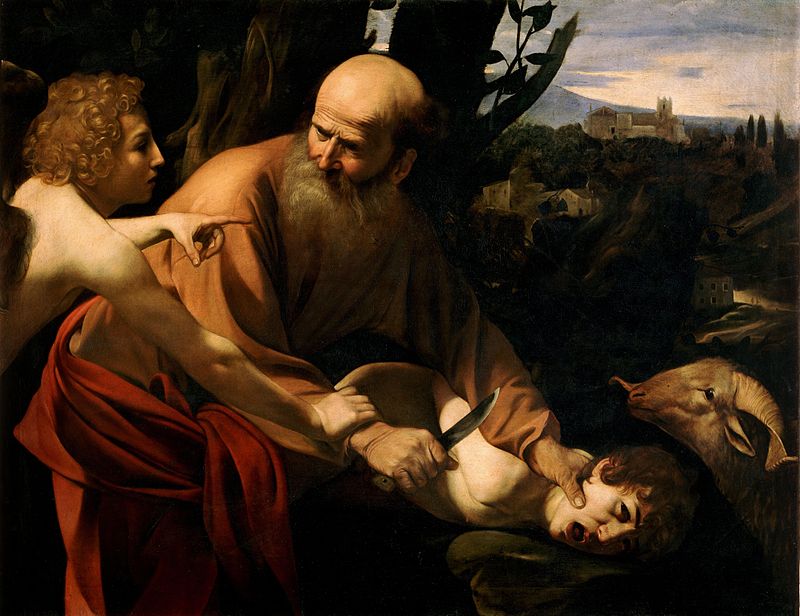
The Father Of Three Faiths

800px-Sacrifice_of_Isaac-Caravaggio_(Uffizi)

Sajjad Rizvi suggests the “very notion of Abrahamic religions is arguably Islamic” – and explains how he sees the relationship between Judaism, Christian, and Islam:

The Quran presents Abraham as an adherent of Islam, but here “Islam” means the primordial faith that connects humanity to one God and leads in turn to Judaism, Christianity and then historical Islam as proclaimed by Muhammad. There are some who view Islam as a faith that supersedes the two earlier monotheistic religions. But I think it’s more useful to understand Islam as a religion that is self-conscious about its relationship to Judaism and Christianity and explicitly takes account of their scriptures and traditions. Almost all the prophets of the Quran will be familiar to those who know the Bible, and the Quran explicitly refers to parables, ideas and stories from the Bible.

The common roots — and inheritances — of the three faiths make it useful for us to think seriously in terms of a Judeo-Christian-Islamic civilization and heritage that we all share. The development of philosophy in Islam also shows a common tradition of rationality. Anyone with a basic understanding of the categories of Aristotle’s thought employed by Christian and Jewish thinkers would find many of the arguments of Islamic philosophers and theologians familiar. The great Islamic philosopher Avicenna (10th-11th century) developed a metaphysical notion of God that had a tremendous impact on the Latin west: the idea that God is the necessary being required to explain the existence of every contingent being.

(Image: Caravaggio’s The Sacrifice of Isaac, 1603, via Wikimedia Commons)