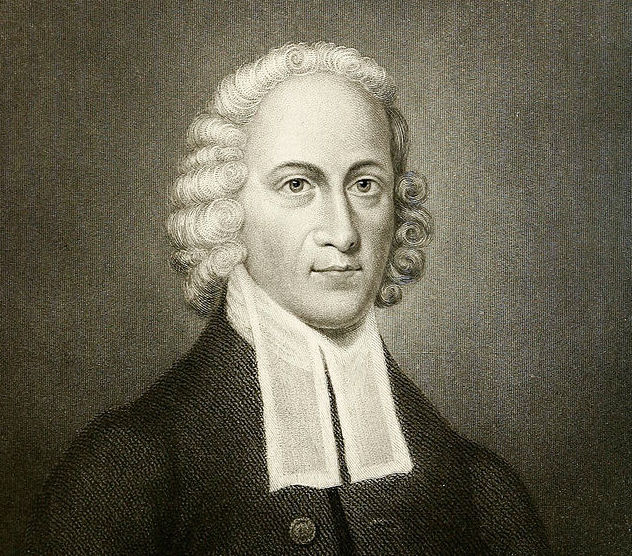
Jonathan Edwards, the great 18th century American theologian and preacher, exists in the popular imagination mainly as a dour purveyor of God’s judgment, famous for his sermon “Sinners in the Hands of an Angry God.” Marilynne Robinson rises to his defense, praising his understanding of sin as “a kind of unawakened experience or perception that is blind to the glory of God and therefore to the glory that pervades being”:
For Edwards, sin was the state everyone was in, in the absence of a conversion experience, which was a kind of religious ecstasy that began with a profound awareness of guilt and a sense of utter dependency on God’s grace. Religion without conversion was almost a kind of Pharisaism, the enactment of faith and virtue without the substance of either. It was, at the same time, where the predisposition to conversion was formed. Edwards meant by his preaching and teaching to lift his hearers into the realm of spiritual light, where they would be capable of true faith, true hope, true love. They would be raised to a heightened esthetic experience, beside which the manifest natural glory of the world would seem a poor thing. Minus the theological frame, the same impulse to apprehend reality through a vision of it that is both higher and truer is present in much American poetry, from Whitman to William Carlos Williams and Wallace Stevens.
Again, for Edwards as for Emerson, this was not contempt for the world but transcendence of a kind that allowed the world and being itself to be seen in its real glory.
Given his very fixed association with hellfire preaching, it is important to remember that it was not particular transgressions that interested Edwards finally, though of course from the pulpit he deplored failures of honesty and charity. Nor was he much concerned with meritorious acts, since these were equally beside the point in the matter of personal salvation. Salvation was for him a revolution of consciousness that opened on an overwhelming sense of the beautiful, the glory of God in all its manifestations. In Edwards’s view, fallenness, the natural state of any human being, as blindness, takes no specific form as behavior and is not to be mitigated by any act of will. But the ontological nearness of humankind to God means that, through grace, perception of the purest, highest and truest kind, itself a kind of ecstasy, can be enjoyed by them, eternally and in this life.
(Image: An 1855 engraving of Edwards, via Wikimedia Commons)
 The Dish
#mediaviewer/File:Jonathan_Edwards_engraving.jpg)