Alexandra Witze flags a report showing that “as many as half of all stars in the Universe lurk outside galactic boundaries”:
“There might be people living out there, out in the middle of cold dark space, that don’t have a Milky Way,” says Harvey Moseley, an astrophysicist at NASA’s Goddard Space Flight Center in Greenbelt, Maryland. The stars were probably tossed there when galaxies collided. A team led by astrophysicist Michael Zemcov, of the California Institute of Technology (Caltech) in Pasadena, reports the discovery in the 7 November issue of Science. … Stars normally reside within galaxies, but can be yanked out by gravitational forces when galaxies collide. Bock suspects that a lot of these renegade stars could have come from relatively lightweight galaxies, which can lose hold of their stars more easily than more massive galaxies. “If this is true, then there is an entire population of stars that’s been sitting out there, but because they are individually so faint we can really only see them in ensemble,” says Moseley.
Nicholas St. Fleur elaborates:
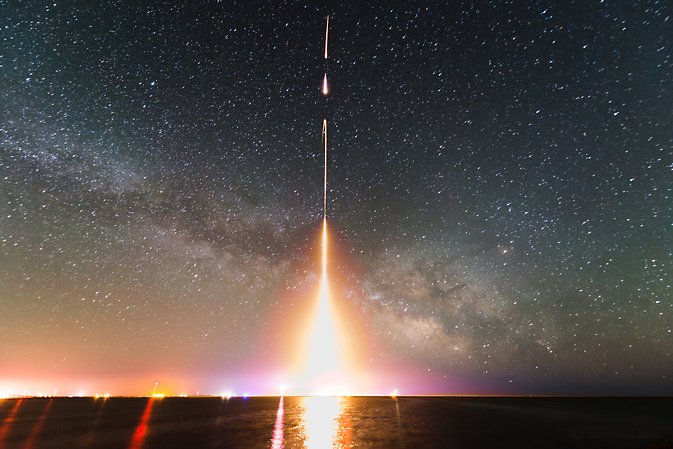
As a part of their research into ancient galaxies, Zemcov and his team of scientists from the U.S., Japan, and Korea, launched a rocket equipped with a built-in telescope to take an enormous picture of space. The experiment, called Cosmic Infrared Background Experiment, or CIBER, had a field of view that was 20 times larger than the surface of the moon, according to Zemcov. It offered the team a single image of millions of galaxies. When the team analyzed the data, they observed twice as much infrared light as they expected to find. To investigate the discrepancy, the team blacked out the light coming from the star clusters and observed that a lot of light seeped from between the galaxies. “It’s like looking at a LiteBrite with all of the little pegs being galaxies with clusters of stars,” said Zemcov. “We masked the light emitted from the galaxies, or pegs, and expected to see a black screen, but actually there were small amounts of light still emitted.” The findings stumped the team at first. Not until they eliminated several other possibilities did they deduce that the light was coming from large amounts of rogue stars.
(Photo: This time-lapse photograph shows the Cosmic Infrared Background Experiment (CIBER) rocket launch, taken from NASA’s Wallops Flight Facility in Virginia in 2013. By T. Arai/University of Tokyo.)
 The Dish