Alice Su has spent six weeks reporting from Iraq, where, as she puts it, “faith seems saturated in hatred and blood.” In an essay about coming to terms with what it means to believe in God in the face of the devastation and suffering she’s witnessed, Su re-reads the gospels’ accounts of the life and teachings of Jesus:
What the hell is this Gospel? Why would the disciples believe it, as Jesus died and Roman rule continued? Why should I believe it, as I stand in front of a Yazidi woman whose daughter is enslaved, counting atrocities in Syria, Iraq, Lebanon, Egypt, Israel and Sudan, feeling like the smallest person in the world, taking notes and knowing they’ll do nothing but elicit some fleeting public sympathy and exert a featherweight bit of pressure on military and political powers?
In Iraq, I consider this unlikely message: Jesus did not end suffering and injustice, but He will end them. He did not fight the way the world fights, with swords and guns and drones and jingoistic anthems. He did not win an ethno-nationalist victory for the Jews. He did not stop Lazarus from dying, nor did he heal every person or raise every Beloved from the dead.
Christ rejected Pharisees and went to the sinners, even to the Gentiles. He was like a Palestinian going to the Israelis, a Sunni going to the Shia, a Kurd going to an Arab, a Yazidi going to an ISIS fighter. He crossed all the lines. He didn’t form a new club to supersede all the others. He said, being in a club won’t save you. Nothing you do will ever save you. Stop trying to be good. Seek God, repent and ask to be saved.
He washed feet.
Then He died.
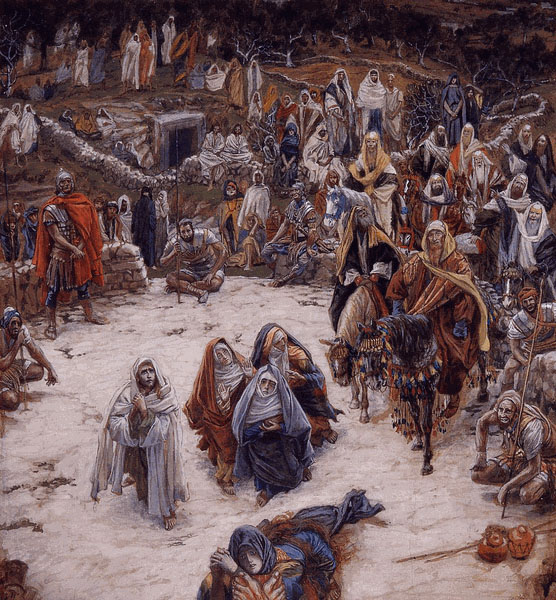
(Image: The Crucifixion, seen from the Cross, by James Tissot, late 19th century, via Wikimedia Commons)
 The Dish
