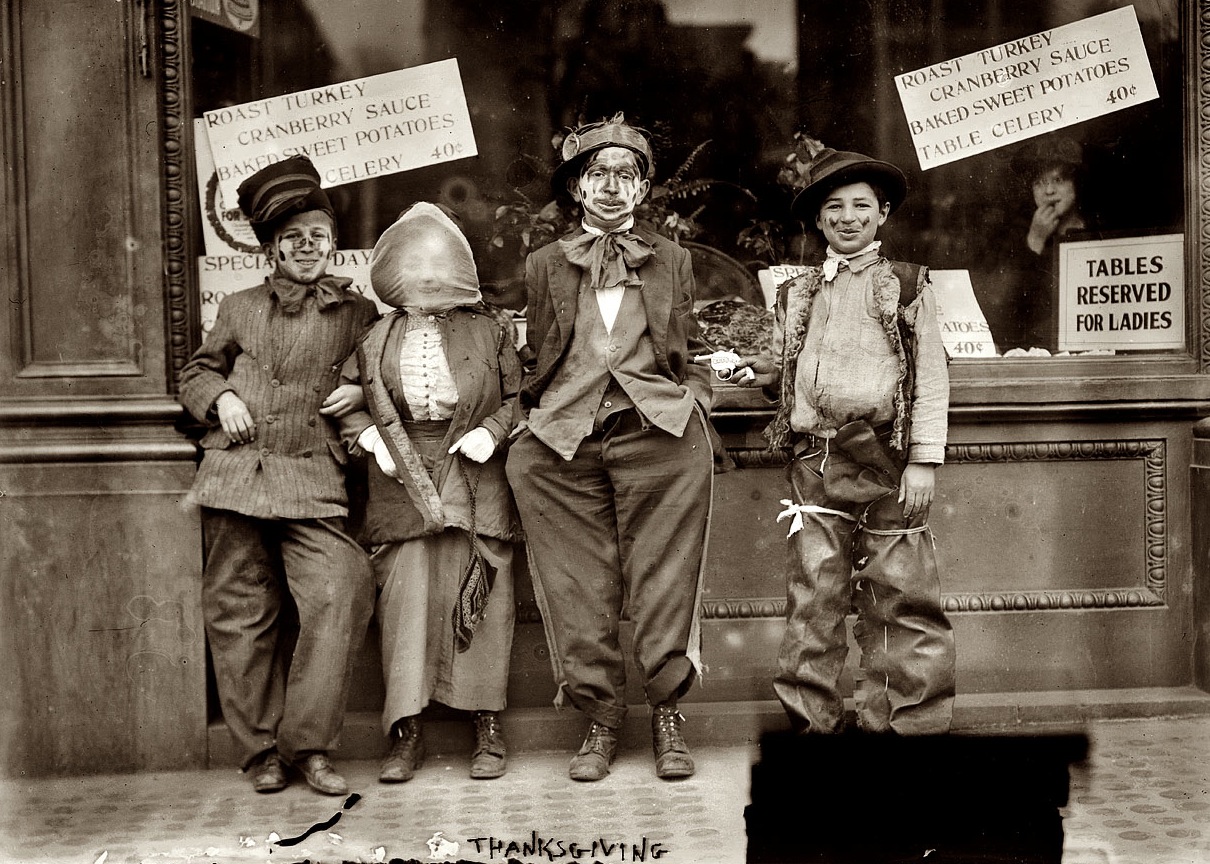
Linton Weeks reflects on the scrappy history of Thanksgiving, which “in turn-of-the-20th century America used to look a heckuva lot like Halloween”:
People — young and old — got all dressed up and staged costumed crawls through the streets. In Los Angeles, Chicago and other places around the country, newspapers ran stories of folks wearing elaborate masks and cloth veils. Thanksgiving mask balls were held in Cape Girardeau, Mo., Montesano, Wash., and points in between. …
In fact, so many people participated in masking and making merry back then that, according to a widely distributed item that appeared in the Los Angeles Times of Nov. 21, 1897, Thanksgiving was “the busiest time of the year for the manufacturers of and dealers in masks and false faces. The fantastical costume parades and the old custom of making and dressing up for amusement on Thanksgiving day keep up from year to year in many parts of the country, so that the quantity of false faces sold at this season is enormous.”
In 2012, Greg Young noted that the “custom was mostly frowned upon by polite society as a distraction from the historic and somber traditions of Thanksgiving”:
Thanksgiving ‘masking’, as it was often called, stemmed from a satirical perversion of destitution and the ancient tradition of mumming, where men in costumes floated from door to door, asking for food and money, often in exchange for music. In the 19th century, makeshift Thanksgiving parades — fantasticals — featured New Yorkers marching through the street in garish costume, most likely inspired by Guy Fawkes Day. By the late 19th century, these had morphed into a day for children to take to the street in ragamuffin garb, going from door to door, begging for fruit, candy and even pennies. …
By 1924, New York could focus its holiday cheer onto more controllable pursuits with the debut of the Macy’s Thanksgiving Day Parade. Within a couple decades, it appears that the merry tradition of Thanksgiving masking slowly relocated over to the less dignified Halloween ….
In an earlier post, Samira Kawash, author of Candy: A Century of Panic and Pleasure, elaborated on the ragamuffin fade-out:
Children weren’t just roaming the streets begging pennies. What was especially annoying was their “practice of ringing all the doorbells and demanding backsheesh.” By 1930, New York’s Superintendent of Schools was publicly condemning the Thanksgiving begging, calling it a “serious annoyance to householders” and encouraging school principles and teachers to instruct students in the origins, meaning, and proper observance of Thanksgiving. Between official disapproval and the low mood and tight purse brought on by the Depression, Thanksgiving mummery virtually disappeared in the late 1930s.
But dressing up and going about ringing doorbells and “demanding backsheesh” didn’t disappear; it just moved to Halloween. We call it “trick or treating.”
Below, watch a home movie of some of the last maskers to traipse around New York in the 1940s:
(Photo via the Library of Congress)
 The Dish