The Best Of The Dish This Weekend

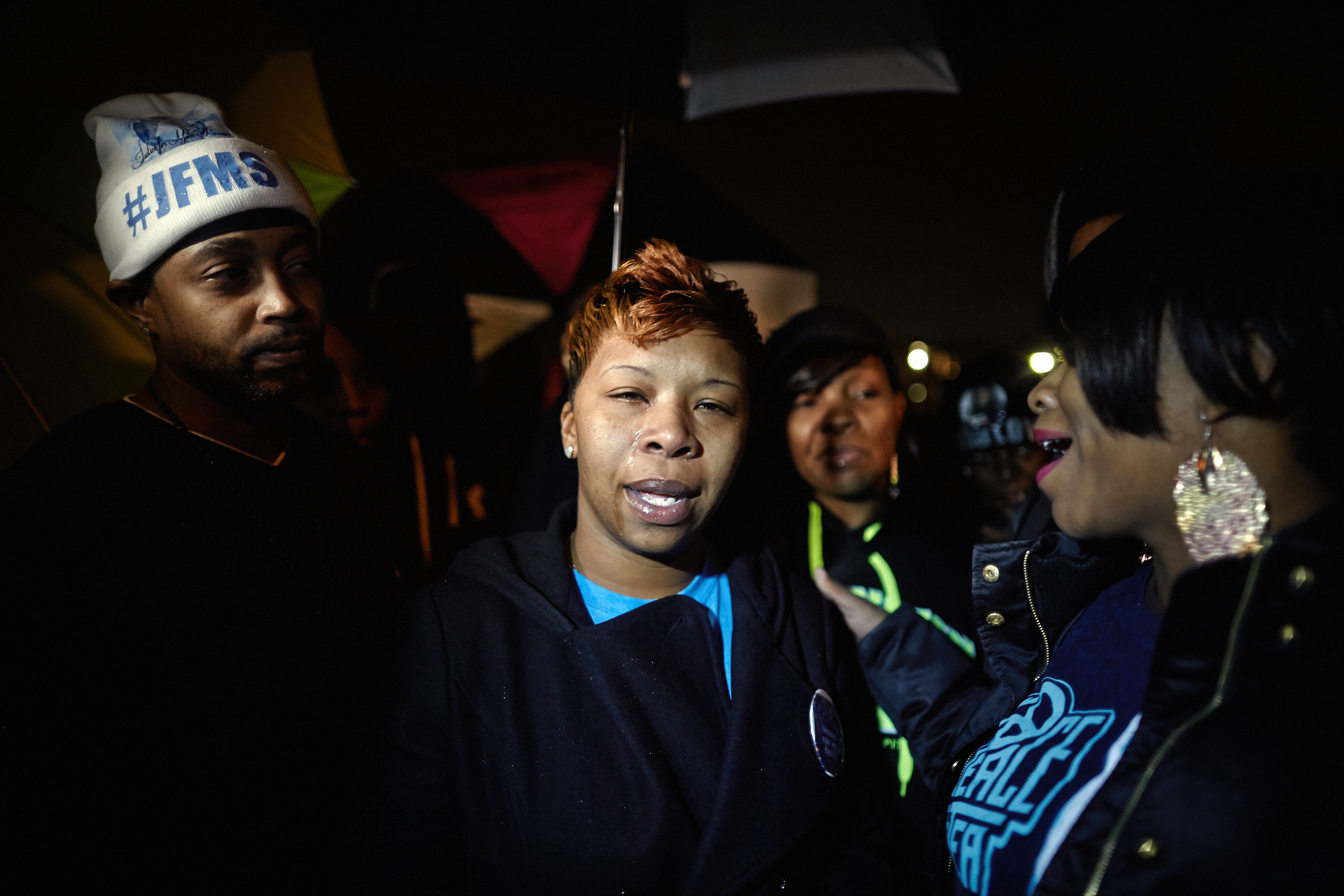
Mother of Michael Brown Addresses Protesters

One reason I’ve been somewhat forgiving of Obama’s executive action on immigration deportations is that I see it as a function not of his choice to be an “imperial” president, but as a result of unprecedented Republican obstructionism. It is, for example, jaw-dropping to hear the GOP declare its shock at the president’s refusal to take into account the results of the mid-terms as a democratic norm he should respect. These are the same people who, in January and February of 2009, responded to Obama’s landslide amid a catastrophic and accelerating depression by giving him zero votes on a desperately needed stimulus package.

We now know they decided as a conscious strategy to say no to anything and everything the new and young president, inheriting two failed wars and an imploding economy, wanted or needed. They were nihilist then as they are nihilist now with respect to the practical demands of actually governing the country. At some point, something had to give, and I can see why, after the GOP had again refused to allow immigration reform even to come to a vote in the House, he might have decided to fuck it.

But here’s how Ross understands this history:

Obama never really looked for domestic issues where he might be willing to do a version of something the other party wanted — as Bush did with education spending and Medicare Part D, and Clinton did with welfare reform. (He’s had a self-admiring willingness to incorporate conservative ideas into essentially liberal proposals, but that’s not really the same thing.)

Again, I just do not recognize this reality. What exactly did the GOP want in 2009? That’s hard to say. But on the issues on which Obama had campaigned – say, the stimulus, healthcare, climate change and immigration – he embraced conservative ideas, as Ross concedes. He packed the stimulus with tax cuts (and still got no GOP votes); he embraced Mitt Romney’s and the Heritage Foundation’s version of healthcare reform over his own party’s preference for single payer (and was treated as a commie because of it); he supported cap and trade on climate change – again a policy innovated on the right (and got nowhere); and on immigration, he backed George W Bush’s formula but sweetened it over six years with aggressive deportations and huge increases in funding for the Mexican border. So what on earth is Ross talking about?

Yes, Obama does have ambitions to be a transformational president, a liberal Reagan. And, after two thumping victories, he still has a solid shot at getting there. And if we had a reasonable or even feisty opposition party – as opposed to a foam-flecked insurrection against everything – that legacy would have been even more informed by conservative thought and ideas. And the idea that no executive action is allowed is just as silly. The executive branch has a key role in determining things like the level of permissible carbon emissions (via the EPA), or priorities in immigration enforcement (via ICE), or national security (via the Pentagon, NSA and CIA). At some point, in other words, it was the GOP who made this president more executive-minded, by removing every other pathway for him to pursue what the country elected him to do. Because they never really accepted that he had won big majorities twice for a reason. And that reason was change.

This weekend, we ran in full a speech by the evangelical scholar and leader David Gushee, changing his mind on gay rights. A reader writes of it:

I’m not a Christian and I have to admit that I often skim or skip much of your Sunday content because it just doesn’t resonate with me.  But I just watched Dr. Gushee’s speech straight through and I have to say thank you for posting it.  As someone totally outside the Christian — and certainly evangelical — community, I doubt I would have been exposed to this otherwise.  What an astonishingly moving speech.  I don’t for a second pretend to understand the evangelical world, its movements or its politics.  But I know that most evangelical people are good, well-meaning individuals, just trying to live in the world in a manner true to their ideals and beliefs.  I can’t see how they could watch this speech and not be moved by it, even if it challenges some of their core thinking.  It’s an elegant and in some ways courageous statement given the social community Dr. Gushee lives in.

It sure is. It’s one of those speeches within which the world shifts a little – permanently. It’s really worth your time. Other posts worth a revisit: a premonition of what might happen in Ferguson this week; Ursula Le Guin’s defense of fantasy fiction and of writing itself; the small sadnesses in YouTube; a devastating poem about the end of a marriage; the cartoon genius of Richard Thompson; what Jesus can mean in Iraq today; and a DFW classic quote on why he will one day be entirely forgotten (if not by the Dish).

The most popular post of the weekend was Illiberal Feminism Strikes Again, followed by Julie Bindel’s critique of the same. 20 more readers became subscribers today. You can join them here – and get access to all the readons and Deep Dish – for a little as $1.99 month. Gift subscriptions are available here and Dish t-shirts here.

See you in the morning, as the Iran talks reach their moment of truth.

(Photo: Lesley McSpadden, the mother of slain Ferguson teen Michael Brown, talks to a crowd of protesterson November 23, 2014 in advance of the Grand Jury verdict on police officer Darren Wilson. By Sebastiano Tomada/Getty Images.)

This Is The Way “Benghazi” Ends …

Isn’t there something quite delicious in the House Intelligence Committee’s conclusion that there is nothing – absolutely nothing – scandalous about “Benghazi” apart from what we knew already: that the outpost was poorly protected and that the State Department had been complacent about consulate security? Even Paul Mirengoff has to take his lumps:

The Committee concludes, among things, that CIA personnel on the ground in Benghazi during the attack behaved bravely and made reasonable tactical decisions that saved lives, and that the CIA received all military support that was available. It further concludes that after the attack, the administration’s initial public narrative (via Susan Rice) on the causes and motivations for the attack was not fully accurate. In addition, edits made to the Benghazi “talking points” were not fully accurate, and the process that produced the talking points was flawed. However, the Committee stops short of finding misconduct or bad faith on the part of Susan Rice or any other administration official.

Butters, who’s long been having a series of primary-enhanced conniptions about the whole thing, nonetheless evinced the classic Republican denial response: “I think the report is full of crap.” His only basis for saying that is that the report relied on the testimony of Obama administration officials – even though it also sought testimony from a bunch of Republican conspiracy theorists, even though it was packed with Republican ideologues, even though it had enormous reach and subpoena power.

At the Dish, we tried long and hard to find something in the Benghazi story that could really stand the test of moderate scrutiny … and failed.  I even jumped the gun and impugned the honesty of Ben Rhodes at one point in trying to be as skeptical of administration assurances as any journalistic outfit should be. But after a while, we decided to ignore the issue unless something striking or new came up. In retrospect, that was the right call.

When you think of the staggering amount of time and resources devoted to chasing down this rabbit-hole, you have to wonder what is really fueling the GOP. I don’t think it’s a positive agenda to tackle some of our obviously pressing problems: eleven million undocumented immigrants, climate change, Iran’s nuclear potential, Jihadism in Iraq, soaring inequality. I think it’s rabid hatred of a president who does not share their priorities and a desperation to find some kind of quick and easy way of consigning him to a treasonous asterisk. They’ve failed on both counts.

A Poem For Sunday

15534608129_47f1a38a89_k

“Pain I Did Not” by Sharon Olds:

When my husband left, there was pain I did not
feel, which those who lose the one
who loves them feel. I was not driven
against the grate of a mortal life, but
just the slowly shut gate
of preference. At times I envied them—
what I saw as the honorable suffering
of one who is thrown against that iron
grille. I think he had come, in private, to
feel he was dying, with me, and if
he had what it took to rip his way out, with his
teeth, then he could be born. And so he went
into another world—this
world, where I do not see or hear him—
and my job is to eat the whole car
of my anger, part by part, some parts
ground down to steel-dust. I like best
the cloth seats, blue-grey, first
car we bought together, long since
marked with the scrubbed stains—drool,
tears, ice cream, no wounds, but only
the month’s blood of release, and the letting
go when the water broke.

(From Stag’s Leap: Poems by Sharon Olds © 2012 by Sharon Olds. Used by permission of Alfred A. Knopf, an imprint of the Knopf Doubleday Publishing Group, a division of Random House LLC. All rights reserved. Photo by Flickr user Thomas)

Quote For The Day II

“Maybe it’s not metaphysics. Maybe it’s existential. I’m talking about the individual US citizen’s deep fear, the same basic fear that you and I have and that everybody has except nobody ever talks about it except existentialists in convoluted French prose. Or Pascal. Our smallness, our insignificance and mortality, yours and mine, the thing that we all spend all our time not thinking about directly, that we are tiny and at the mercy of large forces and that time is always passing and that every day we’ve lost one more day that will never come back and our childhoods are over and our adolescence and the vigor of youth and soon our adulthood, that everything we see around us all the time is decaying and passing, it’s all passing away, and so are we, so am I, and given how fast the first forty-two years have shot by it’s not going to be long before I too pass away, whoever imagined that there was a more truthful way to put it than ‘die,’ ‘pass away,’ the very sound of it makes me feel the way I feel at dusk on a wintry Sunday— …

And not only that, but everybody who knows me or even knows I exist will die, and then everybody who knows those people and might even conceivably have even heard of me will die, and so on, and the gravestones and monuments we spend money to have put in to make sure we’re remembered, these’ll last what—a hundred years? two hundred?—and they’ll crumble, and the grass and insects my decomposition will go to feed will die, and their offspring, or if I’m cremated the trees that are nourished by my windblown ash will die or get cut down and decay, and my urn will decay, and before maybe three or four generations it will be like I never existed, not only will I have passed away but it will be like I was never here, and people in 2104 or whatever will no more think of Stuart A. Nichols Jr. than you or I think of John T. Smith, 1790 to 1864, of Livingston, Virginia, or some such. That everything is on fire, slow fire, and we’re all less than a million breaths away from an oblivion more total than we can even bring ourselves to even try to imagine, in fact, probably that’s why the manic US obsession with production, produce, produce, impact the world, contribute, shape things, to help distract us from how little and totally insignificant and temporary we are,” – David Foster Wallace, The Pale King.

Face Of The Day

dish_fotdnov_23

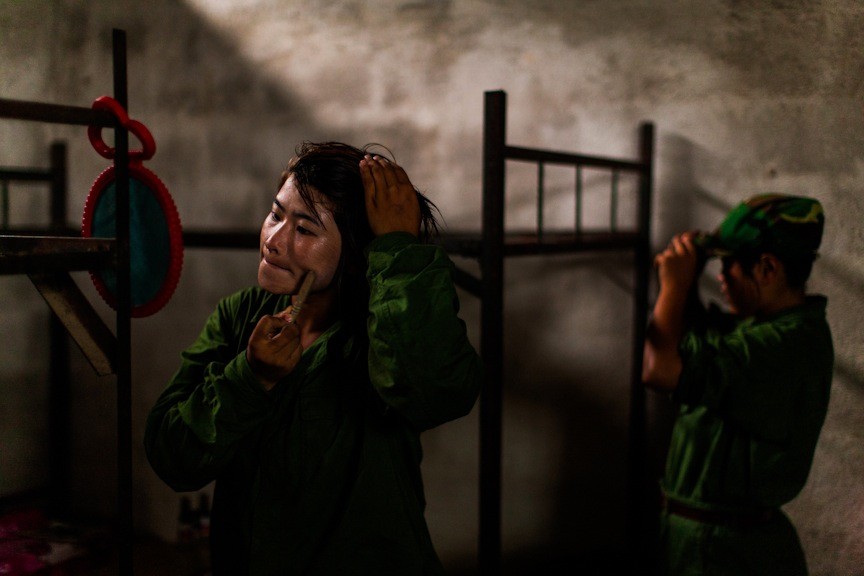
Adriane Ohanesian photographed the women of Burma’s Kachin Independence Army (KIA):

In Kachin State, in northern Myanmar, the anti-government sentiment runs particularly strong. In fact, rebels have a strong enough presence that control over Kachin is effectively split between the government and the Kachin Independence Army (KIA). The KIA is the last remaining major rebel group in Myanmar that has not signed a ceasefire agreement with the government. While the country at large has begun opening its doors, the government has simultaneously banned UN agencies, international NGOs, and even foreigners from entering into KIA territory. Effectively, this leaves the people of Kachin with little access to the outside world.

The women of Kachin have few opportunities in this isolated region, outside of serving the KIA. From the age of 16 women are eligible to join the army, and often remain there until they are discharged for marriage. While some join out of dedication to their people, others are forcibly recruited. This is a look into the lives of the young women going through their first experiences of military training with the KIA.

In an interview, Ohanesian describes how she got access to her subjects:

Through the assistance of local NGOs, I was able to make contact with women who had been soldiers and from there I was able to get into contact directly with the leaders of the Kachin Independence Organization (the political branch of the Army). Once I made contact with the right people within the KIO/KIA the logistics and access were relatively straightforward. When I got on the ground, I explained to the women what I wanted to do, which was to follow their lives from morning to night. I also made sure that they knew that they could ask to me stop photographing at any time. I think that part of gaining the trust and respect from the women was the fact that I accompanied them at all times. I went on every patrol, to every boring military lecture, even if I wasn’t photographing. We were exhausted on patrols together, we were drawing together during boring lectures, and we were falling over slippery rocks in the river when it was time to wash.

In general, my most powerful organizational tool for this project was emailing—a painful amount of emailing. I emailed everyone, and I had meetings with everyone who would offer to see me, even if they seemed to have no relation to the project.

See more pictures from the series here.

(Image caption: After finishing morning training a young woman applies thanaka to her face inside the women’s room at the military base outside of Laiza, Kachin State, Myanmar, May 17, 2013. The 9 women shared an unlit room throughout the two-month training. © Adriane Ohanesian)

Burke’s Leftist Leanings?

In his new biography, The Intellectual Life of Edmund Burke, David Bromwich claims that “no historian today would repeat the commonplace that Burke was the father of modern conservatism.” Jonathan Green unpacks how Bromwich defends that assertion:

After a rich discussion of Burke the philosopher, Bromwich considers his entry into politics. Here we see Burke as the British Parliament’s foremost critic of royal prerogative, as a steadfast EdmundBurke1771defender of American Independence, and as an important strategist for the Rockingham wing of the Whig party. Along the way Bromwich unpacks Burke’s Thoughts on the Present Discontents, in which he defended organized parties as an essential check on executive power, and gives us a sympathetic account of Burke’s intransigent, oft-maligned opposition to George III. …
Throughout his narrative Bromwich keeps the Reflections on the Revolution in France in view, but he is keen to re-situate Burke’s critique of the revolutionaries’ ideology within the context of his earlier writings and speeches. The result is a Burke that is significantly more liberal—and more republican—than recent interpreters have acknowledged.

Samuel Moyn, in a long assessment of Bromwich’s hopes for a “Burkean left,” notes that after 9/11 he’s especially picked up on the British statesman’s criticisms of imperialism – which cuts across today’s party lines:

[This] led Bromwich, in perhaps the most revealing instance of his activism, to reach out to the audience of The American Conservative, a paleoconservative magazine founded in 2002 to oppose the ascendant neocons. True to form, Bromwich invoked Burke in his coalitional plea for a cross-party force to reject strong states and imperial war-making alike.

In an age when Rand Paul speaks out more forcefully than most Democratic politicians against the national surveillance state, Bromwich’s impulse is not unfounded.

But his concern about the overweening state and its imperial outcomes, and his desire to seek common cause with libertarians, is a risky gambit. “It would be hard to say whether statist liberals or statist conservatives are more seduced by love of the state,” he writes. That both have been prone to imperial misadventures seemed to be what mattered most to him—and opened him to making strange bedfellows on the right.

Actually, deepest in Burke, according to Bromwich (and perhaps in Bromwich himself), is an anti-political streak that treats the government as a mere necessary evil. People “want to be left alone with their families and enterprises, affairs of person and neighborhood,” Bromwich summarizes. No wonder that, across his whole career, Burke “seldom mounts a campaign for anything.” It is a deep but troubling insight—one that Bromwich knows is inimical to democracy. On this theory, it is not for us to take control of our society, but merely to ensure that our regrettably necessary government is kept within bounds. Especially after 2001, Bromwich’s affection for Burke insensibly passed from a liberal reformer’s to that of a libertarian anti-statist’s. “Power, in whatever hands, is rarely guilty of too strict limitations on itself” has become his favorite saying from Burke, a much-cited new credo that risks displacing the old one. Indeed, Bromwich chose it as the single epigraph for his biography.

Previous Dish on Bromwich’s Burke here.

(Image: Joshua Reynold’s portrait of Burke, circa 1767-69, via Wikimedia Commons)

Jesus Amidst The Ruins

Asseenfromthecross-vi

Alice Su has spent six weeks reporting from Iraq, where, as she puts it, “faith seems saturated in hatred and blood.” In an essay about coming to terms with what it means to believe in God in the face of the devastation and suffering she’s witnessed, Su re-reads the gospels’ accounts of the life and teachings of Jesus:

What the hell is this Gospel? Why would the disciples believe it, as Jesus died and Roman rule continued? Why should I believe it, as I stand in front of a Yazidi woman whose daughter is enslaved, counting atrocities in Syria, Iraq, Lebanon, Egypt, Israel and Sudan, feeling like the smallest person in the world, taking notes and knowing they’ll do nothing but elicit some fleeting public sympathy and exert a featherweight bit of pressure on military and political powers?

In Iraq, I consider this unlikely message: Jesus did not end suffering and injustice, but He will end them. He did not fight the way the world fights, with swords and guns and drones and jingoistic anthems. He did not win an ethno-nationalist victory for the Jews. He did not stop Lazarus from dying, nor did he heal every person or raise every Beloved from the dead.

Christ rejected Pharisees and went to the sinners, even to the Gentiles. He was like a Palestinian going to the Israelis, a Sunni going to the Shia, a Kurd going to an Arab, a Yazidi going to an ISIS fighter. He crossed all the lines. He didn’t form a new club to supersede all the others. He said, being in a club won’t save you. Nothing you do will ever save you. Stop trying to be good. Seek God, repent and ask to be saved.

He washed feet.

Then He died.

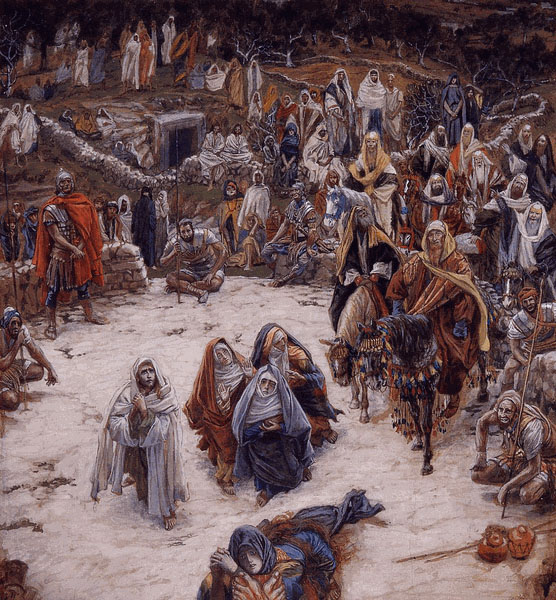
(Image: The Crucifixion, seen from the Cross, by James Tissot, late 19th century, via Wikimedia Commons)

Racial Justice In The Real World

In a wonky but rewarding interview, political philosopher Charles Mills asserts the need for liberal theory to better grapple with racial justice. He turns to a term – the “epistemology of ignorance” – from his book The Racial Contract to help explain the complexities of doing so:

The phrasing (“epistemology of ignorance”) was calculatedly designed by me to be attention-getting through appearing to be oxymoronic. I was trying to capture the idea of norms of cognition that so function as to work against successful cognition. Systems of domination affect us not merely in terms of material advantage and disadvantage, but also in terms of likelihoods of getting things right or wrong, since unfair social privilege reproduces itself in part through people learning to see and feel about the world in ways that accommodate injustice. “Ignorance” is actively reproduced and is resistant to elimination. This is, of course, an old insight of the left tradition with respect to class. I was just translating it into a different vocabulary and applying it to race. So one can see the idea (and my later work on “white ignorance”) as my attempt to contribute to the new “social epistemology,” which breaks with traditional Cartesian epistemological individualism, but in my opinion needs to focus more on social oppression than it currently does.

Mills goes on to make a related point, that we “need to ask how it came about, and has come to seem normal, that ‘social justice’ as a philosophical concept has become so detached from the concerns of actual social justice movements”:

Certainly it’s not the case that if people in the civil rights community were planning a conference on racial justice next month that they would be heatedly debating which philosophers to invite! Rather, mainstream political philosophy is seen as irrelevant to such forums because of the bizarre way it has developed since Rawls (a bizarreness not recognized as such by its practitioners because of the aforementioned norms of disciplinary socialization). Social justice theory should be reconnected with its real-world roots, the correction of injustices, which means that rectificatory justice in non-ideal societies should be the theoretical priority, not distributive justice in ideal societies. Political philosophy needs to exit Rawlsland — a fantasy world in the same extraterrestrial league as Wonderland, Oz and Middle-earth (if not as much fun) — and return to planet Earth.

The Mid-Life Rebound

Jonathan Rauch isn’t alone in preferring his 50s to his 40s:

Studies show quite strongly that people’s satisfaction with their life increases, on average, from their early 50s on through their 60s and 70s and even beyond – for many until disability and final illness exact their toll toward the very end (at which point it’s hard to generalize). In a 2011 study, for example, the Stanford University psychologist Laura Carstensen and seven colleagues found that “the peak of emotional life may not occur until well into the seventh decade” – a finding that is “often met with disbelief in both the general population and the research community,” despite its strength. …

Rauch adds, “In my own case, what seems most relevant is a change frequently described both in popular lore and in the research literature – for some reason, I became more accepting of my limitations”:

The idea that the expectations gap closes with age has recently received some empirical backing, in the form of fascinating findings by Hannes Schwandt, a young economist at Princeton University’s Center for Health and Wellbeing. He used a German longitudinal survey, with data from 1991 to 2004, that, unusually, asked people about both their current life satisfaction and their expected satisfaction five years hence. That allowed him to compare expectations with subsequent reality for the same individuals over time. To his own surprise, he found the same result regardless of respondents’ economic status, generation, and even whether they lived in western or eastern Germany (two very different cultures): younger people consistently and markedly overestimated how satisfied they would be five years later, while older people underestimated future satisfaction. So youth is a period of perpetual disappointment, and older adulthood is a period of pleasant surprise.