A Tale Of Two Gitas

Kurukshetra

Reviewing Richard H. Davis’ The “Bhagavad Gita”: A Biography, Wendy Doniger reminds us that the holy text “incorporates into its seven hundred verses many different sorts of insights, which people use to argue many different, often contradictory, ideas.” She notes that they can roughly be divided into two categories, “the warrior’s Gita, about engaging in the world, and the philosopher’s Gita, about disengaging.” It’s the latter that featured most prominently in the Western imagination:

When Friedrich Schlegel translated a third of the Gita into German in 1808, he left out the battlefield, Krishna’s instructions to Arjuna about work and duty, his teachings about bhakti, and his terrifying manifestation in his Doomsday form. When Hegel, writing in 1827, criticized the Gita for advocating what he saw as a withdrawal and isolation from the world, a passive immersion into the brahman, he did not mention that the martial, interventionist Krishna became personally embodied on what Davis calls “a real Indian battlefield, in order to persuade a warrior to engage in worldly combat.” And so the Gita in Europe fell into disrepute and, for a while, obscurity.

The American Transcendentalists, too, tended to ignore the martial Gita, but they loved the philosophical Gita. In the 1850s, “Thoreau took a borrowed copy of the WilkinsGita with him to Walden Pond, where he imagined himself communing with a Brahmin priest” on the banks of the Ganges as he sat reading on the banks of the pond. When the first edition of Walt Whitman’s Leaves of Grass was published in 1855, Ralph Waldo Emerson commented that it read like “a mixture of the Bhagavat Ghita [sic] and the New York Herald,” and a translation of the Gita was said to have been found under Whitman’s pillow when he died.

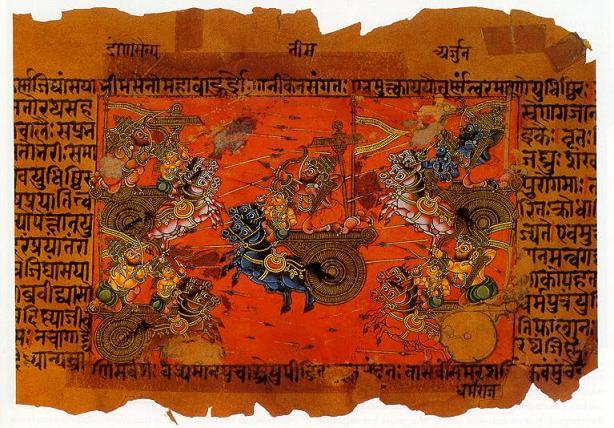
(Image: A manuscript illustration of the battle of Kurukshetra, fought between the Kauravas and the Pandavas, recorded in the Mahabharata, via Wikimedia Commons)

A Poem For Sunday

6831075027_b95d0f337a_b

“Schoolboys in Winter” by John Clare (1793-1864):

The schoolboys still their morning rambles take
To neighbouring village school with playing speed,
Loitering with pastime’s leisure till they quake,
Oft looking up the wild-geese droves to heed,
Watching the letters which their journeys make;
Or plucking haws on which the fieldfares feed,
And hips, and sloes! and on each shallow lake
Making glib slides, where they like shadows go
Till some fresh pastimes in their minds awake.
Then off they start anew and hasty blow
Their numbed and clumpsing fingers till they glow;
Then races with their shadows wildly run
That stride huge giants o’er the shining snow
In the pale splendour of the winter sun.

(Photo by Lisa Widerberg)

Quote For The Day

“Since we are all terminally ill, each breath and each step and day one closer to the last, I must consider those sacraments which soothe our passage. I write on a Wednesday morning in December when snow covers the earth, the sky is grey, and only the evergreens seem alive. This morning I received the sacrament I still believe in: at seven-fifteen the priest elevated the host, then the chalice, and spoke the words of the ritual, and the bread became flesh, the wine became blood, and minutes later I placed on my tongue the taste of forgiveness and love that affirmed, perhaps celebrated, my being alive, my being mortal. This has nothing to do with immortality, with eternity; I love the earth too much to contemplate a life apart from it, although I believe in that life. No, this has to do with mortality and the touch of flesh, and my belief in the sacrament of the Eucharist is simple: without touch, God is a monologue, an idea, a philosophy; he must touch and be touched, the tongue on flesh, and that touch is the result of monologues, the idea, the philosophies which led to faith; but in the instant of the touch there is no place for thinking, for talking; the silent touch affirms all that, and goes deeper: it affirms the mysteries of love and mortality,” – Andre Dubus, “On Charon’s Wharf,” from Broken Vessels.

Jesus Said To Them “My Wife … ” Ctd

The_Holy_Women_at_the_Sepulchre_by_Peter_Paul_Rubens

For two years now, we’ve covered the debate over the papyrus fragment, dubbed “The Gospel of Jesus’s Wife,” that was unveiled by historian Karen L. King of Harvard Divinity School. Joel Baden and Candida Moss update us on the emerging scholarly consensus – that it’s probably a forgery, even if the materials used to construct it are ancient – and try to explain why it’s garnered such attention:

A great deal rides on this question of Jesus’s marital status. Over the centuries, and up to the present, how people have answered this question has served as a cipher in discussions about clerical celibacy. If Jesus spurned marriage, the argument goes, so too should all priests. And if Jesus chose only men as his apostles, so too should the Church. Iconoclastically minded commentators, however, insist that the idea of a celibate Jesus is a later Catholic conspiracy—the product of a male-led Church and a succession of dry, turgid councils—that’s long been used to keep the laity, and women in particular, in check. Dan Brown made a fortune peddling this very idea in The Da Vinci Code, published in 2003.

What has become clear today, thanks to the scholarship of Karen King and others, is that in the messy early Church—ripe with pretensions of order, brimming with disordered diversity—people actively debated the role of women as leaders.

People have been speculating about Jesus’s romantic life since at least the second century A.D., too. In a noncanonical text from that period known as the Gospel of Mary, for example, Peter says to Mary Magdalene, “Sister, we know that the Savior loved you more than all other women.” The second- or third-century Gospel of Philip gets somewhat more explicit, calling Mary his “companion,” and describing Jesus as having “loved her more than all the disciples” and having “kissed her often on the mouth.”

The New Testament pays notable attention to women. The story of Jesus’s life begins with the Virgin Mary holding the newborn child, ends with both Marys stationed at the cross, and along the way suggests that women followed Jesus and helped finance his mission. A woman named Junia is described in Paul’s Letter to the Romans as “prominent among the apostles,” and another, named Phoebe, is called a “deacon.”

(Image: The Three Marys at the Tomb by Peter Paul Rubens, via Wikimedia Commons. Mary Magdalene is, notably, in red.)

Unbuckling The Bible Belt

PZ Myers wants to retire the ubiquitous term:

It vexes me. The official definition says the Bible Belt is the deep South, but that makes no sense. Dwight Moody, of the influential Moody Bible College, was from Massachusetts. William Riley, the pastor who invented fundamentalism, was from … Minneapolis. Saddleback Church is in Orange County. New Saint Andrews College and Doug Wilson are in Idaho; Mars Hill, before its founder’s meltdown, was based in Seattle. The burned over district? New York.

I travel a lot, all over the country, and everywhere I go, North and South, East and West, people tell me they’re living in the Bible Belt. Worse, they’re prone to tell me that their local religious fanatics form the “buckle of the Bible Belt”. Everywhere. The whole damn country. I’ve heard it in Oregon and Ohio, as well as Florida and Texas.

It’s not a belt. It’s a great fat corset, wrapped all around the USA, and it’s covered with elaborate chains and straps and buckles and fasteners. Some people use the term “Bible Belt” to disparage the South, others use it to refer to any entrenched collection of rabid believers, and it’s no longer useful at all. Stop using it!

Less anecdotally, back in 2012, Gallup released a map of the country’s “religiosity belt,” below:

dish_religious-states-us-map-gallup-600

In a post about Gallup’s findings, Richard Florida remarked on how religiosity related to political affiliation:

The map charts state-by-state differences in Gallup’s Religiosity Index, which is based on respondents’ answers to questions about the importance of religion to their everyday lives, and how often they attend religious services. …

Gallup notes the relationship between religious intensity and American voting patterns, with the most religious states generally skewing Republican and the least religious trending Democrat. Our own analysis bears this out. We found a substantial positive correlation between religiosity and the percent of state residents that voted for McCain (.67) and consider themselves conservative (.78), and a substantial negative one between religiosity and the percent of residents who voted for Obama (-.64) and consider themselves liberal (-.75).

Love On The Page

In an interview about her debut collection of stories, New York 1, Tel Aviv 0, Shelly Oriax reflects on the notion that her characters seem to connect love to certain type of attention:

I do think love is a form of attention, yes. It’s arguably much more, too, of course, and I think it has the power to confirm and confer not only our reality but our humanity. But at its core it’s a deep form of attention—we fall in love with the people who pay attention the right way, to whatever it is in us that most needs attention, and who let us do the same for them, no?

But then, yes, some of the people in my stories get in trouble for it. I think you’re right to use the word power, because that’s what really gets them in trouble—not wanting or needing the lover’s attention, but rather giving themselves up to it in some profound way. This can happen at any age, but I do think it’s emotionally young, the feeling that I will cease to exist if this person stops loving me. Ideally, over the years and through experience and awareness, we learn that no one really has that kind of power over us, and that when we feel as though someone does it’s actually our psyche asking for our own attention, et cetera, et cetera. But in fiction, these are the characters we want, right? Young hearts make the best mistakes on the page.

Faces Of The Day

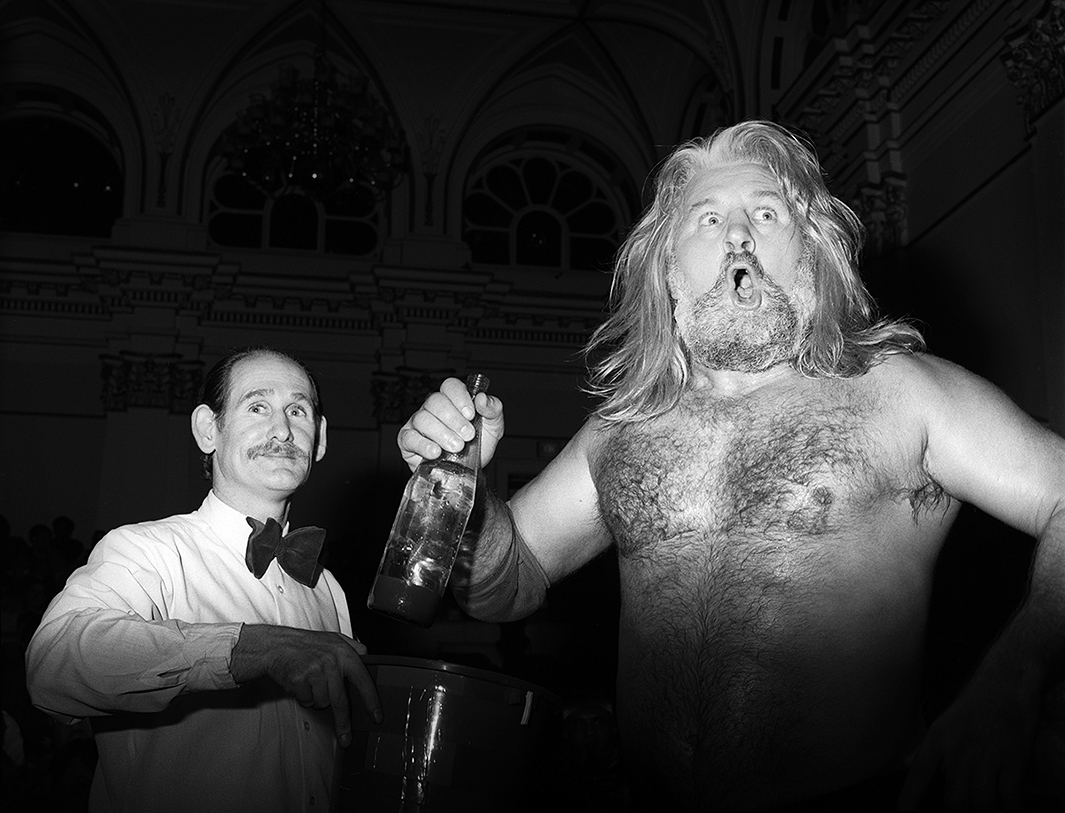
British wrestling, 1988.

In 1988, photographer Peter Byrne spent three months documenting pro wrestling events in the north of England. Jordan G. Teicher elaborates:

While Byrne’s black-and-white photos focus on a sport that was choreographed, they show a simpler time in professional wrestling, one without any of the “razzmatazz and money of WWE,” but with plenty of drama, usually focused around a “good guy” and a “bad guy.” Back then, Byrne said, some wrestlers – like Big Daddy, Giant Haystacks, and Kendo Nagasaki – were household names. Many of the spectators at the matches were “hard-core fans,” he said, while others were just working-class people looking for “a cheap night out.” “Watching these guys slug it out was thoroughly entertaining fun. On the flip side, there were some extremely fit and agile wrestlers who could perform some amazing moves whilst appearing to glide around the canvas like ballet dancers,” he said.

See more of Byrne’s work here.

Weed: A Gateway Out Of Addiction?

Tony O’Neill suggests “the once-taboo idea of using marijuana as a tool for people who want to stop using more dangerous drugs is catching on”:

This Substance.com article by Philippe Lucas of the Multidisciplinary Association of Psychedelic Studies (MAPS) sets out some of the evidence for this “substitution effect;” more research is ongoing. While it’s true that some people can get addicted to marijuana—as with any pleasurable drug or experience, like sex or shopping—the reduced harms here compared with an addiction to alcohol, say, or painkillers are obvious. Most of us who use marijuana in this way don’t get addicted. …

“Certainly, I have clients who use it in this way,” says Dr. Adi Jaffe when I ask for his professional opinion on the pros and cons of using marijuana as a tool to wean off other drugs. Jaffe is a UCLA-trained addiction expert, the man behind All About Addiction and a regular contributor to Psychology Today. He draws from his personal experiences with meth addiction when working with his clients at Alternatives Addiction Treatment in Los Angeles. “When you think about it, this is classic harm reduction methodology,” he continues, “replacing a more harmful and dangerous drug with a lesser one to improve coping while reducing consequences. Harm reduction literature in general supports this idea as a positive step in recovery. If someone struggles with anxiety, they need something to help with it, whether that be neurofeedback, talk therapy or weed.”

Meanwhile, Joe Berkowitz describes how “Nuggets,” the above short film, “succinctly captures the heartbreaking reality of addiction”:

Created by German animation studio, the video begins with an adorable kiwi bird casually strolling along before stumbling upon a golden nugget. The bird’s interest is piqued and so he ingests the liquid inside. It’s instant euphoria, and with it, the kiwi can suddenly fly for a short while. As anyone who’s ever had any golden nuggets of their own can attest, what happens after he finds the next one is not the same. It doesn’t last as long, and the landing is more of crash. Nevertheless, now the bird is no longer casually strolling, but running to get the next hit—with ever-diminishing returns. … [The film] puts into perspective the plight of the addicted person, inviting viewers to feel empathy for them instead of contempt.