The Best Hangover In Fiction? Ctd

The latest in the popular thread:

You kicked off your discussion with Boris Johnson nominating Kingsley Amis’ Lucky Jim. I think it’s worth pointing out that Amis had his own nomination:

Perhaps Franz Kafka’s story The Metamorphosis, which starts with the hero waking up to find he has turned into a man-sized cockroach, is the best literary treatment of all. The central image could hardly be better chosen, and there is a telling touch in the nasty way everybody goes on at the chap.

For my own part, I’d like to nominate the following passage from P.G. Wodehouse’s famous short story “Jeeves Takes Charge,” in which Bertie meets — and hires — Jeeves for the first time:

I shall always remember the morning he came.

It so happened that the night before I had been present at a rather cheery little supper, and I was feeling pretty rocky. On top of this I was trying to read a book Florence Craye had given me. She had been one of the house-party at Easeby, and two or three days before I left we had got engaged. I was due back at the end of the week, and I knew she would expect me to have finished the book by then. You see, she was particularly keen on boosting me up a bit nearer her own plane of intellect. She was a girl with a wonderful profile, but steeped to the gills in serious purpose. I can’t give you a better idea of the way things stood than by telling you that the book she’d given me to read was called “Types of Ethical Theory,” and that when I opened it at random I struck a page beginning:

— The postulate or common understanding involved in speech is certainly co-extensive, in the obligation it carries, with the social organism of which language is the instrument, and the ends of which it is an effort to subserve. 

All perfectly true, no doubt; but not the sort of thing to spring on a lad with a morning head.

I was doing my best to skim through this bright little volume when the bell rang. I crawled off the sofa and opened the door. A kind of darkish sort of respectful Johnnie stood without.

“I was sent by the agency, sir,” he said. “I was given to understand that you required a valet.”

I’d have preferred an undertaker; but I told him to stagger in, and he floated noiselessly through the doorway like a healing zephyr. That impressed me from the start. Meadowes had had flat feet and used to clump. This fellow didn’t seem to have any feet at all. He just streamed in. He had a grave, sympathetic face, as if he, too, knew what it was to sup with the lads.

“Excuse me, sir,” he said gently.

Then he seemed to flicker, and wasn’t there any longer.

I heard him moving about in the kitchen, and presently he came back with a glass on a tray.

“If you would drink this, sir,” he said, with a kind of bedside manner, rather like the royal doctor shooting the bracer into the sick prince. “It is a little preparation of my own invention. It is the Worcester Sauce that gives it its color. The raw egg makes it nutritious. The red pepper gives it its bite. Gentlemen have told me they have found it extremely invigorating after a late evening.”

I would have clutched at anything that looked like a life-line that morning. I swallowed the stuff. For a moment I felt as if somebody had touched off a bomb inside the old bean and was strolling down my throat with a lighted torch, and then everything seemed suddenly to get all right. The sun shone in through the window; birds twittered in the tree-tops; and, generally speaking, hope dawned once more.

“You’re engaged!” I said, as soon as I could say anything.

As for the reader who suggested discussing “the best word for hangover in any language,” I submit for your consideration the New Year’s essay “How to Say ‘Hangover’ in French, German, Finnish, and Many Other Languages,” written by Sam Dean for Bon Appétit magazine, in its entirety. His “world tour of misery” is hard to beat, and a treat for any logophile. There’s just one word that Dean misses: if you wake up drunk among the Tsonga people in South Africa, you might realize you’ve been rhwe: sleeping, drunk and naked, on the floor without a mat.

Several Douglas Adams fans are also weighing in. One writes, “There’s always the Pan-Galactic Gargle Blaster from Douglas Adams’ Hitchhiker’s Guide to the Galaxy series, described as ‘like having your brains smashed out by a slice of lemon, wrapped ’round a large gold brick’ and ‘the alcoholic equivalent to a mugging: expensive and bad for the head.'” Another:

I’m surprised no one has offered the opening to the great Hitchhiker’s Guide to the Galaxy. Here you go:

At eight o’clock on Thursday morning Arthur didn’t feel very good. He woke up blearily, got up, wandered blearily round his room, opened a window, saw a bulldozer, found his slippers, and stomped off to the bathroom to wash.

Toothpaste on the brush – so. Scrub.

Shaving mirror – pointing at the ceiling. He adjusted it. For a moment it reflected a second bulldozer through the bathroom window. Properly adjusted, it reflected Arthur Dent’s bristles. He shaved them off, washed, dried, and stomped off to the kitchen to find something pleasant to put in his mouth.

Kettle, plug, fridge, milk, coffee. Yawn.

The word bulldozer wandered through his mind for a moment in search of something to connect with.

The bulldozer outside the kitchen window was quite a big one.

He stared at it.

“Yellow,” he thought and stomped off back to his bedroom to get dressed.

Passing the bathroom he stopped to drink a large glass of water, and another. He began to suspect that he was hung over. Why was he hung over? Had he been drinking the night before? He supposed that he must have been. He caught a glint in the shaving mirror. “Yellow,” he thought and stomped on to the bedroom.

He stood and thought. The pub, he thought. Oh dear, the pub. He vaguely remembered being angry, angry about something that seemed important. He’d been telling people about it, telling people about it at great length, he rather suspected: his clearest visual recollection was of glazed looks on other people’s faces.

Something about a new bypass he had just found out about. It had been in the pipeline for months only no one seemed to have known about it. Ridiculous. He took a swig of water. It would sort itself out, he’d decided, no one wanted a bypass, the council didn’t have a leg to stand on. It would sort itself out. God what a terrible hangover it had earned him though. He looked at himself in the wardrobe mirror.

He stuck out his tongue. “Yellow,” he thought. The word yellow wandered through his mind in search of something to connect with.

Fifteen seconds later he was out of the house and lying in front of a big yellow bulldozer that was advancing up his garden path.

Meanwhile, a naughty-minded reader can’t help himself:

If you’re going to have a thread on hangovers, I’d think it’s only natural to extend the idea to another thread: the best orgasm in fiction. (Sorry, I don’t have my own selection to recommend, but I do look forward to what your other readers, er, come up with.)

The Best Of The Dish Today

Know dope:

Some further thoughts on the issue of immigration I wrestled with today from a reader:

Like you, I’m an immigrant from Europe. I went through the grinder myself in the wake of 9/11, because of my Arabic name (it is Jewish-Arabic but hey, Arabic nonetheless). That’s my theory at least, because nobody at ICE/INS was ever available to explain to me why I was held up in France waiting for my immigrant visa (I was married to a US citizen thank god and legally entitled to one).

The immigration bureaucracy is terrifying, it literally controls your body. As I am sure you know, once you fall under the jurisdiction of INS, you have no habeas corpus or right to due process. Burden of proof is reversed, and the reason why there is such prosecutorial discretion is precisely because immigration proceedings are essentially lawless. So when conservatives talk about enforcing the immigration laws, well, it’s a little less than forthcoming (to say the least). This makes you appreciate the Magna Carta and British common law even more.

It is indeed hard to convey what it’s like to be helpless in front of the immigration bureaucracy. And one thing that has been missing from this debate is that human empathy. I know that my reader and I were legal immigrants trying to find our way through a maze of prejudice and prohibition; but I’ll never forget the radical insecurity of building a life knowing that it can always at any time be taken away from you. For parents of children legally in the US, the experience is unimaginable to me. Deferring the deportation of these parents is a basic act of compassion. And if the Republicans unleash rage over it, and still refuse to provide any legal remedy, their insensitivity will resonate for decades to come.

Some posts worth revisiting from today: the reckless language of Charles Krauthammer on immigration reform; the excruciating challenge of being circumcised as an adult or child; a model village where dementia is cared for and allowed; and some of the weirder window views sent in over the last few months. Plus: David Foster Wallace on sponsored content.

The most popular post of the day was Gruberism And Our Democracy, Ctd – where readers backed up the ACA; and last night’s Best of The Dish where I waved that inappropriate shirt. More on that today as well.

Many of today’s posts were updated with your emails – read them all here.  You can always leave your unfiltered comments at our Facebook page and @sullydish. 20 more readers became subscribers today. You can join them here – and get access to all the readons and Deep Dish – for a little as $1.99 month. Gift subscriptions are available here. Dish t-shirts are for sale here, including our “Know Dope” shirts, which are detailed here. A final email for the day:

I just got back from seeing Rosewater. It is a beautiful film. During the section that showed the rising of the Green Revolution, with people in the streets, I thought back to how involved and absorbed I had felt about it, from here thousands of miles away, because of The Dish; because of you and your team, and your passion for following what was happening; and because of the rich information and context offered by members of the amazing community you have created. Thank you for creating that space, then and now.

See you in the morning.

Your Monday Cry

The description on the video seen above:

Chris Picco singing Blackbird to his son, Lennon James Picco, who was delivered by emergency C-section at 24 weeks after Chris’ wife Ashley unexpectedly and tragically passed away in her sleep. Lennon’s lack of movement and brain activity was a constant concern for the doctors and nurses at Loma Linda University Children’s Hospital, where he received the absolute best care available. During the pregnancy, Ashley would often feel Lennon moving to music so Chris asked if he could bring his guitar into the NICU and play for Lennon, which he did for several hours during the last days of Lennon’s precious life. One day after filming this, Lennon went to sleep in his daddy’s arms.

A memorial fund has raised more than $100,000. Katy Waldman has mixed feelings about the Internet’s response to the story:

Why are we clicking and sharing (and giving)? Do we even understand what we see onscreen, or has Chris Picco’s tragedy just become another cheap portal to all the feels?

It’s hard to argue that the wave of financial support brought on by the video is somehow sinister. Sure, $100,000 is a lot of money and perhaps better spent elsewhere, but there are far more pernicious uses of a hundred grand than vastly improving the quality of life for a man who just lost his wife and newborn son. And while there may be some injustice in only the iPhone-documented and Facebook-approved tragedies attracting our dollars and attention—remember when the bullied bus driver received hundreds of thousands of dollars for her pain?—the solution to that injustice is pretty clearly not to declare that no one at all should get dollars or attention. (By the way: This is the same tension that many of us face when giving money to homeless people on the subway or street. Should I not give to this guy because I can’t give to everyone? I hope not.)

But it’s not really the strangers donating to Picco who are the bad guys here. It’s the voyeurs we’re truly worried about, the casual clickers ogling the wreckage before drifting on to another listicle. But what if a casual browser’s momentary engagement with Picco’s story isn’t gross, exploitative, or wrong? What if the small gleams of compassion and pity you feel for a dad you’ve never met only add to the store of compassion and pity in the world?

Update from a reader:

Katy Waldman may wonder why the Internet has responded to this story. I don’t. The Internet is made up of human beings.

I haven’t watched the video. I can’t watch the video. The headline is enough to make me cry. Because I too have sang to my son. I too held my son until he went to sleep.

Regardless, I know what is in that video – a very human story. A story not often told, but one that resonates with people. Every parent who sees that story knows the fear of losing their child. Every person who has been in love knows there could be a moment where they will need to give comfort and say goodbye. You are talking about core truths of the human experience that touch the deepest centers of our beings. The tragedy experienced by Chris Picco is something everyone can relate to at some level.

Worrying about what motivates the people watching this video kind of misses the point. What you have here is people reaching out, connecting to their loved ones, sharing something that touched them. Passing around a message of love and strength. Helping out if they can, in the way they can.

So what if some people are voyeurs? I am willing to bet that for every person who felt nothing and moved on to the next link there were many more who were left with a deeper appreciation of what they have and how easily it can all be lost. Some people probably even walked away grateful that they weren’t given that burden to bear. Do the reactions and understanding of the audience really matter? The story, and the truth behind it, is what matters.

Where Are The Widespread Wonder Drugs?

Dan Hurley investigates. Why a focus on genetics hasn’t paid off as much as hoped:

Gleevec, used since 2001 to treat chronic myelogenous leukemia (C.M.L.) and a variety of other cancers, is often pointed to as one of the great gene-to-medicine success stories. Its design followed logically from the identification of an abnormal protein caused by a genetic glitch found in almost every cancer cell of patients with C.M.L.

Many of the drugs developed through target-based discovery, however, work for only single-mutation diseases affecting a tiny number of people. Seventy percent of new drugs approved by the F.D.A. last year were so-called specialty drugs used by no more than 1 percent of the population. The drug Kalydeco, for instance, was approved in 2012 for people with a particular genetic mutation that causes cystic fibrosis. But only about 1,200 people in the United States have the mutation it corrects. For them it can be a lifesaver, but for the tens of millions of people suffering from more widespread diseases, target-based drugs derived from genomics have offered little.

However, he acknowledges that an “overreliance on genomics is not the only factor slowing down the discovery of new drugs”:

One challenge is that the industry is the victim of its own previous successes. In order to thrive, it must come up with drugs that work better than blockbusters of the past. After all, old drugs don’t fade away; they just go generic. Scannell and Warrington have dubbed this the “Better Than the Beatles” problem, as if every new song in the recording industry had to be bigger than “Hey Jude” or “I Want to Hold Your Hand.

At the same time, the demand for proof of safety and efficacy, not only from the F.D.A. but also from trial lawyers and the public at large, is far higher than in years past. The days when drugs like the original insulin could be sold within a year of their discovery by chemists are long gone, and rightly so.

Was Van Gogh Murdered?

Vincent_Willem_van_Gogh_106

That’s the case Steven Naifeh and Gregory White Smith make in their fascinating investigation into the painter’s death, which unsettles the familiar story of a mad artist killing himself. The entire essay is worth reading, but it begins with these questions:

Van Gogh himself wrote not a word about his final days. The film [Lust for Life] got it wrong: he left no suicide note—odd for a man who churned out letters so profligately. A piece of writing allegedly found in his clothes after he died turned out to be an early draft of his final letter to his brother Theo, which he posted the day of the shooting, July 27, 1890. That letter was upbeat—even ebullient—about the future. He had placed a large order for more paints only a few days before a bullet put a hole in his abdomen. Because the missile missed his vital organs, it took 29 agonizing hours to kill him.

None of the earliest accounts of the shooting—those written in the days immediately after the event—mentioned suicide. They said only that Van Gogh had “wounded himself.” Strangely, the townspeople of Auvers, the picturesque community near Paris where he stayed in the last months of his life, maintained a studied silence about the incident. At first, no one admitted having seen Van Gogh on his last, fateful outing, despite the summer crowding in the streets. No one knew where he would have gotten a gun; no one admitted to finding the gun afterward, or any of the other items he had taken with him (canvas, easel, paints, etc.). His deathbed doctors, an obstetrician and a homeopathist, could make no sense of his wounds.

And, anyway, what kind of a person, no matter how unbalanced, tries to kill himself with a shot to the midsection? And then, rather than finish himself off with a second shot, staggers a mile back to his room in agonizing pain from a bullet in his belly?

(Image: Van Gogh’s 1889 self-portrait, via Wikimedia Commons)

Face Of The Day

CHINA-ANIMAL-SHOW

A man grooms his mini poodle after competition at the 2014 China International Pet Show in Beijing on November 17, 2014. The China International Pet Show (CIPS) will take place from November 17 to 20. By Wang Zhao/AFP/Getty Images.

A reader writes regarding Friday’s FOTD:

While I know you posted that white tiger with the best of intentions, I wish you might have accompanied it with some education about the white tiger, which occur in nature, but which zoos usually acquire by breeding a father white tiger to his female white tiger offspring – resulting in a wide variety of health issues that plague these animals throughout their lives. White tigers may seem exotic, but they are actually a representation of animal cruelty. Here is a link with some more information.

The Perils Of Political Poetry

David Wojahn considers them:

If you set out simply to write a poem of social criticism or invective, the results are almost invariably going to be mere agitprop. And that problem afflicts much of the work of even some of our greatest poets of invective—Neruda and Brecht come to mind. Finding a way to blend the personal and the social is a complex and tricky imaginative problem—you have to ask yourself what right you have to address an injustice you yourself have probably not experienced; you have to find a form that allows the personal and the political to commingle in a way that seems effortless and serendipitous; you can’t rely on the same old lefty pieties any more than you can rely on the equivalent pieties that make for a poetic period style. But one of the principal functions of poetry is to preserve and protect human dignity, and if you are sufficiently loyal to that function you find a way to navigate through all the pitfalls, both pitfalls of inadequate craft and of fuzzy political thinking.

How Wojahn describes writing one of his own political poems, “For the Honorable Wayne LaPierre, President, National Rifle Association,” which borrows from Dante and places the gun-rights activist in the seventh circle of Hell:

It’s interesting that Dante seems again and again to encounter his contemporaries in hell and purgatory—people he knew in Florence, often his political adversaries. It’s an incredibly clever way to get back at the people who he felt wronged by. A few years back, I came across a very smug and self-satisfied interview with LaPierre, given right after the Supreme Court had declared the DC handgun ban unconstitutional. It occurred to me that LaPierre was exactly the sort of reprobate Dante placed in the furthest circles of inferno. In one of the rings of Circle Seven he situates “the violent against their neighbors,” and that label seemed to me to aptly fit people like LaPierre and George Zimmerman. To try to re-describe and contemporize Dante’s punishments while still being faithful to his spirit was an exciting challenge, and I think having to focus on that helped me to avoid making the poem simply a diatribe against the NRA.

Why Your Screenplay Needs A Rewrite

hickey-feature-scripts-21

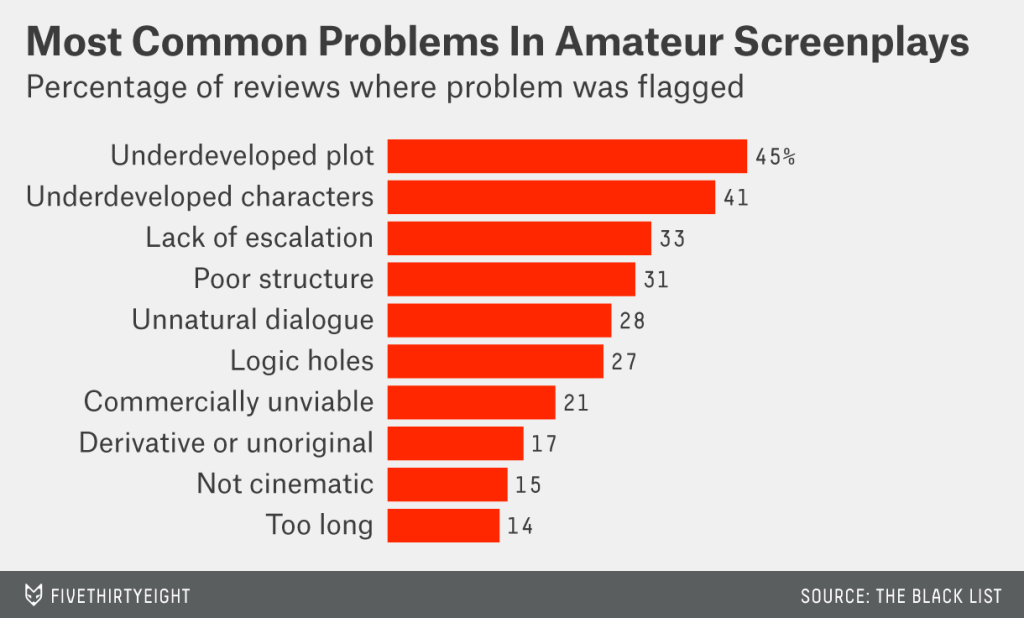
Walt Hickey found a way to quantify the most common problems facing screenwriters:

The Black List offers aspiring screenwriters the chance to have their work evaluated by professional script-readers who work within the industry.1 The readers are drawn from agencies and studios. When scripts are rated highly, the site promotes the screenplays to potential buyers. As a result, The Black List has thousands of script evaluations — grades based on plot, premise, characters, setting and dialogue — from dozens of genres. I asked for a look at those reviews, and they sent over an anonymized record of 4,655 evaluations of 2,784 scripts by 2,221 writers, submitted from March to July of this year. When a script is evaluated, the reader assigns any number of genres to it — from simple drama to prehistoric fantasy — and we can use these to uncover different trends.

First-time writers tend to go one of two ways, said Kate Hagen, a former reader who now oversees the hundred or so readers at The Black List. They write a deeply personal, pseudo-autobiographical screenplay about nothing in particular. “Everybody basically writes that script at first,” Hagen said. “You have to get it out of your system.” Or they swing for the fences and go in the opposite direction, thinking, “I’m going to write a $200 million science fiction movie,” and plan an entire universe and mythology. Those scripts, Hagen said, tend to fail for entirely different reasons.

Quote For The Day

“In the case of Frank Conroy’s ‘essay,’ Celebrity Cruises is trying to position an ad in such a way that we come to it with the lowered guard and leading chin we reserve for coming to an essay, for something that is art (or that is at least trying to be art). An ad that pretends to be art is – at absolute best – like somebody who smiles at you only because he wants something from you. This is dishonest, but what’s insidious is the cumulative effect that such dishonesty has on us: since it offers a perfect simulacrum of goodwill without goodwill’s real substance, it messes with our heads and eventually starts upping our defenses even in cases of genuine smiles and real art and true goodwill. It makes us feel confused and lonely and impotent and angry and scared. It causes despair,” – David Foster Wallace, eighteen years ago, on “sponsored content.”

Back then, an essay sponsored by a cruise line was a rare excrescence. But this excrescence is now the business model for almost all online journalism. It is the business model for the New York Times!

Greece Is Growing

Greece

Finally:

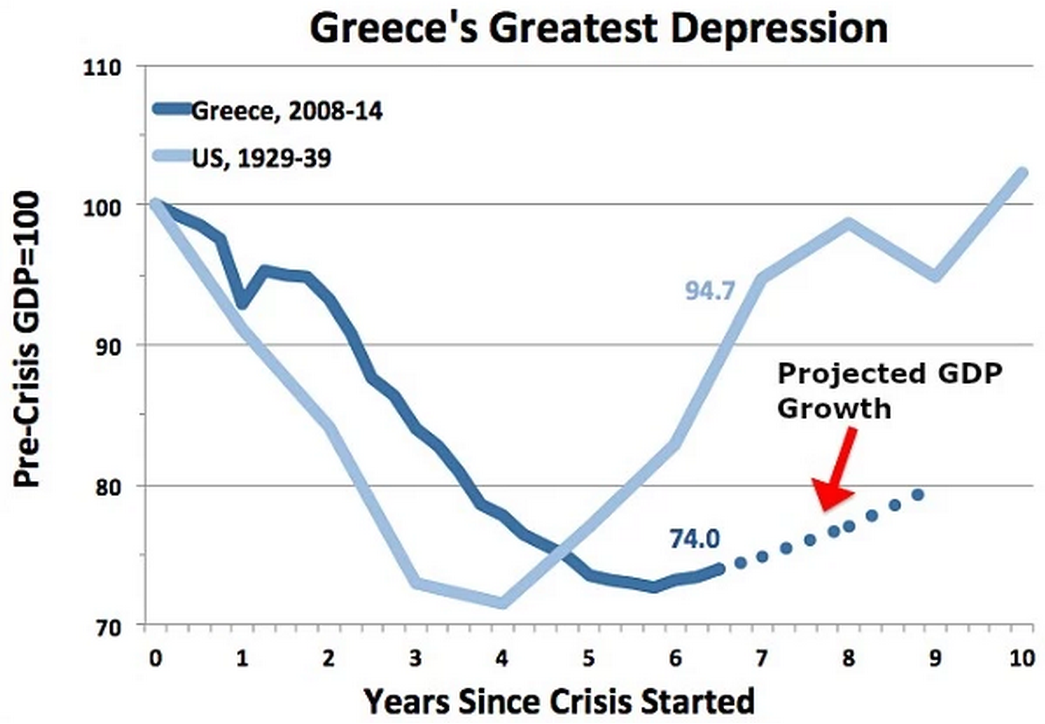
Greece’s crisis-stricken economy has returned to growth following six years of recession, official data showed Friday, marking an end to one of the steepest and longest economic contractions in postwar European history.

But Matt O’Brien warns that “Greece’s comeback, like its collapse, will be nasty, brutish, and long”:

Greece’s depression … is still nowhere near done. You can see that easily enough in the chart above, which I’ve modified from The Economist. It compares Greece the past few years with what used to be the gold standard of economic catastrophe: the U.S. during the Great Depression. Now, Greece’s economy fell marginally less than America’s did back then — around 27 percent at its worst — but the biggest difference between the two is the slope of the recovery. The U.S., as you can see, rocketed back once FDR devalued the dollar and started spending more. Only the double whammy of premature fiscal and monetarytightening knocked it off track in 1937.

Greece, though, has gotten nothing but fiscal and monetary tightening.